
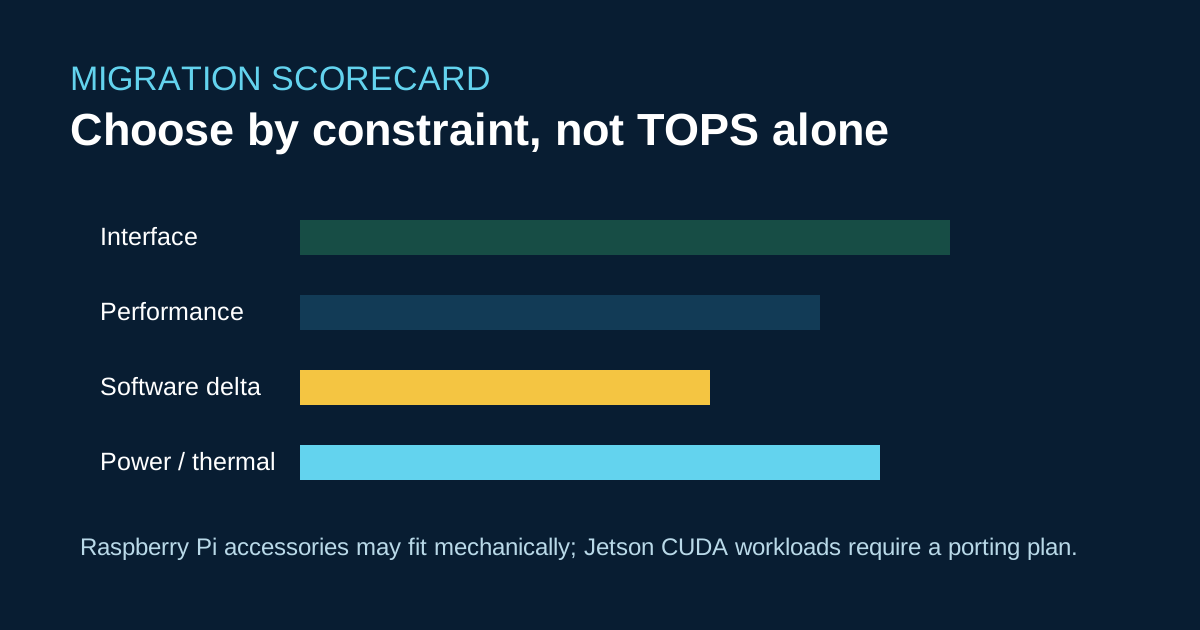
The best replacement is the board that minimizes total engineering risk. Start with interfaces and software, then use CPU/GPU/NPU figures as constraints—not as a promise of application performance.
Four candidate profiles
- Sige5 / RK3576: complete SBC, dual Gigabit Ethernet, 6 TOPS INT8 NPU, 4K-class media, 5–23 V input.
- Sige7 / RK3588: higher CPU/media headroom, up to 32 GB memory, 8K-class codec capabilities, more demanding thermal validation.
- CM5 / RK3576: 55 × 40 mm module for a custom carrier; carrier design becomes the main risk.
- Forge1 / RK3506J: industrial control and HMI, 512 MB DDR3L, dual 100 Mb Ethernet, RS485/CAN, -40 °C to 85 °C.
Use this worksheet before ordering production units:
interface fit = connectors + voltage + timing + driver evidence
software delta = BSP + device tree + AI runtime + update/recovery
field cost = thermal + EMC + test fixtures + service plan
Raspberry Pi accessories may reduce mechanical work, but BCM numbering and libcamera assumptions still require a port. Jetson CUDA/TensorRT applications require a deliberate Rockchip/RKNN migration and accuracy/latency re-validation.
References
Pre-publication check
- Fill the scorecard with measured interface and workload evidence.
- Price software migration and field recovery, not only BOM cost.
- Keep “compatible,” “portable” and “drop-in” as separate claims.