
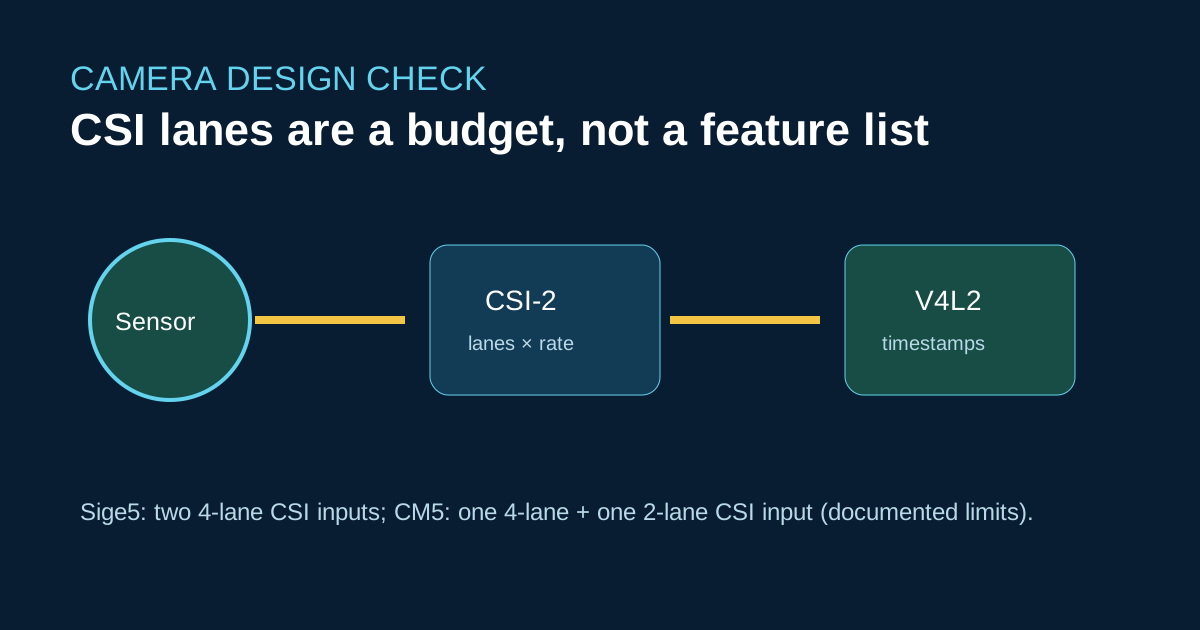
ArmSoM Sige5 lists two 4-lane MIPI CSI inputs; CM5 lists one 4-lane and one 2-lane input. Those are interface capabilities, not a promise that two arbitrary sensors will synchronize or that an AI pipeline will sustain full frame rate.
Bring-up sequence
Start with one sensor and the documented device-tree endpoint. Confirm media topology, pixel format and timestamps before adding the second sensor.
v4l2-ctl --list-devices
media-ctl -p
v4l2-ctl -d /dev/video0 --stream-mmap --stream-count=300 \
  --stream-to=/tmp/capture.raw --verbose
Measure dropped frames and timestamp deltas. If two sensors need hardware sync, expose the trigger and clock requirements on the carrier; software timestamp alignment is not equivalent to a shared exposure edge.
What differs from Raspberry Pi and Jetson Nano
Camera libraries, ISP tuning files and GStreamer elements are platform-specific. A Raspberry Pi libcamera pipeline or Jetson Argus application will not simply run on RK3576. Plan for V4L2/media-controller configuration, Rockchip ISP support and an application-level synchronization test.
References
Pre-publication check
- Document sensor mode, lane count, link frequency and pixel format.
- Include timestamp and dropped-frame evidence.
- Avoid claiming multi-camera AI throughput without a measured workload.