
Based on the Chinese RK3588S Hardware Design Guide V1.2 (2023-12-14) for circuit and PCB review. CM7S carriers must follow module interface definitions; Sige7S supports software and peripheral evaluation. SoC capabilities are not a board connector list. Verify SDK/BSP, kernel, board revision, firmware and multiplexing. Values are source references, not ArmSoM hardware measurements.
RK3588S Hardware Design Guide V1.2 (2023-12-14), CN · §2.1.7
Select capacity and template together
V1.2 describes four 16-bit channels forming 64 bits, up to 8GB per channel and 32GB total. Schematic 32-bit CH0/CH1 cannot use unequal capacities such as 4GB+2GB. This is the guide version’s scope, not a statement about other variants or later BSPs. Confirm memory part, package, firmware and template as a set.
Voltage and mapping are not label changes
Two 32-bit devices use point-to-point DQ/CA. The compatible template fits R3809 and omits R3808 for LPDDR4, reversing this for LPDDR4X. These designators belong to the source template; verify nets on another schematic. LPDDR5 needs its own WCK, mapping and supplies. CM7S integrates DDR, shifting carrier work to input power, interfaces and cooling.
Design parameters and review table
| Item | Source reference |
|---|---|
| V1.2 bus | 4×16bit =64bit |
| V1.2 addressing | 8GB/channel; 32GB total |
| CH0 / CH1 | Equal capacity |
Source figures
No corresponding English design guide was found for this batch. All four editions use Chinese source screenshots with localized captions. Open an image for full resolution; the article text and parameter tables remain copyable. Page references are physical PDF pages.
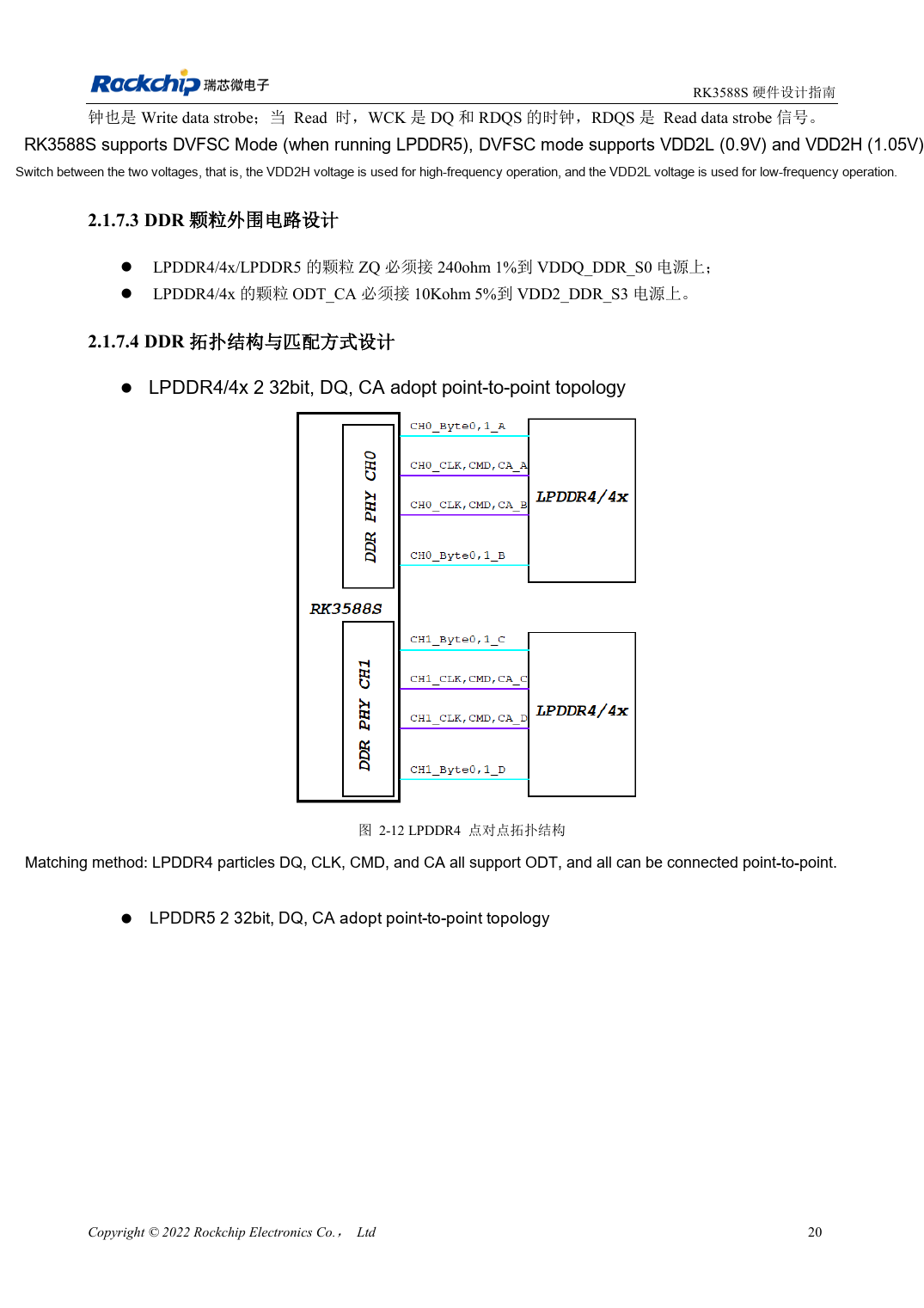
Chinese original · PDF 35 · 2-12
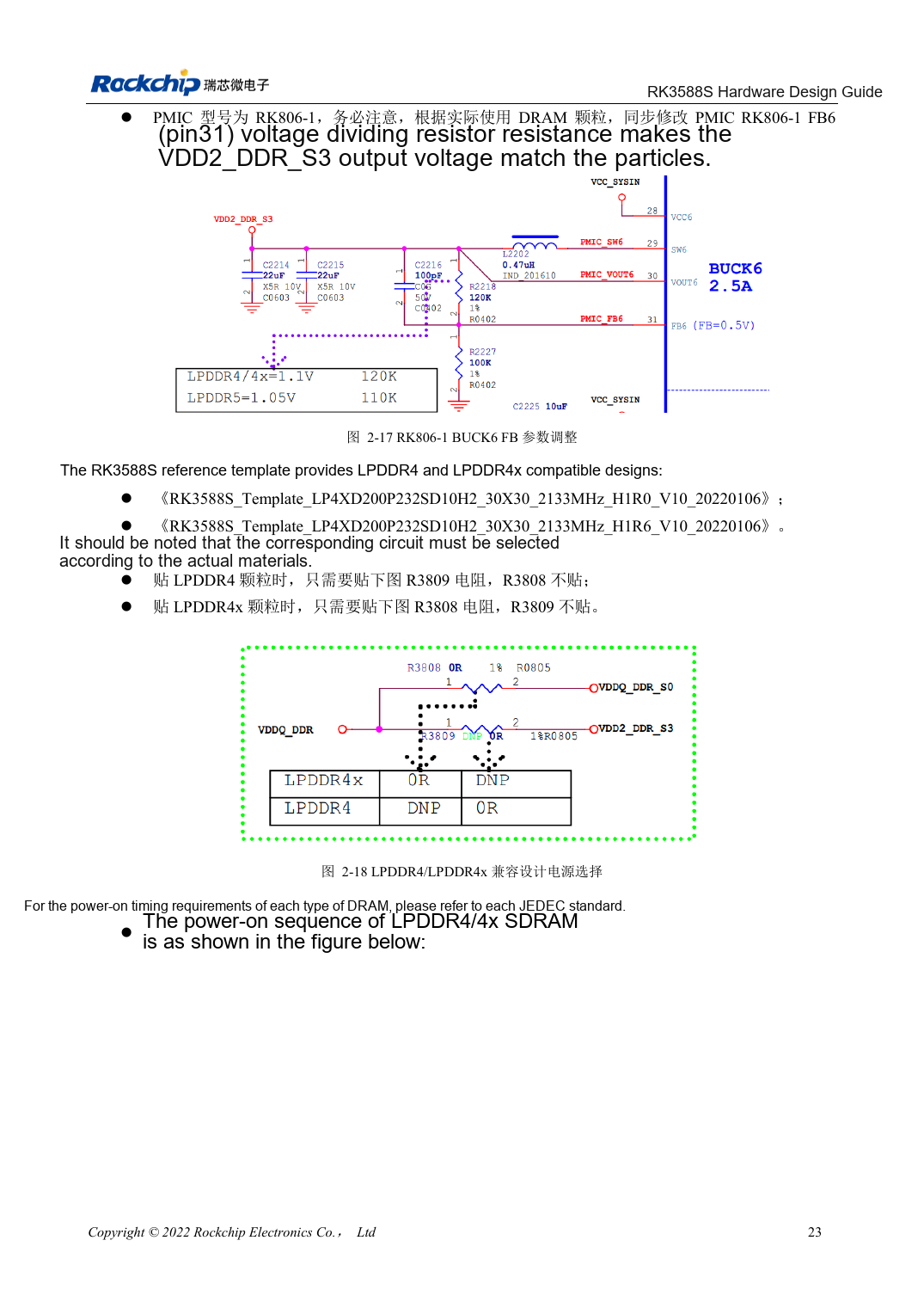
Chinese original · PDF 38 · 2-18
ArmSoM development path
CM7S supports custom carriers: first identify supplies, DDR and boot circuits already integrated in the module, then design outside its connectors. Sige7S provides a starting point for software and peripheral evaluation. For both products, verify exposed interfaces, pin assignments, levels, system images and cooling against the relevant revision. A chip reference schematic is not a product wiring diagram.