
Based on RK3308 Hardware Design Guide V1.0 (2018-09-14), with the 2023 V1.1 compatibility note used to identify variant boundaries. P2 Pro uses RK3308B-S; the historical reference does not replace its board design. This topic article is not a complete page-by-page translation. Source values are not ArmSoM measurements. Check actual interfaces, SDK/BSP, kernel and firmware for the board revision.
RK3308硬件设计指南_V1.0_20180914.pdf · §2.1.6; §2.2; compatibility V1.1
DDR and power depend on the variant
The original RK3308 supports DDR3/DDR3L/DDR2/LPDDR2 on a 16bit channel, up to 512MB; RK3308G integrates 64MB DDR2. LPDDR2 requires 1.8V to rise before or with 1.2V. The guide lists up to 800MHz for DDR3/3L and 533MHz for DDR2/LPDDR2. These are historical platform references, not the installed memory or DDR frequency of P2 Pro.
Keep CPU supply and analog star paths distinct
The old discrete reference uses four bucks and one LDO. CPU VDD_CORE supports DVFS; when replacing its buck, the guide recommends 1.5–2A capability and a 0.6V feedback reference without arbitrary PWM-network changes. VDD_LOG and VDD_1V0 are coupled through a bead, which does not authorize merging CPU power. Route analog 3.3V from the buck source and analog 1.8V from the low-noise LDO source as separate star branches to the codec, avoiding Wi-Fi load current in those paths. PMIC_SLEEP separates always-on and switchable domains; do not switch PLL power off with the CPU.
Review old references against the newer differences
The 2018 RK816-3 scheme requires an external 32.768kHz crystal. Probe CLK32K: touching the crystal with an ordinary probe may stop oscillation. The 2023 compatibility note distinguishes RK816B-3 for GF from RK816B-6 for SMIC S, along with supply and drive-strength changes; select by the complete suffix. Old EVB current measurements used CPU 1.3GHz, DDR 589MHz, 20MHz oscilloscope bandwidth and a specified audio/Wi-Fi workload, not P2 Pro conditions. Validate startup, voltage transitions, audio noise and resume, retaining board revision and measurement conditions.
RK3308 EVB peak current and test conditions
| Net | Voltage / V | Peak current / mA |
|---|---|---|
| VDD_CORE | 0.95–1.34 | 1055 |
| VDD_LOG | 1.04 | 204 |
| VDD_1V0 | 1.04 | 9.8 |
| VCC_DDR | 1.5 | 289 |
| VCC_1V8 | 1.8 | 83.8 |
| VCC_IO (including WiFi) | 3.3 | 709 |
Source: table 2–9, PDF31. Vendor RK3308 EVB, CPU up to 1.3GHz, DDR fixed at 589MHz, oscilloscope bandwidth limited to 20MHz. Cases include memory stresstest and a six-microphone monitoring algorithm with concurrent online music over WiFi. The source calls the data reference-only. Do not transfer old-EVB current, DDR voltage or maximum frequency directly to P2 Pro RK3308B-S: first verify the exact component, power design, software and workload.
Source figures and review pages
Only Chinese originals are available in this batch. All four languages use the same source images, retaining figure context; image labels are not translated. Prose is editable. Page numbers are physical PDF pages.
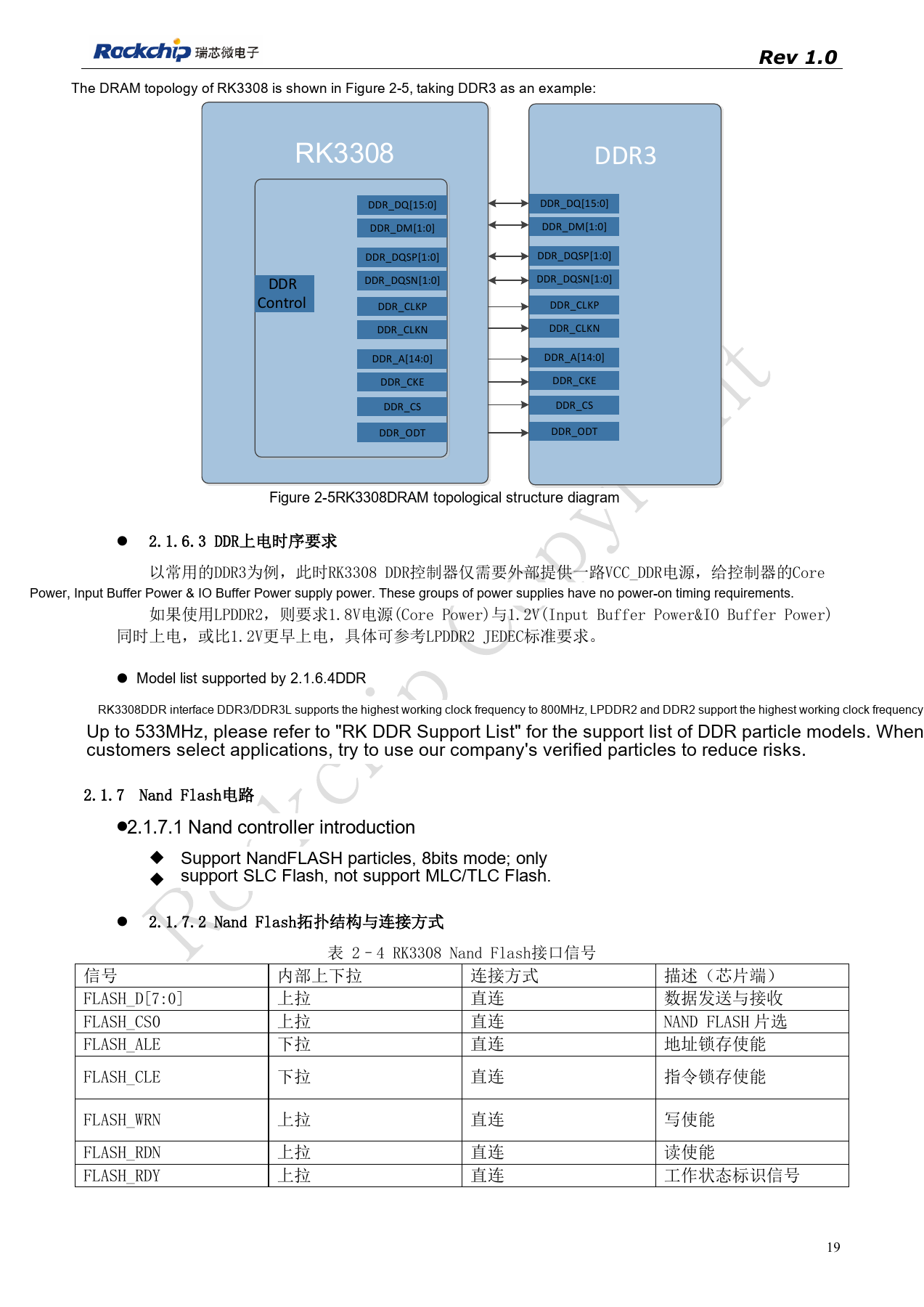
PDF 19
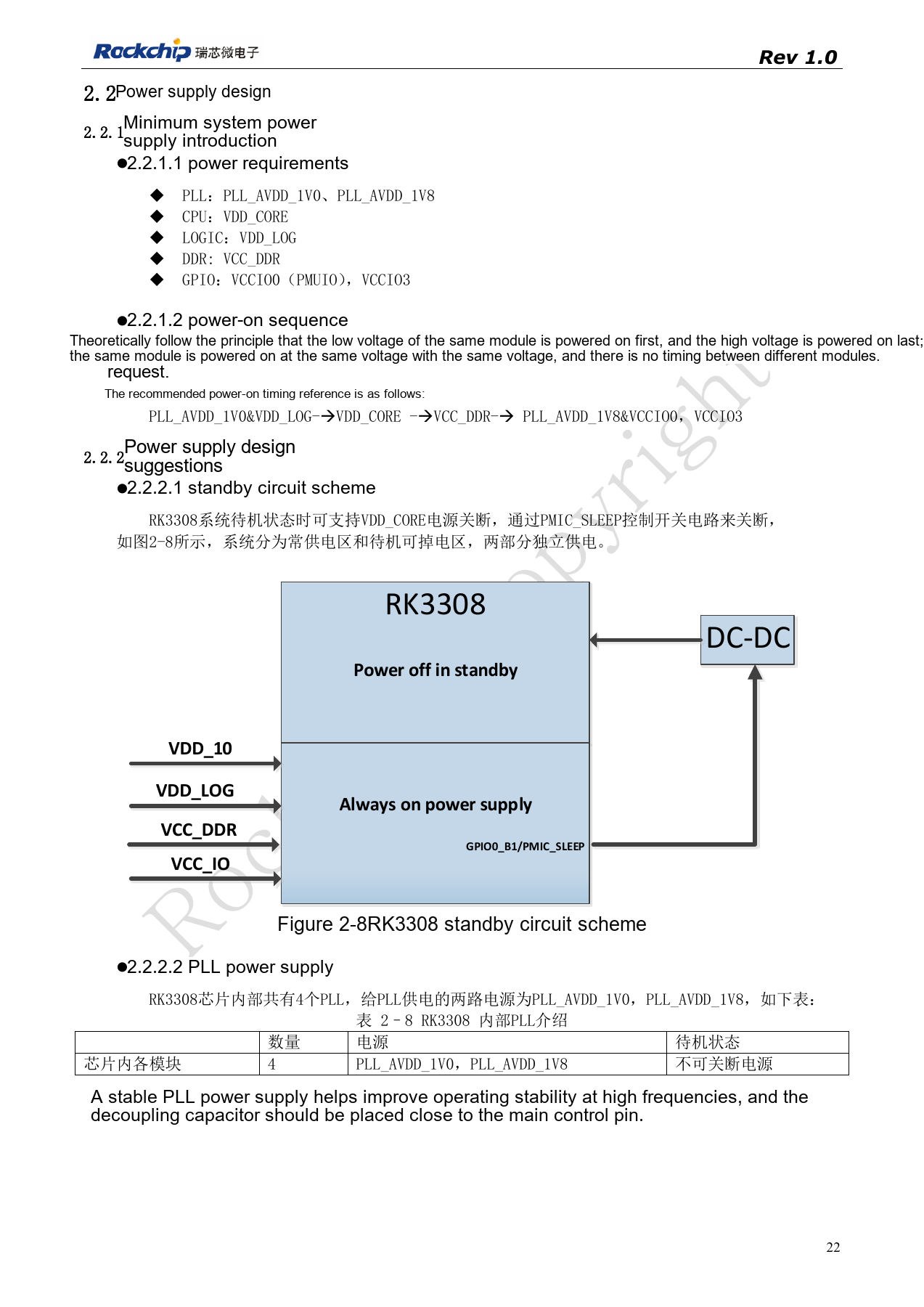
PDF 22
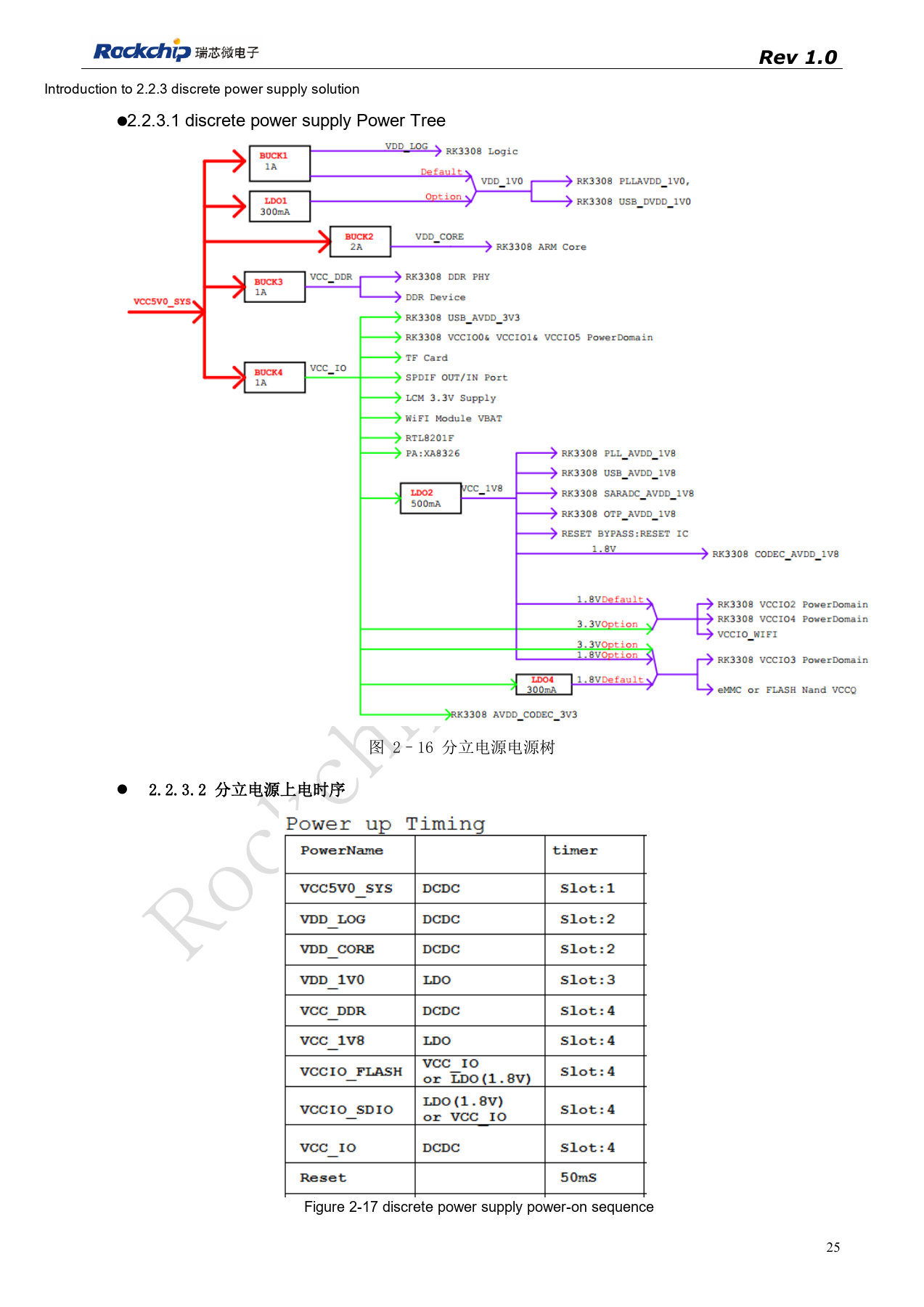
PDF 25
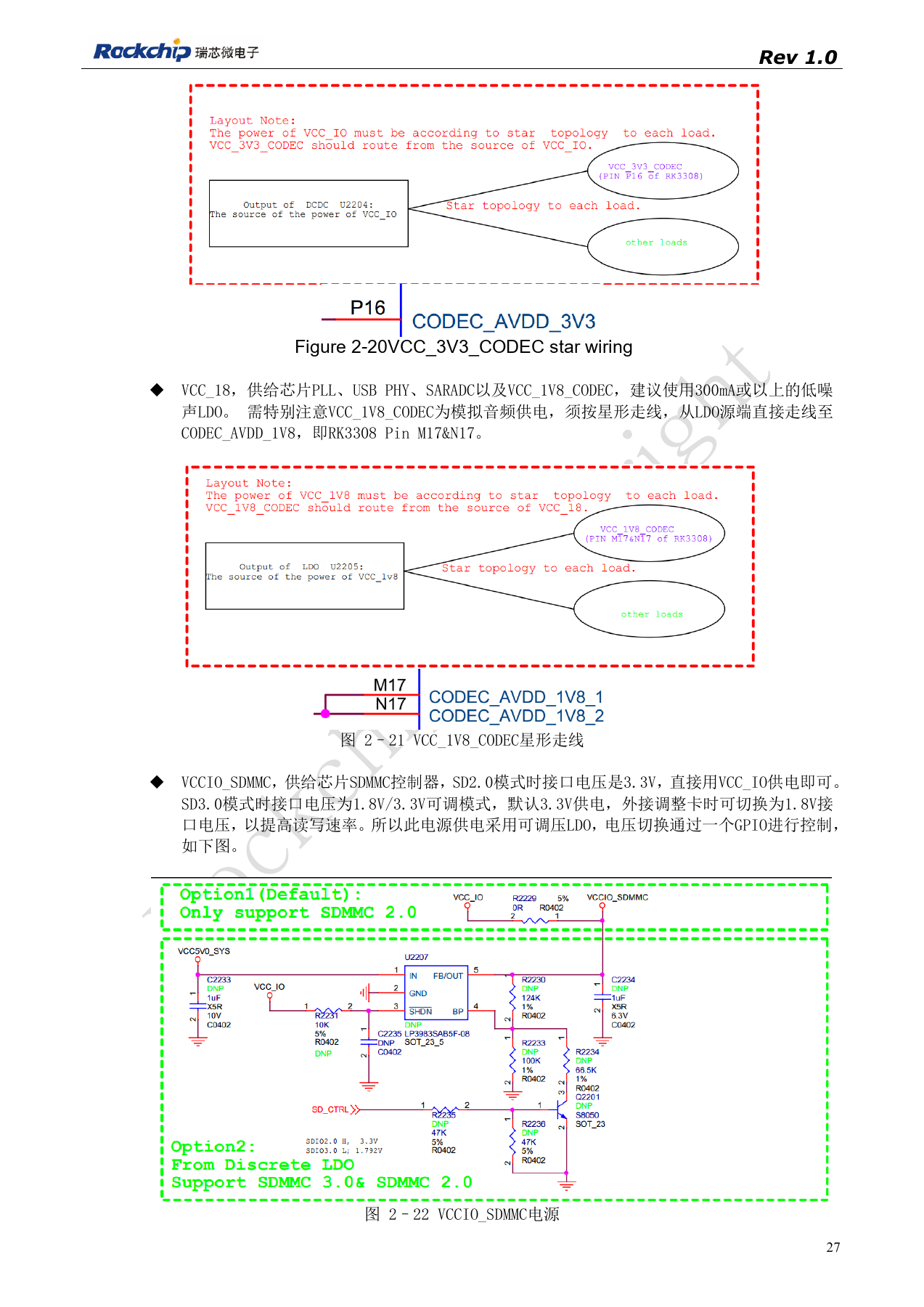
PDF 27
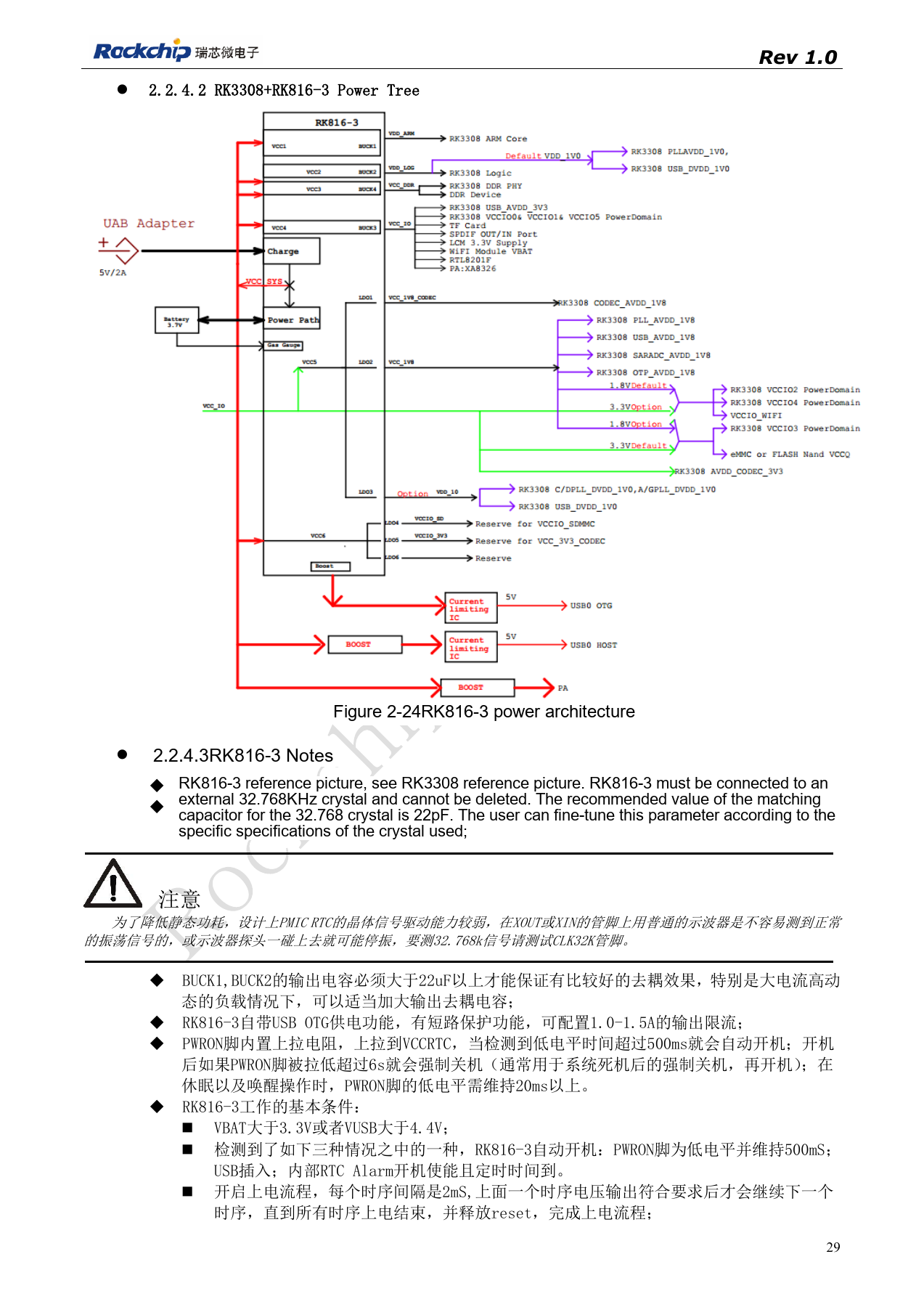
PDF 29