
ArmSoM applicability and source scope
Platform reference for adapting ArmSoM systems, based on CN/EN V1.0.0. No board, SDK/BSP, kernel or wiring combination has been hardware-validated here. The source scope below is not a claim that every ArmSoM board or kernel supports these features. Check the exact SoC, board schematic, SDK/BSP, kernel driver and pinmux. Commands, patches, logs and measurements are source examples, not ArmSoM test results.
Chinese figures are from the Chinese PDF; English/Russian figures are from the English PDF.
| Source SoC | Source kernel scope |
|---|---|
| All Chips | All Versions |
This is a PHY-less MAC-to-MAC connection solution for two APs, or an AP MAC connected to a switch MAC. Connecting two APs this way can avoid two PHYs. Both RMII and RGMII connections are covered.
Editorial notes · ArmSoM documentation · Rockchip Linux
1. Reduced Media Independent Interface
1.1 Hardware Connection
The direct connection of RMII is shown below, where RX_ERR needs to be grounded.
MAC0 --RMII-- MAC1
TXD[1:0] -------- RXD[1:0]
TX_EN -------- RX_DV
REF_CLK -------- REF_CLK
RXD[1:0] -------- TXD[1:0]
RX_DV -------- TX_EN
RX_ERR -------- GND
GND -------- RX_ERR
1.2 Software Configuration
Taking PX30 and RV1126 as examples, RV1126 outputs a 50M reference clock, and PX30 is configured in clock input mode.
rv1126 clock output:
This patch is for the Linux 4.19 kernel.
diff --git a/arch/arm/boot/dts/rv1126-evb-v10.dtsi b/arch/arm/boot/dts/rv1126-evb-v10.dtsi
index 396ef1516054..a384e657ebac 100644
--- a/arch/arm/boot/dts/rv1126-evb-v10.dtsi
+++ b/arch/arm/boot/dts/rv1126-evb-v10.dtsi
@@ -568,26 +568,21 @@
 };
 &gmac {
- phy-mode = "rgmii";
- clock_in_out = "input";
+ phy-mode = "rmii";
+ clock_in_out = "output";
- snps,reset-gpio = <&gpio3 RK_PA0 GPIO_ACTIVE_LOW>;
- snps,reset-active-low;
- /* Reset time is 20ms, 100ms for rtl8211f */
- snps,reset-delays-us = <0 20000 100000>;
-
- assigned-clocks = <&cru CLK_GMAC_SRC>, <&cru CLK_GMAC_TX_RX>, <&cruCLK_GMAC_ETHERNET_OUT>;
- assigned-clock-parents = <&cru CLK_GMAC_SRC_M1>, <&cru RGMII_MODE_CLK>;
- assigned-clock-rates = <125000000>, <0>, <25000000>;
+ assigned-clocks = <&cru CLK_GMAC_SRC_M1>, <&cru CLK_GMAC_SRC>, <&cruCLK_GMAC_TX_RX>;
+ assigned-clock-rates = <0>, <50000000>;
+ assigned-clock-parents = <&cru CLK_GMAC_RGMII_M1>, <&cru CLK_GMAC_SRC_M1>, <&cruRMII_MODE_CLK>;
        pinctrl-names = "default";
- pinctrl-0 = <&rgmiim1_pins &clk_out_ethernetm1_pins>;
-
- tx_delay = <0x2a>;
- rx_delay = <0x1a>;
+ pinctrl-0 = <&rmiim1_pins &gmac_clk_m1_drv_level0_pins>;
- phy-handle = <&phy>;
        status = "okay";
+ fixed-link {
+ speed = <100>;
+ full-duplex;
+ };
 };
 &i2c0 {
px30 clock input:
This change is for the Linux 4.4 kernel patch.
diff --git a/arch/arm64/boot/dts/rockchip/px30-evb-ddr3-v10-linux.dts b/arch/arm64/boot/dts/rockchip/px30-evb-ddr3-v10-linux.dts
index 7693764a0dbe..6f548808e3ec 100644
--- a/arch/arm64/boot/dts/rockchip/px30-evb-ddr3-v10-linux.dts
+++ b/arch/arm64/boot/dts/rockchip/px30-evb-ddr3-v10-linux.dts
@@ -326,11 +326,17 @@
 &gmac {
        phy-supply = <&vcc_phy>;
- clock_in_out = "output";
- snps,reset-gpio = <&gpio2 13 GPIO_ACTIVE_LOW>;
- snps,reset-active-low;
- snps,reset-delays-us = <0 50000 50000>;
+ clock_in_out = "input";
+ assigned-clocks = <&cru SCLK_GMAC>;
+ assigned-clock-parents = <&gmac_clkin>;
+ pinctrl-names = "default";
+ pinctrl-0 = <&rmii_pins &mac_refclk>;
        status = "okay";
+
+ fixed-link {
+ speed = <100>;
+ full-duplex;
+ };
 };
&gpu {
diff --git a/arch/arm64/configs/px30_linux_defconfig b/arch/arm64/configs/px30_linux_defconfig
index b73d05c8ad26..486e971c2d90 100644
--- a/arch/arm64/configs/px30_linux_defconfig
+++ b/arch/arm64/configs/px30_linux_defconfig
@@ -136,6 +136,7 @@ CONFIG_STMMAC_ETH=y
 # CONFIG_NET_VENDOR_VIA is not set
 # CONFIG_NET_VENDOR_WIZNET is not set
 CONFIG_ROCKCHIP_PHY=y
+CONFIG_FIXED_PHY=y
 CONFIG_USB_RTL8150=y
 CONFIG_USB_RTL8152=y
 CONFIG_USB_NET_CDC_MBIM=y
1.3 Test Results
Test results for PX30 and RV1126 as examples.
1.3.1 TCP Testing
RV1126 -> PX30
[root@RV1126_RV1109:/]# iperf -c 192.168.1.101 -i 1 -t 10
------------------------------------------------------------
Client connecting to 192.168.1.101, TCP port 5001
TCP window size: 43.8 KByte (default)
------------------------------------------------------------
[ 3] local 192.168.1.100 port 48618 connected with 192.168.1.101 port 5001
[ ID] Interval Transfer Bandwidth
[ 3] 0.0- 1.0 sec 11.6 MBytes 97.5 Mbits/sec
[ 3] 1.0- 2.0 sec 11.0 MBytes 94.3 Mbits/sec
[ 3] 2.0- 3.0 sec 11.1 MBytes 93.3 Mbits/sec
[ 3] 3.0- 4.0 sec 11.3 MBytes 93.3 Mbits/sec
[ 3] 4.0- 5.0 sec 11.2 MBytes 94.4 Mbits/sec
[ 3] 5.0- 6.0 sec 11.3 MBytes 94.3 Mbits/sec
[ 3] 6.0- 7.0 sec 11.2 MBytes 94.3 Mbits/sec
[ 3] 7.0- 8.0 sec 11.3 MBytes 93.3 Mbits/sec
[ 3] 8.0- 9.0 sec 11.1 MBytes 94.3 Mbits/sec
[ 3] 9.0-10.0 sec 11.2 MBytes 93.3 Mbits/sec
[ 3] 0.0-10.0 sec 112 MBytes 94.0 Mbits/sec
PX30 -> RV1126
[root@px30_64:/]# iperf -c 192.168.1.100 -i 1 -t 10
------------------------------------------------------------
Client connecting to 192.168.1.100, TCP port 5001
TCP window size: 45.0 KByte (default)
------------------------------------------------------------
[ 3] local 192.168.1.101 port 52690 connected with 192.168.1.100 port 5001
[ ID] Interval Transfer Bandwidth
[ 3] 0.0- 1.0 sec 11.5 MBytes 96.5 Mbits/sec
[ 3] 1.0- 2.0 sec 11.2 MBytes 94.4 Mbits/sec
[ 3] 2.0- 3.0 sec 11.4 MBytes 95.4 Mbits/sec
[ 3] 3.0- 4.0 sec 11.1 MBytes 93.3 Mbits/sec
[ 3] 4.0- 5.0 sec 11.2 MBytes 94.4 Mbits/sec
[ 3] 5.0- 6.0 sec 11.1 MBytes 93.3 Mbits/sec
[ 3] 6.0- 7.0 sec 11.4 MBytes 95.4 Mbits/sec
[ 3] 7.0- 8.0 sec 11.2 MBytes 94.4 Mbits/sec
[ 3] 8.0- 9.0 sec 11.1 MBytes 93.3 Mbits/sec
[ 3] 9.0-10.0 sec 11.2 MBytes 94.4 Mbits/sec
[ 3] 0.0-10.0 sec 113 MBytes 94.4 Mbits/sec
1.3.2 UDP Testing
RV1126 -> PX30
[root@RV1126_RV1109:/]# iperf -c 192.168.1.101 -i 1 -t 10 -u -b 100M
------------------------------------------------------------
Client connecting to 192.168.1.101, UDP port 5001
Sending 1470 byte datagrams, IPG target: 112.15 us (kalman adjust)
UDP buffer size: 160 KByte (default)
------------------------------------------------------------
[ 3] local 192.168.1.100 port 48888 connected with 192.168.1.101 port 5001
[ ID] Interval Transfer Bandwidth
[ 3] 0.0- 1.0 sec 11.5 MBytes 96.3 Mbits/sec
[ 3] 1.0- 2.0 sec 11.4 MBytes 95.7 Mbits/sec
[ 3] 2.0- 3.0 sec 11.4 MBytes 95.9 Mbits/sec
[ 3] 3.0- 4.0 sec 11.4 MBytes 95.5 Mbits/sec
[ 3] 4.0- 5.0 sec 11.4 MBytes 95.6 Mbits/sec
[ 3] 5.0- 6.0 sec 11.4 MBytes 95.6 Mbits/sec
[ 3] 6.0- 7.0 sec 11.4 MBytes 95.6 Mbits/sec
[ 3] 7.0- 8.0 sec 11.4 MBytes 96.0 Mbits/sec
[ 3] 8.0- 9.0 sec 11.4 MBytes 95.7 Mbits/sec
[ 3] 9.0-10.0 sec 11.4 MBytes 95.6 Mbits/sec
[ 3] 0.0-10.0 sec 114 MBytes 95.7 Mbits/sec
[ 3] Sent 81437 datagrams
[ 3] Server Report:
[ 3] 0.0-10.0 sec 114 MBytes 95.7 Mbits/sec 0.000 ms 0/81437 (0%)
PX30 -> RV1126
[root@px30_64:/]# iperf -c 192.168.1.100 -i 1 -t 10 -u -b 100M
------------------------------------------------------------
Client connecting to 192.168.1.100, UDP port 5001
Sending 1470 byte datagrams, IPG target: 112.15 us (kalman adjust)
UDP buffer size: 208 KByte (default)
------------------------------------------------------------
[ 3] local 192.168.1.101 port 41144 connected with 192.168.1.100 port 5001
[ ID] Interval Transfer Bandwidth
[ 3] 0.0- 1.0 sec 11.3 MBytes 95.0 Mbits/sec
[ 3] 1.0- 2.0 sec 11.4 MBytes 95.6 Mbits/sec
[ 3] 2.0- 3.0 sec 11.4 MBytes 95.6 Mbits/sec
[ 3] 3.0- 4.0 sec 11.3 MBytes 95.0 Mbits/sec
[ 3] 4.0- 5.0 sec 11.4 MBytes 96.0 Mbits/sec
[ 3] 5.0- 6.0 sec 11.2 MBytes 94.3 Mbits/sec
[ 3] 6.0- 7.0 sec 11.4 MBytes 95.6 Mbits/sec
[ 3] 7.0- 8.0 sec 11.4 MBytes 95.6 Mbits/sec
[ 3] 8.0- 9.0 sec 11.4 MBytes 95.7 Mbits/sec
[ 3] 0.0-10.0 sec 114 MBytes 95.4 Mbits/sec
[ 3] Sent 81133 datagrams
[ 3] Server Report:
[ 3] 0.0-10.0 sec 114 MBytes 95.4 Mbits/sec 0.000 ms 0/81133 (0%)
1.3.3 PING Test
RV1126 -> PX30
[root@RV1126_RV1109:/]# ping -s 65500 192.168.1.101 -c 100
PING 192.168.1.101 (192.168.1.101) 65500(65528) bytes of data.
65508 bytes from 192.168.1.101: icmp_seq=1 ttl=64 time=12.5 ms
65508 bytes from 192.168.1.101: icmp_seq=2 ttl=64 time=13.1 ms
65508 bytes from 192.168.1.101: icmp_seq=3 ttl=64 time=50.8 ms
65508 bytes from 192.168.1.101: icmp_seq=4 ttl=64 time=12.5 ms
65508 bytes from 192.168.1.101: icmp_seq=5 ttl=64 time=12.6 ms
65508 bytes from 192.168.1.101: icmp_seq=6 ttl=64 time=12.5 ms
.............................................................
65508 bytes from 192.168.1.101: icmp_seq=95 ttl=64 time=12.7 ms
65508 bytes from 192.168.1.101: icmp_seq=96 ttl=64 time=12.5 ms
65508 bytes from 192.168.1.101: icmp_seq=97 ttl=64 time=12.6 ms
65508 bytes from 192.168.1.101: icmp_seq=98 ttl=64 time=14.5 ms
65508 bytes from 192.168.1.101: icmp_seq=99 ttl=64 time=46.6 ms
65508 bytes from 192.168.1.101: icmp_seq=100 ttl=64 time=12.9 ms
--- 192.168.1.101 ping statistics ---
100 packets transmitted, 100 received, 0% packet loss, time 99155ms
rtt min/avg/max/mdev = 12.369/15.634/15.890/0.572 ms
PX30 -> RV1126
[root@px30_64:/]# ping -s 65500 192.168.1.100 -c 100
PING 192.168.1.100 (192.168.1.100) 65500(65528) bytes of data.
65508 bytes from 192.168.1.100: icmp_seq=1 ttl=64 time=12.8 ms
65508 bytes from 192.168.1.100: icmp_seq=2 ttl=64 time=12.9 ms
65508 bytes from 192.168.1.100: icmp_seq=3 ttl=64 time=12.5 ms
65508 bytes from 192.168.1.100: icmp_seq=4 ttl=64 time=12.8 ms
65508 bytes from 192.168.1.100: icmp_seq=5 ttl=64 time=12.4 ms
65508 bytes from 192.168.1.100: icmp_seq=6 ttl=64 time=13.1 ms
65508 bytes from 192.168.1.100: icmp_seq=7 ttl=64 time=12.3 ms
65508 bytes from 192.168.1.100: icmp_seq=8 ttl=64 time=12.6 ms
.............................................................
65508 bytes from 192.168.1.100: icmp_seq=95 ttl=64 time=12.3 ms
65508 bytes from 192.168.1.100: icmp_seq=96 ttl=64 time=13.0 ms
65508 bytes from 192.168.1.100: icmp_seq=97 ttl=64 time=12.7 ms
65508 bytes from 192.168.1.100: icmp_seq=98 ttl=64 time=12.6 ms
65508 bytes from 192.168.1.100: icmp_seq=99 ttl=64 time=12.8 ms
65508 bytes from 192.168.1.100: icmp_seq=100 ttl=64 time=12.6 ms
--- 192.168.1.100 ping statistics ---
100 packets transmitted, 100 received, 0% packet loss, time 99184ms
rtt min/avg/max/mdev = 12.177/12.748/14.039/0.384 ms
2. RGMII
2.1 Hardware Connections
The direct connection of RGMII is shown as follows.
MAC0 --RGMII-- MAC1
TXD[3:0] --------- RXD[3:0]
TX_EN --------- RX_DV
TX_CLK --------- RX_CLK
RXD[3:0] --------- TXD[3:0]
RX_DV --------- TX_EN
RX_CLK --------- TX_CLK
2.2 Software Configuration
Taking two RK3399 direct connections as an example, it is necessary to output a 125M TXC clock, configured as a clock output mode. This patch is for the Linux 4.4 kernel.
diff --git a/arch/arm64/boot/dts/rockchip/rk3399-sapphire.dtsi b/arch/arm64/boot/dts/rockchip/rk3399-sapphire.dtsi
index a4076b888f7d..27a853b48c8a 100644
--- a/arch/arm64/boot/dts/rockchip/rk3399-sapphire.dtsi
+++ b/arch/arm64/boot/dts/rockchip/rk3399-sapphire.dtsi
@@ -216,17 +216,23 @@
 &gmac {
        phy-supply = <&vcc_phy>;
        phy-mode = "rgmii";
- clock_in_out = "input";
+ clock_in_out = "output";
        snps,reset-gpio = <&gpio3 15 GPIO_ACTIVE_LOW>;
        snps,reset-active-low;
        snps,reset-delays-us = <0 10000 50000>;
        assigned-clocks = <&cru SCLK_RMII_SRC>;
- assigned-clock-parents = <&clkin_gmac>;
+ assigned-clock-parents = <&cru SCLK_MAC>;
+ assigned-clock-rates = <125000000>;
        pinctrl-names = "default";
        pinctrl-0 = <&rgmii_pins>;
        tx_delay = <0x28>;
        rx_delay = <0x11>;
        status = "okay";
+
+ fixed-link {
+ speed = <1000>;
+ full-duplex;
+ }
 };
2.3 Delayline Configuration
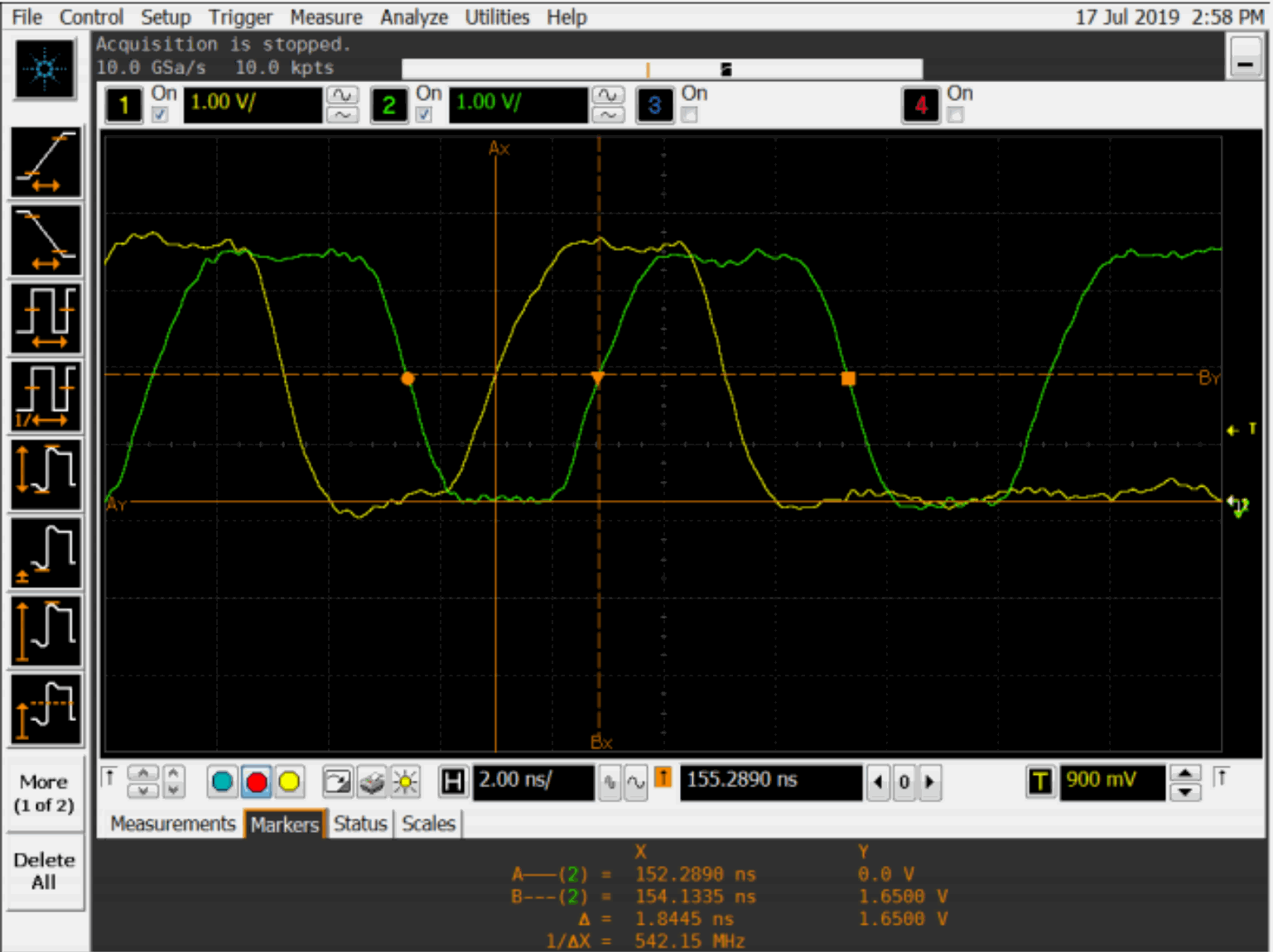
RGMII interfaces require the configuration of Delayline. The common practice is to sweep this window through the PHY, but in MAC To MAC mode, there is no PHY, so now the TX Delayline is measured using an oscilloscope. Close the RX Delayline of both MACs and adjust the TX Delayline to achieve a delay between 1.5- 2ns.
MAC-to-MAC TXC/TXD phase waveform — source EN PDF p.11.