
This complete technical reference follows RK-YH-YF-418 / V2.3.2. It covers seven NPU platform groups: RK3566/RK3568, RK3588, RK3562, RV1103/RV1106, RK3576/RV1126B, RK2118 and RV1103B/RV1106B, plus CPU operators and model I/O restrictions. The PDFs in the Chinese and English directories both have 343 pages and identical SHA-256 hashes; their actual text is Chinese, with no separate English original. English, Russian and German fully translate that Chinese source. All four versions reuse the same Chinese original figures; these are not presented as English-language figures. This is an ArmSoM platform-adaptation reference only: verify board SoC, RKNN-Toolkit2/Compiler/Runtime versions, SDK/BSP, kernel driver, quantization, model and zero-copy interfaces. The source does not prescribe one kernel version for every operator and does not prove support on every ArmSoM board. No model execution, performance measurement or hardware validation was performed.
ArmSoM Docs · RKNN-Toolkit2 · EDITORIAL-NOTES
Software change history
2.1 V2.3.2
- (1) Added documentation for RV1126B.
- (2) Added documentation for RV1106B.
- (3) Updated ConvDilation parameter limits on all platforms.
- (4) Updated Resize operator limits.
2.2 V2.3.0
- (1) Added documentation of exNorm mean_var mode on RK3576/RK3588/RK3562/RK3568.
- (2) MAX/MIN OPs support Broadcast on all platforms.
- (3) Changed the RK3576 Softmax limits.
2.3 V2.2.0
- (1) Changed softmax limits on all platforms except rk3568; added softmax splitting.
- (2) Added RMSNorm support on RK3576, RK3588, RK3562 and RK3568.
2.4 V2.1.0
- (1) Added RK2118 documentation.
- (2) Added RV1103B documentation.
- (3) Updated operator specifications on all platforms.
- (4) Added RK3576 operator specifications, including Hardmax and ConvLut.
- (5) RK2118 exConvStreaming support.
- (6) Added FlashAttentionV2 optimization support to exSDPA on RK3562/RK3576.
2.5 V2.0.0‑beta
- (1) Added supported-operator specifications for RK3576.
- (2) Added hardware-support specifications for exSDPAttention and exMatMul on RK3588/RK3562/RK3576.
- (3) Added CPU operator support for Floor, Mod, And, GatherElements and exMeanVarianceNormalization.
- (4) Added supported-operator specifications for RK2118.
NPU operator specifications
3.1 RK3566/RK3568
3.1.1 Add
Performs elementwise binary addition (C=A+B), supporting multidirectional NumPy-style broadcasting.
Inputs
- A:T1,T2
- shape:[batch,channel,height,width]
- Quantization support
- per‑layer
- Broadcasting support
- Supports broadcasting along any dimension.
- Broadcasting constraints are the same as for Expand.
- B:T1,T2
- shape:[batch,channel,height,width]
- Quantization support
- per‑layer
- Broadcasting support
- Supports broadcasting along any dimension.
- Broadcasting constraints are the same as for Expand.
Outputs
- C:T1
- shape:[batch,channel,height,width]
- Quantization support
- per‑layer
Data-type constraints
- T1:int8(Tensor),float16(Tensor)
- T2:float(constTensor)
3.1.2 AddRelu
Fused Add and Relu computation, C=Relu(A+B).
Inputs
- Same as Add.
Outputs
- Same as Add.
Other support
- Multi-core cooperation: supported.
3.1.3 BatchNormalization
Applies batch normalization to the input tensor as described in https://arxiv.org/abs/1502.03167.
Inputs
- input:T1
- shape:[batch,channel,height,width]
- Quantization support
- per‑layer
Outputs
- output:T1
- shape:[batch,channel,height,width]
- Quantization support
- per‑layer
Data-type constraints
- T1:int8(Tensor),float16(Tensor)
Attributes
- epsilon:float (default=1e‑5)
- Real value added when dividing by the standard deviation to prevent division by 0.
- epsilon∈(0,∞]
- momentum:float
- Moving-average parameter used during training.
3.1.4 Concat
Concatenates a sequence of vectors along axis into one vector. All vector dimensions other than axis must match.
Inputs
- input_tensor:T
- shape:[batch,channel,height,width]
- Quantization support
- per‑layer
Outputs
- output:T
- shape:[batch,channel,height,width]
- Quantization support
- per‑layer
Data-type constraints
- T:int8(Tensor),float16(Tensor)
Attributes
- axisint64
- axis∈{0,1,2,3}
3.1.5 Convolution
Convolution
Inputs
- input_tensor:T1
- shape:[batch,channel,height,width]
- width: when dilated_kernel_h>1, width<16383. Additional limits apply to the first-layer input width; see the model-input description.
- Quantization support
- per‑layer
- shape:[batch,channel,height,width]
- weight:T1
- shape:[output_channel,input_channel,kernel_h,kernel_w]
kernel_h∈[1,31]
kernel_w∈[1,31]
- Quantization support
- per‑layer
- per‑channel
Outputs
- output:T1
- shape:[batch,channel,height,width]
- Quantization support
- per‑layer
Attributes
- strides:int(strides_h,strides_w)
- stride_h∈[1,7]
- stride_w∈[1,7]
- pads:int(pads_top,pads_left,pads_bottom,pads_right)
- pads_top∈[0,15]
- pads_left∈[0,15]
- pads_bottom∈[0,15]
- pads_right∈[0,15]
- group:int
- dilations:int(dilations_h,dilations_w)
- dilations_h∈[1,31]
- dilations_w∈[1,31]
Data-type constraints
- T1:int8(Tensor),float16(Tensor)
3.1.6 DepthwiseConvolution
Depthwise separable convolution
Inputs
- input_tensor:T1
- shape:[batch,channel,height,width]
- width: when dilated_kernel_h>1, width<16383. Additional limits apply to the first-layer input width; see the model-input description.
- Quantization support
- per‑layer
- shape:[batch,channel,height,width]
- weight:T1
- shape:[output_channel,input_channel,kernel_h,kernel_w]
kernel_h∈[1,8]
kernel_w∈[1,8]
- Quantization support
- per‑layer
- per‑channel
Outputs
- output:T1
- shape:[batch,channel,height,width]
- Quantization support
- per‑layer
Attributes
- strides:int(strides_h,strides_w)
- stride_h∈[1,7]
- stride_w∈[1,7]
- pads:int(pads_top,pads_left,pads_bottom,pads_right)
- pads_top∈[0,15]
- pads_left∈[0,15]
- pads_bottom∈[0,15]
- pads_right∈[0,15]
- group:int
- dilations:int(dilations_h,dilations_w)
- dilations_h∈[1,32]
- dilations_w∈[1,32]
Data-type constraints
- T1:int8(Tensor),float16(Tensor)
3.1.7 ConvolutionRelu
Fused Convolution and Relu computation, Output=Relu(Conv(Input)).
Description and specification limits are the same as Convolution.
3.1.8 ConvolutionClip
Fused Convolution and Clip computation, Output=Clip(Conv(Input)).
Description and specification limits are the same as Convolution.
3.1.9 ConvolutionPRelu/LeakyRelu
Fused Convolution and PRelu/LeakyRelu computation, Output = PRelu(Conv(Input)) or Output =
LeakyRelu(Conv(Input))
Description and specification limits are the same as Convolution.
3.1.10 ConvolutionAdd
Fused Convolution and Add computation, Output=Add(Conv(Input0),Input1).
Description and specification limits are the same as Convolution.
3.1.11 ConvolutionSigmoid
Fused Convolution and Sigmoid computation, Output=Sigmoid(Conv(Input)).
Description and specification limits are the same as Convolution.
3.1.12 ConvolutionTanh
Fused Convolution and Tanh computation, Output=Tanh(Conv(Input)).
Description and specification limits are the same as Convolution.
3.1.13 ConvolutionSoftplus
Fused Convolution and Softplus computation, Output=Softplus(Conv(Input)).
Description and specification limits are the same as Convolution.
3.1.14 ConvolutionHardSigmoid
Fused Convolution and HardSigmoid computation, Output=HardSigmoid(Conv(Input)).
Description and specification limits are the same as Convolution.
3.1.15 ConvolutionHardSwish
Fused Convolution and HardSwish computation, Output=HardSwish(Conv(Input)).
Description and specification limits are the same as Convolution.
3.1.16 ConvolutionElu
Fused Convolution and Elu computation, Output=Elu(Conv(Input)).
Description and specification limits are the same as Convolution.
3.1.17 ConvolutionSwish
Fused Convolution and Swish computation, Output=Swish(Conv(Input)).
Description and specification limits are the same as Convolution.
3.1.18 ConvolutionMish
Fused Convolution and Mish computation, Output=Mish(Conv(Input)).
Description and specification limits are the same as Convolution.
3.1.19 ConvolutionAddRelu
Fused Convolution, Add and Relu computation, Output=Relu(Add(Conv(Input0),Input1)).
Description and specification limits are the same as Convolution.
3.1.20 ConvTranspose
Transposed convolution
Inputs
- input_tensor:T1
- shape:[batch,channel,height,width]
- width: when dilated_kernel_h>1, width<16383. In addition, the first-layer input
- shape:[batch,channel,height,width]
width is constrained; see model-input instructions.
- **量化支持**
  - per-layer
- weight:T1
- shape:[output_channel,input_channel,kernel_h,kernel_w]
kernel_h∈[1,31]
kernel_w∈[1,31]
- Quantization support
- per‑layer
- per‑channel
Outputs
- output:T1
- shape:[batch,channel,height,width]
- Quantization support
- per‑layer
Attributes
- strides:int(strides_h,strides_w)
- stride_h supports only 1,2,4,8.
- stride_w supports only 1,2,4,8.
- pads:int(pads_top,pads_left,pads_bottom,pads_right). When setting pad, note that the following are unsupported: kernel_h*dilations_h‑dilations_h‑pads_top<0; kernel_w*dilations_w‑dilations_w‑pads_left<0; stride_h*(height‑1)‑pads_top+1<output_h; stride_w*(width‑1)‑pads_left+1<output_w.
- pads_top∈[0,15]
- pads_left∈[0,15]
- pads_bottom∈[0,15]
- pads_right∈[0,15]
- group:int
- group: only 1 is supported; num_output is supported if and only if num_input=num_output.
- dilations:int(dilations_h,dilations_w)
- dilations_h∈[1,32]
- dilations_w∈[1,32]
- When dilation differs from (1,1), only kernel=(1,1) is supported.
Data-type constraints
- T1:int8(Tensor),float16(Tensor)
3.1.21 ConvTranposeRelu
Fused ConvTranpose and Relu computation, Output=Relu(ConvTranpose(Input)).
Description and specification limits are the same as ConvTranspose.
3.1.22 ConvTranposeClip
Fused ConvTranpose and Clip computation, Output=Clip(ConvTranpose(Input)).
Description and specification limits are the same as ConvTranspose.
3.1.23 ConvTranposePRelu/LeakyRelu
Fused ConvTranpose and PRelu/LeakyRelu computation, Output=PRelu(ConvTranpose(Input)) or Output=
LeakyRelu(ConvTranpose(Input))
Description and specification limits are the same as ConvTranspose.
3.1.24 ConvTranposeAdd
Fused ConvTranpose and Add computation, Output=Add(ConvTranpose(Input0),Input1).
Description and specification limits are the same as ConvTranspose.
3.1.25 ConvTranposeSigmoid
Fused ConvTranpose and Sigmoid computation, Output=Sigmoid(ConvTranpose(Input)).
Description and specification limits are the same as ConvTranspose.
3.1.26 ConvTranposeTanh
Fused ConvTranpose and Tanh computation, Output=Tanh(ConvTranpose(Input)).
Description and specification limits are the same as ConvTranspose.
3.1.27 ConvTranposeSoftplus
Fused ConvTranpose and Softplus computation, Output=Softplus(ConvTranpose(Input)).
Description and specification limits are the same as ConvTranspose.
3.1.28 ConvTranposeHardSigmoid
Fused ConvTranpose and HardSigmoid computation, Output=HardSigmoid(ConvTranpose(Input)).
3.1.29 ConvTranposeHardSwish
Fused ConvTranpose and HardSwish computation, Output=HardSwish(ConvTranpose(Input)).
Description and specification limits are the same as ConvTranspose.
3.1.30 ConvTranposeElu
Fused ConvTranpose and Elu computation, Output=Elu(ConvTranpose(Input)).
Description and specification limits are the same as ConvTranspose.
3.1.31 ConvTranposeSwish
Fused ConvTranpose and Swish computation, Output=Swish(ConvTranpose(Input)).
Description and specification limits are the same as ConvTranspose.
3.1.32 ConvTranposeMish
Fused ConvTranpose and Mish computation, Output=Mish(ConvTranpose(Input)).
Description and specification limits are the same as ConvTranspose.
3.1.33 Div
Performs elementwise binary division (C=A/B), supporting multidirectional NumPy-style broadcasting.
Inputs
- A:T1,T2
- shape:[batch,channel,height,width]
- Quantization support
- per‑layer
- Broadcasting support
- Supports broadcasting along any dimension.
- Broadcasting constraints are the same as for Expand.
- B:T1,T2
- shape:[batch,channel,height,width]
- Quantization support
- per‑layer
- Broadcasting support
- Supports broadcasting along any dimension.
- Broadcasting constraints are the same as for Expand.
Outputs
- C:T1
- shape:[batch,channel,height,width]
- Quantization support
- per‑layer
Data-type constraints
- T1:float16(Tensor)
- T2:float(constTensor)
3.1.34 Expand
Broadcasts the input tensor using the given shape and broadcasting rules, similar to numpy.array(input) *numpy.ones(shape): dimensions are right-aligned; each pair of corresponding dimensions must be equal or one of them must be 1.
Inputs
- input:T1
- shape:[batch,channel,height,width]
- Quantization support
- per‑layer
- shape:T2
- shape:[batch,channel,height,width]
Outputs
- output:T1
- shape:[batch,channel,height,width]
- Quantization support
- per‑layer
Data-type constraints
- T1:int8(Tensor),float16(Tensor)
- T2:int64(Tensor)
Broadcasting constraints
- [b,c,1,w]‑>[b,c,h,w],h∈[1,8192]
- [b,1,1,w]‑>[b,c,h,w],h∈[1,8192]
- [b,c,h,1]‑>[b,c,h,w],w ∈[1,8192]
- [b,1,h,1]‑>[b,c,h,w],w ∈[1,8192]
- [b,c,1,1]‑>[b,c,h,w],h∈[1,8192],w ∈[1,8192]
3.1.35 GRU
Gated Recurrent Unit (GRU). GRU extensions and variants are named exGRU; parameters marked (extern) are exclusive to exGRU. The equations follow:
f = Sigmoid; g = Tanh
r_t = f(x_t · W_r + h_{t-1} · R_r + Wb_r + Rb_r)
z_t = f(x_t · W_z + h_{t-1} · R_z + Wb_z + Rb_z)
h_t = g(x_t · W_h + (r_t ⊙ h_{t-1}) · R_h + Rb_h + Wb_h), (WRB = 0)
h_t = g(x_t · W_h + r_t ⊙ (h_{t-1} · R_h + Rb_h)) + Wb_h, (WRB = 1)
H_t = (1-z_t) ⊙ h_t + z_t ⊙ h_{t-1}
Inputs
- X:T1
- shape:[seq_length,batch_size,input_size]
seqlength∈(0,8192]
- batchsize∈(0,8192]; values greater than 1 must be multiples of 4.
inputsize∈(0,8192]
- Quantization support
- per‑layer
- W:T1
- shape:[num_directions,4*hidden_size,input_size]
inputsize∈(0,8192]
hiddensize∈(0,8192]
- numdirections:1or2
- Quantization support
- per‑layer
- per‑channel
- R:T1
- shape:[num_directions,4*hidden_size,hidden_size]
hiddensize∈(0,8192]
- numdirections:1or2
- Quantization support
- per‑layer
- per‑channel
- B:T2
- shape:[num_directions,8*hidden_size]
hiddensize∈(0,8192]
- numdirections:1or2
- Quantization support
- per‑layer
- per‑channel
- sequence_lens:T3(optional)
- shape:[batch_size]; batchsize∈(0,8192]; values greater than 1 must be multiples of 4.
- shape:[batch_size]; batchsize∈(0,8192]; values greater than 1 must be multiples of 4.
- initial_h:T1(optional)
- shape:[num_directions,batch_size,hidden_size]
- numdirections:1or2; batchsize∈(0,8192]; values greater than 1 must be multiples of 4.
- shape:[num_directions,batch_size,hidden_size]
hiddensize∈(0,8192]
- Quantization support
- per‑layer
Outputs
- Y:T1
- shape:[seq_length,num_directions,batch_size,hidden_size]
seqlength∈(0,8192]
- numdirections:1or2; batchsize∈(0,8192]; values greater than 1 must be multiples of 4.
hiddensize∈(0,8192]
- Quantization support
- per‑layer
- Y_h:T1(optional)
- shape:[num_directions,batch_size,hidden_size]
- numdirections:1or2; batchsize∈(0,8192]; values greater than 1 must be multiples of 4.
- shape:[num_directions,batch_size,hidden_size]
hiddensize∈(0,8192]
- Quantization support
- per‑layer
Attributes
- linear_before_reset:int
- Selects the LBR variant:1(T)or0(F).
- direction(extern):string
- Specifies the GRU processing direction.
- forward: processes GRU forwards.
- reverse: processes GRU backwards.
- bidirectional: processes GRU in both directions.
- sequence_size(extern):int
- Specifies the GRU input seqsize; unrestricted, but alignment to 4 is recommended.
- hidden_size(extern):int
- hiddensize within the GRU unit; unrestricted, but alignment to 8 is recommended.
- input_layout(extern):int
- Specifies a layout consistent with the meaning of the corresponding input shape.
- The specified layout and the actual batch_size, sequence_size and hidden_size of this op must be provided.
- snc: the input shape for this layout is [seqs,batches,input_size].
- (sn)c: the input shape for this layout is [seqs*batches,input_size,1,1].
- output_layout(extern):int
- Specifies a layout consistent with the meaning of the corresponding output shape.
- The specified layout and the actual batch_size, sequence_size, hidden_size and directions of this op must be provided.
- sbnc: the output shape for this layout is [seqs,directions,batches,hidden_size].
- (sn)c: the output shape for this layout is [seqsbatches,directionsinput_size,1,1].
Data-type constraints
- T1:float16(Tensor)
- T2:float(Tensor)
- T3:float(Scalar)
Other support
- Multi-core cooperation: not currently supported.
3.1.36 Gather
Uses Indices to select entries of input X along the specified axis and concatenates them.
Inputs
- X:T1
- shape:[batch,channel,height,width]
- Quantization support
- per‑layer
- Indices:T2
- Indices of the elements to gather; rank =1.
Outputs
- Y:T1
- shape:[batch,channel,height,width]
- Quantization support
- per‑layer
Data-type constraints
- T1:int8(Tensor),float16(Tensor)
- T2:int(Tensor)
Attributes
- axis:int(Tensor)
- axis∈{0,1,2,3}
- Specifies the input dimension accessed by Indices.
Other support
- Multi-core cooperation: not yet supported.
3.1.37 LSTM
Long Short-Term Memory (LSTM). LSTM extensions and variants are named exLSTM; parameters marked (extern) are exclusive to exLSTM. The equations follow:
f = Sigmoid; g = Tanh; h = Tanh
i_t = f(x_t · W_i + h_{t-1} · R_i + Wb_i + Rb_i)
f_t = f(x_t · W_f + h_{t-1} · R_f + Wb_f + Rb_f)
c_t = f(x_t · W_c + h_{t-1} · R_c + Wb_c + Rb_c)
o_t = f(x_t · W_o + h_{t-1} · R_o + Wb_o + Rb_o)
C_t = f_t ⊙ C(t-1) + i_t ⊙ c_t
h_t = o_t ⊙ h(C_t)
Inputs
- X:T1
- shape:[seq_length,batch_size,input_size]
seqlength∈(0,8192]
- batchsize∈(0,8192]; values greater than 1 must be multiples of 4.
inputsize∈(0,8192]
- Quantization support
- per‑layer
- W:T1
- shape:[num_directions,4*hidden_size,input_size]
inputsize∈(0,8192]
hiddensize∈(0,8192]
- numdirections:1or2
- Quantization support
- per‑layer
- per‑channel
- R:T1
- shape:[num_directions,4*hidden_size,hidden_size]
hiddensize∈(0,8192]
- numdirections:1or2
- Quantization support
- per‑layer
- per‑channel
- B:T2,T3
- shape:[num_directions,8*hidden_size]
hiddensize∈(0,8192]
- numdirections:1or2
- Quantization support
- per‑layer
- per‑channel
- sequence_lens:T4,T5(optional)
- shape:[batch_size]; batchsize∈(0,8192]; values greater than 1 must be multiples of 4.
- shape:[batch_size]; batchsize∈(0,8192]; values greater than 1 must be multiples of 4.
- initial_h:T1(optional)
- shape:[num_directions,batch_size,hidden_size]
- numdirections:1or2; batchsize∈(0,8192]; values greater than 1 must be multiples of 4.
- shape:[num_directions,batch_size,hidden_size]
hiddensize∈(0,8192]
- Quantization support
- per‑layer
- initial_c:T1(optional)
- shape:[num_directions,batch_size,hidden_size]
- numdirections:1or2; batchsize∈(0,8192]; values greater than 1 must be multiples of 4.
- shape:[num_directions,batch_size,hidden_size]
hiddensize∈(0,8192]
- Quantization support
- per‑layer
Outputs
- Y:T1
- shape:[seq_length,num_directions,batch_size,hidden_size]
seqlength∈(0,8192]
- numdirections:1or2; batchsize∈(0,8192]; values greater than 1 must be multiples of 4.
hiddensize∈(0,8192]
- Quantization support
- per‑layer
- Y_h:T1(optional)
- shape:[num_directions,batch_size,hidden_size]
- numdirections:1or2; batchsize∈(0,8192]; values greater than 1 must be multiples of 4.
- shape:[num_directions,batch_size,hidden_size]
hiddensize∈(0,8192]
- Quantization support
- per‑layer
- Y_c:T1(optional)
- shape:[num_directions,batch_size,hidden_size]
- numdirections:1or2; batchsize∈(0,8192]; values greater than 1 must be multiples of 4.
- shape:[num_directions,batch_size,hidden_size]
hiddensize∈(0,8192]
- Quantization support
- per‑layer
Attributes
- direction(extern):string
- Specifies the LSTM processing direction.
- forward: processes LSTM forwards.
- reverse: processes LSTM backwards.
- bidirectional: processes LSTM in both directions.
- sequence_size(extern):int
- Specifies the LSTM input seqsize; unrestricted, but alignment to 4 is recommended.
- hidden_size(extern):int
- hiddensize within the LSTM unit; unrestricted, but alignment to 8 is recommended.
- proj_size(extern):int
- proj_size for projection; projsize∈[0,hiddensize].
- Currently restricted to 0; projection is not yet supported.
- input_forget(extern):int
- Selects the cifg variant:1(T)or0(F). Currently restricted to 0, so it is not yet supported.
- has_projection(extern):int
- projection variant:1(T)or0(F). Currently restricted to 0, so it is not yet supported.
- input_layout(extern):int
- Specifies a layout consistent with the meaning of the corresponding input shape.
- The specified layout and the actual batch_size, sequence_size and hidden_size of this op must be provided.
- snc: the input shape for this layout is [seqs,batches,input_size].
- (sn)c: the input shape for this layout is [seqs*batches,input_size,1,1].
- output_layout(extern):int
- Specifies a layout consistent with the meaning of the corresponding output shape.
- The specified layout and the actual batch_size, sequence_size, hidden_size and directions of this op must be provided.
- sbnc: the output shape for this layout is [seqs,directions,batches,hidden_size].
- (sn)c: the output shape for this layout is [seqsbatches,directionsinput_size,1,1].
Data-type constraints
- T1:int8(Tensor),float16(Tensor)
- T2:float(Tensor)
- T3:int32(Tensor)
- T4:float(Scalar)
- T5:int(Scalar)
Other support
- Multi-core cooperation: not currently supported.
3.1.38 Max
Computes the elementwise maximum of the input tensors.
Inputs
- A:T1
- shape:[batch,channel,height,width]
- Quantization support
- per‑layer
- Broadcasting support
- Supports broadcasting along any dimension.
- Broadcasting constraints are the same as for Expand.
- B:T1
- shape:[batch,channel,height,width]
- Quantization support
- per‑layer
- Broadcasting support
- Supports broadcasting along any dimension.
- Broadcasting constraints are the same as for Expand.
Outputs
- C:T1
- shape:[batch,channel,height,width]
- Quantization support
- per‑layer/per‑channel
Data-type constraints
- T1:int8(Tensor),float16(Tensor)
Other support
- Multi-core cooperation: not currently supported.
3.1.39 Min
Computes the elementwise minimum of the input tensors.
Inputs
- A:T1
- shape:[batch,channel,height,width]
- Quantization support
- per‑layer
- Broadcasting support
- Supports broadcasting along any dimension.
- Broadcasting constraints are the same as for Expand.
- B:T1
- shape:[batch,channel,height,width]
- Quantization support
- per‑layer
- Broadcasting support
- Supports broadcasting along any dimension.
- Broadcasting constraints are the same as for Expand.
Outputs
- C:T1
- shape:[batch,channel,height,width]
- Quantization support
- per‑layer/per‑channel
Data-type constraints
- T1:int8(Tensor),float16(Tensor)
Other support
- Multi-core cooperation: not currently supported.
3.1.40 Mul
Performs elementwise binary multiplication (C=A*B), supporting multidirectional NumPy-style broadcasting.
Inputs
- A:T1,T2
- shape:[batch,channel,height,width]
- Quantization support
- per‑layer
- Broadcasting support
- Supports broadcasting along any dimension.
- Broadcasting constraints are the same as for Expand.
- B:T1,T2
- shape:[batch,channel,height,width]
- Quantization support
- per‑layer
- Broadcasting support
- Supports broadcasting along any dimension.
- Broadcasting constraints are the same as for Expand.
Outputs
- C:T1
- shape:[batch,channel,height,width]
- Quantization support
- per‑layer
Data-type constraints
- T1:int8(Tensor),float16(Tensor)
- T2:float(constTensor)
3.1.41 MulRelu
Other descriptions are the same as Mul.
- Supported data types: same as Mul.
3.1.42 Pad
Given a data tensor (data), a tensor of beginning/end padding values for each axis (pads), a mode (mode) and a constant value (constant_value), produces a padded tensor (output).
Inputs
- data:T1
- shape:[batch,channel,height,width]
- Quantization support
- per‑layer
- pads:T2
- shape : [batch_begin, channel_begin, height_begin, width_begin, batch_end, chan‑nel_end,height_end,width_end]
- constant_value(optional):T3
- shape:[1]
- Quantization support
- per‑layer
Outputs
- output:T1
- shape:[batch,channel,height,width]
- Quantization support
- per‑layer
Data-type constraints
- T1:int8(Tensor),float16(Tensor)
- T2:int64(Tensor)
- T3:float(Scalar),int8(Scalar),float16(Scalar)
Attributes
- mode:string (default constant)
- Supported modes: constant,reflect.
- constant: unrestricted.
- Supported modes: constant,reflect.
reflectchannel∈(0,8192],height∈(0,8192],width∈(0,8176]
Other support
- Multi-core cooperation: not yet supported.
3.1.43 MaxPool
MaxPool consumes input tensor X and applies max pooling according to kernel size, stride size and pad lengths. It computes the maximum over subsets of the input tensor determined by the kernel, downsampling into output tensor Y for further processing. The output spatial shape depends on whether explicit padding (pads) or automatic padding (auto_pad) is used. Only explicit padding is used here.
Inputs
- input:T1
- shape:[batch,channel,height,width]
channel∈(0,8192]
height∈(0,8192]
width∈(0,8192]
Outputs
- output:T1
- shape:[batch,channel,height,width]
Attributes
- kernel_shape:int64(kernel_h,kernel_w)
- kernel_h∈(0,7]
- kernel_w∈(0,7]
- auto_pad:string
- Padding mode: only NOTSET is supported.
- ceil_mode:int64
- Computing output shape using ceil or floor: unsupported.
- strides:int64(strides_h,strides_w)
- strides_h∈(0,8]
- strides_w∈(0,8]
- count_include_pad:int64[]
- count_include_pad, whether to include pad values in calculation:1.
- pad:int64(pad_top,pad_left,pad_bottom,pad_right)
- pad_top∈[0,7]
- pad_left∈[0,7]
- pad_bottom∈[0,7]
- pad_right∈[0,7]
- storage_order:int64
- Preferred storage order:0.
Data-type constraints
- T1:int8(Tensor),float16(Tensor)
- T2:float(Tensor)
- T3:float(Scalar)
3.1.44 GlobalMaxPool
GlobalMaxPool takes input tensor X and applies max pooling to values within each channel. It is equivalent to MaxPool with kernel_shape equal to the spatial dimensions of input.
Inputs
- input:T1
- shape:[batch,channel,height,width]
channel∈(0,8192]
height∈(1,7]
width∈(1,7]
Outputs
- output:T1
- shape:[batch,channel,height,width]
Attributes
- kernel_shape:int64(kernel_h,kernel_w)
- kernel_h∈(0,7]
- kernel_w∈(0,7]
- auto_pad:string
- Padding mode: only NOTSET is supported.
- ceil_mode:int64
- Computing output shape using ceil or floor: unsupported.
- strides:int64(strides_h,strides_w)
- strides_h∈(0,8]
- strides_w∈(0,8]
- count_include_pad:int64[]
- count_include_pad, whether to include pad values in calculation:1.
- pad:int64(pad_top,pad_left,pad_bottom,pad_right)
- pad_top∈[0,7]
- pad_left∈[0,7]
- pad_bottom∈[0,7]
- pad_right∈[0,7]
Data-type constraints
- T1:int8(Tensor),float16(Tensor)
- T2:float(Tensor)
- T3:float(Scalar)
3.1.45 AveragePool
AveragePool consumes input tensor X and applies average pooling according to kernel size, stride size and pad lengths. It averages all values in subsets of the input tensor determined by the kernel and downsamples into output tensor Y for further processing. The output spatial shape depends on whether explicit padding (pads) or automatic padding (auto_pad) is used. Only explicit padding is used here.
Inputs
- input:T1
- shape:[batch,channel,height,width]
channel∈(0,8192]
height∈(0,8192]
width∈(0,8192]
Outputs
- output:T1
- shape:[batch,channel,height,width]
Attributes
- kernel_shape:int64(kernel_h,kernel_w)
- kernel_h∈(0,7]
- kernel_w∈(0,7]
- auto_pad:string
- Padding mode: only NOTSET is supported.
- ceil_mode:int64
- Computing output shape using ceil or floor: unsupported.
- strides:int64(strides_h,strides_w)
- strides_h∈(0,8]
- strides_w∈(0,8]
- count_include_pad:int64[]
- count_include_pad, whether to include pad values in calculation:1.
- pad:int64(pad_top,pad_left,pad_bottom,pad_right)
- pad_top∈[0,7]
- pad_left∈[0,7]
- pad_bottom∈[0,7]
- pad_right∈[0,7]
Data-type constraints
- T1:int8(Tensor),float16(Tensor)
- T2:float(Tensor)
- T3:float(Scalar)
3.1.46 GlobalAveragePool
GlobalAveragePool applies average pooling to values within each channel of input tensor X. This equals AveragePool with kernel_shape equal to the spatial dimensions of the input tensor.
Inputs*
- input:T1
- shape:[batch,channel,height,width]
channel∈(0,8192]
height∈(0,7]
width∈(0,7]
Outputs
- output:T1
- shape:[batch,channel,height,width]
Attributes
- kernel_shape:int64(kernel_h,kernel_w)
- kernel_h∈(0,7]
- kernel_w∈(0,7]
- auto_pad:string
- Padding mode: only NOTSET is supported.
- ceil_mode:int64
- Computing output shape using ceil or floor: unsupported.
- strides:int64(strides_h,strides_w)
- strides_h∈(0,8]
- strides_w∈(0,8]
- count_include_pad:int64[]
- count_include_pad, whether to include pad values in calculation:1.
- pad:int64(pad_top,pad_left,pad_bottom,pad_right)
- pad_top∈[0,7]
- pad_left∈[0,7]
- pad_bottom∈[0,7]
- pad_right∈[0,7]
Data-type constraints
- T1:int8(Tensor),float16(Tensor)
- T2:float(Tensor)
- T3:float(Scalar)
3.1.47 Pow
Z =XY
Exponentiation: takes input data (a tensor) and an exponent, and produces output data (a tensor).
Inputs
- X:T1
- shape:[batch,channel,height,width]
- Quantization support
- per‑layer
- Y:T2
- shape:[1]
- Currently supports only 0,1,2,3,0.5,‑0.5.
- shape:[1]
Outputs
- Z:T1
- shape:[batch,channel,height,width]
- Quantization support
- per‑layer
Data-type constraints
- T1:int8(Tensor),float16(Tensor)
- T2:int8(Tensor),int32(Tensor),int64(Tensor),float16(Tensor),float(Tensor)
Other support
- Multi-core cooperation: not yet supported.
3.1.48 Relu
Sets negative input-tensor values to zero; positive values remain unchanged.
Inputs
- input:T1
- shape:[batch,channel,height,width]
- Quantization support
- per‑layer
- Broadcasting support
- None
Outputs
- output:T1
- shape:[batch,channel,height,width]
- Quantization support
- per‑layer
Data-type constraints
- T1:int8(Tensor),float16(Tensor)
Other support
- Multi-core cooperation: not currently supported.
3.1.49 Clip/ReLU6
Clips input-tensor values to [0,6].
Inputs
- input:T1
- shape:[batch,channel,height,width]
- Quantization support
- per‑layer
- Broadcasting support
- None
Outputs
- output:T1
- shape:[batch,channel,height,width]
- Quantization support
- per‑layer
Data-type constraints
- T1:int8(Tensor),float16(Tensor)
Other support
- Multi-core cooperation: not currently supported.
3.1.50 PRelu
Scales negative input-tensor values by a learnable parameter; positive values remain unchanged.
Inputs
- input:T1
- shape:[batch,channel,height,width]
- Quantization support
- per‑layer/per‑channel
- Broadcasting support
- None
Outputs
- output:T1
- shape:[batch,channel,height,width]
- Quantization support
- per‑layer/per‑channel
Attributes
- slope: PRelu coefficient.
- Only a single scalar or coefficients along dimension C are supported.
Data-type constraints
- T1:int8(Tensor),float16(Tensor)
Other support
- Multi-core cooperation: not currently supported.
3.1.51 LeakyRelu
Scales negative input-tensor values by a fixed ratio; positive values remain unchanged.
Inputs
- input:T1
- shape:[batch,channel,height,width]
- Quantization support
- per‑layer
- Broadcasting support
- None
Outputs
- output:T1
- shape:[batch,channel,height,width]
- Quantization support
- per‑layer
Data-type constraints
- T1:int8(Tensor),float16(Tensor)
Other support
- Multi-core cooperation: not currently supported.
3.1.52 Reshape
Returns a tensor of the specified shape without changing the input data or element count.
Inputs
- input:T1
- shape:[batch,channel,height,width]
- Quantization support
- per‑layer
Outputs
- output:T1
- shape:[batch,channel,height,width]
- Quantization support
- per‑layer
Data-type constraints
- T1:int8(Tensor),float16(Tensor)
Attributes
- shape:int
- Specifies the output tensor shape.
Other support
- Multi-core cooperation: not yet supported.
3.1.53 Resize
Resizes the input tensor. In general, each output value is computed as a weighted average of a neighborhood (sampling locations) in the input tensor.
Inputs
- X:T1
- shape:[batch,channel,height,width]
- Quantization support
- per‑layer
- roi(optional):T2
- Not currently supported.
- scales(optional):T2
- Array of scale factors along each dimension.
- sizes(optional):T3
- Target size of the output tensor.
Outputs
- Y:T1
- shape:[batch,channel,height,width]
- Quantization support
- per‑layer
Data-type constraints
- T1:int8(Tensor),float16(Tensor)
- T2:float(Tensor)
- T3:int64(Tensor)
Attributes
- antialias:int (default 0)
- Setting this is currently unsupported.
- axes:int[]
- Setting this is currently unsupported.
- coordinate_transformation_mode:strings (default ”half_pixel”)
- Currently supports only half_pixel, pytorch_half_pixel and align_corners.
- cubic_coeff_a:float (default ‑0.75)
- Setting this is currently unsupported.
- exclude_outside:int (default 0)
- Setting this is currently unsupported.
- extrapolation_value:float (default 0)
- Setting this is currently unsupported.
- keep_aspect_ratio_policy:strings (default ”stretch”)
- Setting this is currently unsupported.
- mode:strings (default ”nearest”)
- Only nearest and linear are currently configurable.
- nearest_mode:strings (default ”round_prefer_floor”)
- Setting this is currently unsupported.
Support: currently only integer scaling in width and height is supported, with integer factors 2‑8. An input (1,c,1,1) can be enlarged to (1,c,h,w).
3.1.54 Slice
Obtains a slice of the current vector using the same rules as NumPy slicing.
Inputs
- input_tensor:T
- shape:[batch,channel,height,width]
- Quantization support
- per‑layer
Outputs
- output:T
- shape:[batch,channel,height,width]
- Quantization support
- per‑layer
Data-type constraints
- T:int8(Tensor),float16(Tensor)
Attributes
- starts:int(Tensor)
- Slice start position: unrestricted.
- ends:int(Tensor)
- Slice end position: unrestricted.
- axes:int(Tensor)
- Slice-axis selection: any axis 0~3; multiple axes may be selected simultaneously.
- steps:int(Tensor)
- Selects the step along each sliced axis.
- When height*width==1&&channel%subc==0&&starts[1]%subc==0&&ends[1]%subc==0&&steps[1]<=subc, steps may differ from 1. Otherwise SliceOP runs on the NPU only when steps==[1,1,1,1].
3.1.55 Split
Splits the vector along axis into num_outputs vectors; split specifies their sizes along axis.
Inputs
- input_tensor:T
- shape:[batch,channel,height,width]
- Quantization support
- per‑layer
Outputs
- output:T
- One or more output vectors, determined by num_outputs.
- shape: determined by the split.
- Quantization support
- per‑layer
Data-type constraints
- T:int8(Tensor),float16(Tensor)
Attributes
- axis:int
- axis∈{0,1,2,3}
- num_outputs:int
- split:int(Tensor)
3.1.56 Sub
- Performs elementwise binary subtraction (C=A‑B), supporting multidirectional NumPy-style broadcasting.
Inputs
- A:T1,T2
- shape:[batch,channel,height,width]
- Quantization support
- per‑layer
- Broadcasting support
- [b,c,1,1]
- [scalar]
- B:T1,T2
- shape:[batch,channel,height,width]
- Quantization support
- per‑layer
- Broadcasting support
- [b,c,1,1]
- [scalar]
Outputs
- C:T1
- shape:[batch,channel,height,width]
- Quantization support
- per‑layer
Data-type constraints
- T1:int8(Tensor),float16(Tensor)
- T2:float(constTensor)
3.1.57 Tile
Constructs a tensor by tiling the given tensor, like NumPy tile but without broadcasting.
Inputs
- input:T1
- shape:[batch,channel,height,width]
- Quantization support
- per‑layer
- repeats:T2
- shape:[batch,channel,height,width]
Outputs
- output:T1
- shape:[batch,channel,height,width]
- Quantization support
- per‑layer
Data-type constraints
- T1:int8(Tensor),float16(Tensor)
- T2:int64(Tensor)
3.1.58 Transpose
Transposes the input tensor.
Inputs
- X:T1
- shape:[n1,c1,h1,w1]
- See the attribute list for detailed constraints.
- Quantization support
- per‑layer
- shape:[n1,c1,h1,w1]
Outputs
- Y:T1,T2
- shape:[n2,c2,h2,w2]
- See the attribute list for detailed constraints.
- Quantization support
- per‑layer
- shape:[n2,c2,h2,w2]
Attributes
- perm, order of transposed axes: constraints for each perm follow (p=8192,q=2048).
- perm=[0,1,2,3]
- Unrestricted
- perm=[0,1,3,2]
- Unsupported
- perm=[0,2,3,1]
- Unsupported
- perm=[0,2,1,3]
- Unsupported
- perm=[0,3,1,2]
- Unsupported
- perm=[0,3,2,1]
- Unsupported
- perm=[1,0,2,3]
- Unsupported
- perm=[1,0,3,2]
- Unsupported
- perm=[1,2,0,3]
- Unsupported
- perm=[1,2,3,0]
- Unsupported
- perm=[1,3,0,2]
- Unsupported
- perm=[1,3,2,0]
- Unsupported
- perm=[2,1,0,3]
- T1,T2:c1<8192,n<8192,h1*w1<8192,(h1=w1=1,n1%4=0)or(n1=h1=1,h1%4=0)
- perm=[2,1,3,0]
- T1,T2:c1<8192,n<8192,h1*w1<8192,(h1=w1=1,n1%4=0)or(n1=h1=1,h1%4=0)
- perm=[2,0,3,1]
- Unsupported
- perm=[2,0,1,3]
- Unsupported
- perm=[2,3,1,0]
- Unsupported
- perm=[2,3,0,1]
- Unsupported
- perm=[3,0,2,1]
- Unsupported
- perm=[3,0,1,2]
- Unsupported
- perm=[3,2,0,1]
- Unsupported
- perm=[3,2,1,0]
- Unsupported
- perm=[3,1,0,2]
- T1,T2:c1<8192,n<8192,h1*w1<8192,(h1=w1=1,n1%4=0)or(n1=h1=1,w1%4=0)
- perm=[3,1,2,0]
- T1,T2:c1<8192,n<8192,h1*w1<8192,(h1=w1=1,n1%4=0)or(n1=h1=1,w1%4=0)
- perm=[0,1,2,3]
Data-type constraints
- T1:int8(Tensor)
- T2:int16(Tensor),float16(Tensor)
Other support
- Multi-core cooperation: not currently supported.
3.1.59 Sigmoid
Applies y=1/(1+exp(‑x)) elementwise to the input tensor to produce the output tensor.
Inputs
- input:T1
- shape:[batch,channel,height,width]
- Quantization support
- per‑layer
Outputs
- output:T1
- shape:[batch,channel,height,width]
- Quantization support
- per‑layer
Data-type constraints
- T1:int8(Tensor),float16(Tensor)
3.1.60 Tanh
Computes the hyperbolic tangent of each input-tensor element.
Inputs
- X:T1
- shape:[batch,channel,height,width]
- Quantization support:per‑layer.
Outputs
- Y:T1
- shape:[batch,channel,height,width]
- Quantization support:per‑layer.
Data-type constraints
- T1:int8(Tensor),float16(Tensor)
3.1.61 Softplus
Applies Softplus elementwise, y=ln(exp(x)+1).
Inputs
- X:T1
- shape:[batch,channel,height,width]
- Quantization support:per‑layer.
Outputs
- Y:T1
- shape:[batch,channel,height,width]
- Quantization support:per‑layer.
Data-type constraints
- T1:int8(Tensor),float16(Tensor)
3.1.62 HardSigmoid
Applies y=max(0,min(1,alpha*x+beta)) elementwise to the input tensor to produce the output tensor, where
alpha=1/6,beta=0.5
Inputs
- input:T1
- shape:[batch,channel,height,width]
- Quantization support
- per‑layer
Outputs
- output:T1
- shape:[batch,channel,height,width]
- Quantization support
- per‑layer
Data-type constraints
- T1:int8(Tensor),float16(Tensor)
3.1.63 HardSwish
Applies HardSwish elementwise: y = x * max(0, min(1, alpha * x + beta)) = x * HardSigmoid<alpha,beta>(x), where alpha=1/6,beta=0.5.
Inputs
- X:T1
- shape:[batch,channel,height,width]
- Quantization support:per‑layer.
Outputs
- Y:T1
- shape:[batch,channel,height,width]
- Quantization support:per‑layer.
Data-type constraints
- T1:int8(Tensor),float16(Tensor)
3.1.64 Elu
Applies f(x)=alpha*(exp(x)‑1.)forx<0,f(x)=xforx>=0 elementwise to produce the output tensor, with alpha=1.
Inputs
- input:T1
- shape:[batch,channel,height,width]
- Quantization support
- per‑layer
Outputs
- output:T1
- shape:[batch,channel,height,width]
- Quantization support
- per‑layer
Data-type constraints
- T1:int8(Tensor),float16(Tensor)
3.1.65 exSwish
Applies the Sigmoid Linear Unit elementwise. Swish is also called SiLU: y=x*sigmoid(x).
Inputs
- X:T1
- shape:[batch,channel,height,width]
- Quantization support:per‑layer.
Outputs
- Y:T1
- shape:[batch,channel,height,width]
- Quantization support:per‑layer.
Data-type constraints
- T1:int8(Tensor),float16(Tensor)
3.1.66 exMish
Applies mish(x)=x*tanh(softplus(x))=x*tanh(ln(1+e^{x})) elementwise to the input tensor to produce the output tensor.
Inputs
- input:T1
- shape:[batch,channel,height,width]
- Quantization support
- per‑layer
Outputs
- output:T1
- shape:[batch,channel,height,width]
- Quantization support
- per‑layer
Data-type constraints
- T1:int8(Tensor),float16(Tensor)
3.1.67 exGelu
Applies y =x∗Φ(x) elementwise to the input tensor to produce the output tensor. When Φ(x) is set to tanh,
y = 0.5 * x * (1 + Tanh(sqrt(2/π) * (x + 0.044715 * x^3)))
Inputs
- input:T1
- shape:[batch,channel,height,width]
- Quantization support
- per‑layer
Outputs
- output:T1
- shape:[batch,channel,height,width]
- Quantization support
- per‑layer
Data-type constraints
- T1:int8(Tensor),float16(Tensor)
3.1.68 exSwooshR
Applies the following function from https://arxiv.org/abs/2310.11230 elementwise to the input tensor to produce the output tensor.
SwooshR(x)=log(1+exp(x-1))-0.08x-0.313261687
Inputs
- input:T1
- shape:[batch,channel,height,width]
- Quantization support
- per‑layer
Outputs
- output:T1
- shape:[batch,channel,height,width]
- Quantization support
- per‑layer
Data-type constraints
- T1:int8(Tensor),float16(Tensor)
3.1.69 exSwooshL
Applies the following function from https://arxiv.org/abs/2310.11230 elementwise to the input tensor to produce the output tensor.
SwooshL(x)=log(1+exp(x-4))-0.08x-0.035
Inputs
- input:T1
- shape:[batch,channel,height,width]
- Quantization support
- per‑layer
Outputs
- output:T1
- shape:[batch,channel,height,width]
- Quantization support
- per‑layer
Data-type constraints
- T1:int8(Tensor),float16(Tensor)
3.1.70 Where
Selects values from x_tensor or y_tensor according to mask_tensor: True selects the corresponding x_tensor value; otherwise the y_tensor value.
Inputs
- mask_tensor:T1
- shape:[batch,channel,height,width]
- Broadcasting support
- Supports broadcasting along any dimension.
- Broadcasting constraints
- Broadcasting constraints are the same as for Expand.
- x_tensor:*T2
- shape:[batch,channel,height,width]
- Quantization support
- per‑layer
- Broadcasting support
- Supports broadcasting along any dimension.
- Broadcasting constraints
- Broadcasting constraints are the same as for Expand.
- y_tensor:T1
- shape:[batch,channel,height,width]
- Quantization support
- per‑layer
- Broadcasting support
- Supports broadcasting along any dimension.
- Broadcasting constraints
- Broadcasting constraints are the same as for Expand.
Outputs
- output:T2
- shape:[batch,channel,height,width]
- Quantization support
- per‑layer
Data-type constraints
- T1:bool(Tensor)
- T2:int8(Tensor),float16(Tensor)
3.1.71 exGlu
Gated Linear Unit function; a is the first half of the input matrix and b is the second half.
GLU(a,b)=a⊗σ(b)
Inputs
- Input:T1
- shape:[batch,channel,height,width]
- Quantization support:per‑layer.
Outputs
- Output:T1
- shape:[batch,channel/2,height,width]
- Quantization support:per‑layer.
Data-type constraints
- T1:int8(Tensor),float16(Tensor)
Attributes
- axis:int(default=1)
- Dimension along which to split the input.
- Constraint: only 1 is supported.
3.1.72 exMatMul
Matrix multiplication
Y =
  A · B + C   if c_type = "add"
  A · B * C   if c_type = "mul"
Inputs
- A:T1
- shape:[b,k,1,n]
- k ∈(0,8192]
- Quantization support
- per‑layer
- shape:[b,k,1,n]
- B:T1
- shape:[b,k,1,m]
- Quantization support
- per‑layer
- C(optional):T1,T2
- shape:[b,n,1,m]
- Quantization support
- per‑layer
- Broadcasting support
- Supports broadcasting along any dimension.
- Broadcasting constraints are the same as for Expand.
Outputs
- Y:T1
- shape:[b,n,1,m]
- Quantization support
- per‑layer
Data-type constraints
- T1:int8(Tensor),float16(Tensor)
- T2:float(Tensor)
Attributes
- c_type:strings(default “add”)
- Select add or mul to specify whether C is added or multiplied.
3.1.73 exNorm
Applies normalization to input data. Currently supports LayerNormlization, RMSNormlization and MeanVarianceNormalization:
LayerNorm(x) = (x - µ) / sqrt(σ^2 + ϵ) · W + B
RMSNorm(x) = x / sqrt(RMS^2 + ϵ) · W + B
MeanVarianceNorm(x) = (x - µ) / sqrt(Variance + ϵ) · W + B
Here x is the input vector. µ and σ2 are the mean and variance of the input vector:
µ = (1/H) Σ_{i=1}^{H} x_i
σ^2 = (1/H) Σ_{i=1}^{H} (x_i - µ)^2
RMS is the root mean square of the input vector:
RMS = sqrt((1/H) Σ_{i=1}^{H} (x_i)^2)
Variance is the equivalent variance of the input vector:
Variance = (1/H) Σ_{i=1}^{H} (x_i)^2 - µ^2
ϵ is a small value preventing division by zero. W and B are optional parameters.
Inputs
- X:T1
- shape:[batch,channel,height,width]
- W(optional):T1
- shape:[batch,channel,height,width]
- B(optional):T1
- shape:[batch,channel,height,width]
Outputs
- Y:T1
- shape:[batch,channel,height,width]
Data-type constraints
- T1:float16(Tensor)
Attributes
- epsilon:float(default 1e‑05)
- epsilon value used to prevent division by 0.
- mode:string
- Supports three selectable Normalization modes: layer, rms and mean_var.
- axes:int64[](default [1])
- Normalization axes: currently only [1] and [1,2,3] are supported.
Other support
- Multi-core cooperation: not yet supported.
3.1.74 exWindow
exWindow derives from window_partition and window_reverse in swin_transformer. In the original paper, input features are divided into non-overlapping windows of window_size×window_size. Input and output features must have a 4-dimensional shape, partitioned in both height and width. The PyTorch implementation follows:
def window_partition(x, window_size):
  """
  Args:
    x: (B, C, H, W)
    window_size (int): window size
  Returns:
    windows: (B, C, num_windows*num_windows, window_size*window_size)
  """
  B, C, H, W = x.shape
  x = x.view(B, C, H // window_size, window_size, W // window_size, window_size)
  windows = x.permute(0, 1, 2, 4, 3, 5).contiguous().view(B, C, -1, window_size*window_size)
  return windows
def window_reverse(windows, window_size, H, W):
  """
  Args:
    windows: (B, C, num_windows*num_windows, window_size*window_size)
    window_size (int): Window size
    H (int): Height of image
    W (int): Width of image
  Returns:
    x: (B, C, H, W)
  """
  B,C,_,_ = windows.shape
  x = windows.view(B, C, H // window_size, W // window_size, window_size, window_size)
  x = x.permute(0, 1, 2, 4, 3, 5).contiguous().view(B, C, H, W)
  return x
Inputs
- X:T1
- shape:[batch,channel,height,width]
Outputs
- Y:T1
- shape:[batch,channel,height,width]
Data-type constraints
- T1:int8(Tensor),float16(Tensor)
Attributes
- mode:string
- Supported modes:partition,reverse,partition_num_first.
- partition: see the window_partition implementation.
- reverse: see the window_reverse implementation.
- partition_num_first differs from partition in that its H,W are divided according to num_windows, whereas partition divides H,W according to window_sizes.
- Supported modes:partition,reverse,partition_num_first.
- window_sizes:listofints
- 2-dimensional vector of window sizes, defining the height and width of each window. Attention calculation and feature extraction within each window use this size.
- num_windows:listofints
- 2-dimensional vector of window counts, defining how many windows the input feature height and width are divided into.
Other support
- Multi-core cooperation: not yet supported.
3.2 RK3588
3.2.1 Add
Performs elementwise binary addition (C=A+B), supporting multidirectional NumPy-style broadcasting.
Inputs
- A:T1,T2
- shape:[batch,channel,height,width]
- Quantization support
- per‑layer
- Broadcasting support
- Supports broadcasting along any dimension.
- Broadcasting constraints are the same as for Expand.
- B:T1,T2
- shape:[batch,channel,height,width]
- Quantization support
- per‑layer
- Broadcasting support
- Supports broadcasting along any dimension.
- Broadcasting constraints are the same as for Expand.
Outputs
- C:T1
- shape:[batch,channel,height,width]
- Quantization support
- per‑layer
Data-type constraints
- T1:int8(Tensor),float16(Tensor)
- T2:float(constTensor)
Other support
- Multi-core cooperation: supported.
3.2.2 AddRelu
Fused Add and Relu computation, C=Relu(A+B).
Inputs
- Same as Add.
Outputs
- Same as Add.
Other support
- Multi-core cooperation: supported.
3.2.3 BatchNormalization
Applies batch normalization to the input tensor as described in https://arxiv.org/abs/1502.03167.
Inputs
- input:T1
- shape:[batch,channel,height,width]
- Quantization support
- per‑layer
Outputs
- output:T1
- shape:[batch,channel,height,width]
- Quantization support
- per‑layer
Data-type constraints
- T1:int8(Tensor),float16(Tensor)
Attributes
- epsilon:float (default=1e‑5)
- Real value added when dividing by the standard deviation to prevent division by 0.
- epsilon∈(0,∞]
- momentum:float
- Moving-average parameter used during training.
Other support
- Multi-core cooperation: not yet supported.
3.2.4 Concat
Concatenates a sequence of vectors along axis into one vector. All vector dimensions other than axis must match.
Inputs
- input_tensor:T
- shape:[batch,channel,height,width]
- Quantization support
- per‑layer
Outputs
- output:T
- shape:[batch,channel,height,width]
- Quantization support
- per‑layer
Data-type constraints
- T:int8(Tensor),float16(Tensor)
Attributes
- axisint64
- axis∈{0,1,2,3}
3.2.5 Convolution
Convolution
Inputs
- input_tensor:T1
- shape:[batch,channel,height,width]
- width: when dilated_kernel_h>1, width<16383. Additional limits apply to the first-layer input width; see the model-input description.
- Quantization support
- per‑layer
- shape:[batch,channel,height,width]
- weight:T1
- shape:[output_channel,input_channel,kernel_h,kernel_w]
kernel_h∈[1,31]
kernel_w∈[1,31]
- Quantization support
- per‑layer
- per‑channel
Outputs
- output:T1
- shape:[batch,channel,height,width]
- Quantization support
- per‑layer
Attributes
- strides:int(strides_h,strides_w)
- stride_h∈[1,7]
- stride_w∈[1,7]
- pads:int(pads_top,pads_left,pads_bottom,pads_right)
- pads_top∈[0,15]
- pads_left∈[0,15]
- pads_bottom∈[0,15]
- pads_right∈[0,15]
- group:int
- dilations:int(dilations_h,dilations_w)
- dilations_h∈[1,31]
- dilations_w∈[1,31]
Data-type constraints
- T1:int8(Tensor),float16(Tensor)
Other support
- Multi-core cooperation: supported.
3.2.6 DepthwiseConvolution
Depthwise separable convolution
Inputs
- input_tensor:T1
- shape:[batch,channel,height,width]
- width: when dilated_kernel_h>1, width<16383. Additional limits apply to the first-layer input width; see the model-input description.
- Quantization support
- per‑layer
- shape:[batch,channel,height,width]
- weight:T1
- shape:[output_channel,input_channel,kernel_h,kernel_w]
kernel_h∈[1,8]
kernel_w∈[1,8]
- Quantization support
- per‑layer
- per‑channel
Outputs
- output:T1
- shape:[batch,channel,height,width]
- Quantization support
- per‑layer
Attributes
- strides:int(strides_h,strides_w)
- stride_h∈[1,7]
- stride_w∈[1,7]
- pads:int(pads_top,pads_left,pads_bottom,pads_right)
- pads_top∈[0,15]
- pads_left∈[0,15]
- pads_bottom∈[0,15]
- pads_right∈[0,15]
- group:int
- dilations:int(dilations_h,dilations_w)
- dilations_h∈[1,32]
- dilations_w∈[1,32]
Data-type constraints
- T1:int8(Tensor),float16(Tensor)
Other support
- Multi-core cooperation: supported.
3.2.7 ConvolutionRelu
Fused Convolution and Relu computation, Output=Relu(Conv(Input)).
Description and specification limits are the same as Convolution.
Other support
- Multi-core cooperation: supported.
3.2.8 ConvolutionClip
Fused Convolution and Clip computation, Output=Clip(Conv(Input)).
Description and specification limits are the same as Convolution.
Other support
- Multi-core cooperation: supported.
3.2.9 ConvolutionPRelu/LeakyRelu
Fused Convolution and PRelu/LeakyRelu computation, Output = PRelu(Conv(Input)) or Output =
LeakyRelu(Conv(Input))
Description and specification limits are the same as Convolution.
Other support
- Multi-core cooperation: supported.
3.2.10 ConvolutionAdd
Fused Convolution and Add computation, Output=Add(Conv(Input0),Input1).
Description and specification limits are the same as Convolution.
Other support
- Multi-core cooperation: supported.
3.2.11 ConvolutionSigmoid
Fused Convolution and Sigmoid computation, Output=Sigmoid(Conv(Input)).
Description and specification limits are the same as Convolution.
Other support
- Multi-core cooperation: not currently supported.
3.2.12 ConvolutionTanh
Fused Convolution and Tanh computation, Output=Tanh(Conv(Input)).
Description and specification limits are the same as Convolution.
Other support
- Multi-core cooperation: not currently supported.
3.2.13 ConvolutionSoftplus
Fused Convolution and Softplus computation, Output=Softplus(Conv(Input)).
Description and specification limits are the same as Convolution.
Other support
- Multi-core cooperation: not currently supported.
3.2.14 ConvolutionHardSigmoid
Fused Convolution and HardSigmoid computation, Output=HardSigmoid(Conv(Input)).
Description and specification limits are the same as Convolution.
Other support
- Multi-core cooperation: not currently supported.
3.2.15 ConvolutionHardSwish
Fused Convolution and HardSwish computation, Output=HardSwish(Conv(Input)).
Description and specification limits are the same as Convolution.
Other support
- Multi-core cooperation: not currently supported.
3.2.16 ConvolutionElu
Fused Convolution and Elu computation, Output=Elu(Conv(Input)).
Description and specification limits are the same as Convolution.
Other support
- Multi-core cooperation: not currently supported.
3.2.17 ConvolutionSwish
Fused Convolution and Swish computation, Output=Swish(Conv(Input)).
Description and specification limits are the same as Convolution.
Other support
- Multi-core cooperation: not currently supported.
3.2.18 ConvolutionMish
Fused Convolution and Mish computation, Output=Mish(Conv(Input)).
Description and specification limits are the same as Convolution.
Other support
- Multi-core cooperation: not currently supported.
3.2.19 ConvolutionAddRelu
Fused Convolution, Add and Relu computation, Output=Relu(Add(Conv(Input0),Input1)).
Description and specification limits are the same as Convolution.
Other support
- Multi-core cooperation: supported.
3.2.20 ConvTranspose
Transposed convolution
Inputs
- input_tensor:T1
- shape:[batch,channel,height,width]
- width: when dilated_kernel_h>1, width<16383. In addition, the first-layer input
- shape:[batch,channel,height,width]
width is constrained; see model-input instructions.
- **量化支持**
  - per-layer
- weight:T1
- shape:[output_channel,input_channel,kernel_h,kernel_w]
kernel_h∈[1,31]
kernel_w∈[1,31]
- Quantization support
- per‑layer
- per‑channel
Outputs
- output:T1
- shape:[batch,channel,height,width]
- Quantization support
- per‑layer
Attributes
- strides:int(strides_h,strides_w)
- stride_h supports only 1,2,4,8.
- stride_w supports only 1,2,4,8.
- pads:int(pads_top,pads_left,pads_bottom,pads_right). When setting pad, note that the following are unsupported: kernel_h*dilations_h‑dilations_h‑pads_top<0; kernel_w*dilations_w‑dilations_w‑pads_left<0; stride_h*(height‑1)‑pads_top+1<output_h; stride_w*(width‑1)‑pads_left+1<output_w.
- pads_top∈[0,15]
- pads_left∈[0,15]
- pads_bottom∈[0,15]
- pads_right∈[0,15]
- group:int
- group: only 1 is supported; num_output is supported if and only if num_input=num_output.
- dilations:int(dilations_h,dilations_w)
- dilations_h∈[1,32]
- dilations_w∈[1,32]
- When dilation differs from (1,1), only kernel=(1,1) is supported.
Data-type constraints
- T1:int8(Tensor),float16(Tensor)
Other support
- Multi-core cooperation: not currently supported.
3.2.21 ConvTranposeRelu
Fused ConvTranpose and Relu computation, Output=Relu(ConvTranpose(Input)).
Description and specification limits are the same as ConvTranspose.
3.2.22 ConvTranposeClip
Fused ConvTranpose and Clip computation, Output=Clip(ConvTranpose(Input)).
Description and specification limits are the same as ConvTranspose.
3.2.23 ConvTranposePRelu/LeakyRelu
Fused ConvTranpose and PRelu/LeakyRelu computation, Output=PRelu(ConvTranpose(Input)) or Output=
LeakyRelu(ConvTranpose(Input))
Description and specification limits are the same as ConvTranspose.
3.2.24 ConvTranposeAdd
Fused ConvTranpose and Add computation, Output=Add(ConvTranpose(Input0),Input1).
Description and specification limits are the same as ConvTranspose.
3.2.25 ConvTranposeSigmoid
Fused ConvTranpose and Sigmoid computation, Output=Sigmoid(ConvTranpose(Input)).
Description and specification limits are the same as ConvTranspose.
3.2.26 ConvTranposeTanh
Fused ConvTranpose and Tanh computation, Output=Tanh(ConvTranpose(Input)).
Description and specification limits are the same as ConvTranspose.
3.2.27 ConvTranposeSoftplus
Fused ConvTranpose and Softplus computation, Output=Softplus(ConvTranpose(Input)).
Description and specification limits are the same as ConvTranspose.
3.2.28 ConvTranposeHardSigmoid
Fused ConvTranpose and HardSigmoid computation, Output=HardSigmoid(ConvTranpose(Input)).
3.2.29 ConvTranposeHardSwish
Fused ConvTranpose and HardSwish computation, Output=HardSwish(ConvTranpose(Input)).
Description and specification limits are the same as ConvTranspose.
3.2.30 ConvTranposeElu
Fused ConvTranpose and Elu computation, Output=Elu(ConvTranpose(Input)).
Description and specification limits are the same as ConvTranspose.
3.2.31 ConvTranposeSwish
Fused ConvTranpose and Swish computation, Output=Swish(ConvTranpose(Input)).
Description and specification limits are the same as ConvTranspose.
3.2.32 ConvTranposeMish
Fused ConvTranpose and Mish computation, Output=Mish(ConvTranpose(Input)).
Description and specification limits are the same as ConvTranspose.
3.2.33 Div
Performs elementwise binary division (C=A/B), supporting multidirectional NumPy-style broadcasting.
Inputs
- A:T1,T2
- shape:[batch,channel,height,width]
- Quantization support
- per‑layer
- Broadcasting support
- Supports broadcasting along any dimension.
- Broadcasting constraints are the same as for Expand.
- B:T1,T2
- shape:[batch,channel,height,width]
- Quantization support
- per‑layer
- Broadcasting support
- Supports broadcasting along any dimension.
- Broadcasting constraints are the same as for Expand.
Outputs
- C:T1
- shape:[batch,channel,height,width]
- Quantization support
- per‑layer
Data-type constraints
- T1:float16(Tensor)
- T2:float(constTensor)
Other support
- Multi-core cooperation: unsupported.
3.2.34 Expand
Broadcasts the input tensor using the given shape and broadcasting rules, similar to numpy.array(input) *numpy.ones(shape): dimensions are right-aligned; each pair of corresponding dimensions must be equal or one of them must be 1.
Inputs
- input:T1
- shape:[batch,channel,height,width]
- Quantization support
- per‑layer
- shape:T2
- shape:[batch,channel,height,width]
Outputs
- output:T1
- shape:[batch,channel,height,width]
- Quantization support
- per‑layer
Data-type constraints
- T1:int8(Tensor),float16(Tensor)
- T2:int64(Tensor)
Broadcasting constraints
- [b,c,1,w]‑>[b,c,h,w],h∈[1,8192]
- [b,1,1,w]‑>[b,c,h,w],h∈[1,8192]
- [b,c,h,1]‑>[b,c,h,w],w ∈[1,8192]
- [b,1,h,1]‑>[b,c,h,w],w ∈[1,8192]
- [b,c,1,1]‑>[b,c,h,w],h∈[1,8192],w ∈[1,8192]
Other support
- Multi-core cooperation: unsupported.
3.2.35 GRU
Gated Recurrent Unit (GRU). GRU extensions and variants are named exGRU; parameters marked (extern) are exclusive to exGRU. The equations follow:
f = Sigmoid; g = Tanh
r_t = f(x_t · W_r + h_{t-1} · R_r + Wb_r + Rb_r)
z_t = f(x_t · W_z + h_{t-1} · R_z + Wb_z + Rb_z)
h_t = g(x_t · W_h + (r_t ⊙ h_{t-1}) · R_h + Rb_h + Wb_h), (WRB = 0)
h_t = g(x_t · W_h + r_t ⊙ (h_{t-1} · R_h + Rb_h)) + Wb_h, (WRB = 1)
H_t = (1-z_t) ⊙ h_t + z_t ⊙ h_{t-1}
Inputs
- X:T1
- shape:[seq_length,batch_size,input_size]
seqlength∈(0,8192]
- batchsize∈(0,8192]; values greater than 1 must be multiples of 4.
inputsize∈(0,8192]
- Quantization support
- per‑layer
- W:T1
- shape:[num_directions,4*hidden_size,input_size]
inputsize∈(0,8192]
hiddensize∈(0,8192]
- numdirections:1or2
- Quantization support
- per‑layer
- per‑channel
- R:T1
- shape:[num_directions,4*hidden_size,hidden_size]
hiddensize∈(0,8192]
- numdirections:1or2
- Quantization support
- per‑layer
- per‑channel
- B:T2
- shape:[num_directions,8*hidden_size]
hiddensize∈(0,8192]
- numdirections:1or2
- Quantization support
- per‑layer
- per‑channel
- sequence_lens:T3(optional)
- shape:[batch_size]; batchsize∈(0,8192]; values greater than 1 must be multiples of 4.
- shape:[batch_size]; batchsize∈(0,8192]; values greater than 1 must be multiples of 4.
- initial_h:T1(optional)
- shape:[num_directions,batch_size,hidden_size]
- numdirections:1or2; batchsize∈(0,8192]; values greater than 1 must be multiples of 4.
- shape:[num_directions,batch_size,hidden_size]
hiddensize∈(0,8192]
- Quantization support
- per‑layer
Outputs
- Y:T1
- shape:[seq_length,num_directions,batch_size,hidden_size]
seqlength∈(0,8192]
- numdirections:1or2; batchsize∈(0,8192]; values greater than 1 must be multiples of 4.
hiddensize∈(0,8192]
- Quantization support
- per‑layer
- Y_h:T1(optional)
- shape:[num_directions,batch_size,hidden_size]
- numdirections:1or2; batchsize∈(0,8192]; values greater than 1 must be multiples of 4.
- shape:[num_directions,batch_size,hidden_size]
hiddensize∈(0,8192]
- Quantization support
- per‑layer
Attributes
- linear_before_reset:int
- Selects the LBR variant:1(T)or0(F).
- direction(extern):string
- Specifies the GRU processing direction.
- forward: processes GRU forwards.
- reverse: processes GRU backwards.
- bidirectional: processes GRU in both directions.
- sequence_size(extern):int
- Specifies the GRU input seqsize; unrestricted, but alignment to 4 is recommended.
- hidden_size(extern):int
- hiddensize within the GRU unit; unrestricted, but alignment to 8 is recommended.
- input_layout(extern):int
- Specifies a layout consistent with the meaning of the corresponding input shape.
- The specified layout and the actual batch_size, sequence_size and hidden_size of this op must be provided.
- snc: the input shape for this layout is [seqs,batches,input_size].
- (sn)c: the input shape for this layout is [seqs*batches,input_size,1,1].
- output_layout(extern):int
- Specifies a layout consistent with the meaning of the corresponding output shape.
- The specified layout and the actual batch_size, sequence_size, hidden_size and directions of this op must be provided.
- sbnc: the output shape for this layout is [seqs,directions,batches,hidden_size].
- (sn)c: the output shape for this layout is [seqsbatches,directionsinput_size,1,1].
Data-type constraints
- T1:float16(Tensor)
- T2:float(Tensor)
- T3:float(Scalar)
Other support
- Multi-core cooperation: not currently supported.
3.2.36 Gather
Uses Indices to select entries of input X along the specified axis and concatenates them.
Inputs
- X:T1
- shape:[batch,channel,height,width]
- Quantization support
- per‑layer
- Indices:T2
- Indices of the elements to gather; rank =1.
Outputs
- Y:T1
- shape:[batch,channel,height,width]
- Quantization support
- per‑layer
Data-type constraints
- T1:int8(Tensor),float16(Tensor)
- T2:int(Tensor)
Attributes
- axis:int(Tensor)
- axis∈{0,1,2,3}
- Specifies the input dimension accessed by Indices.
Other support
- Multi-core cooperation: not yet supported.
3.2.37 Hardmax
Outputs
- input:T1
- shape:[batch,channel,height,width]
axis=1,height∗width<16384;
- axis=3/‑1,channel∗height<16384; also subject to tranpose specification limits.
Outputs
- output:T1
- shape:[batch,channel,height,width]
Data-type constraints
- T1:int8(Tensor),float16(Tensor)
Attributes
- axis:int
- hardmax axis:1,3/‑1, corresponding to channel and width.
Other support
- Multi-core cooperation: not yet supported.
3.2.38 LSTM
Long Short-Term Memory (LSTM). LSTM extensions and variants are named exLSTM; parameters marked (extern) are exclusive to exLSTM. The equations follow:
f = Sigmoid; g = Tanh; h = Tanh
i_t = f(x_t · W_i + h_{t-1} · R_i + Wb_i + Rb_i)
f_t = f(x_t · W_f + h_{t-1} · R_f + Wb_f + Rb_f)
c_t = f(x_t · W_c + h_{t-1} · R_c + Wb_c + Rb_c)
o_t = f(x_t · W_o + h_{t-1} · R_o + Wb_o + Rb_o)
C_t = f_t ⊙ C(t-1) + i_t ⊙ c_t
h_t = o_t ⊙ h(C_t)
Inputs
- X:T1
- shape:[seq_length,batch_size,input_size]
seqlength∈(0,8192]
- batchsize∈(0,8192]; values greater than 1 must be multiples of 4.
inputsize∈(0,8192]
- Quantization support
- per‑layer
- W:T1
- shape:[num_directions,4*hidden_size,input_size]
inputsize∈(0,8192]
hiddensize∈(0,8192]
- numdirections:1or2
- Quantization support
- per‑layer
- per‑channel
- R:T1
- shape:[num_directions,4*hidden_size,hidden_size]
hiddensize∈(0,8192]
- numdirections:1or2
- Quantization support
- per‑layer
- per‑channel
- B:T2,T3
- shape:[num_directions,8*hidden_size]
hiddensize∈(0,8192]
- numdirections:1or2
- Quantization support
- per‑layer
- per‑channel
- sequence_lens:T4,T5(optional)
- shape:[batch_size]; batchsize∈(0,8192]; values greater than 1 must be multiples of 4.
- shape:[batch_size]; batchsize∈(0,8192]; values greater than 1 must be multiples of 4.
- initial_h:T1(optional)
- shape:[num_directions,batch_size,hidden_size]
- numdirections:1or2; batchsize∈(0,8192]; values greater than 1 must be multiples of 4.
- shape:[num_directions,batch_size,hidden_size]
hiddensize∈(0,8192]
- Quantization support
- per‑layer
- initial_c:T1(optional)
- shape:[num_directions,batch_size,hidden_size]
- numdirections:1or2; batchsize∈(0,8192]; values greater than 1 must be multiples of 4.
- shape:[num_directions,batch_size,hidden_size]
hiddensize∈(0,8192]
- Quantization support
- per‑layer
Outputs
- Y:T1
- shape:[seq_length,num_directions,batch_size,hidden_size]
seqlength∈(0,8192]
- numdirections:1or2; batchsize∈(0,8192]; values greater than 1 must be multiples of 4.
hiddensize∈(0,8192]
- Quantization support
- per‑layer
- Y_h:T1(optional)
- shape:[num_directions,batch_size,hidden_size]
- numdirections:1or2; batchsize∈(0,8192]; values greater than 1 must be multiples of 4.
- shape:[num_directions,batch_size,hidden_size]
hiddensize∈(0,8192]
- Quantization support
- per‑layer
- Y_c:T1(optional)
- shape:[num_directions,batch_size,hidden_size]
- numdirections:1or2; batchsize∈(0,8192]; values greater than 1 must be multiples of 4.
- shape:[num_directions,batch_size,hidden_size]
hiddensize∈(0,8192]
- Quantization support
- per‑layer
Attributes
- direction(extern):string
- Specifies the LSTM processing direction.
- forward: processes LSTM forwards.
- reverse: processes LSTM backwards.
- bidirectional: processes LSTM in both directions.
- sequence_size(extern):int
- Specifies the LSTM input seqsize; unrestricted, but alignment to 4 is recommended.
- hidden_size(extern):int
- hiddensize within the LSTM unit; unrestricted, but alignment to 8 is recommended.
- proj_size(extern):int
- proj_size for projection; projsize∈[0,hiddensize].
- Currently restricted to 0; projection is not yet supported.
- input_forget(extern):int
- Selects the cifg variant:1(T)or0(F). Currently restricted to 0, so it is not yet supported.
- has_projection(extern):int
- projection variant:1(T)or0(F). Currently restricted to 0, so it is not yet supported.
- input_layout(extern):int
- Specifies a layout consistent with the meaning of the corresponding input shape.
- The specified layout and the actual batch_size, sequence_size and hidden_size of this op must be provided.
- snc: the input shape for this layout is [seqs,batches,input_size].
- (sn)c: the input shape for this layout is [seqs*batches,input_size,1,1].
- output_layout(extern):int
- Specifies a layout consistent with the meaning of the corresponding output shape.
- The specified layout and the actual batch_size, sequence_size, hidden_size and directions of this op must be provided.
- sbnc: the output shape for this layout is [seqs,directions,batches,hidden_size].
- (sn)c: the output shape for this layout is [seqsbatches,directionsinput_size,1,1].
Data-type constraints
- T1:int8(Tensor),float16(Tensor)
- T2:float(Tensor)
- T3:int32(Tensor)
- T4:float(Scalar)
- T5:int(Scalar)
Other support
- Multi-core cooperation: not currently supported.
3.2.39 Max
Computes the elementwise maximum of the input tensors.
Inputs
- A:T1
- shape:[batch,channel,height,width]
- Quantization support
- per‑layer
- Broadcasting support
- Supports broadcasting along any dimension.
- Broadcasting constraints are the same as for Expand.
- B:T1
- shape:[batch,channel,height,width]
- Quantization support
- per‑layer
- Broadcasting support
- Supports broadcasting along any dimension.
- Broadcasting constraints are the same as for Expand.
Outputs
- C:T1
- shape:[batch,channel,height,width]
- Quantization support
- per‑layer/per‑channel
Data-type constraints
- T1:int8(Tensor),float16(Tensor)
Other support
- Multi-core cooperation: not currently supported.
3.2.40 Min
Computes the elementwise minimum of the input tensors.
Inputs
- A:T1
- shape:[batch,channel,height,width]
- Quantization support
- per‑layer
- Broadcasting support
- Supports broadcasting along any dimension.
- Broadcasting constraints are the same as for Expand.
- B:T1
- shape:[batch,channel,height,width]
- Quantization support
- per‑layer
- Broadcasting support
- Supports broadcasting along any dimension.
- Broadcasting constraints are the same as for Expand.
Outputs
- C:T1
- shape:[batch,channel,height,width]
- Quantization support
- per‑layer/per‑channel
Data-type constraints
- T1:int8(Tensor),float16(Tensor)
Other support
- Multi-core cooperation: not currently supported.
3.2.41 Mul
Performs elementwise binary multiplication (C=A*B), supporting multidirectional NumPy-style broadcasting.
Inputs
- A:T1,T2
- shape:[batch,channel,height,width]
- Quantization support
- per‑layer
- Broadcasting support
- Supports broadcasting along any dimension.
- Broadcasting constraints are the same as for Expand.
- B:T1,T2
- shape:[batch,channel,height,width]
- Quantization support
- per‑layer
- Broadcasting support
- Supports broadcasting along any dimension.
- Broadcasting constraints are the same as for Expand.
Outputs
- C:T1
- shape:[batch,channel,height,width]
- Quantization support
- per‑layer
Data-type constraints
- T1:int8(Tensor),float16(Tensor)
- T2:float(constTensor)
Other support
- Multi-core cooperation: supported.
3.2.42 MulRelu
Fused Mul and Relu computation,C=Relu(A*B).
Inputs
- Same as Mul.
Outputs
- Same as Mul.
Other support
- Multi-core cooperation: supported.
3.2.43 Pad
Given a data tensor (data), a tensor of beginning/end padding values for each axis (pads), a mode (mode) and a constant value (constant_value), produces a padded tensor (output).
Inputs
- data:T1
- shape:[batch,channel,height,width]
- Quantization support
- per‑layer
- pads:T2
- shape : [batch_begin, channel_begin, height_begin, width_begin, batch_end, chan‑nel_end,height_end,
width_end]
- constant_value(optional):T3
- shape:[1]
- Quantization support
- per‑layer
Outputs
- output:T1
- shape:[batch,channel,height,width]
- Quantization support
- per‑layer
Data-type constraints
- T1:int8(Tensor),float16(Tensor)
- T2:int64(Tensor)
- T3:float(Scalar),int8(Scalar),float16(Scalar)
Attributes
- mode:string (default constant)
- Supported modes: constant,reflect.
- constant: unrestricted.
- Supported modes: constant,reflect.
reflectchannel∈(0,8192],height∈(0,8192],width∈(0,8176]
Other support
- Multi-core cooperation: not yet supported.
3.2.44 MaxPool
MaxPool consumes input tensor X and applies max pooling according to kernel size, stride size and pad lengths. It computes the maximum over subsets of the input tensor determined by the kernel, downsampling into output tensor Y for further processing. The output spatial shape depends on whether explicit padding (pads) or automatic padding (auto_pad) is used. Only explicit padding is used here.
Inputs
- input:T1
- shape:[batch,channel,height,width]
channel∈(0,8192]
height∈(0,8192]
width∈(0,8192]
Outputs
- output:T1
- shape:[batch,channel,height,width]
Attributes
- kernel_shape:int64(kernel_h,kernel_w)
- kernel_h∈(0,7]
- kernel_w∈(0,7]
- auto_pad:string
- Padding mode: only NOTSET is supported.
- ceil_mode:int64
- Computing output shape using ceil or floor: unsupported.
- strides:int64(strides_h,strides_w)
- strides_h∈(0,8]
- strides_w∈(0,8]
- count_include_pad:int64[]
- count_include_pad, whether to include pad values in calculation:1.
- pad:int64(pad_top,pad_left,pad_bottom,pad_right)
- pad_top∈[0,7]
- pad_left∈[0,7]
- pad_bottom∈[0,7]
- pad_right∈[0,7]
- storage_order:int64
- Preferred storage order:0.
Data-type constraints
- T1:int8(Tensor),float16(Tensor)
- T2:float(Tensor)
- T3:float(Scalar)
3.2.45 GlobalMaxPool
GlobalMaxPool takes input tensor X and applies max pooling to values within each channel. It is equivalent to MaxPool with kernel_shape equal to the spatial dimensions of input.
Inputs
- input:T1
- shape:[batch,channel,height,width]
channel∈(0,8192]
height∈(0,7]
width∈(0,7]
Outputs
- output:T1
- shape:[batch,channel,height,width]
Attributes
- kernel_shape:int64(kernel_h,kernel_w)
- kernel_h∈(0,7]
- kernel_w∈(0,7]
- auto_pad:string
- Padding mode: only NOTSET is supported.
- ceil_mode:int64
- Computing output shape using ceil or floor: unsupported.
- strides:int64(strides_h,strides_w)
- strides_h∈(0,8]
- strides_w∈(0,8]
- count_include_pad:int64[]
- count_include_pad, whether to include pad values in calculation:1.
- pad:int64(pad_top,pad_left,pad_bottom,pad_right)
- pad_top∈[0,7]
- pad_left∈[0,7]
- pad_bottom∈[0,7]
- pad_right∈[0,7]
Data-type constraints
- T1:int8(Tensor),float16(Tensor)
- T2:float(Tensor)
- T3:float(Scalar)
3.2.46 AveragePool
AveragePool consumes input tensor X and applies average pooling according to kernel size, stride size and pad lengths. It averages all values in subsets of the input tensor determined by the kernel and downsamples into output tensor Y for further processing. The output spatial shape depends on whether explicit padding (pads) or automatic padding (auto_pad) is used. Only explicit padding is used here.
Inputs
- input:T1
- shape:[batch,channel,height,width]
channel∈(0,8192]
height∈(0,8192]
width∈(0,8192]
Outputs
- output:T1
- shape:[batch,channel,height,width]
Attributes
- kernel_shape:int64(kernel_h,kernel_w)
- kernel_h∈(0,7]
- kernel_w∈(0,7]
- auto_pad:string
- Padding mode: only NOTSET is supported.
- ceil_mode:int64
- Computing output shape using ceil or floor: unsupported.
- strides:int64(strides_h,strides_w)
- strides_h∈(0,8]
- strides_w∈(0,8]
- count_include_pad:int64[]
- count_include_pad, whether to include pad values in calculation:1.
- pad:int64(pad_top,pad_left,pad_bottom,pad_right)
- pad_top∈[0,7]
- pad_left∈[0,7]
- pad_bottom∈[0,7]
- pad_right∈[0,7]
Data-type constraints
- T1:int8(Tensor),float16(Tensor)
- T2:float(Tensor)
- T3:float(Scalar)
3.2.47 GlobalAveragePool
GlobalAveragePool applies average pooling to values within each channel of input tensor X. This equals AveragePool with kernel_shape equal to the spatial dimensions of the input tensor.
Inputs
- input:T1
- shape:[batch,channel,height,width]
channel∈(0,8192]
height∈(0,7]
width∈(0,7]
Outputs
- output:T1
- shape:[batch,channel,height,width]
Attributes
- kernel_shape:int64(kernel_h,kernel_w)
- kernel_h∈(0,7]
- kernel_w∈(0,7]
- auto_pad:string
- Padding mode: only NOTSET is supported.
- ceil_mode:int64
- Computing output shape using ceil or floor: unsupported.
- strides:int64(strides_h,strides_w)
- strides_h∈(0,8]
- strides_w∈(0,8]
- count_include_pad:int64[]
- count_include_pad, whether to include pad values in calculation:1.
- pad:int64(pad_top,pad_left,pad_bottom,pad_right)
- pad_top∈[0,7]
- pad_left∈[0,7]
- pad_bottom∈[0,7]
- pad_right∈[0,7]
Data-type constraints
- T1:int8(Tensor),float16(Tensor)
- T2:float(Tensor)
- T3:float(Scalar)
3.2.48 Pow
Z =XY
Exponentiation: takes input data (a tensor) and an exponent, and produces output data (a tensor).
Inputs
- X:T1
- shape:[batch,channel,height,width]
- Quantization support
- per‑layer
- Y:T2
- shape:[1]
- Currently supports only 0,1,2,3,0.5,‑0.5.
- shape:[1]
Outputs
- Z:T1
- shape:[batch,channel,height,width]
- Quantization support
- per‑layer
Data-type constraints
- T1:int8(Tensor),float16(Tensor)
- T2:int8(Tensor),int32(Tensor),int64(Tensor),float16(Tensor),float(Tensor)
Other support
- Multi-core cooperation: not yet supported.
3.2.49 Relu
Sets negative input-tensor values to zero; positive values remain unchanged.
Inputs
- input:T1
- shape:[batch,channel,height,width]
- Quantization support
- per‑layer
- Broadcasting support
- None
Outputs
- output:T1
- shape:[batch,channel,height,width]
- Quantization support
- per‑layer
Data-type constraints
- T1:int8(Tensor),float16(Tensor)
Other support
- Multi-core cooperation: not currently supported.
3.2.50 Clip/ReLU6
Clips input-tensor values to [0,6].
Inputs
- input:T1
- shape:[batch,channel,height,width]
- Quantization support
- per‑layer
- Broadcasting support
- None
Outputs
- output:T1
- shape:[batch,channel,height,width]
- Quantization support
- per‑layer
Data-type constraints
- T1:int8(Tensor),float16(Tensor)
Other support
- Multi-core cooperation: not currently supported.
3.2.51 PRelu
Scales negative input-tensor values by a learnable parameter; positive values remain unchanged.
Inputs
- input:T1
- shape:[batch,channel,height,width]
- Quantization support
- per‑layer/per‑channel
- Broadcasting support
- None
Outputs
- output:T1
- shape:[batch,channel,height,width]
- Quantization support
- per‑layer/per‑channel
Attributes
- slope: PRelu coefficient.
- Only a single scalar or coefficients along dimension C are supported.
Data-type constraints
- T1:int8(Tensor),float16(Tensor)
Other support
- Multi-core cooperation: not currently supported.
3.2.52 LeakyRelu
Scales negative input-tensor values by a fixed ratio; positive values remain unchanged.
Inputs
- input:T1
- shape:[batch,channel,height,width]
- Quantization support
- per‑layer
- Broadcasting support
- None
Outputs
- output:T1
- shape:[batch,channel,height,width]
- Quantization support
- per‑layer
Data-type constraints
- T1:int8(Tensor),float16(Tensor)
Other support
- Multi-core cooperation: not currently supported.
3.2.53 Reshape
Returns a tensor of the specified shape without changing the input data or element count.
Inputs
- input:T1
- shape:[batch,channel,height,width]
- Quantization support
- per‑layer
Outputs
- output:T1
- shape:[batch,channel,height,width]
- Quantization support
- per‑layer
Data-type constraints
- T1:int8(Tensor),float16(Tensor)
Attributes
- shape:int
- Specifies the output tensor shape.
Other support
- Multi-core cooperation: not yet supported.
3.2.54 Resize
Resizes the input tensor. In general, each output value is computed as a weighted average of a neighborhood (sampling locations) in the input tensor.
Inputs
- X:T1
- shape:[batch,channel,height,width]
- Quantization support
- per‑layer
- roi(optional):T2
- Not currently supported.
- scales(optional):T2
- Array of scale factors along each dimension.
- sizes(optional):T3
- Target size of the output tensor.
Outputs
- Y:T1
- shape:[batch,channel,height,width]
- Quantization support
- per‑layer
Data-type constraints
- T1:int8(Tensor),float16(Tensor)
- T2:float(Tensor)
- T3:int64(Tensor)
Attributes
- antialias:int (default 0)
- Setting this is currently unsupported.
- axes:int[]
- Setting this is currently unsupported.
- coordinate_transformation_mode:strings (default ”half_pixel”)
- Currently supports only half_pixel, pytorch_half_pixel and align_corners.
- cubic_coeff_a:float (default ‑0.75)
- Setting this is currently unsupported.
- exclude_outside:int (default 0)
- Setting this is currently unsupported.
- extrapolation_value:float (default 0)
- Setting this is currently unsupported.
- keep_aspect_ratio_policy:strings (default ”stretch”)
- Setting this is currently unsupported.
- mode:strings (default ”nearest”)
- Only nearest and linear are currently configurable.
- nearest_mode:strings (default ”round_prefer_floor”)
- Setting this is currently unsupported.
Support: currently only integer scaling in width and height is supported, with integer factors 2‑8. An input (1,c,1,1) can be enlarged to (1,c,h,w).
- Multi-core cooperation: unsupported.
3.2.55 Slice
Obtains a slice of the current vector using the same rules as NumPy slicing.
Inputs
- input_tensor:T
- shape:[batch,channel,height,width]
- Quantization support
- per‑layer
Outputs
- output:T
- shape:[batch,channel,height,width]
- Quantization support
- per‑layer
Data-type constraints
- T:int8(Tensor),float16(Tensor)
Attributes
- starts:int(Tensor)
- Slice start position: unrestricted.
- ends:int(Tensor)
- Slice end position: unrestricted.
- axes:int(Tensor)
- Slice-axis selection: any axis 0~3; multiple axes may be selected simultaneously.
- steps:int(Tensor)
- Selects the step along each sliced axis.
- When height*width==1&&channel%subc==0&&starts[1]%subc==0&&ends[1]%subc==0&&steps[1]<=subc, steps may differ from 1. Otherwise SliceOP runs on the NPU only when steps==[1,1,1,1].
3.2.56 Softmax
This operator computes normalized exponential values of the input:
Softmax(input, axis) = exp(input - max(input, axis)) / Σ_axis exp(input - max(input, axis))
The “axis” attribute specifies the dimension along which Softmax is applied. The output tensor has the same shape and contains the corresponding input Softmax values.
Inputs
- input:T1
- shape:[batch,channel,height,width], subject to tranpose specification limits.
Outputs
- output:T1
- shape:[batch,channel,height,width]
Data-type constraints
- T1:int8(Tensor),float16(Tensor)
Attributes
- axis:int
- softmax axis:1,3, corresponding to channel and width.
Other support
- Multi-core cooperation: not yet supported.
3.2.57 exSoftmax13
This operator computes normalized exponential values of the input:
exSoftmax13(input, axis) = exp(input - max(input, axis)) / Σ_axis exp(input - max(input, axis))
The “axis” attribute specifies the dimension along which Softmax is applied. The output tensor has the same shape and contains the corresponding input Softmax values.
Inputs
- input:T1
- shape:[batch,channel,height,width], subject to tranpose specification limits.
Outputs
- output:T1
- shape:[batch,channel,height,width]
Data-type constraints
- T1:int8(Tensor),float16(Tensor)
Attributes
- axis:int64
- softmax axis:1,3, corresponding to channel and width.
Other support
- Multi-core cooperation: not yet supported.
3.2.58 exSoftmaxMask
This operator computes normalized exponential values of the input:
input(x, mast_t, mask_value) =
  x + (mast_t - 1) * inf   if mask_value = 0
  x + mast_t * (-inf)      elif mask_value = 1
exSoftmaxMask(input, axis) = exp(input - max(input, axis)) / Σ_axis exp(input - max(input, axis))
The “axis” attribute specifies the dimension along which Softmax is applied. The output tensor has the same shape and contains the corresponding input Softmax values.
Inputs
- input:T1
- shape:[batch,channel,height,width], subject to tranpose specification limits.
- mask(optional):T1
- shape:[1,channel,height,width]
channel∈(0,8192]
- width:· axis=1, unrestricted;
· axis=3/‑1,width∈(0,8192]
Outputs
- output:T1
- shape:[batch,channel,height,width]
Data-type constraints
- T1:int8(Tensor),float16(Tensor)
Attributes
- axis:int64
- softmax axis:1,3, corresponding to channel and width.
- mask_value:int64
- Values requiring masking:0,1.
Other support
- Multi-core cooperation: not yet supported.
3.2.59 Split
Splits the vector along axis into num_outputs vectors; split specifies their sizes along axis.
Inputs
- input_tensor:T
- shape:[batch,channel,height,width]
- Quantization support
- per‑layer
Outputs
- output:T
- One or more output vectors, determined by num_outputs.
- shape: determined by the split.
- Quantization support
- per‑layer
Data-type constraints
- T:int8(Tensor),float16(Tensor)
Attributes
- axis:int
- axis∈{0,1,2,3}
- num_outputs:int
- split:int(Tensor)
3.2.60 Sub
- Performs elementwise binary subtraction (C=A‑B), supporting multidirectional NumPy-style broadcasting.
Inputs
- A:T1,T2
- shape:[batch,channel,height,width]
- Quantization support
- per‑layer
- Broadcasting support
- [b,c,1,1]
- [scalar]
- B:T1,T2
- shape:[batch,channel,height,width]
- Quantization support
- per‑layer
- Broadcasting support
- [b,c,1,1]
- [scalar]
Outputs
- C:T1
- shape:[batch,channel,height,width]
- Quantization support
- per‑layer
Data-type constraints
- T1:int8(Tensor),float16(Tensor)
- T2:float(constTensor)
Other support
- Multi-core cooperation: unsupported.
3.2.61 Tile
Constructs a tensor by tiling the given tensor, like NumPy tile but without broadcasting.
Inputs
- input:T1
- shape:[batch,channel,height,width]
- Quantization support
- per‑layer
- repeats:T2
- shape:[batch,channel,height,width]
Outputs
- output:T1
- shape:[batch,channel,height,width]
- Quantization support
- per‑layer
Data-type constraints
- T1:int8(Tensor),float16(Tensor)
- T2:int64(Tensor)
Other support
- Multi-core cooperation: unsupported.
3.2.62 Transpose
Transposes the input tensor.
Inputs
- X:T1
- shape:[n1,c1,h1,w1]
- See the attribute list for detailed constraints.
- Quantization support
- per‑layer
- shape:[n1,c1,h1,w1]
Outputs
- Y:T1,T2
- shape:[n2,c2,h2,w2]
- See the attribute list for detailed constraints.
- Quantization support
- per‑layer
- shape:[n2,c2,h2,w2]
Attributes
- perm, order of transposed axes: constraints for each perm follow (p=8192,q=2048).
- perm=[0,1,2,3]
- Unrestricted
- perm=[0,1,3,2]
- T1:h1%16=0,h1*w1<16*p,h1*w1<2*q
- T2:h1%8=0,h1*w1<8*p,h1*w1<2*q
- perm=[0,2,3,1]
- T1:c1<8192,h1*w1%8=0,w1*c1<p*16
- T2:c1<8192,h1*w1%8=0,w1*c1<p*8
- perm=[0,2,1,3]
- T1:h1%16=0,h1*w1<16*p,h1*w1<2*q,c1*w1<p
- T2:h1%8=0,h1*w1<8*p,h1*w1<2*q,c1*w1<p
- perm=[0,3,1,2]
- T1,T2:h1*w1<p,w1<8192,h1*c1<p
- perm=[0,3,2,1]
- T1:h1%16=0,h1*w1<16*p,h1*w1<2*q,c1<p*16
- T2:h1%8=0,h1*w1<8*p,h1*w1<2*q,c1<p*8
- perm=[1,0,2,3]
- T1:h1*w1<16*p,n1<8192,h1*w1<p
- T2:h1*w1<8*p,n1<8192,h1*w1<p
- perm=[1,0,3,2]
- T1:h1%16=0,c1*h1*w1<16*p,h1*w1<2*q
- T2:h1%8=0,c1*h1*w1<8*p,h1*w1<2*q
- perm=[1,2,0,3]
- T1:n1*w1<p*16,c1*h1*w1<p,w1%16=0
- T2:n1*w1<p*8,c1*h1*w1p,w1%8=0
- perm=[1,2,3,0]
- T1:h1*w1<p,n1<p*16,c1*h1*w1<p*16,n1*w1<p*16
- T2:h1*w1<p,n1<p*8,c1*h1*w1<p*8,n1*w1<p*8
- perm=[1,3,0,2]
- T1:c1*w1<8192,n1*h1<p,w1%16=0
- T2:c1*w1<8192,n1*h1<p,w1%8=0
- perm=[1,3,2,0]
- T1:c1*h1*w1<p,n1*h1<p,w1<8192,w1%16=0
- T2:c1*h1*w1<p,n1*h1<p,w1<8192,w1%8=0
- perm=[2,1,0,3]
- T1,T2:c1<8192,c1*h1*w1<p,n1*w1<p
- perm=[2,1,3,0]
- T1:c1*h1*w1<p,n1*w1<p*16,c1<8192,n1*w1%4=0
- T2:c1*h1*w1<p,n1*w1<p*8,c1<8192,n1*w1%4=0
- perm=[2,0,3,1]
- T1,T2:c1<8192,c1*h1*w1<p
- perm=[2,0,1,3]
- T1:n1*c1*h1*w1<p,h1*w1%16=0
- T2:n1*c1*h1*w1<p,h1*w1%8=0
- perm=[2,3,1,0]
- T1:c1*h1*w1<p,n1*c1<p,h1*w1<8192,h1*w1%16=0
- T2:c1*h1*w1<p,n1*c1<p,h1*w1<8192,h1*w1%8=0
- perm=[2,3,0,1]
- T1,T2:h1*w1<8192,n1*c1<p
- perm=[3,0,2,1]
- T1:h1*w1<p,n1*c1<8192,c1*h1<p,n1*w1<8192,n1*w1%16=0
- T2:h1*w1<p,n1*c1<8192,c1*h1<p,n1*w1<8192,n1*w1%8=0
- perm=[3,0,1,2]
- T1:h1*w1<p,n1*c1<8192,c1*h1<p,n1*w1<8192,n1*h1*w1%16=0
- T2:h1*w1<p,n1*c1<8192,c1*h1<p,n1*w1<8192,n1*h1*w1%8=0
- perm=[3,2,0,1]
- T1,T2:h1*w1<p,n1*c1<8192,n1*c1*w1<p
- perm=[3,2,1,0]
- T1:c1*h1*w1<p,h1*w1<8192,2*h1*w1<q,n1*c1<p*16,h1%16=0
- T2:c1*h1*w1<p,h1*w1<8192,2*h1*w1<q,n1*c1<p*8,h1%8=0
- perm=[3,1,0,2]
- T1,T2:h1*w1<p,c1*w1<8192,n1*h1<p
- perm=[3,1,2,0]
- T1,T2:h1*w1<p,n1*c1<8192,n1*h1<p,n1*c1*w1<p
- perm=[0,1,2,3]
Data-type constraints
- T1:int8(Tensor)
- T2:int16(Tensor),float16(Tensor)
Other support
- Multi-core cooperation: not currently supported.
3.2.63 Sigmoid
Applies y=1/(1+exp(‑x)) elementwise to the input tensor to produce the output tensor.
Inputs
- input:T1
- shape:[batch,channel,height,width]
- Quantization support
- per‑layer
Outputs
- output:T1
- shape:[batch,channel,height,width]
- Quantization support
- per‑layer
Data-type constraints
- T1:int8(Tensor),float16(Tensor)
Other support
- Multi-core cooperation: not yet supported.
3.2.64 Tanh
Computes the hyperbolic tangent of each input-tensor element.
Inputs
- X:T1
- shape:[batch,channel,height,width]
- Quantization support:per‑layer.
Outputs
- Y:T1
- shape:[batch,channel,height,width]
- Quantization support:per‑layer.
Data-type constraints
- T1:int8(Tensor),float16(Tensor)
Other support
- Multi-core cooperation: not yet supported.
3.2.65 Softplus
Applies Softplus elementwise, y=ln(exp(x)+1).
Inputs
- X:T1
- shape:[batch,channel,height,width]
- Quantization support:per‑layer.
Outputs
- Y:T1
- shape:[batch,channel,height,width]
- Quantization support:per‑layer.
Data-type constraints
- T1:int8(Tensor),float16(Tensor)
Other support
- Multi-core cooperation: not yet supported.
3.2.66 HardSigmoid
Applies y=max(0,min(1,alpha*x+beta)) elementwise to the input tensor to produce the output tensor, where
alpha=1/6,beta=0.5
Inputs
- input:T1
- shape:[batch,channel,height,width]
- Quantization support
- per‑layer
Outputs
- output:T1
- shape:[batch,channel,height,width]
- Quantization support
- per‑layer
Data-type constraints
- T1:int8(Tensor),float16(Tensor)
Other support
- Multi-core cooperation: not yet supported.
3.2.67 HardSwish
Applies HardSwish elementwise: y = x * max(0, min(1, alpha * x + beta)) = x * HardSigmoid<alpha,beta>(x), where alpha=1/6,beta=0.5.
Inputs
- X:T1
- shape:[batch,channel,height,width]
- Quantization support:per‑layer.
Outputs
- Y:T1
- shape:[batch,channel,height,width]
- Quantization support:per‑layer.
Data-type constraints
- T1:int8(Tensor),float16(Tensor)
Other support
- Multi-core cooperation: not yet supported.
3.2.68 Elu
Applies f(x)=alpha*(exp(x)‑1.)forx<0,f(x)=xforx>=0 elementwise to produce the output tensor, with alpha=1.
Inputs
- input:T1
- shape:[batch,channel,height,width]
- Quantization support
- per‑layer
Outputs
- output:T1
- shape:[batch,channel,height,width]
- Quantization support
- per‑layer
Data-type constraints
- T1:int8(Tensor),float16(Tensor)
Other support
- Multi-core cooperation: not yet supported.
3.2.69 exSwish
Applies the Sigmoid Linear Unit elementwise. Swish is also called SiLU: y=x*sigmoid(x).
Inputs
- X:T1
- shape:[batch,channel,height,width]
- Quantization support:per‑layer.
Outputs
- Y:T1
- shape:[batch,channel,height,width]
- Quantization support:per‑layer.
Data-type constraints
- T1:int8(Tensor),float16(Tensor)
Other support
- Multi-core cooperation: not yet supported.
3.2.70 exMish
Applies mish(x)=x*tanh(softplus(x))=x*tanh(ln(1+e^{x})) elementwise to the input tensor to produce the output tensor.
Inputs
- input:T1
- shape:[batch,channel,height,width]
- Quantization support
- per‑layer
Outputs
- output:T1
- shape:[batch,channel,height,width]
- Quantization support
- per‑layer
Data-type constraints
- T1:int8(Tensor),float16(Tensor)
Other support
- Multi-core cooperation: not yet supported.
3.2.71 exGelu
Applies y =x∗Φ(x) elementwise to the input tensor to produce the output tensor. When Φ(x) is set to tanh,
y = 0.5 * x * (1 + Tanh(sqrt(2/π) * (x + 0.044715 * x^3)))
Inputs
- input:T1
- shape:[batch,channel,height,width]
- Quantization support
- per‑layer
Outputs
- output:T1
- shape:[batch,channel,height,width]
- Quantization support
- per‑layer
Data-type constraints
- T1:int8(Tensor),float16(Tensor)
Other support
- Multi-core cooperation: not yet supported.
3.2.72 exSwooshR
Applies the following function from https://arxiv.org/abs/2310.11230 elementwise to the input tensor to produce the output tensor.
SwooshR(x)=log(1+exp(x-1))-0.08x-0.313261687
Inputs
- input:T1
- shape:[batch,channel,height,width]
- Quantization support
- per‑layer
Outputs
- output:T1
- shape:[batch,channel,height,width]
- Quantization support
- per‑layer
Data-type constraints
- T1:int8(Tensor),float16(Tensor)
Other support
- Multi-core cooperation: not yet supported.
3.2.73 exSwooshL
Applies the following function from https://arxiv.org/abs/2310.11230 elementwise to the input tensor to produce the output tensor.
SwooshL(x)=log(1+exp(x-4))-0.08x-0.035
Inputs
- input:T1
- shape:[batch,channel,height,width]
- Quantization support
- per‑layer
Outputs
- output:T1
- shape:[batch,channel,height,width]
- Quantization support
- per‑layer
Data-type constraints
- T1:int8(Tensor),float16(Tensor)
Other support
- Multi-core cooperation: not yet supported.
3.2.74 Where
Selects values from x_tensor or y_tensor according to mask_tensor: True selects the corresponding x_tensor value; otherwise the y_tensor value.
Inputs
- mask_tensor:T1
- shape:[batch,channel,height,width]
- Broadcasting support
- Supports broadcasting along any dimension.
- Broadcasting constraints
- Broadcasting constraints are the same as for Expand.
- x_tensor:*T2
- shape:[batch,channel,height,width]
- Quantization support
- per‑layer
- Broadcasting support
- Supports broadcasting along any dimension.
- Broadcasting constraints
- Broadcasting constraints are the same as for Expand.
- y_tensor:T1
- shape:[batch,channel,height,width]
- Quantization support
- per‑layer
- Broadcasting support
- Supports broadcasting along any dimension.
- Broadcasting constraints
- Broadcasting constraints are the same as for Expand.
Outputs
- output:T2
- shape:[batch,channel,height,width]
- Quantization support
- per‑layer
Data-type constraints
- T1:bool(Tensor)
- T2:int8(Tensor),float16(Tensor)
3.2.75 exGlu
Gated Linear Unit function; a is the first half of the input matrix and b is the second half.
GLU(a,b)=a⊗σ(b)
Inputs
- Input:T1
- shape:[batch,channel,height,width]
- Quantization support:per‑layer.
Outputs
- Output:T1
- shape:[batch,channel/2,height,width]
- Quantization support:per‑layer.
Data-type constraints
- T1:int8(Tensor),float16(Tensor)
Attributes
- axis:int(default=1)
- Dimension along which to split the input.
- Constraint: only 1 is supported.
Other support
- Multi-core cooperation: not yet supported.
3.2.76 exMatMul
Matrix multiplication
Y =
  A · B + C   if c_type = "add"
  A · B * C   if c_type = "mul"
Inputs
- A:T1
- shape:[b,k,1,n]
- k ∈(0,8192]
- Quantization support
- per‑layer
- shape:[b,k,1,n]
- B:T1
- shape:[b,k,1,m]
- Quantization support
- per‑layer
- C(optional):T1,T2
- shape:[b,n,1,m]
- Quantization support
- per‑layer
- Broadcasting support
- Supports broadcasting along any dimension.
- Broadcasting constraints are the same as for Expand.
Outputs
- Y:T1
- shape:[b,n,1,m]
- Quantization support
- per‑layer
Data-type constraints
- T1:int8(Tensor),float16(Tensor)
- T2:float(Tensor)
Attributes
- c_type:strings(default “add”)
- Select add or mul to specify whether C is added or multiplied.
Other support
- Multi-core cooperation: unsupported.
3.2.77 exNorm
Applies normalization to input data. Currently supports LayerNormlization, RMSNormlization and MeanVarianceNormalization:
LayerNorm(x) = (x - µ) / sqrt(σ^2 + ϵ) · W + B
RMSNorm(x) = x / sqrt(RMS^2 + ϵ) · W + B
MeanVarianceNorm(x) = (x - µ) / sqrt(Variance + ϵ) · W + B
Here x is the input vector. µ and σ2 are the mean and variance of the input vector:
µ = (1/H) Σ_{i=1}^{H} x_i
σ^2 = (1/H) Σ_{i=1}^{H} (x_i - µ)^2
RMS is the root mean square of the input vector:
RMS = sqrt((1/H) Σ_{i=1}^{H} (x_i)^2)
Variance is the equivalent variance of the input vector:
Variance = (1/H) Σ_{i=1}^{H} (x_i)^2 - µ^2
ϵ is a small value preventing division by zero. W and B are optional parameters.
Inputs
- X:T1
- shape:[batch,channel,height,width]
- W(optional):T1
- shape:[batch,channel,height,width]
- B(optional):T1
- shape:[batch,channel,height,width]
Outputs
- Y:T1
- shape:[batch,channel,height,width]
Data-type constraints
- T1:float16(Tensor)
Attributes
- epsilon:float(default 1e‑05)
- epsilon value used to prevent division by 0.
- mode:string
- Supports three selectable Normalization modes: layer, rms and mean_var.
- axes:int64[](default [1])
- Normalization axes: currently only [1] and [1,2,3] are supported.
Other support
- Multi-core cooperation: not yet supported.
3.2.78 exSDPAttention
Computes scaled dot-product attention (SDPA) between query, key and value.
Inputs
- query:T1
- shape:[batch,channel,height,width]
channel∈(0,8192]
- Quantization support
- per‑layer
- key:T1
- shape:[batch,channel,height,width]
- Quantization support
- per‑layer
- value:T1
- shape:[batch,channel,height,width]
channel∈(0,8192]
- Quantization support
- per‑layer
- mask(optional):T1,T2
- shape:[batch,channel,height,width]
- Quantization support
- per‑layer
- Broadcasting support
- Supports broadcasting along any dimension.
- scale(optional):T3
Outputs
- output:T1
- shape:[batch,channel,height,width]
- Quantization support
- per‑layer
Data-type constraints
- T1:int8(Tensor),float16(Tensor)
- T2:float(Tensor)
- T3:float(Scalar)
Other support
- Multi-core cooperation: unsupported.
3.2.79 exWindow
exWindow derives from window_partition and window_reverse in swin_transformer. In the original paper, input features are divided into non-overlapping windows of window_size×window_size. Input and output features must have a 4-dimensional shape, partitioned in both height and width. The PyTorch implementation follows:
def window_partition(x, window_size):
  """
  Args:
    x: (B, C, H, W)
    window_size (int): window size
  Returns:
    windows: (B, C, num_windows*num_windows, window_size*window_size)
  """
  B, C, H, W = x.shape
  x = x.view(B, C, H // window_size, window_size, W // window_size, window_size)
  windows = x.permute(0, 1, 2, 4, 3, 5).contiguous().view(B, C, -1, window_size*window_size)
  return windows
def window_reverse(windows, window_size, H, W):
  """
  Args:
    windows: (B, C, num_windows*num_windows, window_size*window_size)
    window_size (int): Window size
    H (int): Height of image
    W (int): Width of image
  Returns:
    x: (B, C, H, W)
  """
  B,C,_,_ = windows.shape
  x = windows.view(B, C, H // window_size, W // window_size, window_size, window_size)
  x = x.permute(0, 1, 2, 4, 3, 5).contiguous().view(B, C, H, W)
  return x
Inputs
- X:T1
- shape:[batch,channel,height,width]
Outputs
- Y:T1
- shape:[batch,channel,height,width]
Data-type constraints
- T1:int8(Tensor),float16(Tensor)
Attributes
- mode:string
- Supported modes:partition,reverse,partition_num_first.
- partition: see the window_partition implementation.
- reverse: see the window_reverse implementation.
- partition_num_first differs from partition in that its H,W are divided according to num_windows, whereas partition divides H,W according to window_sizes.
- Supported modes:partition,reverse,partition_num_first.
- window_sizes:listofints
- 2-dimensional vector of window sizes, defining the height and width of each window. Attention calculation and feature extraction within each window use this size.
- num_windows:listofints
- 2-dimensional vector of window counts, defining how many windows the input feature height and width are divided into.
Other support
- Multi-core cooperation: not yet supported.
3.3 RK3562
3.3.1 Add
Performs elementwise binary addition (C=A+B), supporting multidirectional NumPy-style broadcasting.
Inputs
- A:T1,T2
- shape:[batch,channel,height,width]
- Quantization support
- per‑layer
- Broadcasting support
- Supports broadcasting along any dimension.
- Broadcasting constraints are the same as for Expand.
- B:T1,T2
- shape:[batch,channel,height,width]
- Quantization support
- per‑layer
- Broadcasting support
- Supports broadcasting along any dimension.
- Broadcasting constraints are the same as for Expand.
Outputs
- C:T1
- shape:[batch,channel,height,width]
- Quantization support
- per‑layer
Data-type constraints
- T1:int8(Tensor),float16(Tensor)
- T2:float(constTensor)
3.3.2 AddRelu
Fused Add and Relu computation, C=Relu(A+B).
Inputs
- Same as Add.
Outputs
- Same as Add.
Other support
- Multi-core cooperation: supported.
3.3.3 BatchNormalization
Applies batch normalization to the input tensor as described in https://arxiv.org/abs/1502.03167.
Inputs
- input:T1
- shape:[batch,channel,height,width]
- Quantization support
- per‑layer
Outputs
- output:T1
- shape:[batch,channel,height,width]
- Quantization support
- per‑layer
Data-type constraints
- T1:int8(Tensor),float16(Tensor)
Attributes
- epsilon:float (default=1e‑5)
- Real value added when dividing by the standard deviation to prevent division by 0.
- epsilon∈(0,∞]
- momentum:float
- Moving-average parameter used during training.
3.3.4 Concat
Concatenates a sequence of vectors along axis into one vector. All vector dimensions other than axis must match.
Inputs
- input_tensor:T
- shape:[batch,channel,height,width]
- Quantization support
- per‑layer
Outputs
- output:T
- shape:[batch,channel,height,width]
- Quantization support
- per‑layer
Data-type constraints
- T:int8(Tensor),float16(Tensor)
Attributes
- axisint64
- axis∈{0,1,2,3}
3.3.5 Convolution
Convolution
Inputs
- input_tensor:T1
- shape:[batch,channel,height,width]
- width: when dilated_kernel_h>1, width<16383. Additional limits apply to the first-layer input width; see the model-input description.
- Quantization support
- per‑layer
- shape:[batch,channel,height,width]
- weight:T1
- shape:[output_channel,input_channel,kernel_h,kernel_w]
kernel_h∈[1,31]
kernel_w∈[1,31]
- Quantization support
- per‑layer
- per‑channel
Outputs
- output:T1
- shape:[batch,channel,height,width]
- Quantization support
- per‑layer
Attributes
- strides:int(strides_h,strides_w)
- stride_h∈[1,7]
- stride_w∈[1,7]
- pads:int(pads_top,pads_left,pads_bottom,pads_right)
- pads_top∈[0,15]
- pads_left∈[0,15]
- pads_bottom∈[0,15]
- pads_right∈[0,15]
- group:int
- dilations:int(dilations_h,dilations_w)
- dilations_h∈[1,31]
- dilations_w∈[1,31]
Data-type constraints
- T1:int8(Tensor),float16(Tensor)
3.3.6 DepthwiseConvolution
Depthwise separable convolution
Inputs
- input_tensor:T1
- shape:[batch,channel,height,width]
- width: when dilated_kernel_h>1, width<16383. Additional limits apply to the first-layer input width; see the model-input description.
- Quantization support
- per‑layer
- shape:[batch,channel,height,width]
- weight:T1
- shape:[output_channel,input_channel,kernel_h,kernel_w]
kernel_h∈[1,8]
kernel_w∈[1,8]
- Quantization support
- per‑layer
- per‑channel
Outputs
- output:T1
- shape:[batch,channel,height,width]
- Quantization support
- per‑layer
Attributes
- strides:int(strides_h,strides_w)
- stride_h∈[1,7]
- stride_w∈[1,7]
- pads:int(pads_top,pads_left,pads_bottom,pads_right)
- pads_top∈[0,15]
- pads_left∈[0,15]
- pads_bottom∈[0,15]
- pads_right∈[0,15]
- group:int
- dilations:int(dilations_h,dilations_w)
- dilations_h∈[1,32]
- dilations_w∈[1,32]
Data-type constraints
- T1:int8(Tensor),float16(Tensor)
3.3.7 ConvolutionRelu
Fused Convolution and Relu computation, Output=Relu(Conv(Input)).
Description and specification limits are the same as Convolution.
3.3.8 ConvolutionClip
Fused Convolution and Clip computation, Output=Clip(Conv(Input)).
Description and specification limits are the same as Convolution.
3.3.9 ConvolutionPRelu/LeakyRelu
Fused Convolution and PRelu/LeakyRelu computation, Output = PRelu(Conv(Input)) or Output =
LeakyRelu(Conv(Input))
Description and specification limits are the same as Convolution.
3.3.10 ConvolutionAdd
Fused Convolution and Add computation, Output=Add(Conv(Input0),Input1).
Description and specification limits are the same as Convolution.
3.3.11 ConvolutionSigmoid
Fused Convolution and Sigmoid computation, Output=Sigmoid(Conv(Input)).
Description and specification limits are the same as Convolution.
3.3.12 ConvolutionTanh
Fused Convolution and Tanh computation, Output=Tanh(Conv(Input)).
Description and specification limits are the same as Convolution.
3.3.13 ConvolutionSoftplus
Fused Convolution and Softplus computation, Output=Softplus(Conv(Input)).
Description and specification limits are the same as Convolution.
3.3.14 ConvolutionHardSigmoid
Fused Convolution and HardSigmoid computation, Output=HardSigmoid(Conv(Input)).
Description and specification limits are the same as Convolution.
3.3.15 ConvolutionHardSwish
Fused Convolution and HardSwish computation, Output=HardSwish(Conv(Input)).
Description and specification limits are the same as Convolution.
3.3.16 ConvolutionElu
Fused Convolution and Elu computation, Output=Elu(Conv(Input)).
Description and specification limits are the same as Convolution.
3.3.17 ConvolutionSwish
Fused Convolution and Swish computation, Output=Swish(Conv(Input)).
Description and specification limits are the same as Convolution.
3.3.18 ConvolutionMish
Fused Convolution and Mish computation, Output=Mish(Conv(Input)).
Description and specification limits are the same as Convolution.
3.3.19 ConvolutionAddRelu
Fused Convolution, Add and Relu computation, Output=Relu(Add(Conv(Input0),Input1)).
Description and specification limits are the same as Convolution.
3.3.20 ConvTranspose
Transposed convolution
Inputs
- input_tensor:T1
- shape:[batch,channel,height,width]
- width: when dilated_kernel_h>1, width<16383. In addition, the first-layer input
- shape:[batch,channel,height,width]
width is constrained; see model-input instructions.
- **量化支持**
  - per-layer
- weight:T1
- shape:[output_channel,input_channel,kernel_h,kernel_w]
kernel_h∈[1,31]
kernel_w∈[1,31]
- Quantization support
- per‑layer
- per‑channel
Outputs
- output:T1
- shape:[batch,channel,height,width]
- Quantization support
- per‑layer
Attributes
- strides:int(strides_h,strides_w)
- stride_h∈[1,8]
- stride_w∈[1,8]
- pads:int(pads_top,pads_left,pads_bottom,pads_right). When setting pad, note that the following are unsupported: kernel_h*dilations_h‑dilations_h‑pads_top<0; kernel_w*dilations_w‑dilations_w‑pads_left<0; stride_h*(height‑1)‑pads_top+1<output_h; stride_w*(width‑1)‑pads_left+1<output_w.
- pads_top∈[0,15]
- pads_left∈[0,15]
- pads_bottom∈[0,15]
- pads_right∈[0,15]
- group:int
- group: only 1 is supported; num_output is supported if and only if num_input=num_output.
- dilations:int(dilations_h,dilations_w)
- dilations_h∈[1,32]
- dilations_w∈[1,32]
- When dilation differs from (1,1), only kernel=(1,1) is supported.
Data-type constraints
- T1:int8(Tensor),float16(Tensor)
3.3.21 ConvTranposeRelu
Fused ConvTranpose and Relu computation, Output=Relu(ConvTranpose(Input)).
Description and specification limits are the same as ConvTranspose.
3.3.22 ConvTranposeClip
Fused ConvTranpose and Clip computation, Output=Clip(ConvTranpose(Input)).
Description and specification limits are the same as ConvTranspose.
3.3.23 ConvTranposePRelu/LeakyRelu
Fused ConvTranpose and PRelu/LeakyRelu computation, Output=PRelu(ConvTranpose(Input)) or Output=
LeakyRelu(ConvTranpose(Input))
Description and specification limits are the same as ConvTranspose.
3.3.24 ConvTranposeAdd
Fused ConvTranpose and Add computation, Output=Add(ConvTranpose(Input0),Input1).
Description and specification limits are the same as ConvTranspose.
3.3.25 ConvTranposeSigmoid
Fused ConvTranpose and Sigmoid computation, Output=Sigmoid(ConvTranpose(Input)).
Description and specification limits are the same as ConvTranspose.
3.3.26 ConvTranposeTanh
Fused ConvTranpose and Tanh computation, Output=Tanh(ConvTranpose(Input)).
Description and specification limits are the same as ConvTranspose.
3.3.27 ConvTranposeSoftplus
Fused ConvTranpose and Softplus computation, Output=Softplus(ConvTranpose(Input)).
Description and specification limits are the same as ConvTranspose.
3.3.28 ConvTranposeHardSigmoid
Fused ConvTranpose and HardSigmoid computation, Output=HardSigmoid(ConvTranpose(Input)).
3.3.29 ConvTranposeHardSwish
Fused ConvTranpose and HardSwish computation, Output=HardSwish(ConvTranpose(Input)).
Description and specification limits are the same as ConvTranspose.
3.3.30 ConvTranposeElu
Fused ConvTranpose and Elu computation, Output=Elu(ConvTranpose(Input)).
Description and specification limits are the same as ConvTranspose.
3.3.31 ConvTranposeSwish
Fused ConvTranpose and Swish computation, Output=Swish(ConvTranpose(Input)).
Description and specification limits are the same as ConvTranspose.
3.3.32 ConvTranposeMish
Fused ConvTranpose and Mish computation, Output=Mish(ConvTranpose(Input)).
Description and specification limits are the same as ConvTranspose.
3.3.33 Div
Performs elementwise binary division (C=A/B), supporting multidirectional NumPy-style broadcasting.
Inputs
- A:T1,T2
- shape:[batch,channel,height,width]
- Quantization support
- per‑layer
- Broadcasting support
- Supports broadcasting along any dimension.
- Broadcasting constraints are the same as for Expand.
- B:T1,T2
- shape:[batch,channel,height,width]
- Quantization support
- per‑layer
- Broadcasting support
- Supports broadcasting along any dimension.
- Broadcasting constraints are the same as for Expand.
Outputs
- C:T1
- shape:[batch,channel,height,width]
- Quantization support
- per‑layer
Data-type constraints
- T1:float16(Tensor)
- T2:float(constTensor)
3.3.34 Expand
Inputs
- input1:T1
- shape:[batch,channel,height,width]
- Quantization support
- per‑layer
Outputs
- output:T1
- shape:[batch,channel,height,width]
- Quantization support
- per‑layer
Data-type constraints
- T1:int8(Tensor),float16(Tensor)
Broadcasting constraints
- [b,c,1,w]‑>[b,c,h,w],h∈[1,8192]
- [b,1,1,w]‑>[b,c,h,w],h∈[1,8192]
- [b,c,h,1]‑>[b,c,h,w],w ∈[1,8192]
- [b,1,h,1]‑>[b,c,h,w],w ∈[1,8192]
- [b,c,1,1]‑>[b,c,h,w],h∈[1,8192],w ∈[1,8192]
3.3.35 GRU
Gated Recurrent Unit (GRU). GRU extensions and variants are named exGRU; parameters marked (extern) are exclusive to exGRU. The equations follow:
f = Sigmoid; g = Tanh
r_t = f(x_t · W_r + h_{t-1} · R_r + Wb_r + Rb_r)
z_t = f(x_t · W_z + h_{t-1} · R_z + Wb_z + Rb_z)
h_t = g(x_t · W_h + (r_t ⊙ h_{t-1}) · R_h + Rb_h + Wb_h), (WRB = 0)
h_t = g(x_t · W_h + r_t ⊙ (h_{t-1} · R_h + Rb_h)) + Wb_h, (WRB = 1)
H_t = (1-z_t) ⊙ h_t + z_t ⊙ h_{t-1}
Inputs
- X:T1
- shape:[seq_length,batch_size,input_size]
seqlength∈(0,8192]
- batchsize∈(0,8192]; values greater than 1 must be multiples of 4.
inputsize∈(0,8192]
- Quantization support
- per‑layer
- W:T1
- shape:[num_directions,4*hidden_size,input_size]
inputsize∈(0,8192]
hiddensize∈(0,8192]
- numdirections:1or2
- Quantization support
- per‑layer
- per‑channel
- R:T1
- shape:[num_directions,4*hidden_size,hidden_size]
hiddensize∈(0,8192]
- numdirections:1or2
- Quantization support
- per‑layer
- per‑channel
- B:T2
- shape:[num_directions,8*hidden_size]
hiddensize∈(0,8192]
- numdirections:1or2
- Quantization support
- per‑layer
- per‑channel
- sequence_lens:T3(optional)
- shape:[batch_size]; batchsize∈(0,8192]; values greater than 1 must be multiples of 4.
- shape:[batch_size]; batchsize∈(0,8192]; values greater than 1 must be multiples of 4.
- initial_h:T1(optional)
- shape:[num_directions,batch_size,hidden_size]
- numdirections:1or2; batchsize∈(0,8192]; values greater than 1 must be multiples of 4.
- shape:[num_directions,batch_size,hidden_size]
hiddensize∈(0,8192]
- Quantization support
- per‑layer
Outputs
- Y:T1
- shape:[seq_length,num_directions,batch_size,hidden_size]
seqlength∈(0,8192]
- numdirections:1or2; batchsize∈(0,8192]; values greater than 1 must be multiples of 4.
hiddensize∈(0,8192]
- Quantization support
- per‑layer
- Y_h:T1(optional)
- shape:[num_directions,batch_size,hidden_size]
- numdirections:1or2; batchsize∈(0,8192]; values greater than 1 must be multiples of 4.
- shape:[num_directions,batch_size,hidden_size]
hiddensize∈(0,8192]
- Quantization support
- per‑layer
Attributes
- linear_before_reset:int
- Selects the LBR variant:1(T)or0(F).
- direction(extern):string
- Specifies the GRU processing direction.
- forward: processes GRU forwards.
- reverse: processes GRU backwards.
- bidirectional: processes GRU in both directions.
- sequence_size(extern):int
- Specifies the GRU input seqsize; unrestricted, but alignment to 4 is recommended.
- hidden_size(extern):int
- hiddensize within the GRU unit; unrestricted, but alignment to 8 is recommended.
- input_layout(extern):int
- Specifies a layout consistent with the meaning of the corresponding input shape.
- The specified layout and the actual batch_size, sequence_size and hidden_size of this op must be provided.
- snc: the input shape for this layout is [seqs,batches,input_size].
- (sn)c: the input shape for this layout is [seqs*batches,input_size,1,1].
- output_layout(extern):int
- Specifies a layout consistent with the meaning of the corresponding output shape.
- The specified layout and the actual batch_size, sequence_size, hidden_size and directions of this op must be provided.
- sbnc: the output shape for this layout is [seqs,directions,batches,hidden_size].
- (sn)c: the output shape for this layout is [seqsbatches,directionsinput_size,1,1].
Data-type constraints
- T1:float16(Tensor)
- T2:float(Tensor)
- T3:float(Scalar)
Other support
- Multi-core cooperation: not currently supported.
3.3.36 Gather
Uses Indices to select entries of input X along the specified axis and concatenates them.
Inputs
- X:T1
- shape:[batch,channel,height,width]
- Quantization support
- per‑layer
- Indices:T2
- Indices of the elements to gather; rank =1.
Outputs
- Y:T1
- shape:[batch,channel,height,width]
- Quantization support
- per‑layer
Data-type constraints
- T1:int8(Tensor),float16(Tensor)
- T2:int(Tensor)
Attributes
- axis:int(Tensor)
- axis∈{0,1,2,3}
- Specifies the input dimension accessed by Indices.
Other support
- Multi-core cooperation: not yet supported.
3.3.37 Hardmax
Outputs
- input:T1
- shape:[batch,channel,height,width]
axis=1,height∗width<16384;
- axis=3/‑1,channel∗height<16384; also subject to tranpose specification limits.
Outputs
- output:T1
- shape:[batch,channel,height,width]
Data-type constraints
- T1:int8(Tensor),float16(Tensor)
Attributes
- axis:int
- hardmax axis:1,3/‑1, corresponding to channel and width.
Other support
- Multi-core cooperation: not yet supported.
3.3.38 LSTM
Long Short-Term Memory (LSTM). LSTM extensions and variants are named exLSTM; parameters marked (extern) are exclusive to exLSTM. The equations follow:
f = Sigmoid; g = Tanh; h = Tanh
i_t = f(x_t · W_i + h_{t-1} · R_i + Wb_i + Rb_i)
f_t = f(x_t · W_f + h_{t-1} · R_f + Wb_f + Rb_f)
c_t = f(x_t · W_c + h_{t-1} · R_c + Wb_c + Rb_c)
o_t = f(x_t · W_o + h_{t-1} · R_o + Wb_o + Rb_o)
C_t = f_t ⊙ C(t-1) + i_t ⊙ c_t
h_t = o_t ⊙ h(C_t)
Inputs
- X:T1
- shape:[seq_length,batch_size,input_size]
seqlength∈(0,8192]
- batchsize∈(0,8192]; values greater than 1 must be multiples of 4.
inputsize∈(0,8192]
- Quantization support
- per‑layer
- W:T2
- shape:[num_directions,4*hidden_size,input_size]
inputsize∈(0,8192]
hiddensize∈(0,8192]
- numdirections:1or2
- Quantization support
- per‑layer
- per‑channel
- R:T2
- shape:[num_directions,4*hidden_size,hidden_size]
hiddensize∈(0,8192]
- numdirections:1or2
- Quantization support
- per‑layer
- per‑channel
- B:T2
- shape:[num_directions,8*hidden_size]
hiddensize∈(0,8192]
- numdirections:1or2
- Quantization support
- per‑layer
- per‑channel
- sequence_lens:T2(optional)
- shape:[batch_size]; batchsize∈(0,8192]; values greater than 1 must be multiples of 4.
- shape:[batch_size]; batchsize∈(0,8192]; values greater than 1 must be multiples of 4.
- initial_h:T1(optional)
- shape:[num_directions,batch_size,hidden_size]
- numdirections:1or2; batchsize∈(0,8192]; values greater than 1 must be multiples of 4.
- shape:[num_directions,batch_size,hidden_size]
hiddensize∈(0,8192]
- Quantization support
- per‑layer
- initial_c:T1(optional)
- shape:[num_directions,batch_size,hidden_size]
- numdirections:1or2; batchsize∈(0,8192]; values greater than 1 must be multiples of 4.
- shape:[num_directions,batch_size,hidden_size]
hiddensize∈(0,8192]
- Quantization support
- per‑layer
Outputs
- Y:T1
- shape:[seq_length,num_directions,batch_size,hidden_size]
seqlength∈(0,8192]
- numdirections:1or2; batchsize∈(0,8192]; values greater than 1 must be multiples of 4.
hiddensize∈(0,8192]
- Quantization support
- per‑layer
- Y_h:T1(optional)
- shape:[num_directions,batch_size,hidden_size]
- numdirections:1or2; batchsize∈(0,8192]; values greater than 1 must be multiples of 4.
- shape:[num_directions,batch_size,hidden_size]
hiddensize∈(0,8192]
- Quantization support
- per‑layer
- Y_c:T1(optional)
- shape:[num_directions,batch_size,hidden_size]
- numdirections:1or2; batchsize∈(0,8192]; values greater than 1 must be multiples of 4.
- shape:[num_directions,batch_size,hidden_size]
hiddensize∈(0,8192]
- Quantization support
- per‑layer
Attributes
- direction(extern):string
- Specifies the LSTM processing direction.
- forward: processes LSTM forwards.
- reverse: processes LSTM backwards.
- bidirectional: processes LSTM in both directions.
- sequence_size(extern):int
- Specifies the LSTM input seqsize; unrestricted, but alignment to 4 is recommended.
- hidden_size(extern):int
- hiddensize within the LSTM unit; unrestricted, but alignment to 8 is recommended.
- proj_size(extern):int
- proj_size for projection; projsize∈[0,hiddensize].
- Currently restricted to 0; projection is not yet supported.
- input_forget(extern):int
- Selects the cifg variant:1(T)or0(F). Currently restricted to 0, so it is not yet supported.
- has_projection(extern):int
- projection variant:1(T)or0(F). Currently restricted to 0, so it is not yet supported.
- input_layout(extern):int
- Specifies a layout consistent with the meaning of the corresponding input shape.
- The specified layout and the actual batch_size, sequence_size and hidden_size of this op must be provided.
- snc: the input shape for this layout is [seqs,batches,input_size].
- (sn)c: the input shape for this layout is [seqs*batches,input_size,1,1].
- output_layout(extern):int
- Specifies a layout consistent with the meaning of the corresponding output shape.
- The specified layout and the actual batch_size, sequence_size, hidden_size and directions of this op must be provided.
- sbnc: the output shape for this layout is [seqs,directions,batches,hidden_size].
- (sn)c: the output shape for this layout is [seqsbatches,directionsinput_size,1,1].
Data-type constraints
- T1:int8(Tensor),float16(Tensor)
- T2:float(Tensor)
- T3:int32(Tensor)
- T4:float(Scalar)
Other support
- Multi-core cooperation: not currently supported.
3.3.39 Max
Computes the elementwise maximum of the input tensors.
Inputs
- A:T1
- shape:[batch,channel,height,width]
- Quantization support
- per‑layer
- Broadcasting support
- Supports broadcasting along any dimension.
- Broadcasting constraints are the same as for Expand.
- B:T1
- shape:[batch,channel,height,width]
- Quantization support
- per‑layer
- Broadcasting support
- Supports broadcasting along any dimension.
- Broadcasting constraints are the same as for Expand.
Outputs
- C:T1
- shape:[batch,channel,height,width]
- Quantization support
- per‑layer/per‑channel
Data-type constraints
- T1:int8(Tensor),float16(Tensor)
Other support
- Multi-core cooperation: not currently supported.
3.3.40 Mul
Performs elementwise binary multiplication (C=A*B), supporting multidirectional NumPy-style broadcasting.
Inputs
- A:T1,T2
- shape:[batch,channel,height,width]
- Quantization support
- per‑layer
- Broadcasting support
- Supports broadcasting along any dimension.
- Broadcasting constraints are the same as for Expand.
- B:T1,T2
- shape:[batch,channel,height,width]
- Quantization support
- per‑layer
- Broadcasting support
- Supports broadcasting along any dimension.
- Broadcasting constraints are the same as for Expand.
Outputs
- C:T1
- shape:[batch,channel,height,width]
- Quantization support
- per‑layer
Data-type constraints
- T1:int8(Tensor),float16(Tensor)
- T2:float(constTensor)
3.3.41 MulRelu
Fused Mul and Relu computation,C=Relu(A*B).
Inputs
- Same as Mul.
Outputs
- Same as Mul.
Other support
- Multi-core cooperation: supported.
3.3.42 Pad
Given a data tensor (data), a tensor of beginning/end padding values for each axis (pads), a mode (mode) and a constant value (constant_value), produces a padded tensor (output).
Inputs
- data:T1
- shape:[batch,channel,height,width]
- Quantization support
- per‑layer
- pads:T2
- shape : [batch_begin, channel_begin, height_begin, width_begin, batch_end, chan‑nel_end,height_end,width_end]
- constant_value(optional):T3
- shape:[1]
- Quantization support
- per‑layer
Outputs
- output:T1
- shape:[batch,channel,height,width]
- Quantization support
- per‑layer
Data-type constraints
- T1:int8(Tensor),float16(Tensor)
- T2:int64(Tensor)
- T3:float(Scalar),int8(Scalar),float16(Scalar)
Attributes
- mode:string (default constant)
- Supported modes: constant,reflect.
- constant: unrestricted.
- Supported modes: constant,reflect.
reflectchannel∈(0,8192],height∈(0,8192],width∈(0,8176]
Other support
- Multi-core cooperation: not yet supported.
3.3.43 MaxPool
MaxPool consumes input tensor X and applies max pooling according to kernel size, stride size and pad lengths. It computes the maximum over subsets of the input tensor determined by the kernel, downsampling into output tensor Y for further processing. The output spatial shape depends on whether explicit padding (pads) or automatic padding (auto_pad) is used. Only explicit padding is used here.
Inputs
- input:T1
- shape:[batch,channel,height,width]
channel∈(0,8192]
height∈(0,8192]
width∈(0,8192]
Outputs
- output:T1
- shape:[batch,channel,height,width]
Attributes
- kernel_shape:int64(kernel_h,kernel_w)
- kernel_h∈(0,7]
- kernel_w∈(0,7]
- auto_pad:string
- Padding mode: only NOTSET is supported.
- ceil_mode:int64
- Computing output shape using ceil or floor: unsupported.
- strides:int64(strides_h,strides_w)
- strides_h∈(0,8]
- strides_w∈(0,8]
- count_include_pad:int64[]
- count_include_pad, whether to include pad values in calculation:1.
- pad:int64(pad_top,pad_left,pad_bottom,pad_right)
- pad_top∈[0,7]
- pad_left∈[0,7]
- pad_bottom∈[0,7]
- pad_right∈[0,7]
- storage_order:int64[]
- Preferred storage order:0.
Data-type constraints
- T1:int8(Tensor),float16(Tensor)
- T2:float(Tensor)
- T3:float(Scalar)
3.3.44 GlobalMaxPool
GlobalMaxPool takes input tensor X and applies max pooling to values within each channel. It is equivalent to MaxPool with kernel_shape equal to the spatial dimensions of input.
Inputs
- input:T1
- shape:[batch,channel,height,width]
channel∈(0,8192]
height∈(0,7]
width∈(0,7]
Outputs
- output:T1
- shape:[batch,channel,height,width]
Attributes
- kernel_shape:int64(kernel_h,kernel_w)
- kernel_h∈(0,7]
- kernel_w∈(0,7]
- auto_pad:string
- Padding mode: only NOTSET is supported.
- ceil_mode:int64
- Computing output shape using ceil or floor: unsupported.
- strides:int64(strides_h,strides_w)
- strides_h∈(0,8]
- strides_w∈(0,8]
- count_include_pad:int64[]
- count_include_pad, whether to include pad values in calculation:1.
- pad:int64(pad_top,pad_left,pad_bottom,pad_right)
- pad_top∈[0,7]
- pad_left∈[0,7]
- pad_bottom∈[0,7]
- pad_right∈[0,7]
Data-type constraints
- T1:int8(Tensor),float16(Tensor)
- T2:float(Tensor)
- T3:float(Scalar)
3.3.45 AveragePool
AveragePool consumes input tensor X and applies average pooling according to kernel size, stride size and pad lengths. It averages all values in subsets of the input tensor determined by the kernel and downsamples into output tensor Y for further processing. The output spatial shape depends on whether explicit padding (pads) or automatic padding (auto_pad) is used. Only explicit padding is used here.
Inputs
- input:T1
- shape:[batch,channel,height,width]
channel∈(0,8192]
height∈(0,8192]
width∈(0,8192]
Outputs
- output:T1
- shape:[batch,channel,height,width]
Attributes
- kernel_shape:int64(kernel_h,kernel_w)
- kernel_h∈(0,7]
- kernel_w∈(0,7]
- auto_pad:string
- Padding mode: only NOTSET is supported.
- ceil_mode:int64
- Computing output shape using ceil or floor: unsupported.
- strides:int64(strides_h,strides_w)
- strides_h∈(0,8]
- strides_w∈(0,8]
- count_include_pad:int64[]
- count_include_pad, whether to include pad values in calculation:1.
- pad:int64(pad_top,pad_left,pad_bottom,pad_right)
- pad_top∈[0,7]
- pad_left∈[0,7]
- pad_bottom∈[0,7]
- pad_right∈[0,7]
Data-type constraints
- T1:int8(Tensor),float16(Tensor)
- T2:float(Tensor)
- T3:float(Scalar)
3.3.46 GlobalAveragePool
GlobalAveragePool applies average pooling to values within each channel of input tensor X. This equals AveragePool with kernel_shape equal to the spatial dimensions of the input tensor.
Inputs
- input:T1
- shape:[batch,channel,height,width]
channel∈(0,8192]
height∈(0,7]
width∈(0,7]
Outputs
- output:T1
- shape:[batch,channel,height,width]
Attributes
- kernel_shape:int64(kernel_h,kernel_w)
- kernel_h∈(0,7]
- kernel_w∈(0,7]
- auto_pad:string
- Padding mode: only NOTSET is supported.
- ceil_mode:int64
- Computing output shape using ceil or floor: unsupported.
- strides:int64(strides_h,strides_w)
- strides_h∈(0,8]
- strides_w∈(0,8]
- count_include_pad:int64[]
- count_include_pad, whether to include pad values in calculation:1.
- pad:int64(pad_top,pad_left,pad_bottom,pad_right)
- pad_top∈[0,7]
- pad_left∈[0,7]
- pad_bottom∈[0,7]
- pad_right∈[0,7]
Data-type constraints
- T1:int8(Tensor),float16(Tensor)
- T2:float(Tensor)
- T3:float(Scalar)
3.3.47 Pow
Z =XY
Exponentiation: takes input data (a tensor) and an exponent, and produces output data (a tensor).
Inputs
- X:T1
- shape:[batch,channel,height,width]
- Quantization support
- per‑layer
- Y:T2
- shape:[1]
- Currently supports only 0,1,2,3,0.5,‑0.5.
- shape:[1]
Outputs
- Z:T1
- shape:[batch,channel,height,width]
- Quantization support
- per‑layer
Data-type constraints
- T1:int8(Tensor),float16(Tensor)
- T2:int8(Tensor),int32(Tensor),int64(Tensor),float16(Tensor),float(Tensor)
Other support
- Multi-core cooperation: not yet supported.
3.3.48 Relu
Sets negative input-tensor values to zero; positive values remain unchanged.
Inputs
- input:T1
- shape:[batch,channel,height,width]
- Quantization support
- per‑layer
- Broadcasting support
- None
Outputs
- output:T1
- shape:[batch,channel,height,width]
- Quantization support
- per‑layer
Data-type constraints
- T1:int8(Tensor),float16(Tensor)
Other support
- Multi-core cooperation: not currently supported.
3.3.49 Clip/ReLU6
Clips input-tensor values to [0,6].
Inputs
- input:T1
- shape:[batch,channel,height,width]
- Quantization support
- per‑layer
- Broadcasting support
- None
Outputs
- output:T1
- shape:[batch,channel,height,width]
- Quantization support
- per‑layer
Data-type constraints
- T1:int8(Tensor),float16(Tensor)
Other support
- Multi-core cooperation: not currently supported.
3.3.50 PRelu
Scales negative input-tensor values by a learnable parameter; positive values remain unchanged.
Inputs
- input:T1
- shape:[batch,channel,height,width]
- Quantization support
- per‑layer/per‑channel
- Broadcasting support
- None
Outputs
- output:T1
- shape:[batch,channel,height,width]
- Quantization support
- per‑layer/per‑channel
Attributes
- slope: PRelu coefficient.
- Only a single scalar or coefficients along dimension C are supported.
Data-type constraints
- T1:int8(Tensor),float16(Tensor)
Other support
- Multi-core cooperation: not currently supported.
3.3.51 LeakyRelu
Scales negative input-tensor values by a fixed ratio; positive values remain unchanged.
Inputs
- input:T1
- shape:[batch,channel,height,width]
- Quantization support
- per‑layer
- Broadcasting support
- None
Outputs
- output:T1
- shape:[batch,channel,height,width]
- Quantization support
- per‑layer
Data-type constraints
- T1:int8(Tensor),float16(Tensor)
Other support
- Multi-core cooperation: not currently supported.
3.3.52 Reshape
Returns a tensor of the specified shape without changing the input data or element count.
Inputs
- input:T1
- shape:[batch,channel,height,width]
- Quantization support
- per‑layer
Outputs
- output:T1
- shape:[batch,channel,height,width]
- Quantization support
- per‑layer
Data-type constraints
- T1:int8(Tensor),float16(Tensor)
Attributes
- shape:int
- Specifies the output tensor shape.
Other support
- Multi-core cooperation: not yet supported.
3.3.53 Resize
Resizes the input tensor. In general, each output value is computed as a weighted average of a neighborhood (sampling locations) in the input tensor.
Inputs
- X:T1
- shape:[batch,channel,height,width]
- Quantization support
- per‑layer
- roi(optional):T2
- Not currently supported.
- scales(optional):T2
- Array of scale factors along each dimension.
- sizes(optional):T3
- Target size of the output tensor.
Outputs
- Y:T1
- shape:[batch,channel,height,width]
- Quantization support
- per‑layer
Data-type constraints
- T1:int8(Tensor),float16(Tensor)
- T2:float(Tensor)
- T3:int64(Tensor)
Attributes
- antialias:int (default 0)
- Setting this is currently unsupported.
- axes:int[]
- Setting this is currently unsupported.
- coordinate_transformation_mode:strings (default ”half_pixel”)
- Currently supports only half_pixel, pytorch_half_pixel and align_corners.
- cubic_coeff_a:float (default ‑0.75)
- Setting this is currently unsupported.
- exclude_outside:int (default 0)
- Setting this is currently unsupported.
- extrapolation_value:float (default 0)
- Setting this is currently unsupported.
- keep_aspect_ratio_policy:strings (default ”stretch”)
- Setting this is currently unsupported.
- mode:strings (default ”nearest”)
- Only nearest and linear are currently configurable.
- nearest_mode:strings (default ”round_prefer_floor”)
- Setting this is currently unsupported.
Support: currently only integer scaling in width and height is supported, with integer factors 2‑8. An input (1,c,1,1) can be enlarged to (1,c,h,w).
3.3.54 Slice
Obtains a slice of the current vector using the same rules as NumPy slicing.
Inputs
- input_tensor:T
- shape:[batch,channel,height,width]
- Quantization support
- per‑layer
Outputs
- output:T
- shape:[batch,channel,height,width]
- Quantization support
- per‑layer
Data-type constraints
- T:int8(Tensor),float16(Tensor)
Attributes
- starts:int(Tensor)
- Slice start position: unrestricted.
- ends:int(Tensor)
- Slice end position: unrestricted.
- axes:int(Tensor)
- Slice-axis selection: any axis 0~3; multiple axes may be selected simultaneously.
- steps:int(Tensor)
- Selects the step along each sliced axis.
- When height*width==1&&channel%subc==0&&starts[1]%subc==0&&ends[1]%subc==0&&steps[1]<=subc, steps may differ from 1. Otherwise SliceOP runs on the NPU only when steps==[1,1,1,1].
3.3.55 Softmax
This operator computes normalized exponential values of the input:
Softmax(input, axis) = exp(input - max(input, axis)) / Σ_axis exp(input - max(input, axis))
The “axis” attribute specifies the dimension along which Softmax is applied. The output tensor has the same shape and contains the corresponding input Softmax values.
Inputs
- input:T1
- shape:[batch,channel,height,width], subject to tranpose specification limits.
Outputs
- output:T1
- shape:[batch,channel,height,width]
Data-type constraints
- T1:int8(Tensor),float16(Tensor)
Attributes
- axis:int
- softmax axis:1,3, corresponding to channel and width.
3.3.56 exSoftmax13
This operator computes normalized exponential values of the input:
exSoftmax13(input, axis) = exp(input - max(input, axis)) / Σ_axis exp(input - max(input, axis))
The “axis” attribute specifies the dimension along which Softmax is applied. The output tensor has the same shape and contains the corresponding input Softmax values.
Inputs
- input:T1
- shape:[batch,channel,height,width], subject to tranpose specification limits.
Outputs
- output:T1
- shape:[batch,channel,height,width]
Data-type constraints
- T1:int8(Tensor),float16(Tensor)
Attributes
- axis:int64
- softmax axis:1,3, corresponding to channel and width.
3.3.57 exSoftmaxMask
This operator computes normalized exponential values of the input:
input(x, mast_t, mask_value) =
  x + (mast_t - 1) * inf   if mask_value = 0
  x + mast_t * (-inf)      elif mask_value = 1
exSoftmaxMask(input, axis) = exp(input - max(input, axis)) / Σ_axis exp(input - max(input, axis))
The “axis” attribute specifies the dimension along which Softmax is applied. The output tensor has the same shape and contains the corresponding input Softmax values.
Inputs
- input:T1
- shape:[batch,channel,height,width], subject to tranpose specification limits.
- mask(optional):T1
- shape:[1,channel,height,width]
channel∈(0,8192]
- width:· axis=1, unrestricted;
· axis=3/‑1,width∈(0,8192]
Outputs
- output:T1
- shape:[batch,channel,height,width]
Data-type constraints
- T1:int8(Tensor),float16(Tensor)
Attributes
- axis:int64
- softmax axis:1,3, corresponding to channel and width.
- mask_value:int64
- Values requiring masking:0,1.
3.3.58 Split
Splits the vector along axis into num_outputs vectors; split specifies their sizes along axis.
Inputs
- input_tensor:T
- shape:[batch,channel,height,width]
- Quantization support
- per‑layer
Outputs
- output:T
- One or more output vectors, determined by num_outputs.
- shape: determined by the split.
- Quantization support
- per‑layer
Data-type constraints
- T:int8(Tensor),float16(Tensor)
Attributes
- axis:int
- axis∈{0,1,2,3}
- num_outputs:int
- split:int(Tensor)
3.3.59 Sub
- Performs elementwise binary subtraction (C=A‑B), supporting multidirectional NumPy-style broadcasting.
Inputs
- A:T1,T2
- shape:[batch,channel,height,width]
- Quantization support
- per‑layer
- Broadcasting support
- [b,c,1,1]
- [scalar]
- B:T1,T2
- shape:[batch,channel,height,width]
- Quantization support
- per‑layer
- Broadcasting support
- [b,c,1,1]
- [scalar]
Outputs
- C:T1
- shape:[batch,channel,height,width]
- Quantization support
- per‑layer
Data-type constraints
- T1:int8(Tensor),float16(Tensor)
- T2:float(constTensor)
3.3.60 Tile
Constructs a tensor by tiling the given tensor, like NumPy tile but without broadcasting.
Inputs
- input:T1
- shape:[batch,channel,height,width]
- Quantization support
- per‑layer
- repeats:T2
- shape:[batch,channel,height,width]
Outputs
- output:T1
- shape:[batch,channel,height,width]
- Quantization support
- per‑layer
Data-type constraints
- T1:int8(Tensor),float16(Tensor)
- T2:int64(Tensor)
3.3.61 Transpose
Transposes the input tensor.
Inputs
- X:T1
- shape:[n1,c1,h1,w1]
- See the attribute list for detailed constraints.
- Quantization support
- per‑layer
- shape:[n1,c1,h1,w1]
Outputs
- Y:T1,T2
- shape:[n2,c2,h2,w2]
- See the attribute list for detailed constraints.
- Quantization support
- per‑layer
- shape:[n2,c2,h2,w2]
Attributes
- perm, order of transposed axes: constraints for each perm follow (p=268435456,q=65536).
- perm=[0,1,2,3]
- Unrestricted
- perm=[0,1,3,2]
- T1:h1%16=0,h1*w1<16*p,h1*w1<2*q
- T2:h1%8=0,h1*w1<8*p,h1*w1<2*q
- perm=[0,2,3,1]
- T1:c1<8192,h1*w1%8=0,w1*c1<p*16
- T2:c1<8192,h1*w1%8=0,w1*c1<p*8
- perm=[0,2,1,3]
- T1:h1%16=0,h1*w1<16*p,h1*w1<2*q,c1*w1<p
- T2:h1%8=0,h1*w1<8*p,h1*w1<2*q,c1*w1<p
- perm=[0,3,1,2]
- T1,T2:h1*w1<p,w1<8192,h1*c1<p
- perm=[0,3,2,1]
- T1:h1%16=0,h1*w1<16*p,h1*w1<2*q,c1<p*16
- T2:h1%8=0,h1*w1<8*p,h1*w1<2*q,c1<p*8
- perm=[1,0,2,3]
- T1:h1*w1<16*p,n1<8192,h1*w1<p
- T2:h1*w1<8*p,n1<8192,h1*w1<p
- perm=[1,0,3,2]
- T1:h1%16=0,c1*h1*w1<16*p,h1*w1<2*q
- T2:h1%8=0,c1*h1*w1<8*p,h1*w1<2*q
- perm=[1,2,0,3]
- T1:n1*w1<p*16,c1*h1*w1<p,w1%16=0
- T2:n1*w1<p*8,c1*h1*w1p,w1%8=0
- perm=[1,2,3,0]
- T1:h1*w1<p,n1<p*16,c1*h1*w1<p*16,n1*w1<p*16
- T2:h1*w1<p,n1<p*8,c1*h1*w1<p*8,n1*w1<p*8
- perm=[1,3,0,2]
- T1:c1*w1<8192,n1*h1<p,w1%16=0
- T2:c1*w1<8192,n1*h1<p,w1%8=0
- perm=[1,3,2,0]
- T1:c1*h1*w1<p,n1*h1<p,w1<8192,w1%16=0
- T2:c1*h1*w1<p,n1*h1<p,w1<8192,w1%8=0
- perm=[2,1,0,3]
- T1,T2:c1<8192,c1*h1*w1<p,n1*w1<p
- perm=[2,1,3,0]
- T1:c1*h1*w1<p,n1*w1<p*16,c1<8192,n1*w1%4=0
- T2:c1*h1*w1<p,n1*w1<p*8,c1<8192,n1*w1%4=0
- perm=[2,0,3,1]
- T1,T2:c1<8192,c1*h1*w1<p
- perm=[2,0,1,3]
- T1:n1*c1*h1*w1<p,h1*w1%16=0
- T2:n1*c1*h1*w1<p,h1*w1%8=0
- perm=[2,3,1,0]
- T1:c1*h1*w1<p,n1*c1<p,h1*w1<8192,h1*w1%16=0
- T2:c1*h1*w1<p,n1*c1<p,h1*w1<8192,h1*w1%8=0
- perm=[2,3,0,1]
- T1,T2:h1*w1<8192,n1*c1<p
- perm=[3,0,2,1]
- T1:h1*w1<p,n1*c1<8192,c1*h1<p,n1*w1<8192,n1*w1%16=0
- T2:h1*w1<p,n1*c1<8192,c1*h1<p,n1*w1<8192,n1*w1%8=0
- perm=[3,0,1,2]
- T1:h1*w1<p,n1*c1<8192,c1*h1<p,n1*w1<8192,n1*h1*w1%16=0
- T2:h1*w1<p,n1*c1<8192,c1*h1<p,n1*w1<8192,n1*h1*w1%8=0
- perm=[3,2,0,1]
- T1,T2:h1*w1<p,n1*c1<8192,n1*c1*w1<p
- perm=[3,2,1,0]
- T1:c1*h1*w1<p,h1*w1<8192,2*h1*w1<q,n1*c1<p*16,h1%16=0
- T2:c1*h1*w1<p,h1*w1<8192,2*h1*w1<q,n1*c1<p*8,h1%8=0
- perm=[3,1,0,2]
- T1,T2:h1*w1<p,c1*w1<8192,n1*h1<p
- perm=[3,1,2,0]
- T1,T2:h1*w1<p,n1*c1<8192,n1*h1<p,n1*c1*w1<p
- perm=[0,1,2,3]
Data-type constraints
- T1:int8(Tensor)
- T2:int16(Tensor),float16(Tensor)
Other support
- Multi-core cooperation: not currently supported.
3.3.62 Sigmoid
Applies y=1/(1+exp(‑x)) elementwise to the input tensor to produce the output tensor.
Inputs
- input:T1
- shape:[batch,channel,height,width]
- Quantization support
- per‑layer
Outputs
- output:T1
- shape:[batch,channel,height,width]
- Quantization support
- per‑layer
Data-type constraints
- T1:int8(Tensor),float16(Tensor)
3.3.63 Tanh
Computes the hyperbolic tangent of each input-tensor element.
Inputs
- X:T1
- shape:[batch,channel,height,width]
- Quantization support:per‑layer.
Outputs
- Y:T1
- shape:[batch,channel,height,width]
- Quantization support:per‑layer.
Data-type constraints
- T1:int8(Tensor),float16(Tensor)
3.3.64 Softplus
Applies Softplus elementwise, y=ln(exp(x)+1).
Inputs
- X:T1
- shape:[batch,channel,height,width]
- Quantization support:per‑layer.
Outputs
- Y:T1
- shape:[batch,channel,height,width]
- Quantization support:per‑layer.
Data-type constraints
- T1:int8(Tensor),float16(Tensor)
3.3.65 HardSigmoid
Applies y=max(0,min(1,alpha*x+beta)) elementwise to the input tensor to produce the output tensor, where
alpha=1/6,beta=0.5
Inputs
- input:T1
- shape:[batch,channel,height,width]
- Quantization support
- per‑layer
Outputs
- output:T1
- shape:[batch,channel,height,width]
- Quantization support
- per‑layer
Data-type constraints
- T1:int8(Tensor),float16(Tensor)
3.3.66 HardSwish
Applies HardSwish elementwise: y = x * max(0, min(1, alpha * x + beta)) = x * HardSigmoid<alpha,beta>(x), where alpha=1/6,beta=0.5.
Inputs
- X:T1
- shape:[batch,channel,height,width]
- Quantization support:per‑layer.
Outputs
- Y:T1
- shape:[batch,channel,height,width]
- Quantization support:per‑layer.
Data-type constraints
- T1:int8(Tensor),float16(Tensor)
3.3.67 Elu
Applies f(x)=alpha*(exp(x)‑1.)forx<0,f(x)=xforx>=0 elementwise to produce the output tensor, with alpha=1.
Inputs
- input:T1
- shape:[batch,channel,height,width]
- Quantization support
- per‑layer
Outputs
- output:T1
- shape:[batch,channel,height,width]
- Quantization support
- per‑layer
Data-type constraints
- T1:int8(Tensor),float16(Tensor)
3.3.68 exSwish
Applies the Sigmoid Linear Unit elementwise. Swish is also called SiLU: y=x*sigmoid(x).
Inputs
- X:T1
- shape:[batch,channel,height,width]
- Quantization support:per‑layer.
Outputs
- Y:T1
- shape:[batch,channel,height,width]
- Quantization support:per‑layer.
Data-type constraints
- T1:int8(Tensor),float16(Tensor)
3.3.69 exMish
Applies mish(x)=x*tanh(softplus(x))=x*tanh(ln(1+e^{x})) elementwise to the input tensor to produce the output tensor.
Inputs
- input:T1
- shape:[batch,channel,height,width]
- Quantization support
- per‑layer
Outputs
- output:T1
- shape:[batch,channel,height,width]
- Quantization support
- per‑layer
Data-type constraints
- T1:int8(Tensor),float16(Tensor)
3.3.70 exGelu
Applies y =x∗Φ(x) elementwise to the input tensor to produce the output tensor. When Φ(x) is set to tanh,
y = 0.5 * x * (1 + Tanh(sqrt(2/π) * (x + 0.044715 * x^3)))
Inputs
- input:T1
- shape:[batch,channel,height,width]
- Quantization support
- per‑layer
Outputs
- output:T1
- shape:[batch,channel,height,width]
- Quantization support
- per‑layer
Data-type constraints
- T1:int8(Tensor),float16(Tensor)
3.3.71 Where
Selects values from x_tensor or y_tensor according to mask_tensor: True selects the corresponding x_tensor value; otherwise the y_tensor value.
Inputs
- mask_tensor:T1
- shape:[batch,channel,height,width]
- Broadcasting support
- Supports broadcasting along any dimension.
- Broadcasting constraints
- Broadcasting constraints are the same as for Expand.
- x_tensor:*T2
- shape:[batch,channel,height,width]
- Quantization support
- per‑layer
- Broadcasting support
- Supports broadcasting along any dimension.
- Broadcasting constraints
- Broadcasting constraints are the same as for Expand.
- y_tensor:T1
- shape:[batch,channel,height,width]
- Quantization support
- per‑layer
- Broadcasting support
- Supports broadcasting along any dimension.
- Broadcasting constraints
- Broadcasting constraints are the same as for Expand.
Outputs
- output:T2
- shape:[batch,channel,height,width]
- Quantization support
- per‑layer
Data-type constraints
- T1:bool(Tensor)
- T2:int8(Tensor),float16(Tensor)
3.3.72 exGlu
Gated Linear Unit function; a is the first half of the input matrix and b is the second half.
GLU(a,b)=a⊗σ(b)
Inputs
- Input:T1
- shape:[batch,channel,height,width]
- Quantization support:per‑layer.
Outputs
- Output:T1
- shape:[batch,channel/2,height,width]
- Quantization support:per‑layer.
Data-type constraints
- T1:int8(Tensor),float16(Tensor)
Attributes
- axis:int(default=1)
- Dimension along which to split the input.
- Constraint: only 1 is supported.
3.3.73 exMatMul
Matrix multiplication
Y =
  A · B + C   if c_type = "add"
  A · B * C   if c_type = "mul"
Inputs
- A:T1
- shape:[b,k,1,n]
- k ∈(0,8192]
- Quantization support
- per‑layer
- shape:[b,k,1,n]
- B:T1
- shape:[b,k,1,m]
- Quantization support
- per‑layer
- C(optional):T1,T2
- shape:[b,n,1,m]
- Quantization support
- per‑layer
- Broadcasting support
- Supports broadcasting along any dimension.
- Broadcasting constraints are the same as for Expand.
Outputs
- Y:T1
- shape:[b,n,1,m]
- Quantization support
- per‑layer
Data-type constraints
- T1:int8(Tensor),float16(Tensor)
- T2:float(Tensor)
Attributes
- c_type:strings(default “add”)
- Select add or mul to specify whether C is added or multiplied.
3.3.74 exNorm
Applies normalization to input data. Currently supports LayerNormlization, RMSNormlization and MeanVarianceNormalization:
LayerNorm(x) = (x - µ) / sqrt(σ^2 + ϵ) · W + B
RMSNorm(x) = x / sqrt(RMS^2 + ϵ) · W + B
MeanVarianceNorm(x) = (x - µ) / sqrt(Variance + ϵ) · W + B
Here x is the input vector. µ and σ2 are the mean and variance of the input vector:
µ = (1/H) Σ_{i=1}^{H} x_i
σ^2 = (1/H) Σ_{i=1}^{H} (x_i - µ)^2
RMS is the root mean square of the input vector:
RMS = sqrt((1/H) Σ_{i=1}^{H} (x_i)^2)
Variance is the equivalent variance of the input vector:
Variance = (1/H) Σ_{i=1}^{H} (x_i)^2 - µ^2
ϵ is a small value preventing division by zero. W and B are optional parameters.
Inputs
- X:T1
- shape:[batch,channel,height,width]
- W(optional):T1
- shape:[batch,channel,height,width]
- B(optional):T1
- shape:[batch,channel,height,width]
Outputs
- Y:T1
- shape:[batch,channel,height,width]
Data-type constraints
- T1:float16(Tensor)
Attributes
- epsilon:float(default 1e‑05)
- epsilon value used to prevent division by 0.
- mode:string
- Supports three selectable Normalization modes: layer, rms and mean_var.
- axes:int64[](default [1])
- Normalization axes: currently only [1] and [1,2,3] are supported.
Other support
- Multi-core cooperation: not yet supported.
3.3.75 exSDPAttention
Computes scaled dot-product attention (SDPA) between query, key and value.
Inputs
- query:T1
- shape:[batch,channel,height,width]
channel∈(0,8192]
- Quantization support
- per‑layer
- key:T1
- shape:[batch,channel,height,width]
- Quantization support
- per‑layer
- value:T1
- shape:[batch,channel,height,width]
channel∈(0,8192]
- Quantization support
- per‑layer
- mask(optional):T1,T2
- shape:[batch,channel,height,width]
- Quantization support
- per‑layer
- Broadcasting support
- Broadcasting along any dimension is supported by default.
- With FA enabled, only [b,c,1,1],[1,c,1,1] and [1,c,h,w] are supported.
- scale(optional):T3
Outputs
- output:T1
- shape:[batch,channel,height,width]
- Quantization support
- per‑layer
Data-type constraints
- T1:int8(Tensor),float16(Tensor)
- T2:float(Tensor)
- T3:float(Scalar)
Other support
- FlashAttentionV2(FA): supported.
- Based on https://arxiv.org/abs/2307.08691. Inner loops in cache accelerate execution and reduce bandwidth usage, but increase model size; choose whether to enable this according to the scenario and model.
- RKNPU driver version>=0.8.8
- RKNPU Runtime library (librknnrt.so) version>=2.0.0
- Supported data type:float16.
3.3.76 exWindow
exWindow derives from window_partition and window_reverse in swin_transformer. In the original paper, input features are divided into non-overlapping windows of window_size×window_size. Input and output features must have a 4-dimensional shape, partitioned in both height and width. The PyTorch implementation follows:
def window_partition(x, window_size):
  """
  Args:
    x: (B, C, H, W)
    window_size (int): window size
  Returns:
    windows: (B, C, num_windows*num_windows, window_size*window_size)
  """
  B, C, H, W = x.shape
  x = x.view(B, C, H // window_size, window_size, W // window_size, window_size)
  windows = x.permute(0, 1, 2, 4, 3, 5).contiguous().view(B, C, -1, window_size*window_size)
  return windows
def window_reverse(windows, window_size, H, W):
  """
  Args:
    windows: (B, C, num_windows*num_windows, window_size*window_size)
    window_size (int): Window size
    H (int): Height of image
    W (int): Width of image
  Returns:
    x: (B, C, H, W)
  """
  B,C,_,_ = windows.shape
  x = windows.view(B, C, H // window_size, W // window_size, window_size, window_size)
  x = x.permute(0, 1, 2, 4, 3, 5).contiguous().view(B, C, H, W)
  return x
Inputs
- X:T1
- shape:[batch,channel,height,width]
Outputs
- Y:T1
- shape:[batch,channel,height,width]
Data-type constraints
- T1:int8(Tensor),float16(Tensor)
Attributes
- mode:string
- Supported modes:partition,reverse,partition_num_first.
- partition: see the window_partition implementation.
- reverse: see the window_reverse implementation.
- partition_num_first differs from partition in that its H,W are divided according to num_windows, whereas partition divides H,W according to window_sizes.
- Supported modes:partition,reverse,partition_num_first.
- window_sizes:listofints
- 2-dimensional vector of window sizes, defining the height and width of each window. Attention calculation and feature extraction within each window use this size.
- num_windows:listofints
- 2-dimensional vector of window counts, defining how many windows the input feature height and width are divided into.
Other support
- Multi-core cooperation: not yet supported.
3.4 RV1103/RV1106
3.4.1 Add
Performs elementwise binary addition (C=A+B), supporting multidirectional NumPy-style broadcasting.
Inputs
- A:T1,T2
- shape:[batch,channel,height,width]
- Quantization support
- per‑layer
- Broadcasting support
- Supports broadcasting along any dimension.
- Broadcasting constraints are the same as for Expand.
- B:T1,T2
- shape:[batch,channel,height,width]
- Quantization support
- per‑layer
- Broadcasting support
- Supports broadcasting along any dimension.
- Broadcasting constraints are the same as for Expand.
Outputs
- C:T1
- shape:[batch,channel,height,width]
- Quantization support
- per‑layer
Data-type constraints
- T1:int8(Tensor)
- T2:float(constTensor)
3.4.2 AddRelu
Fused Add and Relu computation, C=Relu(A+B).
Inputs
- Same as Add.
Outputs
- Same as Add.
Other support
- Multi-core cooperation: supported.
3.4.3 BatchNormalization
Applies batch normalization to the input tensor as described in https://arxiv.org/abs/1502.03167.
Inputs
- input:T1
- shape:[batch,channel,height,width]
- Quantization support
- per‑layer
Outputs
- output:T1
- shape:[batch,channel,height,width]
- Quantization support
- per‑layer
Data-type constraints
- T1:int8(Tensor),float16(Tensor)
Attributes
- epsilon:float (default=1e‑5)
- Real value added when dividing by the standard deviation to prevent division by 0.
- epsilon∈(0,∞]
- momentum:float
- Moving-average parameter used during training.
3.4.4 Concat
Concatenates a sequence of vectors along axis into one vector. All vector dimensions other than axis must match.
Inputs
- input_tensor:T
- shape:[batch,channel,height,width]
- Quantization support
- per‑layer
Outputs
- output:T
- shape:[batch,channel,height,width]
- Quantization support
- per‑layer
Data-type constraints
- T:int8(Tensor),float16(Tensor)
Attributes
- axisint64
- axis∈{0,1,2,3}
3.4.5 Convolution
Convolution
Inputs
- input_tensor:T1
- shape:[batch,channel,height,width]
- width: when dilated_kernel_h>1, width<16383. Additional limits apply to the first-layer input width; see the model-input description.
- Quantization support
- per‑layer
- shape:[batch,channel,height,width]
- weight:T1
- shape:[output_channel,input_channel,kernel_h,kernel_w]
kernel_h∈[1,31]
kernel_w∈[1,31]
- Quantization support
- per‑layer
- per‑channel
Outputs
- output:T1
- shape:[batch,channel,height,width]
- Quantization support
- per‑layer
Attributes
- strides:int(strides_h,strides_w)
- stride_h∈[1,7]
- stride_w∈[1,7]
- pads:int(pads_top,pads_left,pads_bottom,pads_right)
- pads_top∈[0,15]
- pads_left∈[0,15]
- pads_bottom∈[0,15]
- pads_right∈[0,15]
- group:int
- dilations:int(dilations_h,dilations_w)
- dilations_h∈[1,31]
- dilations_w∈[1,31]
Data-type constraints
- T1:int8(Tensor)
3.4.6 DepthwiseConvolution
Depthwise separable convolution
Inputs
- input_tensor:T1
- shape:[batch,channel,height,width]
- width: when dilated_kernel_h>1, width<16383. Additional limits apply to the first-layer input width; see the model-input description.
- Quantization support
- per‑layer
- shape:[batch,channel,height,width]
- weight:T1
- shape:[output_channel,input_channel,kernel_h,kernel_w]
kernel_h∈[1,8]
kernel_w∈[1,8]
- Quantization support
- per‑layer
- per‑channel
Outputs
- output:T1
- shape:[batch,channel,height,width]
- Quantization support
- per‑layer
Attributes
- strides:int(strides_h,strides_w)
- stride_h∈[1,7]
- stride_w∈[1,7]
- pads:int(pads_top,pads_left,pads_bottom,pads_right)
- pads_top∈[0,15]
- pads_left∈[0,15]
- pads_bottom∈[0,15]
- pads_right∈[0,15]
- group:int
- dilations:int(dilations_h,dilations_w)
- dilations_h∈[1,32]
- dilations_w∈[1,32]
Data-type constraints
- T1:int8(Tensor)
3.4.7 ConvolutionRelu
Fused Convolution and Relu computation, Output=Relu(Conv(Input)).
Description and specification limits are the same as Convolution.
3.4.8 ConvolutionClip
Fused Convolution and Clip computation, Output=Clip(Conv(Input)).
Description and specification limits are the same as Convolution.
3.4.9 ConvolutionPRelu/LeakyRelu
Fused Convolution and PRelu/LeakyRelu computation, Output = PRelu(Conv(Input)) or Output =
LeakyRelu(Conv(Input))
Description and specification limits are the same as Convolution.
3.4.10 ConvolutionAdd
Fused Convolution and Add computation, Output=Add(Conv(Input0),Input1).
Description and specification limits are the same as Convolution.
3.4.11 ConvolutionSigmoid
Fused Convolution and Sigmoid computation, Output=Sigmoid(Conv(Input)).
Description and specification limits are the same as Convolution.
3.4.12 ConvolutionTanh
Fused Convolution and Tanh computation, Output=Tanh(Conv(Input)).
Description and specification limits are the same as Convolution.
3.4.13 ConvolutionSoftplus
Fused Convolution and Softplus computation, Output=Softplus(Conv(Input)).
Description and specification limits are the same as Convolution.
3.4.14 ConvolutionHardSigmoid
Fused Convolution and HardSigmoid computation, Output=HardSigmoid(Conv(Input)).
Description and specification limits are the same as Convolution.
3.4.15 ConvolutionHardSwish
Fused Convolution and HardSwish computation, Output=HardSwish(Conv(Input)).
Description and specification limits are the same as Convolution.
3.4.16 ConvolutionElu
Fused Convolution and Elu computation, Output=Elu(Conv(Input)).
Description and specification limits are the same as Convolution.
3.4.17 ConvolutionSwish
Fused Convolution and Swish computation, Output=Swish(Conv(Input)).
Description and specification limits are the same as Convolution.
3.4.18 ConvolutionMish
Fused Convolution and Mish computation, Output=Mish(Conv(Input)).
Description and specification limits are the same as Convolution.
3.4.19 ConvolutionAddRelu
Fused Convolution, Add and Relu computation, Output=Relu(Add(Conv(Input0),Input1)).
Description and specification limits are the same as Convolution.
3.4.20 ConvTranspose
Transposed convolution
Inputs
- input_tensor:T1
- shape:[batch,channel,height,width]
- width: when dilated_kernel_h>1, width<16383. In addition, the first-layer input
- shape:[batch,channel,height,width]
width is constrained; see model-input instructions.
- **量化支持**
  - per-layer
- weight:T1
- shape:[output_channel,input_channel,kernel_h,kernel_w]
kernel_h∈[1,31]
kernel_w∈[1,31]
- Quantization support
- per‑layer
- per‑channel
Outputs
- output:T1
- shape:[batch,channel,height,width]
- Quantization support
- per‑layer
Attributes
- strides:int(strides_h,strides_w)
- stride_h∈[1,8]
- stride_w∈[1,8]
- pads:int(pads_top,pads_left,pads_bottom,pads_right). When setting pad, note that the following are unsupported: kernel_h*dilations_h‑dilations_h‑pads_top<0; kernel_w*dilations_w‑dilations_w‑pads_left<0; stride_h*(height‑1)‑pads_top+1<output_h; stride_w*(width‑1)‑pads_left+1<output_w.
- pads_top∈[0,15]
- pads_left∈[0,15]
- pads_bottom∈[0,15]
- pads_right∈[0,15]
- group:int
- group: only 1 is supported; num_output is supported if and only if num_input=num_output.
- dilations:int(dilations_h,dilations_w)
- dilations_h∈[1,32]
- dilations_w∈[1,32]
- When dilation differs from (1,1), only kernel=(1,1) is supported.
Data-type constraints
- T1:int8(Tensor)
3.4.21 ConvTranposeRelu
Fused ConvTranpose and Relu computation, Output=Relu(ConvTranpose(Input)).
Description and specification limits are the same as ConvTranspose.
3.4.22 ConvTranposeClip
Fused ConvTranpose and Clip computation, Output=Clip(ConvTranpose(Input)).
Description and specification limits are the same as ConvTranspose.
3.4.23 ConvTranposePRelu/LeakyRelu
Fused ConvTranpose and PRelu/LeakyRelu computation, Output=PRelu(ConvTranpose(Input)) or Output=
LeakyRelu(ConvTranpose(Input))
Description and specification limits are the same as ConvTranspose.
3.4.24 ConvTranposeAdd
Fused ConvTranpose and Add computation, Output=Add(ConvTranpose(Input0),Input1).
Description and specification limits are the same as ConvTranspose.
3.4.25 ConvTranposeSigmoid
Fused ConvTranpose and Sigmoid computation, Output=Sigmoid(ConvTranpose(Input)).
Description and specification limits are the same as ConvTranspose.
3.4.26 ConvTranposeTanh
Fused ConvTranpose and Tanh computation, Output=Tanh(ConvTranpose(Input)).
Description and specification limits are the same as ConvTranspose.
3.4.27 ConvTranposeSoftplus
Fused ConvTranpose and Softplus computation, Output=Softplus(ConvTranpose(Input)).
Description and specification limits are the same as ConvTranspose.
3.4.28 ConvTranposeHardSigmoid
Fused ConvTranpose and HardSigmoid computation, Output=HardSigmoid(ConvTranpose(Input)).
3.4.29 ConvTranposeHardSwish
Fused ConvTranpose and HardSwish computation, Output=HardSwish(ConvTranpose(Input)).
Description and specification limits are the same as ConvTranspose.
3.4.30 ConvTranposeElu
Fused ConvTranpose and Elu computation, Output=Elu(ConvTranpose(Input)).
Description and specification limits are the same as ConvTranspose.
3.4.31 ConvTranposeSwish
Fused ConvTranpose and Swish computation, Output=Swish(ConvTranpose(Input)).
Description and specification limits are the same as ConvTranspose.
3.4.32 ConvTranposeMish
Fused ConvTranpose and Mish computation, Output=Mish(ConvTranpose(Input)).
Description and specification limits are the same as ConvTranspose.
3.4.33 Div
Performs elementwise binary division (C=A/B), supporting multidirectional NumPy-style broadcasting.
Inputs
- A:T1,T2
- shape:[batch,channel,height,width]
- Quantization support
- per‑layer
- Broadcasting support
- Supports broadcasting along any dimension.
- Broadcasting constraints are the same as for Expand.
- B:T1,T2
- shape:[batch,channel,height,width]
- Quantization support
- per‑layer
- Broadcasting support
- Supports broadcasting along any dimension.
- Broadcasting constraints are the same as for Expand.
Outputs
- C:T1
- shape:[batch,channel,height,width]
- Quantization support
- per‑layer
Data-type constraints
- T1:float16(Tensor)
- T2:float(constTensor)
3.4.34 Expand
Broadcasts the input tensor using the given shape and broadcasting rules, similar to numpy.array(input) *numpy.ones(shape): dimensions are right-aligned; each pair of corresponding dimensions must be equal or one of them must be 1.
Inputs
- input:T1
- shape:[batch,channel,height,width]
- Quantization support
- per‑layer
- shape:T2
- shape:[batch,channel,height,width]
Outputs
- output:T1
- shape:[batch,channel,height,width]
- Quantization support
- per‑layer
Data-type constraints
- T1:int8(Tensor)
- T2:int64(Tensor)
Broadcasting constraints
- [b,c,1,w]‑>[b,c,h,w],h∈[1,8192]
- [b,1,1,w]‑>[b,c,h,w],h∈[1,8192]
- [b,c,h,1]‑>[b,c,h,w],w ∈[1,8192]
- [b,1,h,1]‑>[b,c,h,w],w ∈[1,8192]
- [b,c,1,1]‑>[b,c,h,w],h∈[1,8192],w ∈[1,8192]
3.4.35 Hardmax
Outputs
- input:T1
- shape:[batch,channel,height,width]
channel∗height∗width<=8192
- axis=1,height∗width<16384, and height∗width equals 1 or is greater than 8;
- axis=3/‑1,channel ∗ height < 16384, and channel ∗ height equals 1 or is greater than 8; also subject to tranpose limits.
Outputs
- output:T1
- shape:[batch,channel,height,width]
Data-type constraints
- T1:int8(Tensor),float16(Tensor)
Attributes
- axis:int
- hardmax axis:1,3/‑1, corresponding to channel and width.
Other support
- Multi-core cooperation: not yet supported.
3.4.36 LSTM
Long Short-Term Memory (LSTM). LSTM extensions and variants are named exLSTM; parameters marked (extern) are exclusive to exLSTM. The equations follow:
f = Sigmoid; g = Tanh; h = Tanh
i_t = f(x_t · W_i + h_{t-1} · R_i + Wb_i + Rb_i)
f_t = f(x_t · W_f + h_{t-1} · R_f + Wb_f + Rb_f)
c_t = f(x_t · W_c + h_{t-1} · R_c + Wb_c + Rb_c)
o_t = f(x_t · W_o + h_{t-1} · R_o + Wb_o + Rb_o)
C_t = f_t ⊙ C(t-1) + i_t ⊙ c_t
h_t = o_t ⊙ h(C_t)
Inputs
- X:T1
- shape:[seq_length,batch_size,input_size]
seqlength∈(0,8192]
- batchsize∈(0,8192]; values greater than 1 must be multiples of 4.
inputsize∈(0,8192]
- Quantization support
- per‑layer
- W:T1
- shape:[num_directions,4*hidden_size,input_size]
inputsize∈(0,8192]
hiddensize∈(0,8192]
- numdirections:1or2
- Quantization support
- per‑layer
- per‑channel
- R:T1
- shape:[num_directions,4*hidden_size,hidden_size]
hiddensize∈(0,8192]
- numdirections:1or2
- Quantization support
- per‑layer
- per‑channel
- B:T2
- shape:[num_directions,8*hidden_size]
hiddensize∈(0,8192]
- numdirections:1or2
- Quantization support
- per‑layer
- per‑channel
- sequence_lens:T3(optional)
- shape:[batch_size]; batchsize∈(0,8192]; values greater than 1 must be multiples of 4.
- shape:[batch_size]; batchsize∈(0,8192]; values greater than 1 must be multiples of 4.
- initial_h:T1(optional)
- shape:[num_directions,batch_size,hidden_size]
- numdirections:1or2; batchsize∈(0,8192]; values greater than 1 must be multiples of 4.
- shape:[num_directions,batch_size,hidden_size]
hiddensize∈(0,8192]
- Quantization support
- per‑layer
- initial_c:T3(optional)
- shape:[num_directions,batch_size,hidden_size]
- numdirections:1or2; batchsize∈(0,8192]; values greater than 1 must be multiples of 4.
- shape:[num_directions,batch_size,hidden_size]
hiddensize∈(0,8192]
- Quantization support
- per‑layer
Outputs
- Y:T1
- shape:[seq_length,num_directions,batch_size,hidden_size]
seqlength∈(0,8192]
- numdirections:1or2; batchsize∈(0,8192]; values greater than 1 must be multiples of 4.
hiddensize∈(0,8192]
- Quantization support
- per‑layer
- Y_h:T1(optional)
- shape:[num_directions,batch_size,hidden_size]
- numdirections:1or2; batchsize∈(0,8192]; values greater than 1 must be multiples of 4.
- shape:[num_directions,batch_size,hidden_size]
hiddensize∈(0,8192]
- Quantization support
- per‑layer
- Y_c:T1(optional)
- shape:[num_directions,batch_size,hidden_size]
- numdirections:1or2; batchsize∈(0,8192]; values greater than 1 must be multiples of 4.
- shape:[num_directions,batch_size,hidden_size]
hiddensize∈(0,8192]
- Quantization support
- per‑layer
Attributes
- direction(extern):string
- Specifies the LSTM processing direction.
- forward: processes LSTM forwards.
- reverse: processes LSTM backwards.
- bidirectional: processes LSTM in both directions.
- sequence_size(extern):int
- Specifies the LSTM input seqsize; unrestricted, but alignment to 4 is recommended.
- hidden_size(extern):int
- hiddensize within the LSTM unit; unrestricted, but alignment to 8 is recommended.
- proj_size(extern):int
- proj_size for projection; projsize∈[0,hiddensize].
- Currently restricted to 0; projection is not yet supported.
- input_forget(extern):int
- Selects the cifg variant:1(T)or0(F). Currently restricted to 0, so it is not yet supported.
- has_projection(extern):int
- projection variant:1(T)or0(F). Currently restricted to 0, so it is not yet supported.
- input_layout(extern):int
- Specifies a layout consistent with the meaning of the corresponding input shape.
- The specified layout and the actual batch_size, sequence_size and hidden_size of this op must be provided.
- snc: the input shape for this layout is [seqs,batches,input_size].
- (sn)c: the input shape for this layout is [seqs*batches,input_size,1,1].
- output_layout(extern):int
- Specifies a layout consistent with the meaning of the corresponding output shape.
- The specified layout and the actual batch_size, sequence_size, hidden_size and directions of this op must be provided.
- sbnc: the output shape for this layout is [seqs,directions,batches,hidden_size].
- (sn)c: the output shape for this layout is [seqsbatches,directionsinput_size,1,1].
Data-type constraints
- T1:int8(Tensor)
- T2:int32(Tensor)
- T3:int(Scalar)
Other support
- Multi-core cooperation: not currently supported.
3.4.37 Max
Computes the elementwise maximum of the input tensors.
Inputs
- A:T1
- shape:[batch,channel,height,width]
- Quantization support
- per‑layer
- Broadcasting support
- Supports broadcasting along any dimension.
- Broadcasting constraints are the same as for Expand.
- B:T1
- shape:[batch,channel,height,width]
- Quantization support
- per‑layer
- Broadcasting support
- Supports broadcasting along any dimension.
- Broadcasting constraints are the same as for Expand.
Outputs
- C:T1
- shape:[batch,channel,height,width]
- Quantization support
- per‑layer/per‑channel
Data-type constraints
- T1:int8(Tensor),float16(Tensor)
Other support
- Multi-core cooperation: not currently supported.
3.4.38 Min
Computes the elementwise minimum of the input tensors.
Inputs
- A:T1
- shape:[batch,channel,height,width]
- Quantization support
- per‑layer
- Broadcasting support
- Supports broadcasting along any dimension.
- Broadcasting constraints are the same as for Expand.
- B:T1
- shape:[batch,channel,height,width]
- Quantization support
- per‑layer
- Broadcasting support
- Supports broadcasting along any dimension.
- Broadcasting constraints are the same as for Expand.
Outputs
- C:T1
- shape:[batch,channel,height,width]
- Quantization support
- per‑layer/per‑channel
Data-type constraints
- T1:int8(Tensor),float16(Tensor)
Other support
- Multi-core cooperation: not currently supported.
3.4.39 Mul
Performs elementwise binary multiplication (C=A*B), supporting multidirectional NumPy-style broadcasting.
Inputs
- A:T1,T2
- shape:[batch,channel,height,width]
- Quantization support
- per‑layer
- Broadcasting support
- Supports broadcasting along any dimension.
- Broadcasting constraints are the same as for Expand.
- B:T1,T2
- shape:[batch,channel,height,width]
- Quantization support
- per‑layer
- Broadcasting support
- Supports broadcasting along any dimension.
- Broadcasting constraints are the same as for Expand.
Outputs
- C:T1
- shape:[batch,channel,height,width]
- Quantization support
- per‑layer
Data-type constraints
- T1:int8(Tensor)
- T2:float(constTensor)
3.4.40 MulRelu
Fused Mul and Relu computation,C=Relu(A*B).
Inputs
- Same as Mul.
Outputs
- Same as Mul.
Other support
- Multi-core cooperation: supported.
3.4.41 Pad
Given a data tensor (data), a tensor of beginning/end padding values for each axis (pads), a mode (mode) and a constant value (constant_value), produces a padded tensor (output).
Inputs
- data:T1
- shape:[batch,channel,height,width]
- Quantization support
- per‑layer
- pads:T2
- shape : [batch_begin, channel_begin, height_begin, width_begin, batch_end, chan‑nel_end,height_end,width_end]
- constant_value(optional):T3
- shape:[1]
- Quantization support
- per‑layer
Outputs
- output:T1
- shape:[batch,channel,height,width]
- Quantization support
- per‑layer
Data-type constraints
- T1:int8(Tensor)
- T2:int64(Tensor)
- T3:float(Scalar),int8(Scalar),float16(Scalar)
Attributes
- mode:string (default constant)
- Supported modes: constant,reflect.
- constant: unrestricted.
- Supported modes: constant,reflect.
reflectchannel∈(0,8192],height∈(0,8192],width∈(0,8176]
Other support
- Multi-core cooperation: not yet supported.
3.4.42 MaxPool
MaxPool consumes input tensor X and applies max pooling according to kernel size, stride size and pad lengths. It computes the maximum over subsets of the input tensor determined by the kernel, downsampling into output tensor Y for further processing. The output spatial shape depends on whether explicit padding (pads) or automatic padding (auto_pad) is used. Only explicit padding is used here.
Inputs
- input:T1
- shape:[batch,channel,height,width]
channel∈(0,8192]
height∈(0,8192]
width∈(0,8192]
Outputs
- output:T1
- shape:[batch,channel,height,width]
Attributes
- kernel_shape:int64(kernel_h,kernel_w)
- kernel_h∈(0,7]
- kernel_w∈(0,7]
- auto_pad:string
- Padding mode: only NOTSET is supported.
- ceil_mode:int64
- Computing output shape using ceil or floor: unsupported.
- strides:int64(strides_h,strides_w)
- strides_h∈(0,8]
- strides_w∈(0,8]
- count_include_pad:int64[]
- count_include_pad, whether to include pad values in calculation:1.
- pad:int64(pad_top,pad_left,pad_bottom,pad_right)
- pad_top∈[0,7]
- pad_left∈[0,7]
- pad_bottom∈[0,7]
- pad_right∈[0,7]
- storage_order:int64[]
- Preferred storage order:0.
Data-type constraints
- T1:int8(Tensor),float16(Tensor)
- T2:float(Tensor)
- T3:float(Scalar)
3.4.43 GlobalMaxPool
GlobalMaxPool takes input tensor X and applies max pooling to values within each channel. It is equivalent to MaxPool with kernel_shape equal to the spatial dimensions of input.
Inputs
- input:T1
- shape:[batch,channel,height,width]
channel∈(0,8192]
height∈(0,7]
width∈(0,7]
Outputs
- output:T1
- shape:[batch,channel,height,width]
Attributes
- kernel_shape:int64(kernel_h,kernel_w)
- kernel_h∈(0,7]
- kernel_w∈(0,7]
- auto_pad:string
- Padding mode: only NOTSET is supported.
- ceil_mode:int64
- Computing output shape using ceil or floor: unsupported.
- strides:int64(strides_h,strides_w)
- strides_h∈(0,8]
- strides_w∈(0,8]
- count_include_pad:int64[]
- count_include_pad, whether to include pad values in calculation:1.
- pad:int64(pad_top,pad_left,pad_bottom,pad_right)
- pad_top∈[0,7]
- pad_left∈[0,7]
- pad_bottom∈[0,7]
- pad_right∈[0,7]
Data-type constraints
- T1:int8(Tensor),float16(Tensor)
- T2:float(Tensor)
- T3:float(Scalar)
3.4.44 AveragePool
AveragePool consumes input tensor X and applies average pooling according to kernel size, stride size and pad lengths. It averages all values in subsets of the input tensor determined by the kernel and downsamples into output tensor Y for further processing. The output spatial shape depends on whether explicit padding (pads) or automatic padding (auto_pad) is used. Only explicit padding is used here.
Inputs
- input:T1
- shape:[batch,channel,height,width]
channel∈(0,8192]
height∈(0,8192]
width∈(0,8192]
Outputs
- output:T1
- shape:[batch,channel,height,width]
Attributes
- kernel_shape:int64(kernel_h,kernel_w)
- kernel_h∈(0,7]
- kernel_w∈(0,7]
- auto_pad:string
- Padding mode: only NOTSET is supported.
- ceil_mode:int64
- Computing output shape using ceil or floor: unsupported.
- strides:int64(strides_h,strides_w)
- strides_h∈(0,8]
- strides_w∈(0,8]
- count_include_pad:int64[]
- count_include_pad, whether to include pad values in calculation:1.
- pad:int64(pad_top,pad_left,pad_bottom,pad_right)
- pad_top∈[0,7]
- pad_left∈[0,7]
- pad_bottom∈[0,7]
- pad_right∈[0,7]
Data-type constraints
- T1:int8(Tensor),float16(Tensor)
- T2:float(Tensor)
- T3:float(Scalar)
3.4.45 GlobalAveragePool
GlobalAveragePool applies average pooling to values within each channel of input tensor X. This equals AveragePool with kernel_shape equal to the spatial dimensions of the input tensor.
Inputs
- input:T1
- shape:[batch,channel,height,width]
channel∈(0,8192]
height∈(0,7]
width∈(0,7]
Outputs
- output:T1
- shape:[batch,channel,height,width]
Attributes
- kernel_shape:int64(kernel_h,kernel_w)
- kernel_h∈(0,7]
- kernel_w∈(0,7]
- auto_pad:string
- Padding mode: only NOTSET is supported.
- ceil_mode:int64
- Computing output shape using ceil or floor: unsupported.
- strides:int64(strides_h,strides_w)
- strides_h∈(0,8]
- strides_w∈(0,8]
- count_include_pad:int64[]
- count_include_pad, whether to include pad values in calculation:1.
- pad:int64(pad_top,pad_left,pad_bottom,pad_right)
- pad_top∈[0,7]
- pad_left∈[0,7]
- pad_bottom∈[0,7]
- pad_right∈[0,7]
Data-type constraints
- T1:int8(Tensor),float16(Tensor)
- T2:float(Tensor)
- T3:float(Scalar)
3.4.46 Pow
Z =XY
Exponentiation: takes input data (a tensor) and an exponent, and produces output data (a tensor).
Inputs
- X:T1
- shape:[batch,channel,height,width]
- Quantization support
- per‑layer
- Y:T2
- shape:[1]
- Currently supports only 0,1,2,3,0.5,‑0.5.
- shape:[1]
Outputs
- Z:T1
- shape:[batch,channel,height,width]
- Quantization support
- per‑layer
Data-type constraints
- T1:int8(Tensor),float16(Tensor)
- T2:int8(Tensor),int32(Tensor),int64(Tensor),float16(Tensor),float(Tensor)
Other support
- Multi-core cooperation: not yet supported.
3.4.47 Relu
Sets negative input-tensor values to zero; positive values remain unchanged.
Inputs
- input:T1
- shape:[batch,channel,height,width]
- Quantization support
- per‑layer
- Broadcasting support
- None
Outputs
- output:T1
- shape:[batch,channel,height,width]
- Quantization support
- per‑layer
Data-type constraints
- T1:int8(Tensor),float16(Tensor)
Other support
- Multi-core cooperation: not currently supported.
3.4.48 Clip/ReLU6
Clips input-tensor values to [0,6].
Inputs
- input:T1
- shape:[batch,channel,height,width]
- Quantization support
- per‑layer
- Broadcasting support
- None
Outputs
- output:T1
- shape:[batch,channel,height,width]
- Quantization support
- per‑layer
Data-type constraints
- T1:int8(Tensor),float16(Tensor)
Other support
- Multi-core cooperation: not currently supported.
3.4.49 PRelu
Scales negative input-tensor values by a learnable parameter; positive values remain unchanged.
Inputs
- input:T1
- shape:[batch,channel,height,width]
- Quantization support
- per‑layer/per‑channel
- Broadcasting support
- None
Outputs
- output:T1
- shape:[batch,channel,height,width]
- Quantization support
- per‑layer/per‑channel
Attributes
- slope: PRelu coefficient.
- Only a single scalar or coefficients along dimension C are supported.
Data-type constraints
- T1:int8(Tensor),float16(Tensor)
Other support
- Multi-core cooperation: not currently supported.
3.4.50 LeakyRelu
Scales negative input-tensor values by a fixed ratio; positive values remain unchanged.
Inputs
- input:T1
- shape:[batch,channel,height,width]
- Quantization support
- per‑layer
- Broadcasting support
- None
Outputs
- output:T1
- shape:[batch,channel,height,width]
- Quantization support
- per‑layer
Data-type constraints
- T1:int8(Tensor),float16(Tensor)
Other support
- Multi-core cooperation: not currently supported.
3.4.51 Reshape
Returns a tensor of the specified shape without changing the input data or element count.
Inputs
- input:T1
- shape:[batch,channel,height,width]
- Quantization support
- per‑layer
Outputs
- output:T1
- shape:[batch,channel,height,width]
- Quantization support
- per‑layer
Data-type constraints
- T1:int8(Tensor),float16(Tensor)
Attributes
- shape:int
- Specifies the output tensor shape.
Other support
- Multi-core cooperation: not yet supported.
3.4.52 Resize
Resizes the input tensor. In general, each output value is computed as a weighted average of a neighborhood (sampling locations) in the input tensor.
Inputs
- X:T1
- shape:[batch,channel,height,width]
- Quantization support
- per‑layer
- roi(optional):T2
- Not currently supported.
- scales(optional):T2
- Array of scale factors along each dimension.
- sizes(optional):T3
- Target size of the output tensor.
Outputs
- Y:T1
- shape:[batch,channel,height,width]
- Quantization support
- per‑layer
Data-type constraints
- T1:int8(Tensor)
- T2:float(Tensor)
- T3:int64(Tensor)
Attributes
- antialias:int (default 0)
- Setting this is currently unsupported.
- axes:int[]
- Setting this is currently unsupported.
- coordinate_transformation_mode:strings (default ”half_pixel”)
- Currently supports only half_pixel, pytorch_half_pixel and align_corners.
- cubic_coeff_a:float (default ‑0.75)
- Setting this is currently unsupported.
- exclude_outside:int (default 0)
- Setting this is currently unsupported.
- extrapolation_value:float (default 0)
- Setting this is currently unsupported.
- keep_aspect_ratio_policy:strings (default ”stretch”)
- Setting this is currently unsupported.
- mode:strings (default ”nearest”)
- Only nearest and linear are currently configurable.
- nearest_mode:strings (default ”round_prefer_floor”)
- Setting this is currently unsupported.
Support: currently only integer scaling in width and height is supported, with integer factors 2‑8. An input (1,c,1,1) can be enlarged to (1,c,h,w).
3.4.53 Slice
Obtains a slice of the current vector using the same rules as NumPy slicing.
Inputs
- input_tensor:T
- shape:[batch,channel,height,width]
- Quantization support
- per‑layer
Outputs
- output:T
- shape:[batch,channel,height,width]
- Quantization support
- per‑layer
Data-type constraints
- T:int8(Tensor),float16(Tensor)
Attributes
- starts:int(Tensor)
- Slice start position: unrestricted.
- ends:int(Tensor)
- Slice end position: unrestricted.
- axes:int(Tensor)
- Slice-axis selection: any axis 0~3; multiple axes may be selected simultaneously.
- steps:int(Tensor)
- Selects the step along each sliced axis.
- When height*width==1&&channel%subc==0&&starts[1]%subc==0&&ends[1]%subc==0&&steps[1]<=subc, steps may differ from 1. Otherwise SliceOP runs on the NPU only when steps==[1,1,1,1].
3.4.54 Softmax
This operator computes normalized exponential values of the input:
Softmax(input, axis) = exp(input - max(input, axis)) / Σ_axis exp(input - max(input, axis))
The “axis” attribute specifies the dimension along which Softmax is applied. The output tensor has the same shape and contains the corresponding input Softmax values.
Inputs
- input:T1
- shape:[batch,channel,height,width], subject to tranpose specification limits.
Outputs
- output:T1
- shape:[batch,channel,height,width]
Data-type constraints
- T1:int8(Tensor),float16(Tensor)
Attributes
- axis:int
- softmax axis:1,3, corresponding to channel and width.
3.4.55 exSoftmax13
This operator computes normalized exponential values of the input:
exSoftmax13(input, axis) = exp(input - max(input, axis)) / Σ_axis exp(input - max(input, axis))
The “axis” attribute specifies the dimension along which Softmax is applied. The output tensor has the same shape and contains the corresponding input Softmax values.
Inputs
- input:T1
- shape:[batch,channel,height,width], subject to tranpose specification limits.
Outputs
- output:T1
- shape:[batch,channel,height,width]
Data-type constraints
- T1:int8(Tensor),float16(Tensor)
Attributes
- axis:int64
- softmax axis:1,3, corresponding to channel and width.
3.4.56 exSoftmaxMask
This operator computes normalized exponential values of the input:
input(x, mast_t, mask_value) =
  x + (mast_t - 1) * inf   if mask_value = 0
  x + mast_t * (-inf)      elif mask_value = 1
exSoftmaxMask(input, axis) = exp(input - max(input, axis)) / Σ_axis exp(input - max(input, axis))
The “axis” attribute specifies the dimension along which Softmax is applied. The output tensor has the same shape and contains the corresponding input Softmax values.
Inputs
- input:T1
- shape:[batch,channel,height,width], subject to tranpose specification limits.
- mask(optional):T1
- shape:[1,channel,height,width]
channel∈(0,8192]
- width:· axis=1, unrestricted;
· axis=3/‑1,width∈(0,8192]
Outputs
- output:T1
- shape:[batch,channel,height,width]
Data-type constraints
- T1:int8(Tensor),float16(Tensor)
Attributes
- axis:int64
- softmax axis:1,3, corresponding to channel and width.
- mask_value:int64
- Values requiring masking:0,1.
3.4.57 Split
Splits the vector along axis into num_outputs vectors; split specifies their sizes along axis.
Inputs
- input_tensor:T
- shape:[batch,channel,height,width]
- Quantization support
- per‑layer
Outputs
- output:T
- One or more output vectors, determined by num_outputs.
- shape: determined by the split.
- Quantization support
- per‑layer
Data-type constraints
- T:int8(Tensor),float16(Tensor)
Attributes
- axis:int
- axis∈{0,1,2,3}
- num_outputs:int
- split:int(Tensor)
3.4.58 Sub
- Performs elementwise binary subtraction (C=A‑B), supporting multidirectional NumPy-style broadcasting.
Inputs
- A:T1,T2
- shape:[batch,channel,height,width]
- Quantization support
- per‑layer
- Broadcasting support
- [b,c,1,1]
- [scalar]
- B:T1,T2
- shape:[batch,channel,height,width]
- Quantization support
- per‑layer
- Broadcasting support
- [b,c,1,1]
- [scalar]
Outputs
- C:T1
- shape:[batch,channel,height,width]
- Quantization support
- per‑layer
Data-type constraints
- T1:int8(Tensor)
- T2:float(constTensor)
3.4.59 Tile
Constructs a tensor by tiling the given tensor, like NumPy tile but without broadcasting.
Inputs
- input:T1
- shape:[batch,channel,height,width]
- Quantization support
- per‑layer
- repeats:T2
- shape:[batch,channel,height,width]
Outputs
- output:T1
- shape:[batch,channel,height,width]
- Quantization support
- per‑layer
Data-type constraints
- T1:int8(Tensor),float16(Tensor)
- T2:int64(Tensor)
3.4.60 Transpose
Transposes the input tensor.
Inputs
- X:T1
- shape:[n1,c1,h1,w1]
- See the attribute list for detailed constraints.
- Quantization support
- per‑layer
- shape:[n1,c1,h1,w1]
Outputs
- Y:T1,T2
- shape:[n2,c2,h2,w2]
- See the attribute list for detailed constraints.
- Quantization support
- per‑layer
- shape:[n2,c2,h2,w2]
Attributes
- perm, order of transposed axes: constraints for each perm follow (p=8192,q=2048).
- perm=[0,1,2,3]
- Unrestricted
- perm=[0,1,3,2]
- T1:h1%16=0,h1*w1<16*p,h1*w1<2*q
- T2:h1%8=0,h1*w1<8*p,h1*w1<2*q
- perm=[0,2,3,1]
- T1:c1<8192,h1*w1%8=0,w1*c1<p*16
- T2:c1<8192,h1*w1%8=0,w1*c1<p*8
- perm=[0,2,1,3]
- T1:h1%16=0,h1*w1<16*p,h1*w1<2*q,c1*w1<p
- T2:h1%8=0,h1*w1<8*p,h1*w1<2*q,c1*w1<p
- perm=[0,3,1,2]
- T1,T2:h1*w1<p,w1<8192,h1*c1<p
- perm=[0,3,2,1]
- T1:h1%16=0,h1*w1<16*p,h1*w1<2*q,c1<p*16
- T2:h1%8=0,h1*w1<8*p,h1*w1<2*q,c1<p*8
- perm=[1,0,2,3]
- T1:h1*w1<16*p,n1<8192,h1*w1<p
- T2:h1*w1<8*p,n1<8192,h1*w1<p
- perm=[1,0,3,2]
- T1:h1%16=0,c1*h1*w1<16*p,h1*w1<2*q
- T2:h1%8=0,c1*h1*w1<8*p,h1*w1<2*q
- perm=[1,2,0,3]
- T1:n1*w1<p*16,c1*h1*w1<p,w1%16=0
- T2:n1*w1<p*8,c1*h1*w1p,w1%8=0
- perm=[1,2,3,0]
- T1:h1*w1<p,n1<p*16,c1*h1*w1<p*16,n1*w1<p*16
- T2:h1*w1<p,n1<p*8,c1*h1*w1<p*8,n1*w1<p*8
- perm=[1,3,0,2]
- T1:c1*w1<8192,n1*h1<p,w1%16=0
- T2:c1*w1<8192,n1*h1<p,w1%8=0
- perm=[1,3,2,0]
- T1:c1*h1*w1<p,n1*h1<p,w1<8192,w1%16=0
- T2:c1*h1*w1<p,n1*h1<p,w1<8192,w1%8=0
- perm=[2,1,0,3]
- T1,T2:c1<8192,c1*h1*w1<p,n1*w1<p
- perm=[2,1,3,0]
- T1:c1*h1*w1<p,n1*w1<p*16,c1<8192,n1*w1%4=0
- T2:c1*h1*w1<p,n1*w1<p*8,c1<8192,n1*w1%4=0
- perm=[2,0,3,1]
- T1,T2:c1<8192,c1*h1*w1<p
- perm=[2,0,1,3]
- T1:n1*c1*h1*w1<p,h1*w1%16=0
- T2:n1*c1*h1*w1<p,h1*w1%8=0
- perm=[2,3,1,0]
- T1:c1*h1*w1<p,n1*c1<p,h1*w1<8192,h1*w1%16=0
- T2:c1*h1*w1<p,n1*c1<p,h1*w1<8192,h1*w1%8=0
- perm=[2,3,0,1]
- T1,T2:h1*w1<8192,n1*c1<p
- perm=[3,0,2,1]
- T1:h1*w1<p,n1*c1<8192,c1*h1<p,n1*w1<8192,n1*w1%16=0
- T2:h1*w1<p,n1*c1<8192,c1*h1<p,n1*w1<8192,n1*w1%8=0
- perm=[3,0,1,2]
- T1:h1*w1<p,n1*c1<8192,c1*h1<p,n1*w1<8192,n1*h1*w1%16=0
- T2:h1*w1<p,n1*c1<8192,c1*h1<p,n1*w1<8192,n1*h1*w1%8=0
- perm=[3,2,0,1]
- T1,T2:h1*w1<p,n1*c1<8192,n1*c1*w1<p
- perm=[3,2,1,0]
- T1:c1*h1*w1<p,h1*w1<8192,2*h1*w1<q,n1*c1<p*16,h1%16=0
- T2:c1*h1*w1<p,h1*w1<8192,2*h1*w1<q,n1*c1<p*8,h1%8=0
- perm=[3,1,0,2]
- T1,T2:h1*w1<p,c1*w1<8192,n1*h1<p
- perm=[3,1,2,0]
- T1,T2:h1*w1<p,n1*c1<8192,n1*h1<p,n1*c1*w1<p
- perm=[0,1,2,3]
Data-type constraints
- T1:int8(Tensor)
- T2:int16(Tensor),float16(Tensor)
Other support
- Multi-core cooperation: not currently supported.
3.4.61 Sigmoid
Applies y=1/(1+exp(‑x)) elementwise to the input tensor to produce the output tensor.
Inputs
- input:T1
- shape:[batch,channel,height,width]
- Quantization support
- per‑layer
Outputs
- output:T1
- shape:[batch,channel,height,width]
- Quantization support
- per‑layer
Data-type constraints
- T1:int8(Tensor),float16(Tensor)
3.4.62 Tanh
Computes the hyperbolic tangent of each input-tensor element.
Inputs
- X:T1
- shape:[batch,channel,height,width]
- Quantization support:per‑layer.
Outputs
- Y:T1
- shape:[batch,channel,height,width]
- Quantization support:per‑layer.
Data-type constraints
- T1:int8(Tensor),float16(Tensor)
3.4.63 Softplus
Applies Softplus elementwise, y=ln(exp(x)+1).
Inputs
- X:T1
- shape:[batch,channel,height,width]
- Quantization support:per‑layer.
Outputs
- Y:T1
- shape:[batch,channel,height,width]
- Quantization support:per‑layer.
Data-type constraints
- T1:int8(Tensor),float16(Tensor)
3.4.64 HardSigmoid
Applies y=max(0,min(1,alpha*x+beta)) elementwise to the input tensor to produce the output tensor, where
alpha=1/6,beta=0.5
Inputs
- input:T1
- shape:[batch,channel,height,width]
- Quantization support
- per‑layer
Outputs
- output:T1
- shape:[batch,channel,height,width]
- Quantization support
- per‑layer
Data-type constraints
- T1:int8(Tensor),float16(Tensor)
3.4.65 HardSwish
Applies HardSwish elementwise: y = x * max(0, min(1, alpha * x + beta)) = x * HardSigmoid<alpha,beta>(x), where alpha=1/6,beta=0.5.
Inputs
- X:T1
- shape:[batch,channel,height,width]
- Quantization support:per‑layer.
Outputs
- Y:T1
- shape:[batch,channel,height,width]
- Quantization support:per‑layer.
Data-type constraints
- T1:int8(Tensor),float16(Tensor)
3.4.66 Elu
Applies f(x)=alpha*(exp(x)‑1.)forx<0,f(x)=xforx>=0 elementwise to produce the output tensor, with alpha=1.
Inputs
- input:T1
- shape:[batch,channel,height,width]
- Quantization support
- per‑layer
Outputs
- output:T1
- shape:[batch,channel,height,width]
- Quantization support
- per‑layer
Data-type constraints
- T1:int8(Tensor),float16(Tensor)
3.4.67 exSwish
Applies the Sigmoid Linear Unit elementwise. Swish is also called SiLU: y=x*sigmoid(x).
Inputs
- X:T1
- shape:[batch,channel,height,width]
- Quantization support:per‑layer.
Outputs
- Y:T1
- shape:[batch,channel,height,width]
- Quantization support:per‑layer.
Data-type constraints
- T1:int8(Tensor),float16(Tensor)
3.4.68 exMish
Applies mish(x)=x*tanh(softplus(x))=x*tanh(ln(1+e^{x})) elementwise to the input tensor to produce the output tensor.
Inputs
- input:T1
- shape:[batch,channel,height,width]
- Quantization support
- per‑layer
Outputs
- output:T1
- shape:[batch,channel,height,width]
- Quantization support
- per‑layer
Data-type constraints
- T1:int8(Tensor),float16(Tensor)
3.4.69 exGelu
Applies y =x∗Φ(x) elementwise to the input tensor to produce the output tensor. When Φ(x) is set to tanh,
y = 0.5 * x * (1 + Tanh(sqrt(2/π) * (x + 0.044715 * x^3)))
Inputs
- input:T1
- shape:[batch,channel,height,width]
- Quantization support
- per‑layer
Outputs
- output:T1
- shape:[batch,channel,height,width]
- Quantization support
- per‑layer
Data-type constraints
- T1:int8(Tensor),float16(Tensor)
3.4.70 Where
Selects values from x_tensor or y_tensor according to mask_tensor: True selects the corresponding x_tensor value; otherwise the y_tensor value.
Inputs
- mask_tensor:T1
- shape:[batch,channel,height,width]
- Broadcasting support
- Supports broadcasting along any dimension.
- Broadcasting constraints
- Broadcasting constraints are the same as for Expand.
- x_tensor:*T2
- shape:[batch,channel,height,width]
- Quantization support
- per‑layer
- Broadcasting support
- Supports broadcasting along any dimension.
- Broadcasting constraints
- Broadcasting constraints are the same as for Expand.
- y_tensor:T1
- shape:[batch,channel,height,width]
- Quantization support
- per‑layer
- Broadcasting support
- Supports broadcasting along any dimension.
- Broadcasting constraints
- Broadcasting constraints are the same as for Expand.
Outputs
- output:T2
- shape:[batch,channel,height,width]
- Quantization support
- per‑layer
Data-type constraints
- T1:bool(Tensor)
- T2:int8(Tensor),float16(Tensor)
3.4.71 exGlu
Gated Linear Unit function; a is the first half of the input matrix and b is the second half.
GLU(a,b)=a⊗σ(b)
Inputs
- Input:T1
- shape:[batch,channel,height,width]
- Quantization support:per‑layer.
Outputs
- Output:T1
- shape:[batch,channel/2,height,width]
- Quantization support:per‑layer.
Data-type constraints
- T1:int8(Tensor),float16(Tensor)
Attributes
- axis:int(default=1)
- Dimension along which to split the input.
- Constraint: only 1 is supported.
3.4.72 exMatMul
Matrix multiplication
Y =
  A · B + C   if c_type = "add"
  A · B * C   if c_type = "mul"
Inputs
- A:T1
- shape:[b,k,1,n]
- k ∈(0,8192]
- Quantization support
- per‑layer
- shape:[b,k,1,n]
- B:T1
- shape:[b,k,1,m]
- Quantization support
- per‑layer
- C(optional):T1,T2
- shape:[b,n,1,m]
- Quantization support
- per‑layer
- Broadcasting support
- Supports broadcasting along any dimension.
- Broadcasting constraints are the same as for Expand.
Outputs
- Y:T1
- shape:[b,n,1,m]
- Quantization support
- per‑layer
Data-type constraints
- T1:int8(Tensor)
- T2:float(Tensor)
Attributes
- c_type:strings(default “add”)
- Select add or mul to specify whether C is added or multiplied.
3.4.73 exSDPAttention
Computes scaled dot-product attention (SDPA) between query, key and value.
Inputs
- query:T1
- shape:[batch,channel,height,width]
channel∈(0,8192]
- Quantization support
- per‑layer
- key:T1
- shape:[batch,channel,height,width]
- Quantization support
- per‑layer
- value:T1
- shape:[batch,channel,height,width]
channel∈(0,8192]
- Quantization support
- per‑layer
- mask(optional):T1,T2
- shape:[batch,channel,height,width]
- Quantization support
- per‑layer
- Broadcasting support
- Broadcasting along any dimension is supported by default.
- scale(optional):T3
Outputs
- output:T1
- shape:[batch,channel,height,width]
- Quantization support
- per‑layer
Data-type constraints
- T1:int8(Tensor)
- T2:float(Tensor)
- T3:float(Scalar)
3.4.74 exWindow
exWindow derives from window_partition and window_reverse in swin_transformer. In the original paper, input features are divided into non-overlapping windows of window_size×window_size. Input and output features must have a 4-dimensional shape, partitioned in both height and width. The PyTorch implementation follows:
def window_partition(x, window_size):
  """
  Args:
    x: (B, C, H, W)
    window_size (int): window size
  Returns:
    windows: (B, C, num_windows*num_windows, window_size*window_size)
  """
  B, C, H, W = x.shape
  x = x.view(B, C, H // window_size, window_size, W // window_size, window_size)
  windows = x.permute(0, 1, 2, 4, 3, 5).contiguous().view(B, C, -1, window_size*window_size)
  return windows
def window_reverse(windows, window_size, H, W):
  """
  Args:
    windows: (B, C, num_windows*num_windows, window_size*window_size)
    window_size (int): Window size
    H (int): Height of image
    W (int): Width of image
  Returns:
    x: (B, C, H, W)
  """
  B,C,_,_ = windows.shape
  x = windows.view(B, C, H // window_size, W // window_size, window_size, window_size)
  x = x.permute(0, 1, 2, 4, 3, 5).contiguous().view(B, C, H, W)
  return x
Inputs
- X:T1
- shape:[batch,channel,height,width]
Outputs
- Y:T1
- shape:[batch,channel,height,width]
Data-type constraints
- T1:int8(Tensor),float16(Tensor)
Attributes
- mode:string
- Supported modes:partition,reverse,partition_num_first.
- partition: see the window_partition implementation.
- reverse: see the window_reverse implementation.
- partition_num_first differs from partition in that its H,W are divided according to num_windows, whereas partition divides H,W according to window_sizes.
- Supported modes:partition,reverse,partition_num_first.
- window_sizes:listofints
- 2-dimensional vector of window sizes, defining the height and width of each window. Attention calculation and feature extraction within each window use this size.
- num_windows:listofints
- 2-dimensional vector of window counts, defining how many windows the input feature height and width are divided into.
Other support
- Multi-core cooperation: not yet supported.
3.5 RK3576/RV1126B
3.5.1 Add
Performs elementwise binary addition (C=A+B), supporting multidirectional NumPy-style broadcasting.
Inputs
- A:T1,T2
- shape:[batch,channel,height,width]
- Quantization support
- per‑layer
- Broadcasting support
- Supports broadcasting along any dimension.
- Broadcasting constraints are the same as for Expand.
- B:T1,T2
- shape:[batch,channel,height,width]
- Quantization support
- per‑layer
- Broadcasting support
- Supports broadcasting along any dimension.
- Broadcasting constraints are the same as for Expand.
Outputs
- C:T1
- shape:[batch,channel,height,width]
- Quantization support
- per‑layer
Data-type constraints
- T1:int8(Tensor),float16(Tensor)
- T2:float(constTensor)
Other support
- Multi-core cooperation: supported on RK3576 / unsupported on RV1126B.
3.5.2 AddRelu
Fused Add and Relu computation, C=Relu(A+B).
Inputs
- Same as Add.
Outputs
- Same as Add.
Other support
- Multi-core cooperation: supported on RK3576 / unsupported on RV1126B.
3.5.3 BatchNormalization
Applies batch normalization to the input tensor as described in https://arxiv.org/abs/1502.03167.
Inputs
- input:T1
- shape:[batch,channel,height,width]
- Quantization support
- per‑layer
Outputs
- output:T1
- shape:[batch,channel,height,width]
- Quantization support
- per‑layer
Data-type constraints
- T1:int8(Tensor),float16(Tensor)
Attributes
- epsilon:float (default=1e‑5)
- Real value added when dividing by the standard deviation to prevent division by 0.
- epsilon∈(0,∞]
- momentum:float
- Moving-average parameter used during training.
Other support
- Multi-core cooperation: not yet supported.
3.5.4 Concat
Concatenates a sequence of vectors along axis into one vector. All vector dimensions other than axis must match.
Inputs
- input_tensor:T
- shape:[batch,channel,height,width]
- Quantization support
- per‑layer
Outputs
- output:T
- shape:[batch,channel,height,width]
- Quantization support
- per‑layer
Data-type constraints
- T:int8(Tensor),float16(Tensor)
Attributes
- axisint64
- axis∈{0,1,2,3}
3.5.5 Convolution
Convolution
Inputs
- input_tensor:T1
- shape:[batch,channel,height,width]
- width: when dilated_kernel_h>1, width<16383. Additional limits apply to the first-layer input width; see the model-input description.
- Quantization support
- per‑layer
- shape:[batch,channel,height,width]
- weight:T1
- shape:[output_channel,input_channel,kernel_h,kernel_w]
kernel_h∈[1,31]
kernel_w∈[1,31]
- Quantization support
- per‑layer
- per‑channel
Outputs
- output:T1
- shape:[batch,channel,height,width]
- Quantization support
- per‑layer
Attributes
- strides:int(strides_h,strides_w)
- stride_h∈[1,7]
- stride_w∈[1,7]
- pads:int(pads_top,pads_left,pads_bottom,pads_right)
- pads_top∈[0,15]
- pads_left∈[0,15]
- pads_bottom∈[0,15]
- pads_right∈[0,15]
- group:int
- dilations:int(dilations_h,dilations_w)
- dilations_h∈[1,31]
- dilations_w∈[1,31]
Data-type constraints
- T1:int8(Tensor),float16(Tensor)
Other support
- Multi-core cooperation: supported on RK3576 / unsupported on RV1126B.
3.5.6 DepthwiseConvolution
Depthwise separable convolution
Inputs
- input_tensor:T1
- shape:[batch,channel,height,width]
- width: when dilated_kernel_h>1, width<16383. Additional limits apply to the first-layer input width; see the model-input description.
- Quantization support
- per‑layer
- shape:[batch,channel,height,width]
- weight:T1
- shape:[output_channel,input_channel,kernel_h,kernel_w]
kernel_h∈[1,8]
kernel_w∈[1,8]
- Quantization support
- per‑layer
- per‑channel
Outputs
- output:T1
- shape:[batch,channel,height,width]
- Quantization support
- per‑layer
Attributes
- strides:int(strides_h,strides_w)
- stride_h∈[1,7]
- stride_w∈[1,7]
- pads:int(pads_top,pads_left,pads_bottom,pads_right)
- pads_top∈[0,15]
- pads_left∈[0,15]
- pads_bottom∈[0,15]
- pads_right∈[0,15]
- group:int
- dilations:int(dilations_h,dilations_w)
- dilations_h∈[1,32]
- dilations_w∈[1,32]
Data-type constraints
- T1:int8(Tensor),float16(Tensor)
Other support
- Multi-core cooperation: supported on RK3576 / unsupported on RV1126B.
3.5.7 ConvolutionRelu
Fused Convolution and Relu computation, Output=Relu(Conv(Input)).
Description and specification limits are the same as Convolution.
Other support
- Multi-core cooperation: supported on RK3576 / unsupported on RV1126B.
3.5.8 ConvolutionClip
Fused Convolution and Clip computation, Output=Clip(Conv(Input)).
Description and specification limits are the same as Convolution.
Other support
- Multi-core cooperation: supported on RK3576 / unsupported on RV1126B.
3.5.9 ConvolutionPRelu/LeakyRelu
Fused Convolution and PRelu/LeakyRelu computation, Output = PRelu(Conv(Input)) or Output =
LeakyRelu(Conv(Input))
Description and specification limits are the same as Convolution.
Other support
- Multi-core cooperation: supported on RK3576 / unsupported on RV1126B.
3.5.10 ConvolutionAdd
Fused Convolution and Add computation, Output=Add(Conv(Input0),Input1).
Description and specification limits are the same as Convolution.
Other support
- Multi-core cooperation: supported on RK3576 / unsupported on RV1126B.
3.5.11 ConvolutionSigmoid
Fused Convolution and Sigmoid computation, Output=Sigmoid(Conv(Input)).
Description and specification limits are the same as Convolution.
Other support
- Multi-core cooperation: supported on RK3576 / unsupported on RV1126B.
3.5.12 ConvolutionTanh
Fused Convolution and Tanh computation, Output=Tanh(Conv(Input)).
Description and specification limits are the same as Convolution.
Other support
- Multi-core cooperation: supported on RK3576 / unsupported on RV1126B.
3.5.13 ConvolutionSoftplus
Fused Convolution and Softplus computation, Output=Softplus(Conv(Input)).
Description and specification limits are the same as Convolution.
Other support
- Multi-core cooperation: supported on RK3576 / unsupported on RV1126B.
3.5.14 ConvolutionHardSigmoid
Fused Convolution and HardSigmoid computation, Output=HardSigmoid(Conv(Input)).
Description and specification limits are the same as Convolution.
Other support
- Multi-core cooperation: supported on RK3576 / unsupported on RV1126B.
3.5.15 ConvolutionHardSwish
Fused Convolution and HardSwish computation, Output=HardSwish(Conv(Input)).
Description and specification limits are the same as Convolution.
Other support
- Multi-core cooperation: supported on RK3576 / unsupported on RV1126B.
3.5.16 ConvolutionElu
Fused Convolution and Elu computation, Output=Elu(Conv(Input)).
Description and specification limits are the same as Convolution.
Other support
- Multi-core cooperation: supported on RK3576 / unsupported on RV1126B.
3.5.17 ConvolutionSwish
Fused Convolution and Swish computation, Output=Swish(Conv(Input)).
Description and specification limits are the same as Convolution.
Other support
- Multi-core cooperation: supported on RK3576 / unsupported on RV1126B.
3.5.18 ConvolutionMish
Fused Convolution and Mish computation, Output=Mish(Conv(Input)).
Description and specification limits are the same as Convolution.
Other support
- Multi-core cooperation: supported on RK3576 / unsupported on RV1126B.
3.5.19 ConvolutionAddRelu
Fused Convolution, Add and Relu computation, Output=Relu(Add(Conv(Input0),Input1)).
Description and specification limits are the same as Convolution.
Other support
- Multi-core cooperation: supported on RK3576 / unsupported on RV1126B.
3.5.20 ConvTranspose
Transposed convolution
Inputs
- input_tensor:T1
- shape:[batch,channel,height,width]
- width: when dilated_kernel_h>1, width<16383. Additional limits apply to the first-layer input width; see the model-input description.
- Quantization support
- per‑layer
- shape:[batch,channel,height,width]
- weight:T1
- shape:[output_channel,input_channel,kernel_h,kernel_w]
kernel_h∈[1,31]
kernel_w∈[1,31]
- Quantization support
- per‑layer
- per‑channel
Outputs
- output:T1
- shape:[batch,channel,height,width]
- Quantization support
- per‑layer
Attributes
- strides:int(strides_h,strides_w)
- stride_h∈[1,8]
- stride_w∈[1,8]
- pads:int(pads_top,pads_left,pads_bottom,pads_right). When setting pad, note that the following are unsupported: kernel_h*dilations_h‑dilations_h‑pads_top<0; kernel_w*dilations_w‑dilations_w‑pads_left<0; stride_h*(height‑1)‑pads_top+1<output_h; stride_w*(width‑1)‑pads_left+1<output_w.
- pads_top∈[0,15]
- pads_left∈[0,15]
- pads_bottom∈[0,15]
- pads_right∈[0,15]
- group:int
- group: only 1 is supported; num_output is supported if and only if num_input=num_output.
- dilations:int(dilations_h,dilations_w)
- dilations_h∈[1,32]
- dilations_w∈[1,32]
- When dilation differs from (1,1), only kernel=(1,1) is supported.
Data-type constraints
- T1:int8(Tensor),float16(Tensor)
Other support
- Multi-core cooperation: not currently supported.
3.5.21 ConvTranposeRelu
Fused ConvTranpose and Relu computation, Output=Relu(ConvTranpose(Input)).
Description and specification limits are the same as ConvTranspose.
3.5.22 ConvTranposeClip
Fused ConvTranpose and Clip computation, Output=Clip(ConvTranpose(Input)).
Description and specification limits are the same as ConvTranspose.
3.5.23 ConvTranposePRelu/LeakyRelu
Fused ConvTranpose and PRelu/LeakyRelu computation, Output=PRelu(ConvTranpose(Input)) or Output=
LeakyRelu(ConvTranpose(Input))
Description and specification limits are the same as ConvTranspose.
3.5.24 ConvTranposeAdd
Fused ConvTranpose and Add computation, Output=Add(ConvTranpose(Input0),Input1).
Description and specification limits are the same as ConvTranspose.
3.5.25 ConvTranposeSigmoid
Fused ConvTranpose and Sigmoid computation, Output=Sigmoid(ConvTranpose(Input)).
Description and specification limits are the same as ConvTranspose.
3.5.26 ConvTranposeTanh
Fused ConvTranpose and Tanh computation, Output=Tanh(ConvTranpose(Input)).
Description and specification limits are the same as ConvTranspose.
3.5.27 ConvTranposeSoftplus
Fused ConvTranpose and Softplus computation, Output=Softplus(ConvTranpose(Input)).
Description and specification limits are the same as ConvTranspose.
3.5.28 ConvTranposeHardSigmoid
Fused ConvTranpose and HardSigmoid computation, Output=HardSigmoid(ConvTranpose(Input)).
Description and specification limits are the same as ConvTranspose.
3.5.29 ConvTranposeHardSwish
Fused ConvTranpose and HardSwish computation, Output=HardSwish(ConvTranpose(Input)).
Description and specification limits are the same as ConvTranspose.
3.5.30 ConvTranposeElu
Fused ConvTranpose and Elu computation, Output=Elu(ConvTranpose(Input)).
Description and specification limits are the same as ConvTranspose.
3.5.31 ConvTranposeSwish
Fused ConvTranpose and Swish computation, Output=Swish(ConvTranpose(Input)).
Description and specification limits are the same as ConvTranspose.
3.5.32 ConvTranposeMish
Fused ConvTranpose and Mish computation, Output=Mish(ConvTranpose(Input)).
Description and specification limits are the same as ConvTranspose.
3.5.33 Div
Performs elementwise binary division (C=A/B), supporting multidirectional NumPy-style broadcasting.
Inputs
- A:T1,T2
- shape:[batch,channel,height,width]
- Quantization support
- per‑layer
- Broadcasting support
- Supports broadcasting along any dimension.
- Broadcasting constraints are the same as for Expand.
- B:T1,T2
- shape:[batch,channel,height,width]
- Quantization support
- per‑layer
- Broadcasting support
- Supports broadcasting along any dimension.
- Broadcasting constraints are the same as for Expand.
Outputs
- C:T1
- shape:[batch,channel,height,width]
- Quantization support
- per‑layer
Data-type constraints
- T1:float16(Tensor)
- T2:float(constTensor)
Other support
- Multi-core cooperation: unsupported.
3.5.34 Expand
Broadcasts the input tensor using the given shape and broadcasting rules, similar to numpy.array(input) *numpy.ones(shape): dimensions are right-aligned; each pair of corresponding dimensions must be equal or one of them must be 1.
Inputs
- input:T1
- shape:[batch,channel,height,width]
- Quantization support
- per‑layer
- shape:T2
- shape:[batch,channel,height,width]
Outputs
- output:T1
- shape:[batch,channel,height,width]
- Quantization support
- per‑layer
Data-type constraints
- T1:int8(Tensor),float16(Tensor)
- T2:int64(Tensor)
Broadcasting constraints
- [b,c,1,w]‑>[b,c,h,w],h∈[1,8192]
- [b,1,1,w]‑>[b,c,h,w],h∈[1,8192]
- [b,c,h,1]‑>[b,c,h,w],w ∈[1,8192]
- [b,1,h,1]‑>[b,c,h,w],w ∈[1,8192]
- [b,c,1,1]‑>[b,c,h,w],h∈[1,8192],w ∈[1,8192]
Other support
- Multi-core cooperation: unsupported.
3.5.35 GRU
Gated Recurrent Unit (GRU). GRU extensions and variants are named exGRU; parameters marked (extern) are exclusive to exGRU. The equations follow:
f = Sigmoid; g = Tanh
r_t = f(x_t · W_r + h_{t-1} · R_r + Wb_r + Rb_r)
z_t = f(x_t · W_z + h_{t-1} · R_z + Wb_z + Rb_z)
h_t = g(x_t · W_h + (r_t ⊙ h_{t-1}) · R_h + Rb_h + Wb_h), (WRB = 0)
h_t = g(x_t · W_h + r_t ⊙ (h_{t-1} · R_h + Rb_h)) + Wb_h, (WRB = 1)
H_t = (1-z_t) ⊙ h_t + z_t ⊙ h_{t-1}
Inputs
- X:T1
- shape:[seq_length,batch_size,input_size]
seqlength∈(0,8192]
- batchsize∈(0,8192]; values greater than 1 must be multiples of 4.
inputsize∈(0,8192]
- Quantization support
- per‑layer
- W:T1
- shape:[num_directions,4*hidden_size,input_size]
inputsize∈(0,8192]
hiddensize∈(0,8192]
- numdirections:1or2
- Quantization support
- per‑layer
- per‑channel
- R:T1
- shape:[num_directions,4*hidden_size,hidden_size]
hiddensize∈(0,8192]
- numdirections:1or2
- Quantization support
- per‑layer
- per‑channel
- B:T2
- shape:[num_directions,8*hidden_size]
hiddensize∈(0,8192]
- numdirections:1or2
- Quantization support
- per‑layer
- per‑channel
- sequence_lens:T3(optional)
- shape:[batch_size]; batchsize∈(0,8192]; values greater than 1 must be multiples of 4.
- shape:[batch_size]; batchsize∈(0,8192]; values greater than 1 must be multiples of 4.
- initial_h:T1(optional)
- shape:[num_directions,batch_size,hidden_size]
- numdirections:1or2; batchsize∈(0,8192]; values greater than 1 must be multiples of 4.
- shape:[num_directions,batch_size,hidden_size]
hiddensize∈(0,8192]
- Quantization support
- per‑layer
Outputs
- Y:T1
- shape:[seq_length,num_directions,batch_size,hidden_size]
seqlength∈(0,8192]
- numdirections:1or2; batchsize∈(0,8192]; values greater than 1 must be multiples of 4.
hiddensize∈(0,8192]
- Quantization support
- per‑layer
- Y_h:T1(optional)
- shape:[num_directions,batch_size,hidden_size]
- numdirections:1or2; batchsize∈(0,8192]; values greater than 1 must be multiples of 4.
- shape:[num_directions,batch_size,hidden_size]
hiddensize∈(0,8192]
- Quantization support
- per‑layer
Attributes
- linear_before_reset:int
- Selects the LBR variant:1(T)or0(F).
- direction(extern):string
- Specifies the GRU processing direction.
- forward: processes GRU forwards.
- reverse: processes GRU backwards.
- bidirectional: processes GRU in both directions.
- sequence_size(extern):int
- Specifies the GRU input seqsize; unrestricted, but alignment to 4 is recommended.
- hidden_size(extern):int
- hiddensize within the GRU unit; unrestricted, but alignment to 8 is recommended.
- input_layout(extern):int
- Specifies a layout consistent with the meaning of the corresponding input shape.
- The specified layout and the actual batch_size, sequence_size and hidden_size of this op must be provided.
- snc: the input shape for this layout is [seqs,batches,input_size].
- (sn)c: the input shape for this layout is [seqs*batches,input_size,1,1].
- output_layout(extern):int
- Specifies a layout consistent with the meaning of the corresponding output shape.
- The specified layout and the actual batch_size, sequence_size, hidden_size and directions of this op must be provided.
- sbnc: the output shape for this layout is [seqs,directions,batches,hidden_size].
- (sn)c: the output shape for this layout is [seqsbatches,directionsinput_size,1,1].
Data-type constraints
- T1:float16(Tensor)
- T2:float(Tensor)
- T3:float(Scalar)
Other support
- Multi-core cooperation: not currently supported.
3.5.36 Gather
Uses Indices to select entries of input X along the specified axis and concatenates them.
Inputs
- X:T1
- shape:[batch,channel,height,width]
- Quantization support
- per‑layer
- Indices:T2
- Indices of the elements to gather; rank =1.
Outputs
- Y:T1
- shape:[batch,channel,height,width]
- Quantization support
- per‑layer
Data-type constraints
- T1:int8(Tensor),float16(Tensor)
- T2:int(Tensor)
Attributes
- axis:int(Tensor)
- axis∈{0,1,2,3}
- Specifies the input dimension accessed by Indices.
Other support
- Multi-core cooperation: not yet supported.
3.5.37 Hardmax
Computes hardmax activation for the input, following ONNX Hardmax‑13.
Hardmax(input, axis) =
  1   if i = argmax(input, axis)
  0   otherwise
Inputs
- input:T
- shape:[batch,channel,height,width]; when axis=1, height∗width∈[1,16384);
- When axis=3/‑1,channel∗height∈[1,16384); also subject to tranpose limits.
- shape:[batch,channel,height,width]; when axis=1, height∗width∈[1,16384);
Outputs
- output:T
- shape:[batch,channel,height,width]
Data-type constraints
- T:int8(Tensor),float16(Tensor)
Attributes
- axis:int
- hardmax axis:axis∈{−1,1,3}, corresponding to channel and width.
3.5.38 LSTM
Long Short-Term Memory (LSTM). LSTM extensions and variants are named exLSTM; parameters marked (extern) are exclusive to exLSTM. The equations follow:
f = Sigmoid; g = Tanh; h = Tanh
i_t = f(x_t · W_i + h_{t-1} · R_i + Wb_i + Rb_i)
f_t = f(x_t · W_f + h_{t-1} · R_f + Wb_f + Rb_f)
c_t = f(x_t · W_c + h_{t-1} · R_c + Wb_c + Rb_c)
o_t = f(x_t · W_o + h_{t-1} · R_o + Wb_o + Rb_o)
C_t = f_t ⊙ C(t-1) + i_t ⊙ c_t
h_t = o_t ⊙ h(C_t)
Inputs
- X:T1
- shape:[seq_length,batch_size,input_size]
seqlength∈(0,8192]
- batchsize∈(0,8192]; values greater than 1 must be multiples of 4.
inputsize∈(0,8192]
- Quantization support
- per‑layer
- W:T1
- shape:[num_directions,4*hidden_size,input_size]
inputsize∈(0,8192]
hiddensize∈(0,8192]
- numdirections:1or2
- Quantization support
- per‑layer
- per‑channel
- R:T1
- shape:[num_directions,4*hidden_size,hidden_size]
hiddensize∈(0,8192]
- numdirections:1or2
- Quantization support
- per‑layer
- per‑channel
- B:T2,T3
- shape:[num_directions,8*hidden_size]
hiddensize∈(0,8192]
- numdirections:1or2
- Quantization support
- per‑layer
- per‑channel
- sequence_lens:T4,T5(optional)
- shape:[batch_size]; batchsize∈(0,8192]; values greater than 1 must be multiples of 4.
- shape:[batch_size]; batchsize∈(0,8192]; values greater than 1 must be multiples of 4.
- initial_h:T1(optional)
- shape:[num_directions,batch_size,hidden_size]
- numdirections:1or2; batchsize∈(0,8192]; values greater than 1 must be multiples of 4.
- shape:[num_directions,batch_size,hidden_size]
hiddensize∈(0,8192]
- Quantization support
- per‑layer
- initial_c:T1(optional)
- shape:[num_directions,batch_size,hidden_size]
- numdirections:1or2; batchsize∈(0,8192]; values greater than 1 must be multiples of 4.
- shape:[num_directions,batch_size,hidden_size]
hiddensize∈(0,8192]
- Quantization support
- per‑layer
Outputs
- Y:T1
- shape:[seq_length,num_directions,batch_size,hidden_size]
seqlength∈(0,8192]
- numdirections:1or2; batchsize∈(0,8192]; values greater than 1 must be multiples of 4.
hiddensize∈(0,8192]
- Quantization support
- per‑layer
- Y_h:T1(optional)
- shape:[num_directions,batch_size,hidden_size]
- numdirections:1or2; batchsize∈(0,8192]; values greater than 1 must be multiples of 4.
- shape:[num_directions,batch_size,hidden_size]
hiddensize∈(0,8192]
- Quantization support
- per‑layer
- Y_c:T1(optional)
- shape:[num_directions,batch_size,hidden_size]
- numdirections:1or2; batchsize∈(0,8192]; values greater than 1 must be multiples of 4.
- shape:[num_directions,batch_size,hidden_size]
hiddensize∈(0,8192]
- Quantization support
- per‑layer
Attributes
- direction(extern):string
- Specifies the LSTM processing direction.
- forward: processes LSTM forwards.
- reverse: processes LSTM backwards.
- bidirectional: processes LSTM in both directions.
- sequence_size(extern):int
- Specifies the LSTM input seqsize; unrestricted, but alignment to 4 is recommended.
- hidden_size(extern):int
- hiddensize within the LSTM unit; unrestricted, but alignment to 8 is recommended.
- proj_size(extern):int
- proj_size for projection; projsize∈[0,hiddensize].
- Currently restricted to 0; projection is not yet supported.
- input_forget(extern):int
- Selects the cifg variant:1(T)or0(F). Currently restricted to 0, so it is not yet supported.
- has_projection(extern):int
- projection variant:1(T)or0(F). Currently restricted to 0, so it is not yet supported.
- input_layout(extern):int
- Specifies a layout consistent with the meaning of the corresponding input shape.
- The specified layout and the actual batch_size, sequence_size and hidden_size of this op must be provided.
- snc: the input shape for this layout is [seqs,batches,input_size].
- (sn)c: the input shape for this layout is [seqs*batches,input_size,1,1].
- output_layout(extern):int
- Specifies a layout consistent with the meaning of the corresponding output shape.
- The specified layout and the actual batch_size, sequence_size, hidden_size and directions of this op must be provided.
- sbnc: the output shape for this layout is [seqs,directions,batches,hidden_size].
- (sn)c: the output shape for this layout is [seqsbatches,directionsinput_size,1,1].
Data-type constraints
- T1:int8(Tensor),float16(Tensor)
- T2:float(Tensor)
- T3:int32(Tensor)
- T4:float(Scalar)
- T5:int(Scalar)
Other support
- Multi-core cooperation: not currently supported.
3.5.39 Max
Computes the elementwise maximum of the input tensors.
Inputs
- A:T1
- shape:[batch,channel,height,width]
- Quantization support
- per‑layer
- Broadcasting support
- Supports broadcasting along any dimension.
- Broadcasting constraints are the same as for Expand.
- B:T1
- shape:[batch,channel,height,width]
- Quantization support
- per‑layer
- Broadcasting support
- Supports broadcasting along any dimension.
- Broadcasting constraints are the same as for Expand.
Outputs
- C:T1
- shape:[batch,channel,height,width]
- Quantization support
- per‑layer/per‑channel
Data-type constraints
- T1:int8(Tensor),float16(Tensor)
Other support
- Multi-core cooperation: not currently supported.
3.5.40 Greater
Computes Greater for input tensors A and B.
Inputs
- A:T1
- shape:[batch,channel,height,width]
- Quantization support
- per‑layer
- Broadcasting support
- Supports broadcasting along any dimension.
- Broadcasting constraints are the same as for Expand.
- B:T1
- shape:[batch,channel,height,width]
- Quantization support
- per‑layer
- Broadcasting support
- Supports broadcasting along any dimension.
- Broadcasting constraints are the same as for Expand.
Outputs
- C:T1
- shape:[batch,channel,height,width]
- Quantization support
- per‑layer/per‑channel
Data-type constraints
- T1:int8(Tensor),float16(Tensor)
Other support
- Multi-core cooperation: not currently supported.
3.5.41 Min
Computes the elementwise minimum of the input tensors.
Inputs
- A:T1
- shape:[batch,channel,height,width]
- Quantization support
- per‑layer
- Broadcasting support
- Supports broadcasting along any dimension.
- Broadcasting constraints are the same as for Expand.
- B:T1
- shape:[batch,channel,height,width]
- Quantization support
- per‑layer
- Broadcasting support
- Supports broadcasting along any dimension.
- Broadcasting constraints are the same as for Expand.
Outputs
- C:T1
- shape:[batch,channel,height,width]
- Quantization support
- per‑layer/per‑channel
Data-type constraints
- T1:int8(Tensor),float16(Tensor)
Other support
- Multi-core cooperation: not currently supported.
3.5.42 Mul
Performs elementwise binary multiplication (C=A*B), supporting multidirectional NumPy-style broadcasting.
Inputs
- A:T1,T2
- shape:[batch,channel,height,width]
- Quantization support
- per‑layer
- Broadcasting support
- Supports broadcasting along any dimension.
- Broadcasting constraints are the same as for Expand.
- B:T1,T2
- shape:[batch,channel,height,width]
- Quantization support
- per‑layer
- Broadcasting support
- Supports broadcasting along any dimension.
- Broadcasting constraints are the same as for Expand.
Outputs
- C:T1
- shape:[batch,channel,height,width]
- Quantization support
- per‑layer
Data-type constraints
- T1:int8(Tensor),float16(Tensor)
- T2:float(constTensor)
Other support
- Multi-core cooperation: supported on RK3576 / unsupported on RV1126B.
3.5.43 MulRelu
Fused Mul and Relu computation,C=Relu(A*B).
Inputs
- Same as Mul.
Outputs
- Same as Mul.
Other support
- Multi-core cooperation: supported on RK3576 / unsupported on RV1126B.
3.5.44 Pad
Given a data tensor (data), a tensor of beginning/end padding values for each axis (pads), a mode (mode) and a constant value (constant_value), produces a padded tensor (output).
Inputs
- data:T1
- shape:[batch,channel,height,width]
- Quantization support
- per‑layer
- pads:T2
- shape : [batch_begin, channel_begin, height_begin, width_begin, batch_end, chan‑nel_end,height_end,width_end]
- constant_value(optional):T3
- shape:[1]
- Quantization support
- per‑layer
Outputs
- output:T1
- shape:[batch,channel,height,width]
- Quantization support
- per‑layer
Data-type constraints
- T1:int8(Tensor),float16(Tensor)
- T2:int64(Tensor)
- T3:float(Scalar),int8(Scalar),float16(Scalar)
Attributes
- mode:string (default constant)
- Supported modes: constant,reflect.
- constant: unrestricted.
- Supported modes: constant,reflect.
reflectchannel∈(0,8192],height∈(0,8192],width∈(0,8176]
Other support
- Multi-core cooperation: not yet supported.
3.5.45 MaxPool
MaxPool consumes input tensor X and applies max pooling according to kernel size, stride size and pad lengths. It computes the maximum over subsets of the input tensor determined by the kernel, downsampling into output tensor Y for further processing. The output spatial shape depends on whether explicit padding (pads) or automatic padding (auto_pad) is used. Only explicit padding is used here.
Inputs
- input:T1
- shape:[batch,channel,height,width]
channel∈(0,8192]
height∈(0,8192]
width∈(0,8192]
Outputs
- output:T1
- shape:[batch,channel,height,width]
Attributes
- kernel_shape:int64(kernel_h,kernel_w)
- kernel_h∈(0,7]
- kernel_w∈(0,7]
- auto_pad:string
- Padding mode: only NOTSET is supported.
- ceil_mode:int64
- Computing output shape using ceil or floor: unsupported.
- strides:int64(strides_h,strides_w)
- strides_h∈(0,8]
- strides_w∈(0,8]
- count_include_pad:int64[]
- count_include_pad, whether to include pad values in calculation:1.
- pad:int64(pad_top,pad_left,pad_bottom,pad_right)
- pad_top∈[0,7]
- pad_left∈[0,7]
- pad_bottom∈[0,7]
- pad_right∈[0,7]
- storage_order:int64[]
- Preferred storage order:0.
Data-type constraints
- T1:int8(Tensor),float16(Tensor)
- T2:float(Tensor)
- T3:float(Scalar)
3.5.46 GlobalMaxPool
GlobalMaxPool takes input tensor X and applies max pooling to values within each channel. It is equivalent to MaxPool with kernel_shape equal to the spatial dimensions of input.
Inputs
- input:T1
- shape:[batch,channel,height,width]
channel∈(0,8192]
height∈(0,8192]
width∈(0,8192]
Outputs
- output:T1
- shape:[batch,channel,height,width]
Attributes
- kernel_shape:int64(kernel_h,kernel_w)
- kernel_h∈(0,7]
- kernel_w∈(0,7]
- auto_pad:string
- Padding mode: only NOTSET is supported.
- ceil_mode:int64
- Computing output shape using ceil or floor: unsupported.
- strides:int64(strides_h,strides_w)
- strides_h∈(0,8]
- strides_w∈(0,8]
- count_include_pad:int64[]
- count_include_pad, whether to include pad values in calculation:1.
- pad:int64(pad_top,pad_left,pad_bottom,pad_right)
- pad_top∈[0,7]
- pad_left∈[0,7]
- pad_bottom∈[0,7]
- pad_right∈[0,7]
Data-type constraints
- T1:int8(Tensor),float16(Tensor)
- T2:float(Tensor)
- T3:float(Scalar)
3.5.47 AveragePool
AveragePool consumes input tensor X and applies average pooling according to kernel size, stride size and pad lengths. It averages all values in subsets of the input tensor determined by the kernel and downsamples into output tensor Y for further processing. The output spatial shape depends on whether explicit padding (pads) or automatic padding (auto_pad) is used. Only explicit padding is used here.
Inputs
- input:T1
- shape:[batch,channel,height,width]
channel∈(0,8192]
height∈(0,8192]
width∈(0,8192]
Outputs
- output:T1
- shape:[batch,channel,height,width]
Attributes
- kernel_shape:int64(kernel_h,kernel_w)
- kernel_h∈(0,7]
- kernel_w∈(0,7]
- auto_pad:string
- Padding mode: only NOTSET is supported.
- ceil_mode:int64
- Computing output shape using ceil or floor: unsupported.
- strides:int64(strides_h,strides_w)
- strides_h∈(0,8]
- strides_w∈(0,8]
- count_include_pad:int64[]
- count_include_pad, whether to include pad values in calculation:1.
- pad:int64(pad_top,pad_left,pad_bottom,pad_right)
- pad_top∈[0,7]
- pad_left∈[0,7]
- pad_bottom∈[0,7]
- pad_right∈[0,7]
Data-type constraints
- T1:int8(Tensor),float16(Tensor)
- T2:float(Tensor)
- T3:float(Scalar)
3.5.48 GlobalAveragePool
GlobalAveragePool applies average pooling to values within each channel of input tensor X. This equals AveragePool with kernel_shape equal to the spatial dimensions of the input tensor.
Inputs
- input:T1
- shape:[batch,channel,height,width]
channel∈(0,8192]
height∈(1,7]
width∈(1,7]
Outputs
- output:T1
- shape:[batch,channel,height,width]
Attributes
- kernel_shape:int64(kernel_h,kernel_w)
- kernel_h∈(0,7]
- kernel_w∈(0,7]
- auto_pad:string
- Padding mode: only NOTSET is supported.
- ceil_mode:int64
- Computing output shape using ceil or floor: unsupported.
- strides:int64(strides_h,strides_w)
- strides_h∈(0,8]
- strides_w∈(0,8]
- count_include_pad:int64[]
- count_include_pad, whether to include pad values in calculation:1.
- pad:int64(pad_top,pad_left,pad_bottom,pad_right)
- pad_top∈[0,7]
- pad_left∈[0,7]
- pad_bottom∈[0,7]
- pad_right∈[0,7]
Data-type constraints
- T1:int8(Tensor),float16(Tensor)
- T2:float(Tensor)
- T3:float(Scalar)
3.5.49 Pow
Z =XY
Exponentiation: takes input data (a tensor) and an exponent, and produces output data (a tensor).
Inputs
- X:T1
- shape:[batch,channel,height,width]
- Quantization support
- per‑layer
- Y:T2
- shape:[1]
- Currently supports only 0,1,2,3,0.5,‑0.5.
- shape:[1]
Outputs
- Z:T1
- shape:[batch,channel,height,width]
- Quantization support
- per‑layer
Data-type constraints
- T1:int8(Tensor),float16(Tensor)
- T2:int8(Tensor),int32(Tensor),int64(Tensor),float16(Tensor),float(Tensor)
Other support
- Multi-core cooperation: not yet supported.
3.5.50 Relu
Sets negative input-tensor values to zero; positive values remain unchanged.
Inputs
- input:T1
- shape:[batch,channel,height,width]
- Quantization support
- per‑layer
- Broadcasting support
- None
Outputs
- output:T1
- shape:[batch,channel,height,width]
- Quantization support
- per‑layer
Data-type constraints
- T1:int8(Tensor),float16(Tensor)
Other support
- Multi-core cooperation: not currently supported.
3.5.51 Clip/ReLU6
Clips input-tensor values to [0,6].
Inputs
- input:T1
- shape:[batch,channel,height,width]
- Quantization support
- per‑layer
- Broadcasting support
- None
Outputs
- output:T1
- shape:[batch,channel,height,width]
- Quantization support
- per‑layer
Data-type constraints
- T1:int8(Tensor),float16(Tensor)
Other support
- Multi-core cooperation: not currently supported.
3.5.52 PRelu
Scales negative input-tensor values by a learnable parameter; positive values remain unchanged.
Inputs
- input:T1
- shape:[batch,channel,height,width]
- Quantization support
- per‑layer/per‑channel
- Broadcasting support
- None
Outputs
- output:T1
- shape:[batch,channel,height,width]
- Quantization support
- per‑layer/per‑channel
Attributes
- slope: PRelu coefficient.
- Only a single scalar or coefficients along dimension C are supported.
Data-type constraints
- T1:int8(Tensor),float16(Tensor)
Other support
- Multi-core cooperation: not currently supported.
3.5.53 LeakyRelu
Scales negative input-tensor values by a fixed ratio; positive values remain unchanged.
Inputs
- input:T1
- shape:[batch,channel,height,width]
- Quantization support
- per‑layer
- Broadcasting support
- None
Outputs
- output:T1
- shape:[batch,channel,height,width]
- Quantization support
- per‑layer
Data-type constraints
- T1:int8(Tensor),float16(Tensor)
Other support
- Multi-core cooperation: not currently supported.
3.5.54 Reshape
Returns a tensor of the specified shape without changing the input data or element count.
Inputs
- input:T1
- shape:[batch,channel,height,width]
- Quantization support
- per‑layer
Outputs
- output:T1
- shape:[batch,channel,height,width]
- Quantization support
- per‑layer
Data-type constraints
- T1:int8(Tensor),float16(Tensor)
Attributes
- shape:int
- Specifies the output tensor shape.
Other support
- Multi-core cooperation: not yet supported.
3.5.55 Resize
Resizes the input tensor. In general, each output value is computed as a weighted average of a neighborhood (sampling locations) in the input tensor.
Inputs
- X:T1
- shape:[batch,channel,height,width]
- Quantization support
- per‑layer
- roi(optional):T2
- Not currently supported.
- scales(optional):T2
- Array of scale factors along each dimension.
- sizes(optional):T3
- Target size of the output tensor.
Outputs
- Y:T1
- shape:[batch,channel,height,width]
- Quantization support
- per‑layer
Data-type constraints
- T1:int8(Tensor),float16(Tensor)
- T2:float(Tensor)
- T3:int64(Tensor)
Attributes
- antialias:int (default 0)
- Setting this is currently unsupported.
- axes:int[]
- Setting this is currently unsupported.
- coordinate_transformation_mode:strings (default ”half_pixel”)
- Currently supports only half_pixel, pytorch_half_pixel and align_corners.
- cubic_coeff_a:float (default ‑0.75)
- Setting this is currently unsupported.
- exclude_outside:int (default 0)
- Setting this is currently unsupported.
- extrapolation_value:float (default 0)
- Setting this is currently unsupported.
- keep_aspect_ratio_policy:strings (default ”stretch”)
- Setting this is currently unsupported.
- mode:strings (default ”nearest”)
- Only nearest and linear are currently configurable.
- nearest_mode:strings (default ”round_prefer_floor”)
- Setting this is currently unsupported.
Support: currently only integer scaling in width and height is supported, with integer factors 2‑8. An input (1,c,1,1) can be enlarged to (1,c,h,w).
- Multi-core cooperation: unsupported.
3.5.56 Slice
Obtains a slice of the current vector using the same rules as NumPy slicing.
Inputs
- input_tensor:T
- shape:[batch,channel,height,width]
- Quantization support
- per‑layer
Outputs
- output:T
- shape:[batch,channel,height,width]
- Quantization support
- per‑layer
Data-type constraints
- T:int8(Tensor),float16(Tensor)
Attributes
- starts:int(Tensor)
- Slice start position: unrestricted.
- ends:int(Tensor)
- Slice end position: unrestricted.
- axes:int(Tensor)
- Slice-axis selection: any axis 0~3; multiple axes may be selected simultaneously.
- steps:int(Tensor)
- Selects the step along each sliced axis.
- When height*width==1&&channel%subc==0&&starts[1]%subc==0&&ends[1]%subc==0&&steps[1]<=subc, steps may differ from 1. Otherwise SliceOP runs on the NPU only when steps==[1,1,1,1].
3.5.57 Softmax
This operator computes normalized exponential values of the input:
Softmax(input, axis) = exp(input - max(input, axis)) / Σ_axis exp(input - max(input, axis))
The “axis” attribute specifies the dimension along which Softmax is applied. The output tensor has the same shape and contains the corresponding input Softmax values.
Inputs
- input:T1
- shape:[batch,channel,height,width], subject to tranpose specification limits.
Outputs
- output:T1
- shape:[batch,channel,height,width]
Data-type constraints
- T1:int8(Tensor),float16(Tensor)
Attributes
- axis:int64
- softmax axis:1,3, corresponding to channel and width.
Other support
- Multi-core cooperation: not yet supported.
3.5.58 exSoftmax13
This operator computes normalized exponential values of the input:
exSoftmax13(input, axis) = exp(input - max(input, axis)) / Σ_axis exp(input - max(input, axis))
The “axis” attribute specifies the dimension along which Softmax is applied. The output tensor has the same shape and contains the corresponding input Softmax values.
Inputs
- input:T1
- shape:[batch,channel,height,width], subject to tranpose specification limits.
Outputs
- output:T1
- shape:[batch,channel,height,width]
Data-type constraints
- T1:int8(Tensor),float16(Tensor)
Attributes
- axis:int64
- softmax axis:1,3, corresponding to channel and width.
Other support
- Multi-core cooperation: not yet supported.
3.5.59 exSoftmaxMask
This operator computes normalized exponential values of the input:
input(x, mast_t, mask_value) =
  x + (mast_t - 1) * inf   if mask_value = 0
  x + mast_t * (-inf)      elif mask_value = 1
exSoftmaxMask(input, axis) = exp(input - max(input, axis)) / Σ_axis exp(input - max(input, axis))
The “axis” attribute specifies the dimension along which Softmax is applied. The output tensor has the same shape and contains the corresponding input Softmax values.
Inputs
- input:T1
- shape:[batch,channel,height,width], subject to tranpose specification limits.
- mask(optional):T1
- shape:[1,channel,height,width]
channel∈(0,8192]
- width:· axis=1, unrestricted;
· axis=3/‑1,width∈(0,8192]
Outputs
- output:T1
- shape:[batch,channel,height,width]
Data-type constraints
- T1:int8(Tensor),float16(Tensor)
Attributes
- axis:int64
- softmax axis:1,3, corresponding to channel and width.
- mask_value:int64
- Values requiring masking:0,1.
Other support
- Multi-core cooperation: not yet supported.
3.5.60 Split
Splits the vector along axis into num_outputs vectors; split specifies their sizes along axis.
Inputs
- input_tensor:T
- shape:[batch,channel,height,width]
- Quantization support
- per‑layer
Outputs
- output:T
- One or more output vectors, determined by num_outputs.
- shape: determined by the split.
- Quantization support
- per‑layer
Data-type constraints
- T:int8(Tensor),float16(Tensor)
Attributes
- axis:int
- axis∈{0,1,2,3}
- num_outputs:int
- split:int(Tensor)
3.5.61 Sub
- Performs elementwise binary subtraction (C=A‑B), supporting multidirectional NumPy-style broadcasting.
Inputs
- A:T1,T2
- shape:[batch,channel,height,width]
- Quantization support
- per‑layer
- Broadcasting support
- [b,c,1,1]
- [scalar]
- B:T1,T2
- shape:[batch,channel,height,width]
- Quantization support
- per‑layer
- Broadcasting support
- [b,c,1,1]
- [scalar]
Outputs
- C:T1
- shape:[batch,channel,height,width]
- Quantization support
- per‑layer
Data-type constraints
- T1:int8(Tensor),float16(Tensor)
- T2:float(constTensor)
Other support
- Multi-core cooperation: unsupported.
3.5.62 Tile
Constructs a tensor by tiling the given tensor, like NumPy tile but without broadcasting.
Inputs
- input:T1
- shape:[batch,channel,height,width]
- Quantization support
- per‑layer
- repeats:T2
- shape:[batch,channel,height,width]
Outputs
- output:T1
- shape:[batch,channel,height,width]
- Quantization support
- per‑layer
Data-type constraints
- T1:int8(Tensor),float16(Tensor)
- T2:int64(Tensor)
Other support
- Multi-core cooperation: unsupported.
3.5.63 Transpose
Transposes the input tensor.
Inputs
- X:T1
- shape:[n1,c1,h1,w1]
- See the attribute list for detailed constraints.
- Quantization support
- per‑layer
- shape:[n1,c1,h1,w1]
Outputs
- Y:T1,T2
- shape:[n2,c2,h2,w2]
- See the attribute list for detailed constraints.
- Quantization support
- per‑layer
- shape:[n2,c2,h2,w2]
Attributes
- perm, order of transposed axes: constraints for each perm follow (p=268435456,q=65536).
- perm=[0,1,2,3]
- Unrestricted
- perm=[0,1,3,2]
- T1:h1%16=0,h1*w1<16*p,h1*w1<2*q
- T2:h1%8=0,h1*w1<8*p,h1*w1<2*q
- perm=[0,2,3,1]
- T1:c1<8192,h1*w1%8=0,w1*c1<p*16
- T2:c1<8192,h1*w1%8=0,w1*c1<p*8
- perm=[0,2,1,3]
- T1:h1%16=0,h1*w1<16*p,h1*w1<2*q,c1*w1<p
- T2:h1%8=0,h1*w1<8*p,h1*w1<2*q,c1*w1<p
- perm=[0,3,1,2]
- T1,T2:h1*w1<p,w1<8192,h1*c1<p
- perm=[0,3,2,1]
- T1:h1%16=0,h1*w1<16*p,h1*w1<2*q,c1<p*16
- T2:h1%8=0,h1*w1<8*p,h1*w1<2*q,c1<p*8
- perm=[1,0,2,3]
- T1:h1*w1<16*p,n1<8192,h1*w1<p
- T2:h1*w1<8*p,n1<8192,h1*w1<p
- perm=[1,0,3,2]
- T1:h1%16=0,c1*h1*w1<16*p,h1*w1<2*q
- T2:h1%8=0,c1*h1*w1<8*p,h1*w1<2*q
- perm=[1,2,0,3]
- T1:n1*w1<p*16,c1*h1*w1<p,w1%16=0
- T2:n1*w1<p*8,c1*h1*w1p,w1%8=0
- perm=[1,2,3,0]
- T1:h1*w1<p,n1<p*16,c1*h1*w1<p*16,n1*w1<p*16
- T2:h1*w1<p,n1<p*8,c1*h1*w1<p*8,n1*w1<p*8
- perm=[1,3,0,2]
- T1:c1*w1<8192,n1*h1<p,w1%16=0
- T2:c1*w1<8192,n1*h1<p,w1%8=0
- perm=[1,3,2,0]
- T1:c1*h1*w1<p,n1*h1<p,w1<8192,w1%16=0
- T2:c1*h1*w1<p,n1*h1<p,w1<8192,w1%8=0
- perm=[2,1,0,3]
- T1,T2:c1<8192,c1*h1*w1<p,n1*w1<p
- perm=[2,1,3,0]
- T1:c1*h1*w1<p,n1*w1<p*16,c1<8192,n1*w1%4=0
- T2:c1*h1*w1<p,n1*w1<p*8,c1<8192,n1*w1%4=0
- perm=[2,0,3,1]
- T1,T2:c1<8192,c1*h1*w1<p
- perm=[2,0,1,3]
- T1:n1*c1*h1*w1<p,h1*w1%16=0
- T2:n1*c1*h1*w1<p,h1*w1%8=0
- perm=[2,3,1,0]
- T1:c1*h1*w1<p,n1*c1<p,h1*w1<8192,h1*w1%16=0
- T2:c1*h1*w1<p,n1*c1<p,h1*w1<8192,h1*w1%8=0
- perm=[2,3,0,1]
- T1,T2:h1*w1<8192,n1*c1<p
- perm=[3,0,2,1]
- T1:h1*w1<p,n1*c1<8192,c1*h1<p,n1*w1<8192,n1*w1%16=0
- T2:h1*w1<p,n1*c1<8192,c1*h1<p,n1*w1<8192,n1*w1%8=0
- perm=[3,0,1,2]
- T1:h1*w1<p,n1*c1<8192,c1*h1<p,n1*w1<8192,n1*h1*w1%16=0
- T2:h1*w1<p,n1*c1<8192,c1*h1<p,n1*w1<8192,n1*h1*w1%8=0
- perm=[3,2,0,1]
- T1,T2:h1*w1<p,n1*c1<8192,n1*c1*w1<p
- perm=[3,2,1,0]
- T1:c1*h1*w1<p,h1*w1<8192,2*h1*w1<q,n1*c1<p*16,h1%16=0
- T2:c1*h1*w1<p,h1*w1<8192,2*h1*w1<q,n1*c1<p*8,h1%8=0
- perm=[3,1,0,2]
- T1,T2:h1*w1<p,c1*w1<8192,n1*h1<p
- perm=[3,1,2,0]
- T1,T2:h1*w1<p,n1*c1<8192,n1*h1<p,n1*c1*w1<p
- perm=[0,1,2,3]
Data-type constraints
- T1:int8(Tensor)
- T2:int16(Tensor),float16(Tensor)
Other support
- Multi-core cooperation: not currently supported.
3.5.64 Sigmoid
Applies y=1/(1+exp(‑x)) elementwise to the input tensor to produce the output tensor.
Inputs
- input:T1
- shape:[batch,channel,height,width]
- Quantization support
- per‑layer
Outputs
- output:T1
- shape:[batch,channel,height,width]
- Quantization support
- per‑layer
Data-type constraints
- T1:int8(Tensor),float16(Tensor)
Other support
- Multi-core cooperation: not yet supported.
3.5.65 Tanh
Computes the hyperbolic tangent of each input-tensor element.
Inputs
- X:T1
- shape:[batch,channel,height,width]
- Quantization support:per‑layer.
Outputs
- Y:T1
- shape:[batch,channel,height,width]
- Quantization support:per‑layer.
Data-type constraints
- T1:int8(Tensor),float16(Tensor)
Other support
- Multi-core cooperation: not yet supported.
3.5.66 Softplus
Applies Softplus elementwise, y=ln(exp(x)+1).
Inputs
- X:T1
- shape:[batch,channel,height,width]
- Quantization support:per‑layer.
Outputs
- Y:T1
- shape:[batch,channel,height,width]
- Quantization support:per‑layer.
Data-type constraints
- T1:int8(Tensor),float16(Tensor)
Other support
- Multi-core cooperation: not yet supported.
3.5.67 HardSigmoid
Applies y=max(0,min(1,alpha*x+beta)) elementwise to the input tensor to produce the output tensor, where
alpha=1/6,beta=0.5
Inputs
- input:T1
- shape:[batch,channel,height,width]
- Quantization support
- per‑layer
Outputs
- output:T1
- shape:[batch,channel,height,width]
- Quantization support
- per‑layer
Data-type constraints
- T1:int8(Tensor),float16(Tensor)
Other support
- Multi-core cooperation: not yet supported.
3.5.68 HardSwish
Applies HardSwish elementwise: y = x * max(0, min(1, alpha * x + beta)) = x * HardSigmoid<alpha,beta>(x), where alpha=1/6,beta=0.5.
Inputs
- X:T1
- shape:[batch,channel,height,width]
- Quantization support:per‑layer.
Outputs
- Y:T1
- shape:[batch,channel,height,width]
- Quantization support:per‑layer.
Data-type constraints
- T1:int8(Tensor),float16(Tensor)
Other support
- Multi-core cooperation: not yet supported.
3.5.69 Elu
Applies f(x)=alpha*(exp(x)‑1.)forx<0,f(x)=xforx>=0 elementwise to produce the output tensor, with alpha=1.
Inputs
- input:T1
- shape:[batch,channel,height,width]
- Quantization support
- per‑layer
Outputs
- output:T1
- shape:[batch,channel,height,width]
- Quantization support
- per‑layer
Data-type constraints
- T1:int8(Tensor),float16(Tensor)
Other support
- Multi-core cooperation: not yet supported.
3.5.70 exSwish
Applies the Sigmoid Linear Unit elementwise. Swish is also called SiLU: y=x*sigmoid(x).
Inputs
- X:T1
- shape:[batch,channel,height,width]
- Quantization support:per‑layer.
Outputs
- Y:T1
- shape:[batch,channel,height,width]
- Quantization support:per‑layer.
Data-type constraints
- T1:int8(Tensor),float16(Tensor)
Other support
- Multi-core cooperation: not yet supported.
3.5.71 exMish
Applies mish(x)=x*tanh(softplus(x))=x*tanh(ln(1+e^{x})) elementwise to the input tensor to produce the output tensor.
Inputs
- input:T1
- shape:[batch,channel,height,width]
- Quantization support
- per‑layer
Outputs
- output:T1
- shape:[batch,channel,height,width]
- Quantization support
- per‑layer
Data-type constraints
- T1:int8(Tensor),float16(Tensor)
Other support
- Multi-core cooperation: not yet supported.
3.5.72 exGelu
Applies y =x∗Φ(x) elementwise to the input tensor to produce the output tensor. When Φ(x) is set to tanh,
y = 0.5 * x * (1 + Tanh(sqrt(2/π) * (x + 0.044715 * x^3)))
Inputs
- input:T1
- shape:[batch,channel,height,width]
- Quantization support
- per‑layer
Outputs
- output:T1
- shape:[batch,channel,height,width]
- Quantization support
- per‑layer
Data-type constraints
- T1:int8(Tensor),float16(Tensor)
Other support
- Multi-core cooperation: not yet supported.
3.5.73 Where
Selects values from x_tensor or y_tensor according to mask_tensor: True selects the corresponding x_tensor value; otherwise the y_tensor value.
Inputs
- mask_tensor:T1
- shape:[batch,channel,height,width]
- Broadcasting support
- Supports broadcasting along any dimension.
- Broadcasting constraints
- Broadcasting constraints are the same as for Expand.
- x_tensor:T2
- shape:[batch,channel,height,width]
- Quantization support
- per‑layer
- Broadcasting support
- Supports broadcasting along any dimension.
- Broadcasting constraints
- Broadcasting constraints are the same as for Expand.
- y_tensor:T2
- shape:[batch,channel,height,width]
- Quantization support
- per‑layer
- Broadcasting support
- Supports broadcasting along any dimension.
- Broadcasting constraints
- Broadcasting constraints are the same as for Expand.
Outputs
- output:T2
- shape:[batch,channel,height,width]
- Quantization support
- per‑layer
Data-type constraints
- T1:bool(Tensor)
- T2:int8(Tensor),float16(Tensor)
3.5.74 exGlu
Gated Linear Unit function; a is the first half of the input matrix and b is the second half.
GLU(a,b)=a⊗σ(b)
Inputs
- Input:T1
- shape:[batch,channel,height,width]
- Quantization support:per‑layer.
Outputs
- Output:T1
- shape:[batch,channel/2,height,width]
- Quantization support:per‑layer.
Data-type constraints
- T1:int8(Tensor),float16(Tensor)
Attributes
- axis:int(default=1)
- Dimension along which to split the input.
- Constraint: only 1 is supported.
Other support
- Multi-core cooperation: not yet supported.
3.5.75 exMatMul
Matrix multiplication
Y =
  A · B + C   if c_type = "add"
  A · B * C   if c_type = "mul"
Inputs
- A:T1
- shape:[b,k,1,n]
- k ∈(0,8192]
- Quantization support
- per‑layer
- shape:[b,k,1,n]
- B:T1
- shape:[b,k,1,m]
- Quantization support
- per‑layer
- C(optional):T1,T2
- shape:[b,n,1,m]
- Quantization support
- per‑layer
- Broadcasting support
- Supports broadcasting along any dimension.
- Broadcasting constraints are the same as for Expand.
Outputs
- Y:T1
- shape:[b,n,1,m]
- Quantization support
- per‑layer
Data-type constraints
- T1:int8(Tensor),float16(Tensor)
- T2:float(Tensor)
Attributes
- c_type:strings(default “add”)
- Select add or mul to specify whether C is added or multiplied.
Other support
- Multi-core cooperation: unsupported.
3.5.76 exNorm
Applies normalization to input data. Currently supports LayerNormlization, RMSNormlization and MeanVarianceNormalization:
LayerNorm(x) = (x - µ) / sqrt(σ^2 + ϵ) · W + B
RMSNorm(x) = x / sqrt(RMS^2 + ϵ) · W + B
MeanVarianceNorm(x) = (x - µ) / sqrt(Variance + ϵ) · W + B
Here x is the input vector. µ and σ2 are the mean and variance of the input vector:
µ = (1/H) Σ_{i=1}^{H} x_i
σ^2 = (1/H) Σ_{i=1}^{H} (x_i - µ)^2
RMS is the root mean square of the input vector:
RMS = sqrt((1/H) Σ_{i=1}^{H} (x_i)^2)
Variance is the equivalent variance of the input vector:
Variance = (1/H) Σ_{i=1}^{H} (x_i)^2 - µ^2
ϵ is a small value preventing division by zero. W and B are optional parameters.
Inputs
- X:T1
- shape:[batch,channel,height,width]
- W(optional):T1
- shape:[batch,channel,height,width]
- B(optional):T1
- shape:[batch,channel,height,width]
Outputs
- Y:T1
- shape:[batch,channel,height,width]
Data-type constraints
- T1:float16(Tensor)
Attributes
- epsilon:float(default 1e‑05)
- epsilon value used to prevent division by 0.
- mode:string
- Supports three selectable Normalization modes: layer, rms and mean_var.
- axes:int64[](default [1])
- Normalization axes: currently only [1] and [1,2,3] are supported.
Other support
- Multi-core cooperation: not yet supported.
3.5.77 exSDPAttention
Computes scaled dot-product attention (SDPA) between query, key and value.
Inputs
- query:T1
- shape:[batch,channel,height,width]
channel∈(0,8192]
- Quantization support
- per‑layer
- key:T1
- shape:[batch,channel,height,width]
- Quantization support
- per‑layer
- value:T1
- shape:[batch,channel,height,width]
channel∈(0,8192]
- Quantization support
- per‑layer
- mask(optional):T1,T2
- shape:[batch,channel,height,width]
- Quantization support
- per‑layer
- Broadcasting support
- Broadcasting along any dimension is supported by default.
- With FA enabled, only [b,c,1,1],[1,c,1,1] and [1,c,h,w] are supported.
- scale(optional):T3
Outputs
- output:T1
- shape:[batch,channel,height,width]
- Quantization support
- per‑layer
Data-type constraints
- T1:int8(Tensor),float16(Tensor)
- T2:float(Tensor)
- T3:float(Scalar)
Other support
- Multi-core cooperation: supported on RK3576 / unsupported on RV1126B.
- FlashAttentionV2(FA): supported.
- Based on https://arxiv.org/abs/2307.08691. Inner loops in cache accelerate execution and reduce bandwidth usage, but increase model size; choose whether to enable this according to the scenario and model.
- RKNPU driver version>=0.9.7
- RKNPU Runtime library (librknnrt.so) version>=2.1.0
- Supported data type:float16.
3.5.78 exWindow
exWindow derives from window_partition and window_reverse in swin_transformer. In the original paper, input features are divided into non-overlapping windows of window_size×window_size. Input and output features must have a 4-dimensional shape, partitioned in both height and width. The PyTorch implementation follows:
def window_partition(x, window_size):
  """
  Args:
    x: (B, C, H, W)
    window_size (int): window size
  Returns:
    windows: (B, C, num_windows*num_windows, window_size*window_size)
  """
  B, C, H, W = x.shape
  x = x.view(B, C, H // window_size, window_size, W // window_size, window_size)
  windows = x.permute(0, 1, 2, 4, 3, 5).contiguous().view(B, C, -1, window_size*window_size)
  return windows
def window_reverse(windows, window_size, H, W):
  """
  Args:
    windows: (B, C, num_windows*num_windows, window_size*window_size)
    window_size (int): Window size
    H (int): Height of image
    W (int): Width of image
  Returns:
    x: (B, C, H, W)
  """
  B,C,_,_ = windows.shape
  x = windows.view(B, C, H // window_size, W // window_size, window_size, window_size)
  x = x.permute(0, 1, 2, 4, 3, 5).contiguous().view(B, C, H, W)
  return x
Inputs
- X:T1
- shape:[batch,channel,height,width]
Outputs
- Y:T1
- shape:[batch,channel,height,width]
Data-type constraints
- T1:int8(Tensor),float16(Tensor)
Attributes
- mode:string
- Supported modes:partition,reverse,partition_num_first.
- partition: see the window_partition implementation.
- reverse: see the window_reverse implementation.
- partition_num_first differs from partition in that its H,W are divided according to num_windows, whereas partition divides H,W according to window_sizes.
- Supported modes:partition,reverse,partition_num_first.
- window_sizes:listofints
- 2-dimensional vector of window sizes, defining the height and width of each window. Attention calculation and feature extraction within each window use this size.
- num_windows:listofints
- 2-dimensional vector of window counts, defining how many windows the input feature height and width are divided into.
Other support
- Multi-core cooperation: not yet supported.
3.6 RK2118
3.6.1 Add
Performs elementwise binary addition (C=A+B), supporting multidirectional NumPy-style broadcasting.
Inputs
- A:T1,T2
- shape:[batch,channel,height,width]
- Quantization support
- per‑layer
- Broadcasting support
- Supports broadcasting along any dimension.
- Broadcasting constraints are the same as for Expand.
- B:T1,T2
- shape:[batch,channel,height,width]
- Quantization support
- per‑layer
- Broadcasting support
- Supports broadcasting along any dimension.
- Broadcasting constraints are the same as for Expand.
Outputs
- C:T1
- shape:[batch,channel,height,width]
- Quantization support
- per‑layer
Data-type constraints
- T1:float16(Tensor)
- T2:float(constTensor)
3.6.2 AddRelu
Fused Add and Relu computation, C=Relu(A+B).
Inputs
- Same as Add.
Outputs
- Same as Add.
3.6.3 BatchNormalization
Applies batch normalization to the input tensor as described in https://arxiv.org/abs/1502.03167.
Inputs
- input:T1
- shape:[batch,channel,height,width]
- Quantization support
- per‑layer
Outputs
- output:T1
- shape:[batch,channel,height,width]
- Quantization support
- per‑layer
Data-type constraints
- T1:float16(Tensor)
Attributes
- epsilon:float (default=1e‑5)
- Real value added when dividing by the standard deviation to prevent division by 0.
- epsilon∈(0,∞]
- momentum:float
- Moving-average parameter used during training.
3.6.4 Concat
Concatenates a sequence of vectors along axis into one vector. All vector dimensions other than axis must match.
Inputs
- input_tensor:T
- shape:[batch,channel,height,width]
- Quantization support
- per‑layer
Outputs
- output:T
- shape:[batch,channel,height,width]
- Quantization support
- per‑layer
Data-type constraints
- T:float16(Tensor)
Attributes
- axisint64
- axis∈{0,1,2,3}
3.6.5 Convolution
Convolution
Inputs
- input_tensor:T1
- shape:[batch,channel,height,width]
- width: when dilated_kernel_h>1, width<16383. Additional limits apply to the first-layer input width; see the model-input description.
- Quantization support
- per‑layer
- shape:[batch,channel,height,width]
- weight:T1
- shape:[output_channel,input_channel,kernel_h,kernel_w]
kernel_h∈[1,31]
kernel_w∈[1,31]
- Quantization support
- per‑layer
- per‑channel
Outputs
- output:T1
- shape:[batch,channel,height,width]
- Quantization support
- per‑layer
Attributes
- strides:int(strides_h,strides_w)
- stride_h∈[1,7]
- stride_w∈[1,7]
- pads:int(pads_top,pads_left,pads_bottom,pads_right)
- pads_top∈[0,15]
- pads_left∈[0,15]
- pads_bottom∈[0,15]
- pads_right∈[0,15]
- group:int
- dilations:int(dilations_h,dilations_w)
- dilations_h∈[1,31]
- dilations_w∈[1,31]
Data-type constraints
- T1:float16(Tensor)
3.6.6 DepthwiseConvolution
Depthwise separable convolution
Inputs
- input_tensor:T1
- shape:[batch,channel,height,width]
- width: when dilated_kernel_h>1, width<16383. Additional limits apply to the first-layer input width; see the model-input description.
- Quantization support
- per‑layer
- shape:[batch,channel,height,width]
- weight:T1
- shape:[output_channel,input_channel,kernel_h,kernel_w]
kernel_h∈[1,8]
kernel_w∈[1,8]
- Quantization support
- per‑layer
- per‑channel
Outputs
- output:T1
- shape:[batch,channel,height,width]
- Quantization support
- per‑layer
Attributes
- strides:int(strides_h,strides_w)
- stride_h∈[1,7]
- stride_w∈[1,7]
- pads:int(pads_top,pads_left,pads_bottom,pads_right)
- pads_top∈[0,15]
- pads_left∈[0,15]
- pads_bottom∈[0,15]
- pads_right∈[0,15]
- group:int
- dilations:int(dilations_h,dilations_w)
- dilations_h∈[1,32]
- dilations_w∈[1,32]
Data-type constraints
- T1:float16(Tensor)
3.6.7 ConvolutionRelu
Fused Convolution and Relu computation, Output=Relu(Conv(Input)).
Description and specification limits are the same as Convolution.
3.6.8 ConvolutionClip
Fused Convolution and Clip computation, Output=Clip(Conv(Input)).
Description and specification limits are the same as Convolution.
3.6.9 ConvolutionPRelu/LeakyRelu
Fused Convolution and PRelu/LeakyRelu computation, Output = PRelu(Conv(Input)) or Output =
LeakyRelu(Conv(Input))
Description and specification limits are the same as Convolution.
3.6.10 ConvolutionAdd
Fused Convolution and Add computation, Output=Add(Conv(Input0),Input1).
Description and specification limits are the same as Convolution.
3.6.11 ConvolutionSigmoid
Fused Convolution and Sigmoid computation, Output=Sigmoid(Conv(Input)).
Description and specification limits are the same as Convolution.
3.6.12 ConvolutionTanh
Fused Convolution and Tanh computation, Output=Tanh(Conv(Input)).
Description and specification limits are the same as Convolution.
3.6.13 ConvolutionSoftplus
Fused Convolution and Softplus computation, Output=Softplus(Conv(Input)).
Description and specification limits are the same as Convolution.
3.6.14 ConvolutionHardSigmoid
Fused Convolution and HardSigmoid computation, Output=HardSigmoid(Conv(Input)).
Description and specification limits are the same as Convolution.
3.6.15 ConvolutionHardSwish
Fused Convolution and HardSwish computation, Output=HardSwish(Conv(Input)).
Description and specification limits are the same as Convolution.
3.6.16 ConvolutionElu
Fused Convolution and Elu computation, Output=Elu(Conv(Input)).
Description and specification limits are the same as Convolution.
3.6.17 ConvolutionSwish
Fused Convolution and Swish computation, Output=Swish(Conv(Input)).
Description and specification limits are the same as Convolution.
3.6.18 ConvolutionMish
Fused Convolution and Mish computation, Output=Mish(Conv(Input)).
Description and specification limits are the same as Convolution.
3.6.19 ConvTranspose
Transposed convolution
Inputs
- input_tensor:T1
- shape:[batch,channel,height,width]
- width: when dilated_kernel_h>1, width<16383. In addition, the first-layer input
- shape:[batch,channel,height,width]
width is constrained; see model-input instructions.
- **量化支持**
  - per-layer
- weight:T1
- shape:[output_channel,input_channel,kernel_h,kernel_w]
kernel_h∈[1,31]
kernel_w∈[1,31]
- Quantization support
- per‑layer
- per‑channel
Outputs
- output:T1
- shape:[batch,channel,height,width]
- Quantization support
- per‑layer
Attributes
- strides:int(strides_h,strides_w)
- stride_h∈[1,8]
- stride_w∈[1,8]
- pads:int(pads_top,pads_left,pads_bottom,pads_right). When setting pad, note that the following are unsupported: kernel_h*dilations_h‑dilations_h‑pads_top<0; kernel_w*dilations_w‑dilations_w‑pads_left<0; stride_h*(height‑1)‑pads_top+1<output_h; stride_w*(width‑1)‑pads_left+1<output_w.
- pads_top∈[0,15]
- pads_left∈[0,15]
- pads_bottom∈[0,15]
- pads_right∈[0,15]
- group:int
- group: only 1 is supported; num_output is supported if and only if num_input=num_output.
- dilations:int(dilations_h,dilations_w)
- dilations_h∈[1,32]
- dilations_w∈[1,32]
- When dilation differs from (1,1), only kernel=(1,1) is supported.
Data-type constraints
- T1:float16(Tensor)
3.6.20 Div
Performs elementwise binary division (C=A/B), supporting multidirectional NumPy-style broadcasting.
Inputs
- A:T1,T2
- shape:[batch,channel,height,width]
- Quantization support
- per‑layer
- Broadcasting support
- [b,c,1,1]
- [scalar]
- B:T1,T2
- shape:[batch,channel,height,width]
- Quantization support
- per‑layer
- Broadcasting support
- [b,c,1,1]
- [scalar]
Outputs
- C:T1
- shape:[batch,channel,height,width]
- Quantization support
- per‑layer
Data-type constraints
- T1:float16(Tensor)
- T2:float(constTensor)
3.6.21 Expand
Broadcasts the input tensor using the given shape and broadcasting rules, similar to numpy.array(input) *numpy.ones(shape): dimensions are right-aligned; each pair of corresponding dimensions must be equal or one of them must be 1.
Inputs
- input:T1
- shape:[batch,channel,height,width]
- Quantization support
- per‑layer
- shape:T2
- shape:[batch,channel,height,width]
Outputs
- output:T1
- shape:[batch,channel,height,width]
- Quantization support
- per‑layer
Data-type constraints
- T1:float16(Tensor)
- T2:int64(Tensor)
Broadcasting constraints
- [b,c,1,w]‑>[b,c,h,w],h∈[1,8192]
- [b,1,1,w]‑>[b,c,h,w],h∈[1,8192]
- [b,c,h,1]‑>[b,c,h,w],w ∈[1,8192]
- [b,1,h,1]‑>[b,c,h,w],w ∈[1,8192]
- [b,c,1,1]‑>[b,c,h,w],h∈[1,8192],w ∈[1,8192]
3.6.22 LSTM
Long Short-Term Memory (LSTM). LSTM extensions and variants are named exLSTM; parameters marked (extern) are exclusive to exLSTM. The equations follow:
f = Sigmoid; g = Tanh; h = Tanh
i_t = f(x_t · W_i + h_{t-1} · R_i + Wb_i + Rb_i)
f_t = f(x_t · W_f + h_{t-1} · R_f + Wb_f + Rb_f)
c_t = f(x_t · W_c + h_{t-1} · R_c + Wb_c + Rb_c)
o_t = f(x_t · W_o + h_{t-1} · R_o + Wb_o + Rb_o)
C_t = f_t ⊙ C(t-1) + i_t ⊙ c_t
h_t = o_t ⊙ h(C_t)
Inputs
- X:T1
- shape:[seq_length,batch_size,input_size]
seqlength∈(0,8192]
- batchsize∈(0,8192]; values greater than 1 must be multiples of 4.
inputsize∈(0,8192]
- Quantization support
- per‑layer
- W:T1
- shape:[num_directions,4*hidden_size,input_size]
inputsize∈(0,8192]
hiddensize∈(0,8192]
- numdirections:1or2
- Quantization support
- per‑layer
- per‑channel
- R:T1
- shape:[num_directions,4*hidden_size,hidden_size]
hiddensize∈(0,8192]
- numdirections:1or2
- Quantization support
- per‑layer
- per‑channel
- B:T2
- shape:[num_directions,8*hidden_size]
hiddensize∈(0,8192]
- numdirections:1or2
- Quantization support
- per‑layer
- per‑channel
- sequence_lens:T3(optional)
- shape:[batch_size]; batchsize∈(0,8192]; values greater than 1 must be multiples of 4.
- shape:[batch_size]; batchsize∈(0,8192]; values greater than 1 must be multiples of 4.
- initial_h:T1(optional)
- shape:[num_directions,batch_size,hidden_size]
- numdirections:1or2; batchsize∈(0,8192]; values greater than 1 must be multiples of 4.
- shape:[num_directions,batch_size,hidden_size]
hiddensize∈(0,8192]
- Quantization support
- per‑layer
- initial_c:T1(optional)
- shape:[num_directions,batch_size,hidden_size]
- numdirections:1or2; batchsize∈(0,8192]; values greater than 1 must be multiples of 4.
- shape:[num_directions,batch_size,hidden_size]
hiddensize∈(0,8192]
- Quantization support
- per‑layer
Outputs
- Y:T1
- shape:[seq_length,num_directions,batch_size,hidden_size]
seqlength∈(0,8192]
- numdirections:1or2; batchsize∈(0,8192]; values greater than 1 must be multiples of 4.
hiddensize∈(0,8192]
- Quantization support
- per‑layer
- Y_h:T1(optional)
- shape:[num_directions,batch_size,hidden_size]
- numdirections:1or2; batchsize∈(0,8192]; values greater than 1 must be multiples of 4.
- shape:[num_directions,batch_size,hidden_size]
hiddensize∈(0,8192]
- Quantization support
- per‑layer
- Y_c:T1(optional)
- shape:[num_directions,batch_size,hidden_size]
- numdirections:1or2; batchsize∈(0,8192]; values greater than 1 must be multiples of 4.
- shape:[num_directions,batch_size,hidden_size]
hiddensize∈(0,8192]
- Quantization support
- per‑layer
Attributes
- direction(extern):string
- Specifies the LSTM processing direction.
- forward: processes LSTM forwards.
- reverse: processes LSTM backwards.
- bidirectional: processes LSTM in both directions.
- sequence_size(extern):int
- Specifies the LSTM input seqsize; unrestricted, but alignment to 4 is recommended.
- hidden_size(extern):int
- hiddensize within the LSTM unit; unrestricted, but alignment to 8 is recommended.
- proj_size(extern):int
- proj_size for projection; projsize∈[0,hiddensize].
- Currently restricted to 0; projection is not yet supported.
- input_forget(extern):int
- Selects the cifg variant:1(T)or0(F). Currently restricted to 0, so it is not yet supported.
- has_projection(extern):int
- projection variant:1(T)or0(F). Currently restricted to 0, so it is not yet supported.
- input_layout(extern):int
- Specifies a layout consistent with the meaning of the corresponding input shape.
- The specified layout and the actual batch_size, sequence_size and hidden_size of this op must be provided.
- snc: the input shape for this layout is [seqs,batches,input_size].
- (sn)c: the input shape for this layout is [seqs*batches,input_size,1,1].
- output_layout(extern):int
- Specifies a layout consistent with the meaning of the corresponding output shape.
- The specified layout and the actual batch_size, sequence_size, hidden_size and directions of this op must be provided.
- sbnc: the output shape for this layout is [seqs,directions,batches,hidden_size].
- (sn)c: the output shape for this layout is [seqsbatches,directionsinput_size,1,1].
Data-type constraints
- T1:float16(Tensor)
- T2:float(Tensor)
- T3:float(Scalar)
Other support
- Multi-core cooperation: not currently supported.
3.6.23 Max
Computes the elementwise maximum of the input tensors.
Inputs
- A:T1
- shape:[batch,channel,height,width]
- Quantization support
- per‑layer
- Broadcasting support
- Supports broadcasting along any dimension.
- Broadcasting constraints are the same as for Expand.
- B:T1
- shape:[batch,channel,height,width]
- Quantization support
- per‑layer
- Broadcasting support
- Supports broadcasting along any dimension.
- Broadcasting constraints are the same as for Expand.
Outputs
- C:T1
- shape:[batch,channel,height,width]
- Quantization support
- per‑layer/per‑channel
Data-type constraints
- T1:float16(Tensor)
Other support
- Multi-core cooperation: not currently supported.
3.6.24 Mul
Performs elementwise binary multiplication (C=A*B), supporting multidirectional NumPy-style broadcasting.
Inputs
- A:T1,T2
- shape:[batch,channel,height,width]
- Quantization support
- per‑layer
- Broadcasting support
- Supports broadcasting along any dimension.
- Broadcasting constraints are the same as for Expand.
- B:T1,T2
- shape:[batch,channel,height,width]
- Quantization support
- per‑layer
- Broadcasting support
- Supports broadcasting along any dimension.
- Broadcasting constraints are the same as for Expand.
Outputs
- C:T1
- shape:[batch,channel,height,width]
- Quantization support
- per‑layer
Data-type constraints
- T1:float16(Tensor)
- T2:float(constTensor)
3.6.25 MulRelu
Fused Mul and Relu computation,C=Relu(A*B).
Inputs
- Same as Mul.
Outputs
- Same as Mul.
Other support
- Multi-core cooperation: supported.
3.6.26 Pad
Given a data tensor (data), a tensor of beginning/end padding values for each axis (pads), a mode (mode) and a constant value (constant_value), produces a padded tensor (output).
Inputs
- data:T1
- shape:[batch,channel,height,width]
- Quantization support
- per‑layer
- pads:T2
- shape : [batch_begin, channel_begin, height_begin, width_begin, batch_end, chan‑nel_end,height_end,width_end]
- constant_value(optional):T3
- shape:[1]
- Quantization support
- per‑layer
Outputs
- output:T1
- shape:[batch,channel,height,width]
- Quantization support
- per‑layer
Data-type constraints
- T1:float16(Tensor)
- T2:int64(Tensor)
- T3:float(Scalar),int8(Scalar),float16(Scalar)
Attributes
- mode:string (default constant)
- Supported modes: constant,reflect.
- constant: unrestricted.
- Supported modes: constant,reflect.
reflectchannel∈(0,8192],height∈(0,8192],width∈(0,8176]
Other support
- Multi-core cooperation: not yet supported.
3.6.27 MaxPool
MaxPool consumes input tensor X and applies max pooling according to kernel size, stride size and pad lengths. It computes the maximum over subsets of the input tensor determined by the kernel, downsampling into output tensor Y for further processing. The output spatial shape depends on whether explicit padding (pads) or automatic padding (auto_pad) is used. Only explicit padding is used here.
Inputs
- input:T1
- shape:[batch,channel,height,width]
channel∈(0,8192]
height∈(0,8192]
width∈(0,8192]
Outputs
- output:T1
- shape:[batch,channel,height,width]
Attributes
- kernel_shape:int64(kernel_h,kernel_w)
- kernel_h∈(0,7]
- kernel_w∈(0,7]
- Note: kernel_h=1 and kernel_w=1 together are unsupported.
- auto_pad:string
- Padding mode: only NOTSET is supported.
- ceil_mode:int64
- Computing output shape using ceil or floor: unsupported.
- strides:int64(strides_h,strides_w)
- strides_h∈(0,8]
- strides_w∈(0,8]
- count_include_pad:int64[]
- count_include_pad, whether to include pad values in calculation:1.
- pad:int64(pad_top,pad_left,pad_bottom,pad_right)
- pad_top∈[0,7]
- pad_left∈[0,7]
- pad_bottom∈[0,7]
- pad_right∈[0,7]
Data-type constraints
- T1:float16(Tensor)
- T2:float(Tensor)
- T3:float(Scalar)
3.6.28 GlobalMaxPool
GlobalMaxPool takes input tensor X and applies max pooling to values within each channel. It is equivalent to MaxPool with kernel_shape equal to the spatial dimensions of input.
Inputs
- input:T1
- shape:[batch,channel,height,width]
channel∈(0,8192]
height∈(0,7]
width∈(0,7]
Outputs
- output:T1
- shape:[batch,channel,height,width]
Attributes
- kernel_shape:int64(kernel_h,kernel_w)
- kernel_h∈(0,7]
- kernel_w∈(0,7]. Note: kernel_h=1 and kernel_w=1 together are unsupported.
- auto_pad:string
- Padding mode: only NOTSET is supported.
- ceil_mode:int64
- Computing output shape using ceil or floor: unsupported.
- strides:int64(strides_h,strides_w)
- strides_h∈(0,8]
- strides_w∈(0,8]
- count_include_pad:int64[]
- count_include_pad, whether to include pad values in calculation:1.
- pad:int64(pad_top,pad_left,pad_bottom,pad_right)
- pad_top∈[0,7]
- pad_left∈[0,7]
- pad_bottom∈[0,7]
- pad_right∈[0,7]
Data-type constraints
- T1:float16(Tensor)
- T2:float(Tensor)
- T3:float(Scalar)
3.6.29 AveragePool
- Unsupported (converted by the tool into convolution).
3.6.30 GlobalAveragePool
- Unsupported (converted by the tool into convolution).
3.6.31 Pow
Z =XY
Exponentiation: takes input data (a tensor) and an exponent, and produces output data (a tensor).
Inputs
- X:T1
- shape:[batch,channel,height,width]
- Quantization support
- per‑layer
- Y:T2
- shape:[1]
- Currently supports only 0,1,2,3,0.5,‑0.5.
- shape:[1]
Outputs
- Z:T1
- shape:[batch,channel,height,width]
- Quantization support
- per‑layer
Data-type constraints
- T1:float16(Tensor)
- T2:int8(Tensor),int32(Tensor),int64(Tensor),float16(Tensor),float(Tensor)
Other support
- Multi-core cooperation: not yet supported.
3.6.32 Relu
Sets negative input-tensor values to zero; positive values remain unchanged.
Inputs
- input:T1
- shape:[batch,channel,height,width]
- Broadcasting support
- None
Outputs
- output:T1
- shape:[batch,channel,height,width]
Data-type constraints
- T1:float16(Tensor)
Other support
- Multi-core cooperation: not currently supported.
3.6.33 Clip/ReLU6
Clips input-tensor values to [0,6].
Inputs
- input:T1
- shape:[batch,channel,height,width]
- Broadcasting support
- None
Outputs
- output:T1
- shape:[batch,channel,height,width]
Data-type constraints
- T1:float16(Tensor)
Other support
- Multi-core cooperation: not currently supported.
3.6.34 PRelu
Scales negative input-tensor values by a learnable parameter; positive values remain unchanged.
Inputs
- input:T1
- shape:[batch,channel,height,width]
- Broadcasting support
- None
Outputs
- output:T1
- shape:[batch,channel,height,width]
Attributes
- slope: PRelu coefficient.
- Only a single scalar or coefficients along dimension C are supported.
Data-type constraints
- T1:float16(Tensor)
Other support
- Multi-core cooperation: not currently supported.
3.6.35 LeakyRelu
Scales negative input-tensor values by a fixed ratio; positive values remain unchanged.
Inputs
- input:T1
- shape:[batch,channel,height,width]
- Broadcasting support
- None
Outputs
- output:T1
- shape:[batch,channel,height,width]
Data-type constraints
- T1:float16(Tensor)
Other support
- Multi-core cooperation: not currently supported.
3.6.36 Reshape
Returns a tensor of the specified shape without changing the input data or element count.
Inputs
- input:T1
- shape:[batch,channel,height,width]
- Quantization support
- per‑layer
Outputs
- output:T1
- shape:[batch,channel,height,width]
- Quantization support
- per‑layer
Data-type constraints
- T1:float16(Tensor)
Attributes
- shape:int
- Specifies the output tensor shape.
Other support
- Multi-core cooperation: not yet supported.
3.6.37 Resize
Resizes the input tensor. In general, each output value is computed as a weighted average of a neighborhood (sampling locations) in the input tensor.
Inputs
- X:T1
- shape:[batch,channel,height,width]
- Quantization support
- per‑layer
- roi(optional):T2
- Not currently supported.
- scales(optional):T2
- Array of scale factors along each dimension.
- sizes(optional):T3
- Target size of the output tensor.
Outputs
- Y:T1
- shape:[batch,channel,height,width]
- Quantization support
- per‑layer
Data-type constraints
- T1:float16(Tensor)
- T2:float(Tensor)
- T3:int64(Tensor)
Attributes
- antialias:int (default 0)
- Setting this is currently unsupported.
- axes:int[]
- Setting this is currently unsupported.
- coordinate_transformation_mode:strings (default ”half_pixel”)
- Currently supports only half_pixel, pytorch_half_pixel and align_corners.
- cubic_coeff_a:float (default ‑0.75)
- Setting this is currently unsupported.
- exclude_outside:int (default 0)
- Setting this is currently unsupported.
- extrapolation_value:float (default 0)
- Setting this is currently unsupported.
- keep_aspect_ratio_policy:strings (default ”stretch”)
- Setting this is currently unsupported.
- mode:strings (default ”nearest”)
- Only nearest and linear are currently configurable.
- nearest_mode:strings (default ”round_prefer_floor”)
- Setting this is currently unsupported.
Support: currently only integer scaling in width and height is supported, with integer factors 2‑8. An input (1,c,1,1) can be enlarged to (1,c,h,w).
3.6.38 Slice
Obtains a slice of the current vector using the same rules as NumPy slicing.
Inputs
- input_tensor:T
- shape:[batch,channel,height,width]
- Quantization support
- per‑layer
Outputs
- output:T
- shape:[batch,channel,height,width]
- Quantization support
- per‑layer
Data-type constraints
- T:float16(Tensor)
Attributes
- starts:int(Tensor)
- Slice start position: unrestricted.
- ends:int(Tensor)
- Slice end position: unrestricted.
- axes:int(Tensor)
- Slice-axis selection: any axis 0~3; multiple axes may be selected simultaneously.
- steps:int(Tensor)
- Selects the step along each sliced axis.
- When height*width==1&&channel%subc==0&&starts[1]%subc==0&&ends[1]%subc==0&&steps[1]<=subc, steps may differ from 1. Otherwise SliceOP runs on the NPU only when steps==[1,1,1,1].
3.6.39 Softmax
This operator computes normalized exponential values of the input:
Softmax(input, axis) = exp(input - max(input, axis)) / Σ_axis exp(input - max(input, axis))
The “axis” attribute specifies the dimension along which Softmax is applied. The output tensor has the same shape and contains the corresponding input Softmax values.
Inputs
- input:T1
- shape:[batch,channel,height,width]
channel∈(0,8192]
- width:· axis=1, unrestricted;
· axis=3/‑1,width∈(0,8192]
Also subject to tranpose specification limits.
Outputs
- output:T1
- shape:[batch,channel,height,width]
Data-type constraints
- T1:float16(Tensor)
Attributes
- axis:int64
- softmax axis:1,3, corresponding to channel and width.
3.6.40 exSoftmax13
This operator computes normalized exponential values of the input:
exSoftmax13(input, axis) = exp(input - max(input, axis)) / Σ_axis exp(input - max(input, axis))
The “axis” attribute specifies the dimension along which Softmax is applied. The output tensor has the same shape and contains the corresponding input Softmax values.
Inputs
- input:T1
- shape:[batch,channel,height,width]
channel∈(0,8192]
- width:· axis=1, unrestricted;
· axis=3/‑1,width∈(0,8192]
Also subject to tranpose specification limits.
Outputs
- output:T1
- shape:[batch,channel,height,width]
Data-type constraints
- T1:float16(Tensor)
Attributes
- axis:int64
- softmax axis:1,3, corresponding to channel and width.
3.6.41 exSoftmaxMask
- Not yet supported.
3.6.42 Split
Splits the vector along axis into num_outputs vectors; split specifies their sizes along axis.
Inputs
- input_tensor:T
- shape:[batch,channel,height,width]
- Quantization support
- per‑layer
Outputs
- output:T
- One or more output vectors, determined by num_outputs.
- shape: determined by the split.
- Quantization support
- per‑layer
Data-type constraints
- T:float16(Tensor)
Attributes
- axis:int
- axis∈{0,1,2,3}
- num_outputs:int
- split:int(Tensor)
3.6.43 Sub
- Performs elementwise binary subtraction (C=A‑B), supporting multidirectional NumPy-style broadcasting.
Inputs
- A:T1,T2
- shape:[batch,channel,height,width]
- Quantization support
- per‑layer
- Broadcasting support
- [b,c,1,1]
- [scalar]
- B:T1,T2
- shape:[batch,channel,height,width]
- Quantization support
- per‑layer
- Broadcasting support
- [b,c,1,1]
- [scalar]
Outputs
- C:T1
- shape:[batch,channel,height,width]
- Quantization support
- per‑layer
Data-type constraints
- T1:float16(Tensor)
- T2:float(constTensor)
3.6.44 Tile
Constructs a tensor by tiling the given tensor, like NumPy tile but without broadcasting.
Inputs
- input:T1
- shape:[batch,channel,height,width]
- Quantization support
- per‑layer
- repeats:T2
- shape:[batch,channel,height,width]
Outputs
- output:T1
- shape:[batch,channel,height,width]
- Quantization support
- per‑layer
Data-type constraints
- T1:int8(Tensor),float16(Tensor)
- T2:int64(Tensor)
3.6.45 Transpose
Transposes the input tensor.
Inputs
- X:T1
- shape:[n1,c1,h1,w1]
- See the attribute list for detailed constraints.
- Quantization support
- per‑layer
- shape:[n1,c1,h1,w1]
Outputs
- Y:T1
- shape:[n2,c2,h2,w2]
- See the attribute list for detailed constraints.
- Quantization support
- per‑layer
- shape:[n2,c2,h2,w2]
Attributes
- perm, order of transposed axes: constraints for each perm follow (p=268435456,q=65536).
- perm=[0,1,2,3]
- Unrestricted
- perm=[0,1,3,2]
- T1:h1%8=0,h1*w1<8*p,h1*w1<2*q
- perm=[0,2,3,1]
- T1:c1<8192,h1*w1%8=0,w1*c1<p*8
- perm=[0,2,1,3]
- T1:h1%8=0,h1*w1<8*p,h1*w1<2*q,c1*w1<p
- perm=[0,3,1,2]
- T1:h1*w1<p,w1<8192,h1*c1<p
- perm=[0,3,2,1]
- T1:h1%8=0,h1*w1<8*p,h1*w1<2*q,c1<p*8
- perm=[1,0,2,3]
- T1:h1*w1<8*p,n1<8192,h1*w1<p
- perm=[1,0,3,2]
- T1:h1%8=0,c1*h1*w1<8*p,h1*w1<2*q
- perm=[1,2,0,3]
- T1:n1*w1<p*8,c1*h1*w1p,w1%8=0
- perm=[1,2,3,0]
- T1:h1*w1<p,n1<p*8,c1*h1*w1<p*8,n1*w1<p*8
- perm=[1,3,0,2]
- T1:c1*w1<8192,n1*h1<p,w1%8=0
- perm=[1,3,2,0]
- T1:c1*h1*w1<p,n1*h1<p,w1<8192,w1%8=0
- perm=[2,1,0,3]
- T1:c1<8192,c1*h1*w1<p,n1*w1<p
- perm=[2,1,3,0]
- T1:c1*h1*w1<p,n1*w1<p*8,c1<8192,n1*w1%4=0
- perm=[2,0,3,1]
- T1:c1<8192,c1*h1*w1<p
- perm=[2,0,1,3]
- T1:n1*c1*h1*w1<p,h1*w1%8=0
- perm=[2,3,1,0]
- T1:c1*h1*w1<p,n1*c1<p,h1*w1<8192,h1*w1%8=0
- perm=[2,3,0,1]
- T1:h1*w1<8192,n1*c1<p
- perm=[3,0,2,1]
- T1:h1*w1<p,n1*c1<8192,c1*h1<p,n1*w1<8192,n1*w1%8=0
- perm=[3,0,1,2]
- T1:h1*w1<p,n1*c1<8192,c1*h1<p,n1*w1<8192,n1*h1*w1%8=0
- perm=[3,2,0,1]
- T1:h1*w1<p,n1*c1<8192,n1*c1*w1<p
- perm=[3,2,1,0]
- T1:c1*h1*w1<p,h1*w1<8192,2*h1*w1<q,n1*c1<p*8,h1%8=0
- perm=[3,1,0,2]
- T1:h1*w1<p,c1*w1<8192,n1*h1<p
- perm=[3,1,2,0]
- T1:h1*w1<p,n1*c1<8192,n1*h1<p,n1*c1*w1<p
- perm=[0,1,2,3]
Data-type constraints
- T1:int16(Tensor),float16(Tensor)
Other support
- Multi-core cooperation: not currently supported.
3.6.46 Sigmoid
Applies y=1/(1+exp(‑x)) elementwise to the input tensor to produce the output tensor.
Inputs
- input:T1
- shape:[batch,channel,height,width]
- Quantization support
- per‑layer
Outputs
- output:T1
- shape:[batch,channel,height,width]
- Quantization support
- per‑layer
Data-type constraints
- T1:float16(Tensor)
3.6.47 Tanh
Computes the hyperbolic tangent of each input-tensor element.
Inputs
- X:T1
- shape:[batch,channel,height,width]
- Quantization support:per‑layer.
Outputs
- Y:T1
- shape:[batch,channel,height,width]
- Quantization support:per‑layer.
Data-type constraints
- T1:float16(Tensor)
3.6.48 Softplus
Applies Softplus elementwise, y=ln(exp(x)+1).
Inputs
- X:T1
- shape:[batch,channel,height,width]
- Quantization support:per‑layer.
Outputs
- Y:T1
- shape:[batch,channel,height,width]
- Quantization support:per‑layer.
Data-type constraints
- T1:float16(Tensor)
3.6.49 HardSigmoid
Applies y=max(0,min(1,alpha*x+beta)) elementwise to the input tensor to produce the output tensor, where
alpha=1/6,beta=0.5
Inputs
- input:T1
- shape:[batch,channel,height,width]
- Quantization support
- per‑layer
Outputs
- output:T1
- shape:[batch,channel,height,width]
- Quantization support
- per‑layer
Data-type constraints
- T1:float16(Tensor)
3.6.50 HardSwish
Applies HardSwish elementwise: y = x * max(0, min(1, alpha * x + beta)) = x * HardSigmoid<alpha,beta>(x), where alpha=1/6,beta=0.5.
Inputs
- X:T1
- shape:[batch,channel,height,width]
- Quantization support:per‑layer.
Outputs
- Y:T1
- shape:[batch,channel,height,width]
- Quantization support:per‑layer.
Data-type constraints
- T1:float16(Tensor)
3.6.51 Elu
Applies f(x)=alpha*(exp(x)‑1.)forx<0,f(x)=xforx>=0 elementwise to produce the output tensor, with alpha=1.
Inputs
- input:T1
- shape:[batch,channel,height,width]
- Quantization support
- per‑layer
Outputs
- output:T1
- shape:[batch,channel,height,width]
- Quantization support
- per‑layer
Data-type constraints
- T1:float16(Tensor)
3.6.52 exSwish
Applies the Sigmoid Linear Unit elementwise. Swish is also called SiLU: y=x*sigmoid(x).
Inputs
- X:T1
- shape:[batch,channel,height,width]
- Quantization support:per‑layer.
Outputs
- Y:T1
- shape:[batch,channel,height,width]
- Quantization support:per‑layer.
Data-type constraints
- T1:float16(Tensor)
3.6.53 exMish
Applies mish(x)=x*tanh(softplus(x))=x*tanh(ln(1+e^{x})) elementwise to the input tensor to produce the output tensor.
Inputs
- input:T1
- shape:[batch,channel,height,width]
- Quantization support
- per‑layer
Outputs
- output:T1
- shape:[batch,channel,height,width]
- Quantization support
- per‑layer
Data-type constraints
- T1:float16(Tensor)
3.6.54 exGelu
Applies y =x∗Φ(x) elementwise to the input tensor to produce the output tensor. When Φ(x) is set to tanh,
y = 0.5 * x * (1 + Tanh(sqrt(2/π) * (x + 0.044715 * x^3)))
Inputs
- input:T1
- shape:[batch,channel,height,width]
- Quantization support
- per‑layer
Outputs
- output:T1
- shape:[batch,channel,height,width]
- Quantization support
- per‑layer
Data-type constraints
- T1:float16(Tensor)
3.6.55 Where
Selects values from x_tensor or y_tensor according to mask_tensor: True selects the corresponding x_tensor value; otherwise the y_tensor value.
Inputs
- mask_tensor:T1
- shape:[batch,channel,height,width]
- Broadcasting support
- Supports broadcasting along any dimension.
- Broadcasting constraints
- Broadcasting constraints are the same as for Expand.
- x_tensor:*T2
- shape:[batch,channel,height,width]
- Quantization support
- per‑layer
- Broadcasting support
- Supports broadcasting along any dimension.
- Broadcasting constraints
- Broadcasting constraints are the same as for Expand.
- y_tensor:T1
- shape:[batch,channel,height,width]
- Quantization support
- per‑layer
- Broadcasting support
- Supports broadcasting along any dimension.
- Broadcasting constraints
- Broadcasting constraints are the same as for Expand.
Outputs
- output:T2
- shape:[batch,channel,height,width]
- Quantization support
- per‑layer
Data-type constraints
- T1:bool(Tensor)
- T2:float16(Tensor)
3.6.56 exConvStreaming
To reduce latency in speech models, the original convolution input is divided into time-frame segments. Each segment is convolved separately and the results are cached for subsequent time frames, enabling streaming audio processing.
Inputs
- input_tensor:T1
- shape:[batch,channel,height,width]
- width: currently width=1 is supported.
- Quantization support
- per‑layer
- shape:[batch,channel,height,width]
- weight:T1
- shape:[output_channel,input_channel,kernel_h,kernel_w]
kernel_h∈[1,31]
kernel_w∈[1,31]
- Quantization support
- per‑layer
- per‑channel
Outputs
- output:T1
- shape:[batch,channel,height,width]
- Quantization support
- per‑layer
Attributes
- strides:int(strides_h,strides_w)
- stride_h∈[1,7]
- stride_w∈[1,7]
- pads:int(pads_top,pads_left,pads_bottom,pads_right)
- pads_top∈[0,15]
- pads_left∈[0,15]
- pads_bottom∈[0,15]
- pads_right∈[0,15]
- group:int
- dilations:int(dilations_h,dilations_w)
- dilations_h∈[1,32]
- dilations_w∈[1,32]
Data-type constraints
- T1:float16(Tensor)
Other support
- Multi-core cooperation: not yet supported.
3.6.57 exConvStreamingPRelu/LeakyRelu
Fused exConvStreaming and PRelu/LeakyRelu computation, Output = PRelu(exConvStreaming(Input)) or
Output=
LeakyRelu(exConvStreaming(Input))
Description and limits are the same as exConvStreaming.
3.6.58 exGlu
Gated Linear Unit function; a is the first half of the input matrix and b is the second half.
GLU(a,b)=a⊗σ(b)
Inputs
- Input:T1
- shape:[batch,channel,height,width]
- Quantization support:per‑layer.
Outputs
- Output:T1
- shape:[batch,channel/2,height,width]
- Quantization support:per‑layer.
Data-type constraints
- T1:float16(Tensor)
Attributes
- axis:int(default=1)
- Dimension along which to split the input.
- Constraint: only 1 is supported.
3.6.59 exMatMul
Matrix multiplication
Y =
  A · B + C   if c_type = "add"
  A · B * C   if c_type = "mul"
Inputs
- A:T1
- shape:[b,k,1,n]
- k ∈(0,8192]
- Quantization support
- per‑layer
- shape:[b,k,1,n]
- B:T1
- shape:[b,k,1,m]
- Quantization support
- per‑layer
- C(optional):T1,T2
- shape:[b,n,1,m]
- Quantization support
- per‑layer
- Broadcasting support
- Supports broadcasting along any dimension.
- Broadcasting constraints are the same as for Expand.
Outputs
- Y:T1
- shape:[b,n,1,m]
- Quantization support
- per‑layer
Data-type constraints
- T1:float16(Tensor)
- T2:float(Tensor)
Attributes
- c_type:strings(default “add”)
- Select add or mul to specify whether C is added or multiplied.
3.6.60 exWindow
exWindow derives from window_partition and window_reverse in swin_transformer. In the original paper, input features are divided into non-overlapping windows of window_size×window_size. Input and output features must have a 4-dimensional shape, partitioned in both height and width. The PyTorch implementation follows:
def window_partition(x, window_size):
  """
  Args:
    x: (B, C, H, W)
    window_size (int): window size
  Returns:
    windows: (B, C, num_windows*num_windows, window_size*window_size)
  """
  B, C, H, W = x.shape
  x = x.view(B, C, H // window_size, window_size, W // window_size, window_size)
  windows = x.permute(0, 1, 2, 4, 3, 5).contiguous().view(B, C, -1, window_size*window_size)
  return windows
def window_reverse(windows, window_size, H, W):
  """
  Args:
    windows: (B, C, num_windows*num_windows, window_size*window_size)
    window_size (int): Window size
    H (int): Height of image
    W (int): Width of image
  Returns:
    x: (B, C, H, W)
  """
  B,C,_,_ = windows.shape
  x = windows.view(B, C, H // window_size, W // window_size, window_size, window_size)
  x = x.permute(0, 1, 2, 4, 3, 5).contiguous().view(B, C, H, W)
  return x
Inputs
- X:T1
- shape:[batch,channel,height,width]
Outputs
- Y:T1
- shape:[batch,channel,height,width]
Data-type constraints
- T1:float16(Tensor)
Attributes
- mode:string
- Supported modes:partition,reverse,partition_num_first.
- partition: see the window_partition implementation.
- reverse: see the window_reverse implementation.
- partition_num_first differs from partition in that its H,W are divided according to num_windows, whereas partition divides H,W according to window_sizes.
- Supported modes:partition,reverse,partition_num_first.
- window_sizes:listofints
- 2-dimensional vector of window sizes, defining the height and width of each window. Attention calculation and feature extraction within each window use this size.
- num_windows:listofints
- 2-dimensional vector of window counts, defining how many windows the input feature height and width are divided into.
Other support
- Multi-core cooperation: not yet supported.
3.7 RV1103B/RV1106B
3.7.1 Add
Performs elementwise binary addition (C=A+B), supporting multidirectional NumPy-style broadcasting.
Inputs
- A:T1,T2
- shape:[batch,channel,height,width]
- Quantization support
- per‑layer
- Broadcasting support
- Supports broadcasting along any dimension.
- Broadcasting constraints are the same as for Expand.
- B:T1,T2
- shape:[batch,channel,height,width]
- Quantization support
- per‑layer
- Broadcasting support
- Supports broadcasting along any dimension.
- Broadcasting constraints are the same as for Expand.
Outputs
- C:T1
- shape:[batch,channel,height,width]
- Quantization support
- per‑layer
Data-type constraints
- T1:int8(Tensor)
- T2:float(constTensor)
3.7.2 AddRelu
Fused Add and Relu computation, C=Relu(A+B).
Inputs
- Same as Add.
Outputs
- Same as Add.
Other support
- Multi-core cooperation: supported.
3.7.3 BatchNormalization
Applies batch normalization to the input tensor as described in https://arxiv.org/abs/1502.03167.
Inputs
- input:T1
- shape:[batch,channel,height,width]
- Quantization support
- per‑layer
Outputs
- output:T1
- shape:[batch,channel,height,width]
- Quantization support
- per‑layer
Data-type constraints
- T1:int8(Tensor)
Attributes
- epsilon:float (default=1e‑5)
- Real value added when dividing by the standard deviation to prevent division by 0.
- epsilon∈(0,∞]
- momentum:float
- Moving-average parameter used during training.
3.7.4 Concat
Concatenates a sequence of vectors along axis into one vector. All vector dimensions other than axis must match.
Inputs
- input_tensor:T
- shape:[batch,channel,height,width]
- Quantization support
- per‑layer
Outputs
- output:T
- shape:[batch,channel,height,width]
- Quantization support
- per‑layer
Data-type constraints
- T:int8(Tensor)
Attributes
- axisint64
- axis∈{0,1,2,3}
3.7.5 Convolution
Convolution
Inputs
- input_tensor:T1
- shape:[batch,channel,height,width]
- width: when dilated_kernel_h>1, width<16383. Additional limits apply to the first-layer input width; see the model-input description.
- Quantization support
- per‑layer
- shape:[batch,channel,height,width]
- weight:T1
- shape:[output_channel,input_channel,kernel_h,kernel_w]
kernel_h∈[1,31]
kernel_w∈[1,31]
- Quantization support
- per‑layer
- per‑channel
Outputs
- output:T1
- shape:[batch,channel,height,width]
- Quantization support
- per‑layer
Attributes
- strides:int(strides_h,strides_w)
- stride_h∈[1,7]
- stride_w∈[1,7]
- pads:int(pads_top,pads_left,pads_bottom,pads_right)
- pads_top∈[0,15]
- pads_left∈[0,15]
- pads_bottom∈[0,15]
- pads_right∈[0,15]
- group:int
- dilations:int(dilations_h,dilations_w)
- dilations_h∈[1,31]
- dilations_w∈[1,31]
Data-type constraints
- T1:int8(Tensor)
3.7.6 DepthwiseConvolution
Depthwise separable convolution
Inputs
- input_tensor:T1
- shape:[batch,channel,height,width]
- width: when dilated_kernel_h>1, width<16383. Additional limits apply to the first-layer input width; see the model-input description.
- Quantization support
- per‑layer
- shape:[batch,channel,height,width]
- weight:T1
- shape:[output_channel,input_channel,kernel_h,kernel_w]
kernel_h∈[1,8]
kernel_w∈[1,8]
- Quantization support
- per‑layer
- per‑channel
Outputs
- output:T1
- shape:[batch,channel,height,width]
- Quantization support
- per‑layer
Attributes
- strides:int(strides_h,strides_w)
- stride_h∈[1,7]
- stride_w∈[1,7]
- pads:int(pads_top,pads_left,pads_bottom,pads_right)
- pads_top∈[0,15]
- pads_left∈[0,15]
- pads_bottom∈[0,15]
- pads_right∈[0,15]
- group:int
- dilations:int(dilations_h,dilations_w)
- dilations_h∈[1,32]
- dilations_w∈[1,32]
Data-type constraints
- T1:int8(Tensor)
3.7.7 ConvolutionRelu
Fused Convolution and Relu computation, Output=Relu(Conv(Input)).
Description and specification limits are the same as Convolution.
3.7.8 ConvolutionClip
Fused Convolution and Clip computation, Output=Clip(Conv(Input)).
Description and specification limits are the same as Convolution.
3.7.9 ConvolutionPRelu/LeakyRelu
Fused Convolution and PRelu/LeakyRelu computation, Output = PRelu(Conv(Input)) or Output =
LeakyRelu(Conv(Input))
Description and specification limits are the same as Convolution.
3.7.10 ConvolutionAdd
Fused Convolution and Add computation, Output=Add(Conv(Input0),Input1).
Description and specification limits are the same as Convolution.
3.7.11 ConvolutionSigmoid
Fused Convolution and Sigmoid computation, Output=Sigmoid(Conv(Input)).
Description and specification limits are the same as Convolution.
3.7.12 ConvolutionTanh
Fused Convolution and Tanh computation, Output=Tanh(Conv(Input)).
Description and specification limits are the same as Convolution.
3.7.13 ConvolutionSoftplus
Fused Convolution and Softplus computation, Output=Softplus(Conv(Input)).
Description and specification limits are the same as Convolution.
3.7.14 ConvolutionHardSigmoid
Fused Convolution and HardSigmoid computation, Output=HardSigmoid(Conv(Input)).
Description and specification limits are the same as Convolution.
3.7.15 ConvolutionHardSwish
Fused Convolution and HardSwish computation, Output=HardSwish(Conv(Input)).
Description and specification limits are the same as Convolution.
3.7.16 ConvolutionElu
Fused Convolution and Elu computation, Output=Elu(Conv(Input)).
Description and specification limits are the same as Convolution.
3.7.17 ConvolutionSwish
Fused Convolution and Swish computation, Output=Swish(Conv(Input)).
Description and specification limits are the same as Convolution.
3.7.18 ConvolutionMish
Fused Convolution and Mish computation, Output=Mish(Conv(Input)).
Description and specification limits are the same as Convolution.
3.7.19 ConvTranspose
Transposed convolution
Inputs
- input_tensor:T1
- shape:[batch,channel,height,width]
- width: when dilated_kernel_h>1, width<16383. In addition, the first-layer input
- shape:[batch,channel,height,width]
width is constrained; see model-input instructions.
- **量化支持**
  - per-layer
- weight:T1
- shape:[output_channel,input_channel,kernel_h,kernel_w]
kernel_h∈[1,31]
kernel_w∈[1,31]
- Quantization support
- per‑layer
- per‑channel
Outputs
- output:T1
- shape:[batch,channel,height,width]
- Quantization support
- per‑layer
Attributes
- strides:int(strides_h,strides_w)
- stride_h∈[1,8]
- stride_w∈[1,8]
- pads:int(pads_top,pads_left,pads_bottom,pads_right). When setting pad, note that the following are unsupported: kernel_h*dilations_h‑dilations_h‑pads_top<0; kernel_w*dilations_w‑dilations_w‑pads_left<0; stride_h*(height‑1)‑pads_top+1<output_h; stride_w*(width‑1)‑pads_left+1<output_w.
- pads_top∈[0,15]
- pads_left∈[0,15]
- pads_bottom∈[0,15]
- pads_right∈[0,15]
- group:int
- group: only 1 is supported; num_output is supported if and only if num_input=num_output.
- dilations:int(dilations_h,dilations_w)
- dilations_h∈[1,32]
- dilations_w∈[1,32]
- When dilation differs from (1,1), only kernel=(1,1) is supported.
Data-type constraints
- T1:int8(Tensor)
3.7.20 ConvTranposeRelu
Fused ConvTranpose and Relu computation, Output=Relu(ConvTranpose(Input)).
Description and specification limits are the same as ConvTranspose.
3.7.21 ConvTranposeClip
Fused ConvTranpose and Clip computation, Output=Clip(ConvTranpose(Input)).
Description and specification limits are the same as ConvTranspose.
3.7.22 ConvTranposePRelu/LeakyRelu
Fused ConvTranpose and PRelu/LeakyRelu computation, Output=PRelu(ConvTranpose(Input)) or Output=
LeakyRelu(ConvTranpose(Input))
Description and specification limits are the same as ConvTranspose.
3.7.23 Div
Performs elementwise binary division (C=A/B), supporting multidirectional NumPy-style broadcasting.
Inputs
- A:T1,T2
- shape:[batch,channel,height,width]
- Quantization support
- per‑layer
- Broadcasting support
- [b,c,1,1]
- [scalar]
- B:T1,T2
- shape:[batch,channel,height,width]
- Quantization support
- per‑layer
- Broadcasting support
- [b,c,1,1]
- [scalar]
Outputs
- C:T1
- shape:[batch,channel,height,width]
- Quantization support
- per‑layer
Data-type constraints
- T1:float16(Tensor)
- T2:float(constTensor)
3.7.24 Expand
Broadcasts the input tensor using the given shape and broadcasting rules, similar to numpy.array(input) *numpy.ones(shape): dimensions are right-aligned; each pair of corresponding dimensions must be equal or one of them must be 1.
Inputs
- input:T1
- shape:[batch,channel,height,width]
- Quantization support
- per‑layer
- shape:T2
- shape:[batch,channel,height,width]
Outputs
- output:T1
- shape:[batch,channel,height,width]
- Quantization support
- per‑layer
Data-type constraints
- T1:int8(Tensor)
- T2:int64(Tensor)
Broadcasting constraints
- [b,c,1,w]‑>[b,c,h,w],h∈[1,8192]
- [b,1,1,w]‑>[b,c,h,w],h∈[1,8192]
- [b,c,h,1]‑>[b,c,h,w],w ∈[1,8192]
- [b,1,h,1]‑>[b,c,h,w],w ∈[1,8192]
- [b,c,1,1]‑>[b,c,h,w],h∈[1,8192],w ∈[1,8192]
3.7.25 Max
Computes the elementwise maximum of the input tensors.
Inputs
- A:T1
- shape:[batch,channel,height,width]
- Quantization support
- per‑layer
- Broadcasting support
- Supports broadcasting along any dimension.
- Broadcasting constraints are the same as for Expand.
- B:T1
- shape:[batch,channel,height,width]
- Quantization support
- per‑layer
- Broadcasting support
- Supports broadcasting along any dimension.
- Broadcasting constraints are the same as for Expand.
Outputs
- C:T1
- shape:[batch,channel,height,width]
- Quantization support
- per‑layer/per‑channel
Data-type constraints
- T1:int8(Tensor)
Other support
- Multi-core cooperation: not currently supported.
3.7.26 Mul
Performs elementwise binary multiplication (C=A*B), supporting multidirectional NumPy-style broadcasting.
Inputs
- A:T1,T2
- shape:[batch,channel,height,width]
- Quantization support
- per‑layer
- Broadcasting support
- Supports broadcasting along any dimension.
- Broadcasting constraints are the same as for Expand.
- B:T1,T2
- shape:[batch,channel,height,width]
- Quantization support
- per‑layer
- Broadcasting support
- Supports broadcasting along any dimension.
- Broadcasting constraints are the same as for Expand.
Outputs
- C:T1
- shape:[batch,channel,height,width]
- Quantization support
- per‑layer
Data-type constraints
- T1:int8(Tensor)
- T2:float(constTensor)
3.7.27 MulRelu
Fused Mul and Relu computation,C=Relu(A*B).
Inputs
- Same as Mul.
Outputs
- Same as Mul.
Other support
- Multi-core cooperation: supported.
3.7.28 Pad
Given a data tensor (data), a tensor of beginning/end padding values for each axis (pads), a mode (mode) and a constant value (constant_value), produces a padded tensor (output).
Inputs
- data:T1
- shape:[batch,channel,height,width]
- Quantization support
- per‑layer
- pads:T2
- shape : [batch_begin, channel_begin, height_begin, width_begin, batch_end, chan‑nel_end,height_end,width_end]
- constant_value(optional):T3
- shape:[1]
- Quantization support
- per‑layer
Outputs
- output:T1
- shape:[batch,channel,height,width]
- Quantization support
- per‑layer
Data-type constraints
- T1:int8(Tensor)
- T2:int64(Tensor)
- T3:float(Scalar),int8(Scalar),float16(Scalar)
Attributes
- mode:string (default constant)
- Supported modes: constant,reflect.
- constant: unrestricted.
- Supported modes: constant,reflect.
reflectchannel∈(0,8192],height∈(0,8192],width∈(0,8176]
Other support
- Multi-core cooperation: not yet supported.
3.7.29 MaxPool
MaxPool consumes input tensor X and applies max pooling according to kernel size, stride size and pad lengths. It computes the maximum over subsets of the input tensor determined by the kernel, downsampling into output tensor Y for further processing. The output spatial shape depends on whether explicit padding (pads) or automatic padding (auto_pad) is used. Only explicit padding is used here.
Inputs
- input:T1
- shape:[batch,channel,height,width]
channel∈(0,8192]
height∈(0,7]
width∈(0,7]
Outputs
- output:T1
- shape:[batch,channel,height,width]
Attributes
- kernel_shape:int64(kernel_h,kernel_w)
- kernel_h∈(0,7]
- kernel_w∈(0,7]
- auto_pad:string
- Padding mode: only NOTSET is supported.
- ceil_mode:int64
- Computing output shape using ceil or floor: unsupported.
- strides:int64(strides_h,strides_w)
- strides_h∈(0,8]
- strides_w∈(0,8]
- count_include_pad:int64[]
- count_include_pad, whether to include pad values in calculation:1.
- pad:int64(pad_top,pad_left,pad_bottom,pad_right)
- pad_top∈[0,7]
- pad_left∈[0,7]
- pad_bottom∈[0,7]
- pad_right∈[0,7]
Data-type constraints
- T1:int8(Tensor)
- T2:float(Tensor)
- T3:float(Scalar)
3.7.30 GlobalMaxPool
GlobalMaxPool takes input tensor X and applies max pooling to values within each channel. It is equivalent to MaxPool with kernel_shape equal to the spatial dimensions of input.
Inputs
- input:T1
- shape:[batch,channel,height,width]
channel∈(0,8192]
height∈(0,7]
width∈(0,7]
Outputs
- output:T1
- shape:[batch,channel,height,width]
Attributes
- kernel_shape:int64(kernel_h,kernel_w)
- kernel_h∈(0,7]
- kernel_w∈(0,7]
- auto_pad:string
- Padding mode: only NOTSET is supported.
- ceil_mode:int64
- Computing output shape using ceil or floor: unsupported.
- strides:int64(strides_h,strides_w)
- strides_h∈(0,8]
- strides_w∈(0,8]
- count_include_pad:int64[]
- count_include_pad, whether to include pad values in calculation:1.
- pad:int64(pad_top,pad_left,pad_bottom,pad_right)
- pad_top∈[0,7]
- pad_left∈[0,7]
- pad_bottom∈[0,7]
- pad_right∈[0,7]
Data-type constraints
- T1:int8(Tensor)
- T2:float(Tensor)
- T3:float(Scalar)
3.7.31 AveragePool
- Unsupported (converted by the tool into convolution).
3.7.32 GlobalAveragePool
- Unsupported (converted by the tool into convolution).
3.7.33 Relu
Sets negative input-tensor values to zero; positive values remain unchanged.
Inputs
- input:T1
- shape:[batch,channel,height,width]
- Quantization support
- per‑layer
- Broadcasting support
- None
Outputs
- output:T1
- shape:[batch,channel,height,width]
- Quantization support
- per‑layer
Data-type constraints
- T1:int8(Tensor)
Other support
- Multi-core cooperation: not currently supported.
3.7.34 Clip/ReLU6
Clips input-tensor values to [0,6].
Inputs
- input:T1
- shape:[batch,channel,height,width]
- Quantization support
- per‑layer
- Broadcasting support
- None
Outputs
- output:T1
- shape:[batch,channel,height,width]
- Quantization support
- per‑layer
Data-type constraints
- T1:int8(Tensor)
Other support
- Multi-core cooperation: not currently supported.
3.7.35 PRelu
Scales negative input-tensor values by a learnable parameter; positive values remain unchanged.
Inputs
- input:T1
- shape:[batch,channel,height,width]
- Quantization support
- per‑layer/per‑channel
- Broadcasting support
- None
Outputs
- output:T1
- shape:[batch,channel,height,width]
- Quantization support
- per‑layer/per‑channel
Attributes
- slope: PRelu coefficient.
- Only a single scalar or coefficients along dimension C are supported.
Data-type constraints
- T1:int8(Tensor)
Other support
- Multi-core cooperation: not currently supported.
3.7.36 LeakyRelu
Scales negative input-tensor values by a fixed ratio; positive values remain unchanged.
Inputs
- input:T1
- shape:[batch,channel,height,width]
- Quantization support
- per‑layer
- Broadcasting support
- None
Outputs
- output:T1
- shape:[batch,channel,height,width]
- Quantization support
- per‑layer
Data-type constraints
- T1:int8(Tensor)
Other support
- Multi-core cooperation: not currently supported.
3.7.37 Reshape
Returns a tensor of the specified shape without changing the input data or element count.
Inputs
- input:T1
- shape:[batch,channel,height,width]
- Quantization support
- per‑layer
Outputs
- output:T1
- shape:[batch,channel,height,width]
- Quantization support
- per‑layer
Data-type constraints
- T1:int8(Tensor)
Attributes
- shape:int
- Specifies the output tensor shape.
Other support
- Multi-core cooperation: not yet supported.
3.7.38 Resize
Resizes the input tensor. In general, each output value is computed as a weighted average of a neighborhood (sampling locations) in the input tensor.
Inputs
- X:T1
- shape:[batch,channel,height,width]
- Quantization support
- per‑layer
- roi(optional):T2
- Not currently supported.
- scales(optional):T2
- Array of scale factors along each dimension.
- sizes(optional):T3
- Target size of the output tensor.
Outputs
- Y:T1
- shape:[batch,channel,height,width]
- Quantization support
- per‑layer
Data-type constraints
- T1:int8(Tensor)
- T2:float(Tensor)
- T3:int64(Tensor)
Attributes
- antialias:int (default 0)
- Setting this is currently unsupported.
- axes:int[]
- Setting this is currently unsupported.
- coordinate_transformation_mode:strings (default ”half_pixel”)
- Currently supports only half_pixel, pytorch_half_pixel and align_corners.
- cubic_coeff_a:float (default ‑0.75)
- Setting this is currently unsupported.
- exclude_outside:int (default 0)
- Setting this is currently unsupported.
- extrapolation_value:float (default 0)
- Setting this is currently unsupported.
- keep_aspect_ratio_policy:strings (default ”stretch”)
- Setting this is currently unsupported.
- mode:strings (default ”nearest”)
- Only nearest and linear are currently configurable.
- nearest_mode:strings (default ”round_prefer_floor”)
- Setting this is currently unsupported.
Support: currently only integer scaling in width and height is supported, with integer factors 2‑8. An input (1,c,1,1) can be enlarged to (1,c,h,w).
3.7.39 Slice
Obtains a slice of the current vector using the same rules as NumPy slicing.
Inputs
- input_tensor:T
- shape:[batch,channel,height,width]
- Quantization support
- per‑layer
Outputs
- output:T
- shape:[batch,channel,height,width]
- Quantization support
- per‑layer
Data-type constraints
- T:int8(Tensor)
Attributes
- starts:int(Tensor)
- Slice start position: unrestricted.
- ends:int(Tensor)
- Slice end position: unrestricted.
- axes:int(Tensor)
- Slice-axis selection: any axis 0~3; multiple axes may be selected simultaneously.
- steps:int(Tensor)
- Selects the step along each sliced axis.
- When height*width==1&&channel%subc==0&&starts[1]%subc==0&&ends[1]%subc==0&&steps[1]<=subc, steps may differ from 1. Otherwise SliceOP runs on the NPU only when steps==[1,1,1,1].
3.7.40 Softmax
This operator computes normalized exponential values of the input:
Softmax(input, axis) = exp(input - max(input, axis)) / Σ_axis exp(input - max(input, axis))
The “axis” attribute specifies the dimension along which Softmax is applied. The output tensor has the same shape and contains the corresponding input Softmax values.
Inputs
- input:T1
- shape:[batch,channel,height,width], subject to tranpose specification limits.
Outputs
- output:T1
- shape:[batch,channel,height,width]
Data-type constraints
- T1:int8(Tensor)
Attributes
- axis:int64
- softmax axis:1,3, corresponding to channel and width.
3.7.41 exSoftmax13
This operator computes normalized exponential values of the input:
exSoftmax13(input, axis) = exp(input - max(input, axis)) / Σ_axis exp(input - max(input, axis))
The “axis” attribute specifies the dimension along which Softmax is applied. The output tensor has the same shape and contains the corresponding input Softmax values.
Inputs
- input:T1
- shape:[batch,channel,height,width], subject to tranpose specification limits.
Outputs
- output:T1
- shape:[batch,channel,height,width]
Data-type constraints
- T1:int8(Tensor)
Attributes
- axis:int64
- softmax axis:1,3, corresponding to channel and width.
3.7.42 exSoftmaxMask
- Not yet supported.
3.7.43 Split
Splits the vector along axis into num_outputs vectors; split specifies their sizes along axis.
Inputs
- input_tensor:T
- shape:[batch,channel,height,width]
- Quantization support
- per‑layer
Outputs
- output:T
- One or more output vectors, determined by num_outputs.
- shape: determined by the split.
- Quantization support
- per‑layer
Data-type constraints
- T:int8(Tensor)
Attributes
- axis:int
- axis∈{0,1,2,3}
- num_outputs:int
- split:int(Tensor)
3.7.44 Sub
- Performs elementwise binary subtraction (C=A‑B), supporting multidirectional NumPy-style broadcasting.
Inputs
- A:T1,T2
- shape:[batch,channel,height,width]
- Quantization support
- per‑layer
- Broadcasting support
- [b,c,1,1]
- [scalar]
- B:T1,T2
- shape:[batch,channel,height,width]
- Quantization support
- per‑layer
- Broadcasting support
- [b,c,1,1]
- [scalar]
Outputs
- C:T1
- shape:[batch,channel,height,width]
- Quantization support
- per‑layer
Data-type constraints
- T1:int8(Tensor)
- T2:float(constTensor)
3.7.45 Tile
Constructs a tensor by tiling the given tensor, like NumPy tile but without broadcasting.
Inputs
- input:T1
- shape:[batch,channel,height,width]
- Quantization support
- per‑layer
- repeats:T2
- shape:[batch,channel,height,width]
Outputs
- output:T1
- shape:[batch,channel,height,width]
- Quantization support
- per‑layer
Data-type constraints
- T1:int8(Tensor),float16(Tensor)
- T2:int64(Tensor)
3.7.46 Transpose
Transposes the input tensor.
Inputs
- X:T1
- shape:[n1,c1,h1,w1]
- See the attribute list for detailed constraints.
- Quantization support
- per‑layer
- shape:[n1,c1,h1,w1]
Outputs
- Y:T1,T2
- shape:[n2,c2,h2,w2]
- See the attribute list for detailed constraints.
- Quantization support
- per‑layer
- shape:[n2,c2,h2,w2]
Attributes
- perm, order of transposed axes: constraints for each perm follow (p=268435456,q=65536).
- perm=[0,1,2,3]
- Unrestricted
- perm=[0,1,3,2]
- T1:h1%16=0,h1*w1<16*p,h1*w1<2*q
- T2:h1%8=0,h1*w1<8*p,h1*w1<2*q
- perm=[0,2,3,1]
- T1:c1<8192,h1*w1%8=0,w1*c1<p*16
- T2:c1<8192,h1*w1%8=0,w1*c1<p*8
- perm=[0,2,1,3]
- T1:h1%16=0,h1*w1<16*p,h1*w1<2*q,c1*w1<p
- T2:h1%8=0,h1*w1<8*p,h1*w1<2*q,c1*w1<p
- perm=[0,3,1,2]
- T1,T2:h1*w1<p,w1<8192,h1*c1<p
- perm=[0,3,2,1]
- T1:h1%16=0,h1*w1<16*p,h1*w1<2*q,c1<p*16
- T2:h1%8=0,h1*w1<8*p,h1*w1<2*q,c1<p*8
- perm=[1,0,2,3]
- T1:h1*w1<16*p,n1<8192,h1*w1<p
- T2:h1*w1<8*p,n1<8192,h1*w1<p
- perm=[1,0,3,2]
- T1:h1%16=0,c1*h1*w1<16*p,h1*w1<2*q
- T2:h1%8=0,c1*h1*w1<8*p,h1*w1<2*q
- perm=[1,2,0,3]
- T1:n1*w1<p*16,c1*h1*w1<p,w1%16=0
- T2:n1*w1<p*8,c1*h1*w1p,w1%8=0
- perm=[1,2,3,0]
- T1:h1*w1<p,n1<p*16,c1*h1*w1<p*16,n1*w1<p*16
- T2:h1*w1<p,n1<p*8,c1*h1*w1<p*8,n1*w1<p*8
- perm=[1,3,0,2]
- T1:c1*w1<8192,n1*h1<p,w1%16=0
- T2:c1*w1<8192,n1*h1<p,w1%8=0
- perm=[1,3,2,0]
- T1:c1*h1*w1<p,n1*h1<p,w1<8192,w1%16=0
- T2:c1*h1*w1<p,n1*h1<p,w1<8192,w1%8=0
- perm=[2,1,0,3]
- T1,T2:c1<8192,c1*h1*w1<p,n1*w1<p
- perm=[2,1,3,0]
- T1:c1*h1*w1<p,n1*w1<p*16,c1<8192,n1*w1%4=0
- T2:c1*h1*w1<p,n1*w1<p*8,c1<8192,n1*w1%4=0
- perm=[2,0,3,1]
- T1,T2:c1<8192,c1*h1*w1<p
- perm=[2,0,1,3]
- T1:n1*c1*h1*w1<p,h1*w1%16=0
- T2:n1*c1*h1*w1<p,h1*w1%8=0
- perm=[2,3,1,0]
- T1:c1*h1*w1<p,n1*c1<p,h1*w1<8192,h1*w1%16=0
- T2:c1*h1*w1<p,n1*c1<p,h1*w1<8192,h1*w1%8=0
- perm=[2,3,0,1]
- T1,T2:h1*w1<8192,n1*c1<p
- perm=[3,0,2,1]
- T1:h1*w1<p,n1*c1<8192,c1*h1<p,n1*w1<8192,n1*w1%16=0
- T2:h1*w1<p,n1*c1<8192,c1*h1<p,n1*w1<8192,n1*w1%8=0
- perm=[3,0,1,2]
- T1:h1*w1<p,n1*c1<8192,c1*h1<p,n1*w1<8192,n1*h1*w1%16=0
- T2:h1*w1<p,n1*c1<8192,c1*h1<p,n1*w1<8192,n1*h1*w1%8=0
- perm=[3,2,0,1]
- T1,T2:h1*w1<p,n1*c1<8192,n1*c1*w1<p
- perm=[3,2,1,0]
- T1:c1*h1*w1<p,h1*w1<8192,2*h1*w1<q,n1*c1<p*16,h1%16=0
- T2:c1*h1*w1<p,h1*w1<8192,2*h1*w1<q,n1*c1<p*8,h1%8=0
- perm=[3,1,0,2]
- T1,T2:h1*w1<p,c1*w1<8192,n1*h1<p
- perm=[3,1,2,0]
- T1,T2:h1*w1<p,n1*c1<8192,n1*h1<p,n1*c1*w1<p
- perm=[0,1,2,3]
Data-type constraints
- T1:int8(Tensor)
- T2:int16(Tensor)
Other support
- Multi-core cooperation: not currently supported.
3.7.47 Sigmoid
Applies y=1/(1+exp(‑x)) elementwise to the input tensor to produce the output tensor.
Inputs
- input:T1
- shape:[batch,channel,height,width]
- Quantization support
- per‑layer
Outputs
- output:T1
- shape:[batch,channel,height,width]
- Quantization support
- per‑layer
Data-type constraints
- T1:int8(Tensor)
3.7.48 Tanh
Computes the hyperbolic tangent of each input-tensor element.
Inputs
- X:T1
- shape:[batch,channel,height,width]
- Quantization support:per‑layer.
Outputs
- Y:T1
- shape:[batch,channel,height,width]
- Quantization support:per‑layer.
Data-type constraints
- T1:int8(Tensor)
3.7.49 Softplus
Applies Softplus elementwise, y=ln(exp(x)+1).
Inputs
- X:T1
- shape:[batch,channel,height,width]
- Quantization support:per‑layer.
Outputs
- Y:T1
- shape:[batch,channel,height,width]
- Quantization support:per‑layer.
Data-type constraints
- T1:int8(Tensor)
3.7.50 HardSigmoid
Applies y=max(0,min(1,alpha*x+beta)) elementwise to the input tensor to produce the output tensor, where
alpha=1/6,beta=
- (0) 5
Inputs
- input:T1
- shape:[batch,channel,height,width]
- Quantization support
- per‑layer
Outputs
- output:T1
- shape:[batch,channel,height,width]
- Quantization support
- per‑layer
Data-type constraints
- T1:int8(Tensor)
3.7.51 HardSwish
Applies HardSwish elementwise, y = x * max(0, min(1, alpha * x + beta)) = x * HardSigmoid<alpha,beta>(x), where alpha=1/6,
beta=0.5
Inputs
- X:T1
- shape:[batch,channel,height,width]
- Quantization support:per‑layer.
Outputs
- Y:T1
- shape:[batch,channel,height,width]
- Quantization support:per‑layer.
Data-type constraints
- T1:int8(Tensor)
3.7.52 Elu
Applies f(x)=alpha*(exp(x)‑1.)forx<0,f(x)=xforx>=0 elementwise to produce the output tensor, with alpha=1.
Inputs
- input:T1
- shape:[batch,channel,height,width]
- Quantization support
- per‑layer
Outputs
- output:T1
- shape:[batch,channel,height,width]
- Quantization support
- per‑layer
Data-type constraints
- T1:int8(Tensor)
3.7.53 exSwish
Applies the Sigmoid Linear Unit elementwise. Swish is also called SiLU: y=x*sigmoid(x).
Inputs
- X:T1
- shape:[batch,channel,height,width]
- Quantization support:per‑layer.
Outputs
- Y:T1
- shape:[batch,channel,height,width]
- Quantization support:per‑layer.
Data-type constraints
- T1:int8(Tensor)
3.7.54 exMish
Applies mish(x)=x*tanh(softplus(x))=x*tanh(ln(1+e^{x})) elementwise to the input tensor to produce the output tensor.
Inputs
- input:T1
- shape:[batch,channel,height,width]
- Quantization support
- per‑layer
Outputs
- output:T1
- shape:[batch,channel,height,width]
- Quantization support
- per‑layer
Data-type constraints
- T1:int8(Tensor)
3.7.55 exGelu
Applies y =x∗Φ(x) elementwise to the input tensor to produce the output tensor. When Φ(x) is set to tanh,
$y=
- (0) 5*x*(1+Tanh(\sqrt{\frac{2}{\pi}}*(x+0.044715*x^3)))$
Inputs
- input:T1
- shape:[batch,channel,height,width]
- Quantization support
- per‑layer
Outputs
- output:T1
- shape:[batch,channel,height,width]
- Quantization support
- per‑layer
Data-type constraints
- T1:int8(Tensor)
3.7.56 Where
Selects values from x_tensor or y_tensor according to mask_tensor: True selects the corresponding x_tensor value; otherwise the y_tensor value.
Inputs
- mask_tensor:T1
- shape:[batch,channel,height,width]
- Broadcasting support
- Supports broadcasting along any dimension.
- Broadcasting constraints
- Broadcasting constraints are the same as for Expand.
- x_tensor:*T2
- shape:[batch,channel,height,width]
- Quantization support
- per‑layer
- Broadcasting support
- Supports broadcasting along any dimension.
- Broadcasting constraints
- Broadcasting constraints are the same as for Expand.
- y_tensor:T1
- shape:[batch,channel,height,width]
- Quantization support
- per‑layer
- Broadcasting support
- Supports broadcasting along any dimension.
- Broadcasting constraints
- Broadcasting constraints are the same as for Expand.
Outputs
- output:T2
- shape:[batch,channel,height,width]
- Quantization support
- per‑layer
Data-type constraints
- T1:bool(Tensor)
- T2:int8(Tensor)
3.7.57 exGlu
Gated Linear Unit function; a is the first half of the input matrix and b is the second half.
GLU(a,b)=a⊗σ(b)
Inputs
- Input:T1
- shape:[batch,channel,height,width]
- Quantization support:per‑layer.
Outputs
- Output:T1
- shape:[batch,channel/2,height,width]
- Quantization support:per‑layer.
Data-type constraints
- T1:int8(Tensor)
Attributes
- axis:int(default=1)
- Dimension along which to split the input.
- Constraint: only 1 is supported.
3.7.58 exMatMul
Matrix multiplication
Y =
  A · B + C   if c_type = "add"
  A · B * C   if c_type = "mul"
Inputs
- A:T1
- shape:[b,k,1,n]
- k ∈(0,8192]
- Quantization support
- per‑layer
- shape:[b,k,1,n]
- B:T1
- shape:[b,k,1,m]
- Quantization support
- per‑layer
- C(optional):T1,T2
- shape:[b,n,1,m]
- Quantization support
- per‑layer
- Broadcasting support
- Supports broadcasting along any dimension.
- Broadcasting constraints are the same as for Expand.
Outputs
- Y:T1
- shape:[b,n,1,m]
- Quantization support
- per‑layer
Data-type constraints
- T1:int8(Tensor)
- T2:float(Tensor)
Attributes
- c_type:strings(default “add”)
- Select add or mul to specify whether C is added or multiplied.
3.7.59 exWindow
exWindow derives from window_partition and window_reverse in swin_transformer. In the original paper, input features are divided into non-overlapping windows of window_size×window_size. Input and output features must have a 4-dimensional shape, partitioned in both height and width. The PyTorch implementation follows:
def window_partition(x, window_size):
  """
  Args:
    x: (B, C, H, W)
    window_size (int): window size
  Returns:
    windows: (B, C, num_windows*num_windows, window_size*window_size)
  """
  B, C, H, W = x.shape
  x = x.view(B, C, H // window_size, window_size, W // window_size, window_size)
  windows = x.permute(0, 1, 2, 4, 3, 5).contiguous().view(B, C, -1, window_size*window_size)
  return windows
def window_reverse(windows, window_size, H, W):
  """
  Args:
    windows: (B, C, num_windows*num_windows, window_size*window_size)
    window_size (int): Window size
    H (int): Height of image
    W (int): Width of image
  Returns:
    x: (B, C, H, W)
  """
  B,C,_,_ = windows.shape
  x = windows.view(B, C, H // window_size, W // window_size, window_size, window_size)
  x = x.permute(0, 1, 2, 4, 3, 5).contiguous().view(B, C, H, W)
  return x
Inputs
- X:T1
- shape:[batch,channel,height,width]
Outputs
- Y:T1
- shape:[batch,channel,height,width]
Data-type constraints
- T1:int8(Tensor)
Attributes
- mode:string
- Supported modes:partition,reverse,partition_num_first.
- partition: see the window_partition implementation.
- reverse: see the window_reverse implementation.
- partition_num_first differs from partition in that its H,W are divided according to num_windows, whereas partition divides H,W according to window_sizes.
- Supported modes:partition,reverse,partition_num_first.
- window_sizes:listofints
- 2-dimensional vector of window sizes, defining the height and width of each window. Attention calculation and feature extraction within each window use this size.
- num_windows:listofints
- 2-dimensional vector of window counts, defining how many windows the input feature height and width are divided into.
Other support
- Multi-core cooperation: not yet supported.
- 3566/3568 operator specifications
- 3588 operator specifications
- 3562 operator specifications
- 1103/1106 operator specifications
- 3576/RV1126B operator specifications
- 2118 operator specifications
- 1103B/1106B operator specifications
CPU operator specifications
4.1 Note:
- RK2118 supports none of the CPU operators.
- RV1106/RV1103/RV1106B/RV1103B support only some of the CPU operators listed below.
- Concat, DataConvert, Div, exLayerNorm, Exp, Gather, ReduceL2, ReduceMax, Reshape,ScatterND,Softmax
4.2 Add
- Description: addition.
- Constraints: unrestricted.
4.3 AveragePool
- Description: average pooling.
- Constraints: unrestricted.
4.4 ArgMin
- Description: index of the minimum value.
- Constraints: unrestricted.
4.5 ArgMax
- Description: index of the maximum value.
- Constraints: unrestricted.
4.6 BatchNormalization
- Description: batch normalization.
- Constraints: unrestricted.
4.7 Cast
- Description: data-type conversion.
- Specification constraints
SRC supports:float32/bool/int8/float16/int32/int64; DST supports:float32/int8/int32/float16.
4.8 Clip
- Description: clipping activation layer.
- Constraints: unrestricted.
4.9 Concat
- Description: concatenation.
- Constraints: axis supports only {0,1,2,3}.
4.10 Convolution
- Description: convolution.
- Constraints: unrestricted.
4.11 ConvTranspose/Deconvolution
- Description: transposed convolution.
- Constraints: unrestricted.
4.12 ConvTransposePad
- Description: combined OP.
- Constraints: unrestricted.
4.13 Cos
- Description: cosine function.
- Constraints: unrestricted.
4.14 DataConvert
- Description: data-type conversion.
- Constraints: only bool/int8/float type conversion is supported.
4.15 DepthToSpace
- Description: channel/spatial dimension conversion.
- Constraints: unrestricted.
4.16 Div
- Description: division.
- Constraints: unrestricted.
4.17 Equal
- Description: equality.
- Constraints: unrestricted.
4.18 Exp
- Description: exponential function.
- Constraints: unrestricted.
4.19 Flatten
- Description: flattening.
- Constraints: unrestricted.
4.20 Gather
- Description: gather operation.
- Constraints: unrestricted.
4.21 Greater
- Description: greater than.
- Constraints: unrestricted.
4.22 GreaterOrEqual
- Description: greater than or equal.
- Constraints: unrestricted.
4.23 GRU
- Description: gated recurrent unit.
- Constraints: unrestricted.
4.24 exGRU
- Description: gated recurrent unit.
- Constraints: unrestricted.
- Note: ONNX extension operator.
4.25 exHardSwish
- Description: activation function.
- Constraints: unrestricted.
- Note: ONNX extension operator.
4.26 InstanceNormalization
- Description: instance normalization.
- Constraints: unrestricted.
4.27 exLayerNorm
- Description: layer normalization.
- Constraints: unrestricted.
- Note: ONNX extension operator.
4.28 Less
- Description: less than.
- Constraints: unrestricted.
4.29 LessOrEqual
- Description: less than or equal.
- Constraints: unrestricted.
4.30 LogSoftmax
- Description: activation function.
- Constraints: batchsize supports only 1.
4.31 LpNormalization
- Description: Lp normalization.
- Constraints: unrestricted.
4.32 exLRN
- Description: local response normalization.
- Constraints: unrestricted.
- Note: ONNX extension operator.
4.33 MatMul
- Description: multidimensional matrix multiplication.
- Constraints: unrestricted (supports four-dimensional x four-dimensional and four-dimensional x three-dimensional computation).
4.34 Max
- Description: maximum value.
- Constraints: unrestricted.
4.35 MaxPool
- Description: max pooling.
- Constraints: unrestricted.
4.36 MaxRoiPool
- Description: regional max pooling.
- Constraints: unrestricted.
4.37 MaxUnpool
- Description: inverse max pooling.
- Constraints: unrestricted.
4.38 exMish
- Description: activation function.
- Constraints: unrestricted.
- Note: ONNX extension operator.
4.39 Min
- Description: minimum value.
- Constraints: unrestricted.
4.40 Mul
- Description: multiplication.
- Constraints: unrestricted.
4.41 Pad
- Description: padding.
- Constraints: unrestricted.
4.42 Pow
- Description: exponentiation.
- Constraints: unrestricted.
4.43 exProposal
- Description: region proposal network.
- Constraints: batchsize supports only 1.
- Note: ONNX extension operator.
4.44 ReduceMax
- Description: computes Max along specified dimensions.
- Constraints: output cannot exceed 4 dimensions.
4.45 ReduceMean
- Description: computes Mean along specified dimensions.
- Constraints: output cannot exceed 4 dimensions.
4.46 ReduceSum
- Description: computes Sum along specified dimensions.
- Constraints: output cannot exceed 4 dimensions.
4.47 ReduceMin
- Description: computes Min along specified dimensions.
- Constraints: output cannot exceed 4 dimensions.
4.48 Reorg
- Description: data rearrangement.
- Constraints: unrestricted.
4.49 Reshape
- Description: data reshaping.
- Constraints: unrestricted.
4.50 Resize
- Description: scales data in width and height.
- Constraints: supported interpolation methods are bilinear;nearest2d.
4.51 ReverseSequence
- Description: sequence reversal.
- Constraints: unrestricted.
4.52 exRMSNorm
- Description: root-mean-square normalization.
- Constraints: unrestricted.
- Note: ONNX extension operator.
4.53 RoiAlign
- Description: region-aligned pooling.
- Constraints: only AvgPoolMode is supported; batchsize supports only 1.
4.54 ScatterND
- Description: N-dimensional indexed data access.
- Constraints: unrestricted.
4.55 Sin
- Description: sine function.
- Constraints: unrestricted.
4.56 Slice
- Description: slicing.
- Constraints: batchsize supports only 1.
4.57 Softmax
- Description: activation function.
- Constraints: batchsize supports only 1.
- Note: consistent with ONNX OPSET11.
4.58 exSoftmax13
- Description: activation function.
- Constraints: batchsize supports only 1.
- Note: ONNX extension operator consistent with ONNX OPSET13.
4.59 SpaceToDetph
- Description: converts spatial dimensions into the channel dimension.
- Constraints: unrestricted.
4.60 Split
- Description: data splitting.
- Constraints: unrestricted.
4.61 Sqrt
- Description: square root.
- Constraints: unrestricted.
4.62 Squeeze
- Description: squeezes data dimensions.
- Constraints: unrestricted.
4.63 Sub
- Description: subtraction.
- Constraints: unrestricted.
4.64 Tanh
- Description: hyperbolic tangent.
- Constraints: unrestricted.
4.65 Tile
- Description: extends data by copying.
- Constraints: batchsize supports only 1; broadcasting is unsupported.
4.66 Transpose
- Description: transposition.
- Constraints: unrestricted.
4.67 Upsample
- Description: upsampling.
- Constraints: supported interpolation methods are bilinear;nearest2d.
4.68 Not
- Description: elementwise logical NOT.
- Constraints: unrestricted.
4.69 where
- Description: selects data by mask.
- Constraints: unrestricted.
4.70 Erf
- Description: error function.
- Constraints: unrestricted.
4.71 Floor
- Description: floor function.
- Constraints: unrestricted.
4.72 Mod
- Description: modulo function.
- Constraints: unrestricted.
4.73 exMeanVarianceNormalization
- Description: mean-variance normalization.
- Constraints: unrestricted.
4.74 And
- Description: AND function.
- Constraints: unrestricted.
4.75 GatherElements
- Description: element gathering.
- Constraints: unrestricted.
4.76 Log
- Description: Log function.
- Constraints: unrestricted.
4.77 exDataConvert
- Description: precision conversion.
- Constraints: unrestricted.
4.78 SpaceToDepth
- Description: dimension transformation.
- Constraints: unrestricted.
4.79 SoftmaxMask
- Description: activation function fusing where and softmax.
- Constraints: unrestricted.
4.80 TransposeReshape
- Description: combined OP.
- Constraints: unrestricted.
4.81 ReshapeTranspose
- Description: combined OP.
- Constraints: unrestricted.
4.82 ReduceL2
- Description: L2 norm along an axis.
- Constraints: unrestricted.
4.83 LayerNormalization
- Description: layer standardization.
- Constraints: unrestricted.
4.84 PassThrough
- Description: direct connection.
- Constraints: unrestricted.
4.85 Expand
- Description: tensor data replication or expansion.
- Constraints: unrestricted.
4.86 Sigmoid
- Description: activation function.
- Constraints: unrestricted.
4.87 Tanh
- Description: trigonometric function.
- Constraints: unrestricted.
4.88 Cos
- Description: trigonometric function.
- Constraints: unrestricted.
4.89 Sin
- Description: trigonometric function.
- Constraints: unrestricted.
4.90 exSwish
- Description: activation function.
- Constraints: unrestricted.
4.91 exGlu
- Description: activation function.
- Constraints: unrestricted.
4.92 exGelu
- Description: activation function.
- Constraints: unrestricted.
4.93 exWindow
- Description: exWindow derives from Swin‑Transformer window_partition and window_reverse.
- Constraints: unrestricted.
4.94 exNorm
- Description: with mode set to ‘pixel‘, exNorm uses PixelNorm. If mode is omitted, exNorm
uses LayerNorm by default.
- Constraints: unrestricted.
4.95 Round
- Description: data saturation.
- Constraints: unrestricted.
4.96 TopK
- Description: retrieves the top K values.
- Constraints: unrestricted.
4.97 exSwooshR
- Description: activation function.
- Constraints: unrestricted.
4.98 exSwooshL
- Description: activation function.
- Constraints: unrestricted.
4.99 OneHot
- Description: one-hot encoding.
- Constraints: unrestricted.
Model input/output restrictions
5.1 Model input restrictions
- (1) These alignment constraints apply only to zero-copy APIs, not ordinary APIs.
- (2) Input-width alignment can be queried through the zero-copy API w_stride attribute. Note: w_stride cannot be changed.
- (3) Only input width has alignment requirements depending on channel; other dimensions are unrestricted.
- (4) If mean and scale are not needed, configure mean and scale as 0 and 1 respectively.
- (5) If channel>4, mean/scale use only the first value, mean[0] and scale[0], for all channels.
- (6) If the first layer is floating point, there is no quant operation.
- (7) RV1106/RV1103/RV1103B do not support CPU mean/scale/quant operations.
- (8) See Rockchip_RKNPU_User_Guide_RKNN_SDK for detailed usage.
5.1.1 RK3566/RK3568
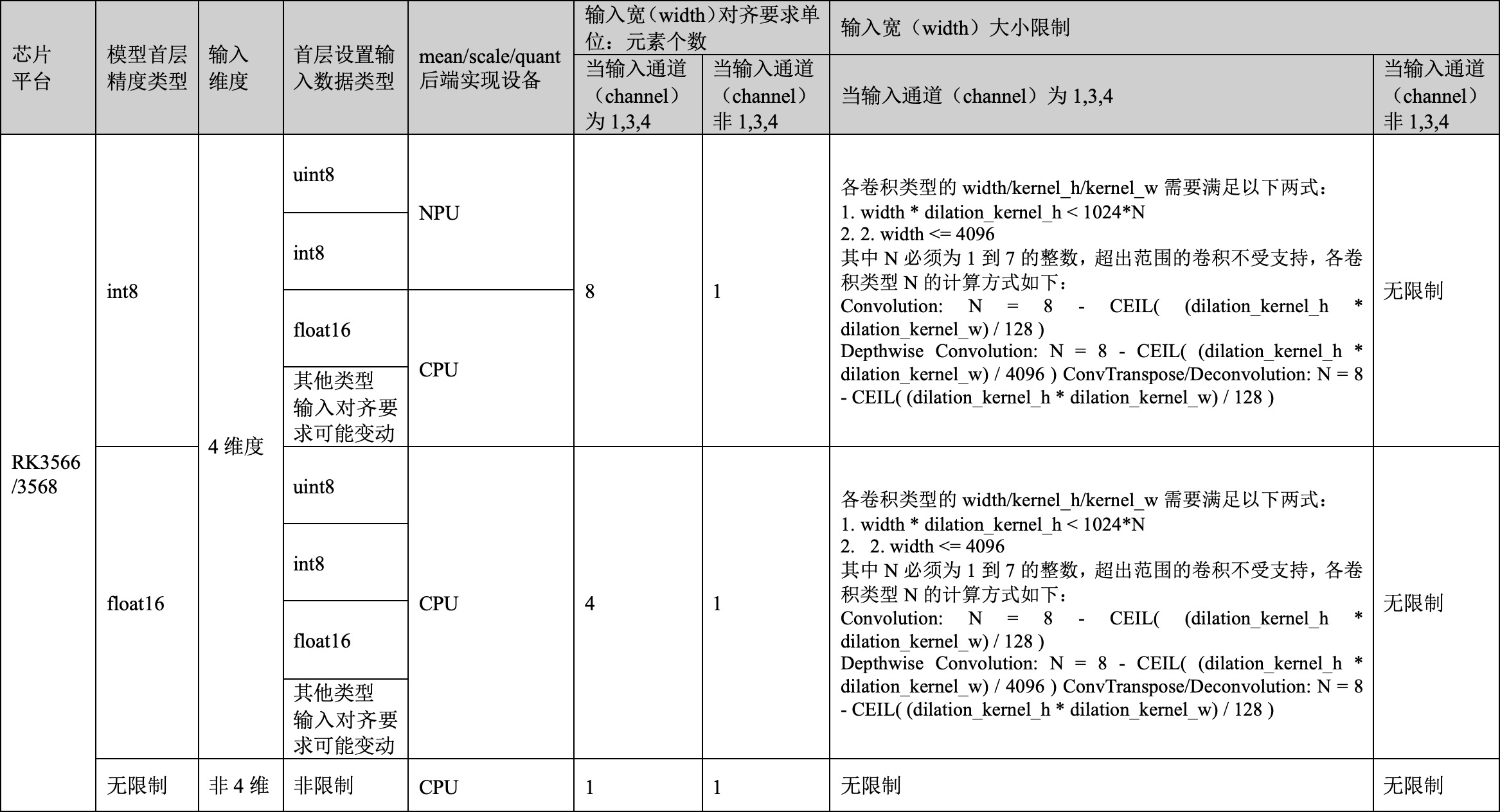
Editable transcription of the original (merged cells expanded):
| Platform | First-layer precision | Input dimensions | Configured first-layer input type | mean/scale/quant backend | width alignment (elements), channel=1,3,4 | width alignment (elements), channel≠1,3,4 | width limits, channel=1,3,4 | width limits, channel≠1,3,4 |
|---|---|---|---|---|---|---|---|---|
| RK3566/RK3568 | int8 | 4 | uint8 | NPU | 8 | 1 | A | Unrestricted |
| RK3566/RK3568 | int8 | 4 | int8 | NPU | 8 | 1 | A | Unrestricted |
| RK3566/RK3568 | int8 | 4 | float16 | CPU | 8 | 1 | A | Unrestricted |
| RK3566/RK3568 | int8 | 4 | Other types (input alignment may change) | CPU | 8 | 1 | A | Unrestricted |
| RK3566/RK3568 | float16 | 4 | uint8 | CPU | 4 | 1 | B | Unrestricted |
| RK3566/RK3568 | float16 | 4 | int8 | CPU | 4 | 1 | B | Unrestricted |
| RK3566/RK3568 | float16 | 4 | float16 | CPU | 4 | 1 | B | Unrestricted |
| RK3566/RK3568 | float16 | 4 | Other types (input alignment may change) | CPU | 4 | 1 | B | Unrestricted |
| RK3566/RK3568 | Unrestricted | Not 4-dimensional | Unrestricted | CPU | 1 | 1 | Unrestricted | Unrestricted |
For each convolution type, width/kernel_h/kernel_w must satisfy both conditions below. N must be an integer from 1 to 7; convolutions outside that range are unsupported. N is computed below. The image spells dilation_kernel_h/w differently from dilated_kernel_h/w in the last chapter; the image spelling is preserved.
| Condition | Formula |
|---|---|
| A (1) | width * dilation_kernel_h < 1024 * N |
| A (2) | width <= 4096 |
| A / Convolution | N = 8 - CEIL((dilation_kernel_h * dilation_kernel_w) / 128) |
| A / Depthwise Convolution | N = 8 - CEIL((dilation_kernel_h * dilation_kernel_w) / 4096) |
| A / ConvTranspose/Deconvolution | N = 8 - CEIL((dilation_kernel_h * dilation_kernel_w) / 128) |
| Condition | Formula |
|---|---|
| B (1) | width * dilation_kernel_h < 1024 * N |
| B (2) | width <= 4096 |
| B / Convolution | N = 8 - CEIL((dilation_kernel_h * dilation_kernel_w) / 128) |
| B / Depthwise Convolution | N = 8 - CEIL((dilation_kernel_h * dilation_kernel_w) / 4096) |
| B / ConvTranspose/Deconvolution | N = 8 - CEIL((dilation_kernel_h * dilation_kernel_w) / 128) |
5.1.2 RK3588
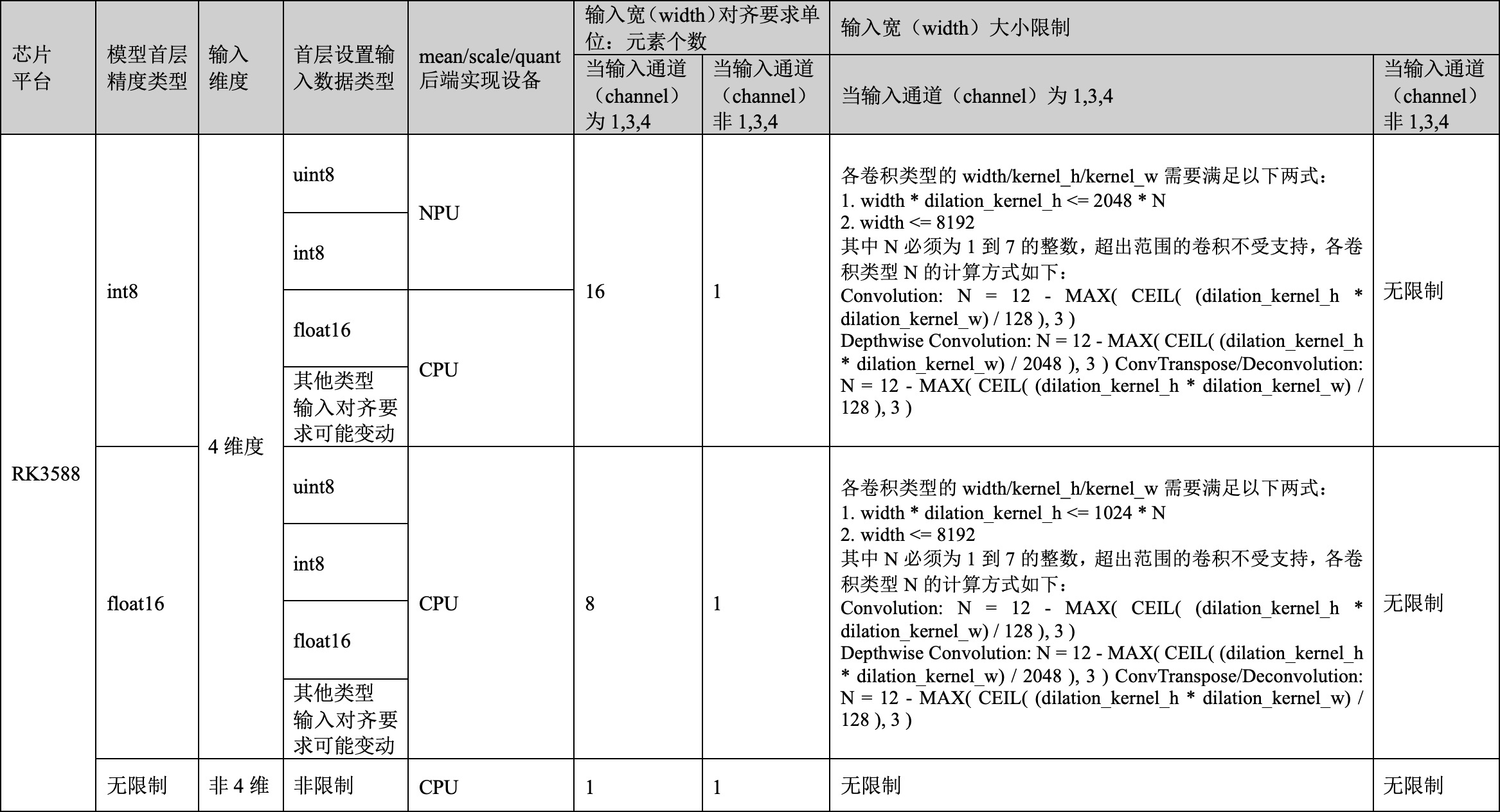
Editable transcription of the original (merged cells expanded):
| Platform | First-layer precision | Input dimensions | Configured first-layer input type | mean/scale/quant backend | width alignment (elements), channel=1,3,4 | width alignment (elements), channel≠1,3,4 | width limits, channel=1,3,4 | width limits, channel≠1,3,4 |
|---|---|---|---|---|---|---|---|---|
| RK3588 | int8 | 4 | uint8 | NPU | 16 | 1 | A | Unrestricted |
| RK3588 | int8 | 4 | int8 | NPU | 16 | 1 | A | Unrestricted |
| RK3588 | int8 | 4 | float16 | CPU | 16 | 1 | A | Unrestricted |
| RK3588 | int8 | 4 | Other types (input alignment may change) | CPU | 16 | 1 | A | Unrestricted |
| RK3588 | float16 | 4 | uint8 | CPU | 8 | 1 | B | Unrestricted |
| RK3588 | float16 | 4 | int8 | CPU | 8 | 1 | B | Unrestricted |
| RK3588 | float16 | 4 | float16 | CPU | 8 | 1 | B | Unrestricted |
| RK3588 | float16 | 4 | Other types (input alignment may change) | CPU | 8 | 1 | B | Unrestricted |
| RK3588 | Unrestricted | Not 4-dimensional | Unrestricted | CPU | 1 | 1 | Unrestricted | Unrestricted |
For each convolution type, width/kernel_h/kernel_w must satisfy both conditions below. N must be an integer from 1 to 7; convolutions outside that range are unsupported. N is computed below. The image spells dilation_kernel_h/w differently from dilated_kernel_h/w in the last chapter; the image spelling is preserved.
| Condition | Formula |
|---|---|
| A (1) | width * dilation_kernel_h <= 2048 * N |
| A (2) | width <= 8192 |
| A / Convolution | N = 12 - MAX(CEIL((dilation_kernel_h * dilation_kernel_w) / 128), 3) |
| A / Depthwise Convolution | N = 12 - MAX(CEIL((dilation_kernel_h * dilation_kernel_w) / 2048), 3) |
| A / ConvTranspose/Deconvolution | N = 12 - MAX(CEIL((dilation_kernel_h * dilation_kernel_w) / 128), 3) |
| Condition | Formula |
|---|---|
| B (1) | width * dilation_kernel_h <= 1024 * N |
| B (2) | width <= 8192 |
| B / Convolution | N = 12 - MAX(CEIL((dilation_kernel_h * dilation_kernel_w) / 128), 3) |
| B / Depthwise Convolution | N = 12 - MAX(CEIL((dilation_kernel_h * dilation_kernel_w) / 2048), 3) |
| B / ConvTranspose/Deconvolution | N = 12 - MAX(CEIL((dilation_kernel_h * dilation_kernel_w) / 128), 3) |
5.1.3 RV1103/RV1106
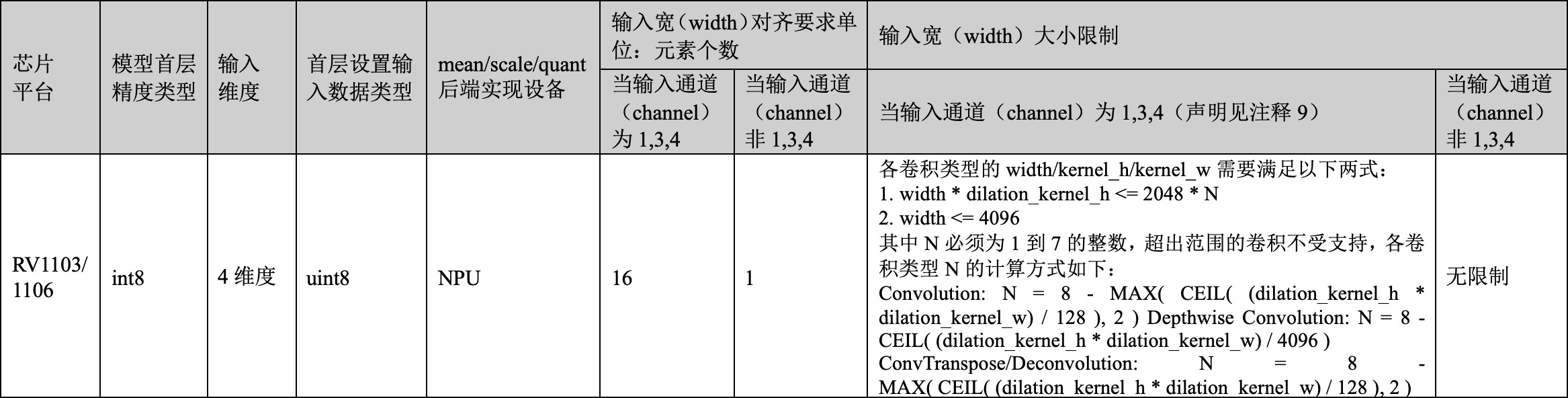
Editable transcription of the original (merged cells expanded):
| Platform | First-layer precision | Input dimensions | Configured first-layer input type | mean/scale/quant backend | width alignment (elements), channel=1,3,4 | width alignment (elements), channel≠1,3,4 | width limits, channel=1,3,4 | width limits, channel≠1,3,4 |
|---|---|---|---|---|---|---|---|---|
| RV1103/RV1106 | int8 | 4 | uint8 | NPU | 16 | 1 | A | Unrestricted |
For each convolution type, width/kernel_h/kernel_w must satisfy both conditions below. N must be an integer from 1 to 7; convolutions outside that range are unsupported. N is computed below. The image spells dilation_kernel_h/w differently from dilated_kernel_h/w in the last chapter; the image spelling is preserved.
| Condition | Formula |
|---|---|
| A (1) | width * dilation_kernel_h <= 2048 * N |
| A (2) | width <= 4096 |
| A / Convolution | N = 8 - MAX(CEIL((dilation_kernel_h * dilation_kernel_w) / 128), 2) |
| A / Depthwise Convolution | N = 8 - CEIL((dilation_kernel_h * dilation_kernel_w) / 4096) |
| A / ConvTranspose/Deconvolution | N = 8 - MAX(CEIL((dilation_kernel_h * dilation_kernel_w) / 128), 2) |
The original header refers to note 9, but the supplied input notes list only 1–8. Note 9 was not found and is not invented.
5.1.4 RK3562
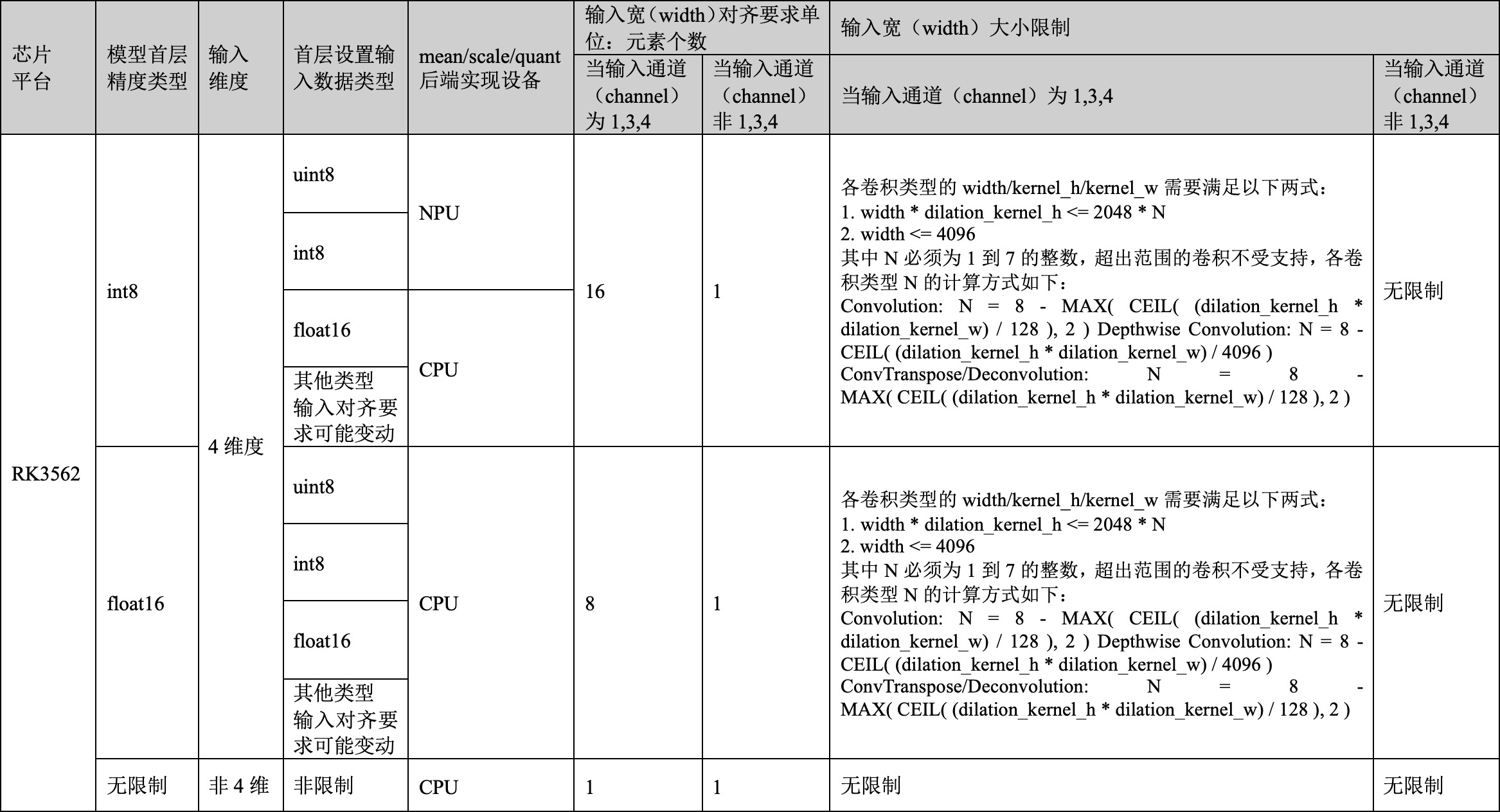
Editable transcription of the original (merged cells expanded):
| Platform | First-layer precision | Input dimensions | Configured first-layer input type | mean/scale/quant backend | width alignment (elements), channel=1,3,4 | width alignment (elements), channel≠1,3,4 | width limits, channel=1,3,4 | width limits, channel≠1,3,4 |
|---|---|---|---|---|---|---|---|---|
| RK3562 | int8 | 4 | uint8 | NPU | 16 | 1 | A | Unrestricted |
| RK3562 | int8 | 4 | int8 | NPU | 16 | 1 | A | Unrestricted |
| RK3562 | int8 | 4 | float16 | CPU | 16 | 1 | A | Unrestricted |
| RK3562 | int8 | 4 | Other types (input alignment may change) | CPU | 16 | 1 | A | Unrestricted |
| RK3562 | float16 | 4 | uint8 | CPU | 8 | 1 | B | Unrestricted |
| RK3562 | float16 | 4 | int8 | CPU | 8 | 1 | B | Unrestricted |
| RK3562 | float16 | 4 | float16 | CPU | 8 | 1 | B | Unrestricted |
| RK3562 | float16 | 4 | Other types (input alignment may change) | CPU | 8 | 1 | B | Unrestricted |
| RK3562 | Unrestricted | Not 4-dimensional | Unrestricted | CPU | 1 | 1 | Unrestricted | Unrestricted |
For each convolution type, width/kernel_h/kernel_w must satisfy both conditions below. N must be an integer from 1 to 7; convolutions outside that range are unsupported. N is computed below. The image spells dilation_kernel_h/w differently from dilated_kernel_h/w in the last chapter; the image spelling is preserved.
| Condition | Formula |
|---|---|
| A (1) | width * dilation_kernel_h <= 2048 * N |
| A (2) | width <= 4096 |
| A / Convolution | N = 8 - MAX(CEIL((dilation_kernel_h * dilation_kernel_w) / 128), 2) |
| A / Depthwise Convolution | N = 8 - CEIL((dilation_kernel_h * dilation_kernel_w) / 4096) |
| A / ConvTranspose/Deconvolution | N = 8 - MAX(CEIL((dilation_kernel_h * dilation_kernel_w) / 128), 2) |
| Condition | Formula |
|---|---|
| B (1) | width * dilation_kernel_h <= 2048 * N |
| B (2) | width <= 4096 |
| B / Convolution | N = 8 - MAX(CEIL((dilation_kernel_h * dilation_kernel_w) / 128), 2) |
| B / Depthwise Convolution | N = 8 - CEIL((dilation_kernel_h * dilation_kernel_w) / 4096) |
| B / ConvTranspose/Deconvolution | N = 8 - MAX(CEIL((dilation_kernel_h * dilation_kernel_w) / 128), 2) |
5.1.5 RK3576/RV1126B
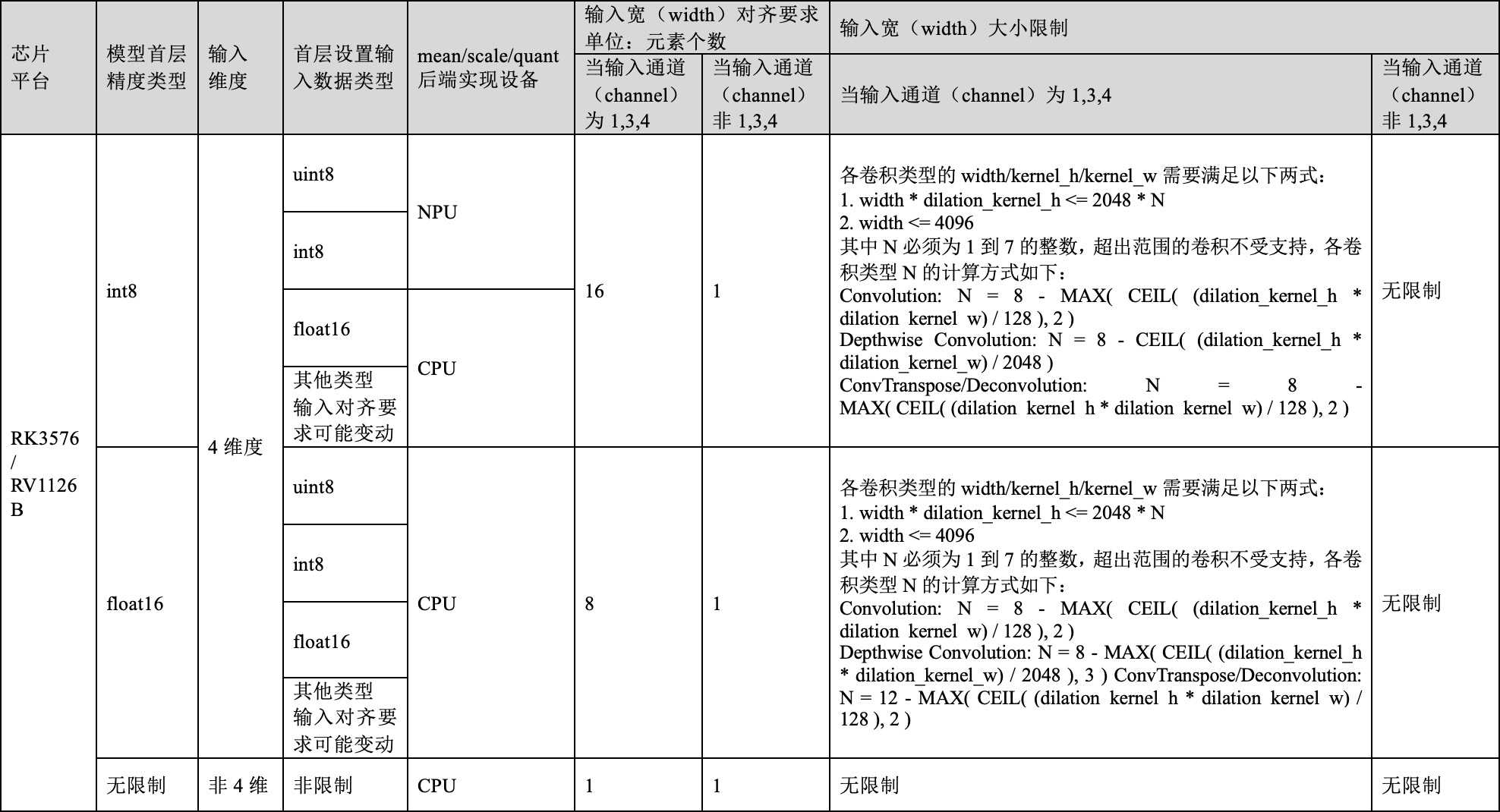
Editable transcription of the original (merged cells expanded):
| Platform | First-layer precision | Input dimensions | Configured first-layer input type | mean/scale/quant backend | width alignment (elements), channel=1,3,4 | width alignment (elements), channel≠1,3,4 | width limits, channel=1,3,4 | width limits, channel≠1,3,4 |
|---|---|---|---|---|---|---|---|---|
| RK3576/RV1126B | int8 | 4 | uint8 | NPU | 16 | 1 | A | Unrestricted |
| RK3576/RV1126B | int8 | 4 | int8 | NPU | 16 | 1 | A | Unrestricted |
| RK3576/RV1126B | int8 | 4 | float16 | CPU | 16 | 1 | A | Unrestricted |
| RK3576/RV1126B | int8 | 4 | Other types (input alignment may change) | CPU | 16 | 1 | A | Unrestricted |
| RK3576/RV1126B | float16 | 4 | uint8 | CPU | 8 | 1 | B | Unrestricted |
| RK3576/RV1126B | float16 | 4 | int8 | CPU | 8 | 1 | B | Unrestricted |
| RK3576/RV1126B | float16 | 4 | float16 | CPU | 8 | 1 | B | Unrestricted |
| RK3576/RV1126B | float16 | 4 | Other types (input alignment may change) | CPU | 8 | 1 | B | Unrestricted |
| RK3576/RV1126B | Unrestricted | Not 4-dimensional | Unrestricted | CPU | 1 | 1 | Unrestricted | Unrestricted |
For each convolution type, width/kernel_h/kernel_w must satisfy both conditions below. N must be an integer from 1 to 7; convolutions outside that range are unsupported. N is computed below. The image spells dilation_kernel_h/w differently from dilated_kernel_h/w in the last chapter; the image spelling is preserved.
| Condition | Formula |
|---|---|
| A (1) | width * dilation_kernel_h <= 2048 * N |
| A (2) | width <= 4096 |
| A / Convolution | N = 8 - MAX(CEIL((dilation_kernel_h * dilation_kernel_w) / 128), 2) |
| A / Depthwise Convolution | N = 8 - CEIL((dilation_kernel_h * dilation_kernel_w) / 2048) |
| A / ConvTranspose/Deconvolution | N = 8 - MAX(CEIL((dilation_kernel_h * dilation_kernel_w) / 128), 2) |
| Condition | Formula |
|---|---|
| B (1) | width * dilation_kernel_h <= 2048 * N |
| B (2) | width <= 4096 |
| B / Convolution | N = 8 - MAX(CEIL((dilation_kernel_h * dilation_kernel_w) / 128), 2) |
| B / Depthwise Convolution | N = 8 - MAX(CEIL((dilation_kernel_h * dilation_kernel_w) / 2048), 3) |
| B / ConvTranspose/Deconvolution | N = 12 - MAX(CEIL((dilation_kernel_h * dilation_kernel_w) / 128), 2) |
5.1.6 RK2118
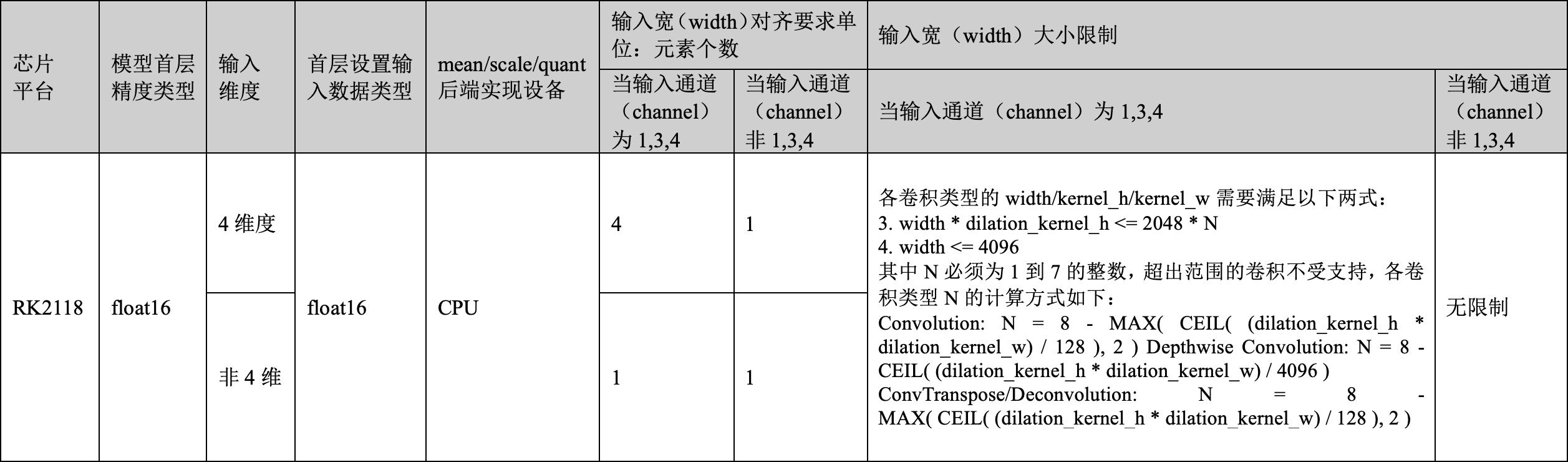
Editable transcription of the original (merged cells expanded):
| Platform | First-layer precision | Input dimensions | Configured first-layer input type | mean/scale/quant backend | width alignment (elements), channel=1,3,4 | width alignment (elements), channel≠1,3,4 | width limits, channel=1,3,4 | width limits, channel≠1,3,4 |
|---|---|---|---|---|---|---|---|---|
| RK2118 | float16 | 4 | float16 | CPU | 4 | 1 | A | Unrestricted |
| RK2118 | float16 | Not 4-dimensional | float16 | CPU | 1 | 1 | A | Unrestricted |
For each convolution type, width/kernel_h/kernel_w must satisfy both conditions below. N must be an integer from 1 to 7; convolutions outside that range are unsupported. N is computed below. The image spells dilation_kernel_h/w differently from dilated_kernel_h/w in the last chapter; the image spelling is preserved.
| Condition | Formula |
|---|---|
| A (1) | width * dilation_kernel_h <= 2048 * N |
| A (2) | width <= 4096 |
| A / Convolution | N = 8 - MAX(CEIL((dilation_kernel_h * dilation_kernel_w) / 128), 2) |
| A / Depthwise Convolution | N = 8 - CEIL((dilation_kernel_h * dilation_kernel_w) / 4096) |
| A / ConvTranspose/Deconvolution | N = 8 - MAX(CEIL((dilation_kernel_h * dilation_kernel_w) / 128), 2) |
5.1.7 RV1103B
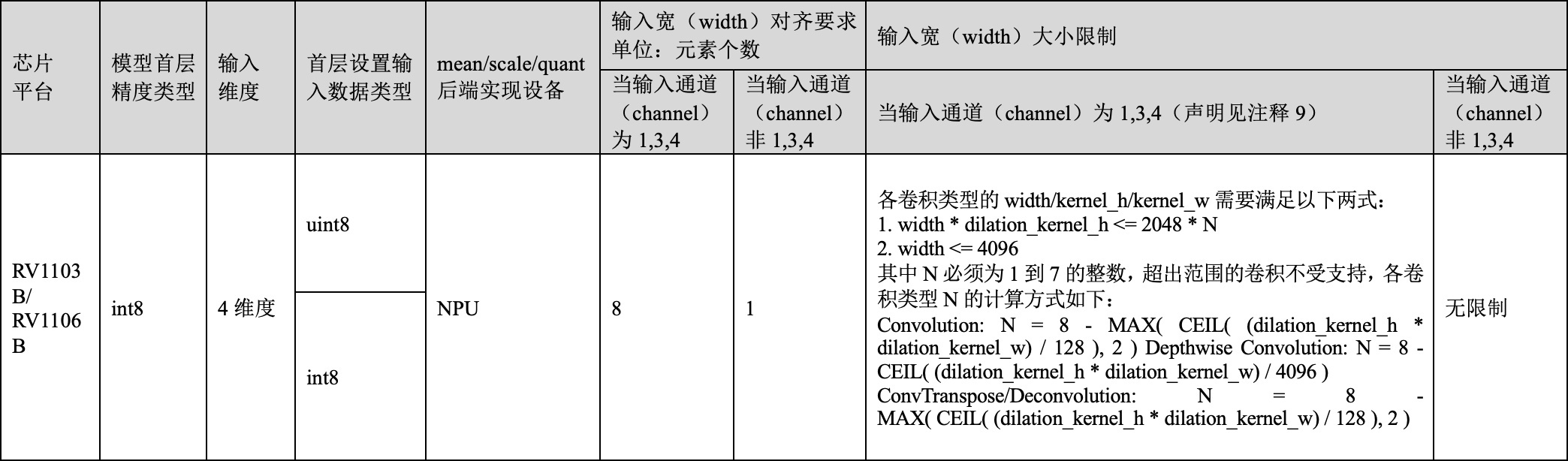
Editable transcription of the original (merged cells expanded):
| Platform | First-layer precision | Input dimensions | Configured first-layer input type | mean/scale/quant backend | width alignment (elements), channel=1,3,4 | width alignment (elements), channel≠1,3,4 | width limits, channel=1,3,4 | width limits, channel≠1,3,4 |
|---|---|---|---|---|---|---|---|---|
| RV1103B/RV1106B | int8 | 4 | uint8 | NPU | 8 | 1 | A | Unrestricted |
| RV1103B/RV1106B | int8 | 4 | int8 | NPU | 8 | 1 | A | Unrestricted |
For each convolution type, width/kernel_h/kernel_w must satisfy both conditions below. N must be an integer from 1 to 7; convolutions outside that range are unsupported. N is computed below. The image spells dilation_kernel_h/w differently from dilated_kernel_h/w in the last chapter; the image spelling is preserved.
| Condition | Formula |
|---|---|
| A (1) | width * dilation_kernel_h <= 2048 * N |
| A (2) | width <= 4096 |
| A / Convolution | N = 8 - MAX(CEIL((dilation_kernel_h * dilation_kernel_w) / 128), 2) |
| A / Depthwise Convolution | N = 8 - CEIL((dilation_kernel_h * dilation_kernel_w) / 4096) |
| A / ConvTranspose/Deconvolution | N = 8 - MAX(CEIL((dilation_kernel_h * dilation_kernel_w) / 128), 2) |
The original header refers to note 9, but the supplied input notes list only 1–8. Note 9 was not found and is not invented.
5.2 Model output restrictions
- (1) For an NHWC output tensor, alignment is required when output conversion is performed by the NPU; CPU conversion has no alignment requirement.
- (2) Output precision int8/float16 denotes the original output data type of the model’s last layer.
- (3) For NCHW output implemented on the NPU using a zero-copy interface, allocate output memory according to the queried size.
- (4) For NC1HWC2 output, allocate output memory according to the queried size.
5.2.1 RK3566/RK3568
| Chip platform | Model output precision | Output dimensions | Output Layout setting | Channel alignment requirement | H*W alignment requirement |
|---|---|---|---|---|---|
| RK3566 /RK3568 |
int8 | 4 dimensions | NCHW | None | None |
| RK3566 /RK3568 |
int8 | 4 dimensions | NHWC | Aligned to 8 | None |
| RK3566 /RK3568 |
int8 | 4 dimensions | NC1HWC2 | Last layer convolution-type: aligned to 16; last layer non-convolution-type: aligned to 8. | H*W aligned to 4 |
| RK3566 /RK3568 |
int8 | 4 dimensions | UNDEFINE | None | None |
| RK3566 /RK3568 |
float16 | 4 dimensions | NCHW | None | None |
| RK3566 /RK3568 |
float16 | 4 dimensions | NHWC | Aligned to 4 | |
| RK3566 /RK3568 |
float16 | 4 dimensions | NC1HWC2 | Last layer convolution-type: aligned to 8; last layer non-convolution-type: aligned to 4. | H*W aligned to 4 |
| RK3566 /RK3568 |
float16 | 4 dimensions | UNDEFINE | None | None |
| RK3566 /RK3568 |
Unrestricted | Not 4 dimensions | UNDEFINE | None | None |
5.2.2 RK3588
| Chip platform | Model output precision | Output dimensions | Output Layout setting | Channel alignment requirement | H*W alignment requirement |
|---|---|---|---|---|---|
| RK3588 | int8 | 4 dimensions | NCHW | None | None |
| RK3588 | int8 | 4 dimensions | NHWC | Aligned to 16 | None |
| RK3588 | int8 | 4 dimensions | NC1HWC2 | Last layer convolution-type: aligned to 32; last layer non-convolution-type: aligned to 16. | H*W aligned to 4 |
| RK3588 | int8 | 4 dimensions | UNDEFINE | None | None |
| RK3588 | float16 | 4 dimensions | NCHW | None | None |
| RK3588 | float16 | 4 dimensions | NHWC | Aligned to 8 | None |
| RK3588 | float16 | 4 dimensions | NC1HWC2 | Last layer convolution-type: aligned to 16; last layer non-convolution-type: aligned to 8. | H*W aligned to 4 |
| RK3588 | float16 | 4 dimensions | UNDEFINE | None | None |
| RK3588 | Unrestricted | Not 4 dimensions | UNDEFINE | None | None |
5.2.3 RV1103/RV1106
| Chip platform | Model output precision | Output dimensions | Output Layout setting | Channel alignment requirement | H*W alignment requirement |
|---|---|---|---|---|---|
| RV1103 /RV1106 |
int8 | 4 dimensions | NC1HWC2 | Last layer convolution-type: aligned to 32; last layer non-convolution-type: aligned to 16. | H*W aligned to 4 |
| RV1103 /RV1106 |
int8 | 4 dimensions | NHWC | None | None |
5.2.4 RK3562
| Chip platform | Model output precision | Output dimensions | Output Layout setting | Channel alignment requirement | H*W alignment requirement |
|---|---|---|---|---|---|
| RK3562 | int8 | 4 dimensions | NCHW | None | None |
| RK3562 | int8 | 4 dimensions | NHWC | None | None |
| RK3562 | int8 | 4 dimensions | NC1HWC2 | Last layer convolution-type: aligned to 32; last layer non-convolution-type: aligned to 16. | H*W aligned to 4 |
| RK3562 | int8 | 4 dimensions | UNDEFINE | None | None |
| RK3562 | float16 | 4 dimensions | NCHW | None | None |
| RK3562 | float16 | 4 dimensions | NHWC | None | None |
| RK3562 | float16 | 4 dimensions | NC1HWC2 | Last layer convolution-type: aligned to 16; last layer non-convolution-type: aligned to 8. | H*W aligned to 4 |
| RK3562 | float16 | 4 dimensions | UNDEFINE | None | None |
| RK3562 | Unrestricted | Not 4 dimensions | UNDEFINE | None | None |
5.2.5 RK3576/RV1126B
| Chip platform | Model output precision | Output dimensions | Output Layout setting | Channel alignment requirement | H*W alignment requirement |
|---|---|---|---|---|---|
| RK3576/ RV1126B |
int8 | 4 dimensions | NCHW | None | None |
| RK3576/ RV1126B |
int8 | 4 dimensions | NHWC | None | None |
| RK3576/ RV1126B |
int8 | 4 dimensions | NC1HWC2 | Last layer convolution-type: aligned to 32; last layer non-convolution-type: aligned to 16. | H*W aligned to 4 |
| RK3576/ RV1126B |
int8 | 4 dimensions | UNDEFINE | None | None |
| RK3576/ RV1126B |
float16 | 4 dimensions | NCHW | None | None |
| RK3576/ RV1126B |
float16 | 4 dimensions | NHWC | None | None |
| RK3576/ RV1126B |
float16 | 4 dimensions | NC1HWC2 | Last layer convolution-type: aligned to 16; last layer non-convolution-type: aligned to 8. | H*W aligned to 4 |
| RK3576/ RV1126B |
float16 | 4 dimensions | UNDEFINE | None | None |
| RK3576/ RV1126B |
Unrestricted | Not 4 dimensions | UNDEFINE | None | None |
5.2.6 RK2118
| Chip platform | Model output precision | Output dimensions | Output Layout setting | Channel alignment requirement | H*W alignment requirement |
|---|---|---|---|---|---|
| RK2118 | float16 | 4 dimensions | NC1HWC2 | Last layer convolution-type: aligned to 8; last layer non-convolution-type: aligned to 4. | H*W aligned to 4 |
| RK2118 | float16 | 4 dimensions | NHWC | None | None |
| RK2118 | float16 | Not 4 dimensions | UNDEFINE | None | None |
5.2.7 RV1103B/RV1106B
| Chip platform | Model output precision | Output dimensions | Output Layout setting | Channel alignment requirement | H*W alignment requirement |
|---|---|---|---|---|---|
| RV1103B/ RV1106B |
int8 | 4 dimensions | NC1HWC2 | Last layer convolution-type: aligned to 8; last layer non-convolution-type: aligned to 8. | H*W aligned to 4 |
| RV1103B/ RV1106B |
int8 | 4 dimensions | NHWC | None | None |
Special notes
Contents
- Special notes
- dilated_kernel_h
- dilated_kernel_w
6.1 dilated_kernel_h
dilated_kernel_h=kernel_h*dilations_h‑dilations_h+1
6.2 dilated_kernel_w
dilated_kernel_w=kernel_w*dilations_w‑dilations_w+1