
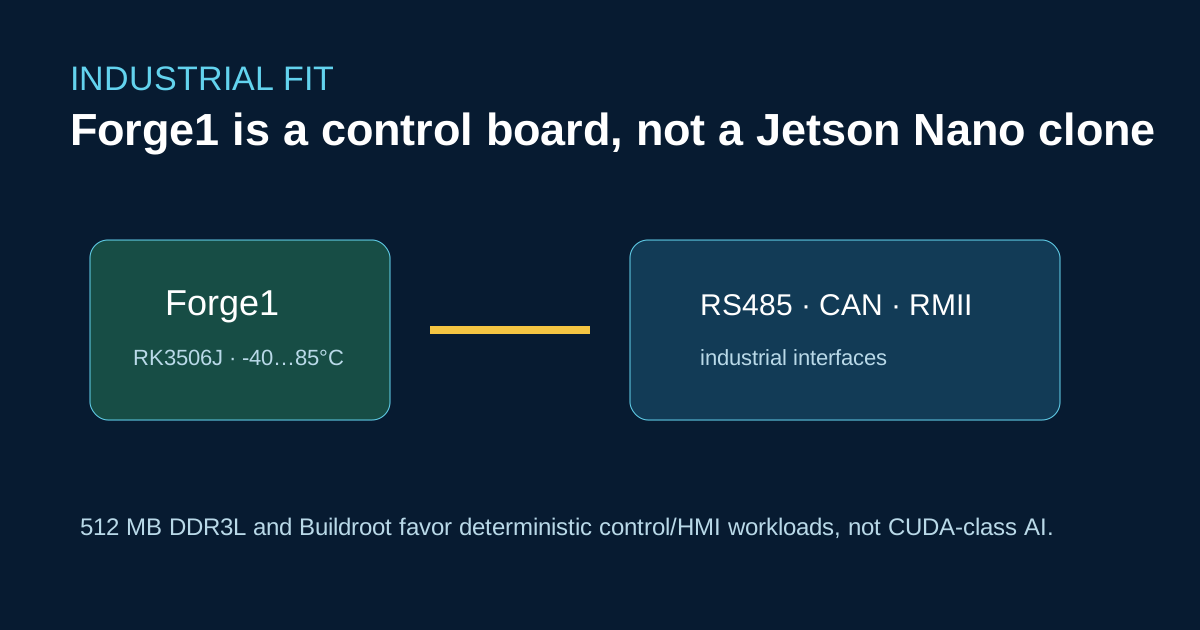
Forge1 is an industrial board built around the RK3506J triple-core Cortex-A7, 512 MB DDR3L, dual 100 Mb Ethernet and interfaces such as RS485 and CAN. It is designed for gateways, HMI, PLC and appliance control—not for matching Jetson Nano CUDA workloads.
A useful fit test
Choose Forge1 when temperature range, fieldbus wiring and deterministic UI/control matter more than GPU/NPU throughput. The documented -40 °C to 85 °C operating range and Buildroot focus are valuable constraints, not disadvantages to hide.
ip -details link show can0
ip link set can0 type can bitrate 1000000 dbitrate 3000000 fd on
ip link set can0 up
candump can0
Validate bus termination, isolation and watchdog behavior with the final harness. A Raspberry Pi 40-pin accessory may fit mechanically, but voltage, pin mux and software support still need review.
Migration boundary
Porting a Python GPIO application is usually cheaper than porting a Jetson CUDA stack. Budget for Buildroot package integration, field update design and industrial validation rather than advertising Forge1 as a universal replacement.
References
Pre-publication check
- State temperature, memory and interface limits.
- Include CAN/RS485 electrical validation.
- Separate control determinism from AI performance claims.