Choose a Rockchip platform by the complete model, video and interface pipeline, then compare CPU specifications or TOPS. For ArmSoM projects, RK3588 platforms are useful candidates for demanding multimedia and expansion; RK3576 platforms merit evaluation for compact computing and embedded AI. RK3572 requires a separate check of its newer NPU stack and the intended board’s availability.
This article turns the supplied nine-chip comparison into an engineering selection guide. Silicon specifications are not promises about ArmSoM board features. No third-party measurements are presented as our tests, and process node, power consumption, clock rates, availability and lifecycle are not inferred from model numbers.
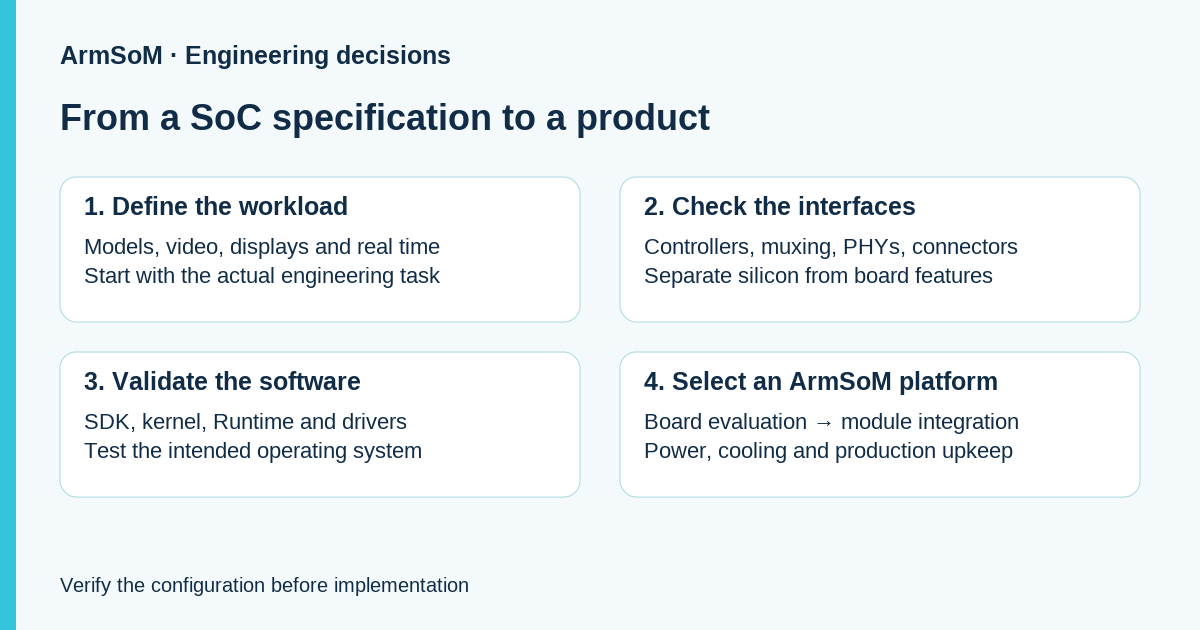
1. Narrow the list with CPU and accelerator requirements
| SoC | CPU | GPU family | Stated NPU rating |
|---|---|---|---|
| RK3588 | 4 × Cortex-A76 + 4 × Cortex-A55 | Mali-G610 | 6 TOPS |
| RK3576 | 4 × Cortex-A72 + 4 × Cortex-A53 | Mali-G52 | 6 TOPS* |
| RK3572 | 2 × Cortex-A73 + 6 × Cortex-A53 | Mali-G310 | 4 TOPS* |
| RK3562 | 4 × Cortex-A53 | Mali-G52 | 1 TOPS |
| RK3568 | 4 × Cortex-A55 | Mali-G52 | 1 TOPS |
| RK3566 | 4 × Cortex-A55 | Mali-G52 | 1 TOPS |
| RK3399 | 2 × Cortex-A72 + 4 × Cortex-A53 | Mali-T860 | — |
| RK3326 | 4 × Cortex-A35 | Mali-G31 | — |
| PX30 | 4 × Cortex-A35 | Mali-G31 | — |
The asterisk retains the supplied comparison’s sparse-compute qualification for RK3576 and RK3572. This is not an equal-conditions performance ranking. GPU families are listed without mixing API support from different driver releases. A dash means no dedicated NPU is listed for those models; it does not mean AI cannot run on their CPU or GPU.
The official RK3562 product page and RK3572 introduction provide basic platform references. Deployment still depends on operator coverage, quantization accuracy, memory use and end-to-end latency.
AI projects need more than a TOPS comparison
Fix the input resolution, model revision, quantization, batch size and target frame rate. Measure preprocessing, inference and postprocessing separately. Multi-camera systems also incur decoding, color conversion and memory-copy costs: a fast inference kernel does not prove a fast video pipeline.
The integrated NPUs in RK3588 and RK3576 use RKNN2; RK3572 uses RKNN3. An external RK182X accelerator introduces another deployment path. Conversion tools, model files and Runtime must match; see the ArmSoM RKNN2/RKNN3 guide.
2. Build a shortlist around application constraints
| Project | Candidates to evaluate | Required checks |
|---|---|---|
| Multiple vision streams, complex displays, substantial expansion | RK3588; Sige7, AIM7, LM7 | Codec and concurrency limits, storage throughput, cooling and carrier routing |
| Smart terminals, edge gateways, compact AI | RK3576; CM5, Sige5 | Model accuracy, exposed interfaces and target Android/Linux image |
| Cost/function balance on a newer platform | RK3572 | RKNN3 integration, BSP maturity, board and production plans |
| Gateways, control and established designs | RK3568 / RK3566 | Do not assume identical pins or interfaces |
| Simpler displays or embedded terminals | RK3562 | Native display interfaces; include bridge and driver cost if HDMI is required |
| Existing device upgrades and maintenance | RK3399 / RK3326 / PX30 | Software assets, memory pressure, security updates and actual supply |
This is a screening order, not a benchmark chart. A maintenance-oriented recommendation is not an end-of-life announcement. Redesign benefits must justify migration, certification and regression costs when an existing software platform works well.
3. Split a multimedia maximum into five questions
- Codec: H.264, H.265, VP9 and AV1 have different resolution, frame-rate and profile limits. A headline maximum does not apply to every format.
- Pixel format: Can bit depth, YUV420/422/444, stride and buffer layout pass correctly through ISP, RGA, MPP and display?
- Concurrency: Can the required cameras, encoder and displays operate together within bandwidth and display-resource limits?
- Physical connection: Check HDMI/eDP/DP combinations, MIPI lanes, Type-C multiplexing and actual connectors.
- Target OS: Validate Linux and Android drivers, userspace components, camera tuning and application frameworks separately.
The ArmSoM video-codec documentation can inform a test plan. Its presence does not establish that a particular simultaneous workload has passed.
4. Take memory, networking and storage down to board level
The silicon address limit is not a purchasable RAM option. Budget weights, activations, inputs, outputs, video buffers and operating-system headroom for inference. For NAS workloads, include sustained writes, networking, filesystem behavior and temperature.
| Common shortcut | What to establish instead |
|---|---|
| Two MACs mean two usable network ports | PHYs, interface modes, connectors, drivers and board-level speed |
| PCIe, SATA and USB counts can be added | Combo-PHY sharing, lane allocation and simultaneous-use restrictions |
| UFS support means a board can accept UFS | Pads, power, boot support and the actual BOM |
| A CAN controller connects directly to the bus | Transceivers, isolation, termination and device tree |
| A module automatically exposes every SoC interface | Module pinout, carrier routing, voltage levels and software |
For a module such as CM5, maintain separate module and carrier interface lists. For a complete Sige board, begin with its schematic and connectors. Never fill a specification gap using another chip’s features.
5. Keep a reviewable selection record
The supplied comparison lists these datasheet editions. They are the source author’s stated basis, not a claim that every listed edition was obtained and checked page by page here. Official briefs from other revisions serve as cross-checks, not silent replacements.
| Model | Edition listed in the supplied source |
|---|---|
| RK3588 | V1.8 · 20240821 |
| RK3576 | V1.3 · 20240826 |
| RK3572 | V1.0 · 20260324 |
| RK3562 | V2.0 · 20241104 |
| RK3568 / RK3568B2 | V2.1 · 20240621 |
| RK3566 | V1.4 · 20240621 |
| RK3399 | V1.8 · 20180529 |
| RK3326 | V1.4 · 20190110 |
| PX30 | V1.2 · 20190110 |
Record the complete chip suffix, board revision, RAM/storage configuration, schematic revision, SDK release, kernel commit, NPU Runtime, workload, results and unresolved items. In particular, retain distinctions between RK3568B2 and RK3568, and between RK3588 and RK3588S.
6. Move from a shortlist to an ArmSoM prototype
Validate a real business pipeline on a development board before selecting a module and carrier. Use your own data for vision, the target panel for display, and sustained traffic for storage. Include cold boot, power-loss recovery, long runs and upgrade regression rather than qualifying a design from one successful demo.
Write the conclusion as constraints met and gaps remaining, not a universal winning chip. References: the supplied nine-chip article, the official material linked above and the relevant ArmSoM documentation.
Products and further reading
Start an ArmSoM evaluation with the RK3588-based Sige7, AIM7 or LM7, or the RK3576-based CM5 and Sige5. Check interfaces and available images in the Sige7, CM5 and Sige5 documentation. These links support product selection; they do not certify every SDK combination discussed here.