
Choosing a single-board computer eventually comes down to practical questions: can it connect the required peripherals, run a suitable operating system and provide useful information when something goes wrong? Public discussion, clear documentation and working projects deserve attention alongside hardware specifications.
ArmSoM Sige7 brings RK3588 computing, networking and storage connections together on a compact board. This article uses community discussion as a starting point for planning a Linux project, with the existing ArmSoMNAS user story as a concrete example.
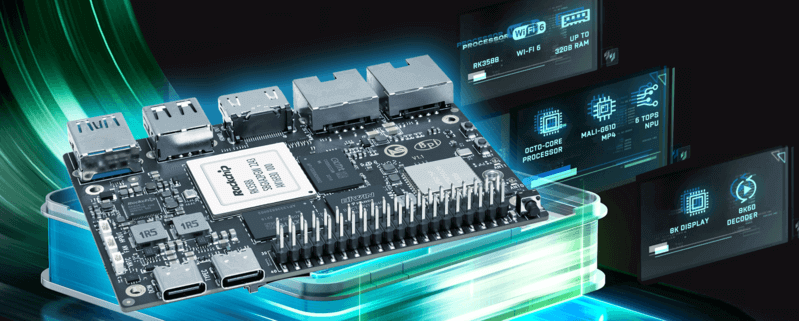
Official Sige7 product artwork. Check the documentation for your hardware revision and configuration.
A public record you can examine
Jeff Geerling opened Sige7’s testing thread in November 2024; ArmSoM/BPI supplied the sample. It remains marked “testing in progress”, with unfinished benchmarks and historical setup problems. User platima separately discusses Ubuntu/Frigate-rk and cooling. This is not Jeff’s endorsement. Read the original context.
Check the date, author and environment when reading such discussions. An early problem does not establish the state of a current release, while another user’s successful setup cannot prove every environment works. Use the record to shape your own evaluation rather than substitute for it.
What does Sige7 bring to a project?
The official specifications list an octa-core RK3588, an NPU rated up to 6 TOPS (INT8), memory configurations up to 32GB, dual 2.5GbE and M.2 PCIe 3.0 x4 NVMe expansion.
| Project direction | Available resources | First prototype checks |
|---|---|---|
| Network and storage services | Two wired network interfaces and NVMe expansion | Network topology, disk layout and actual storage workload |
| Edge vision | Application processor and supported NPU tools | Model compatibility, capture path and processing latency |
| Linux application prototypes | Memory, display and peripheral connections | Image support, dependencies and application recovery |
Interface rates and compute specifications help shortlist platforms. Application results still depend on the system, model, storage and cooling. Defining measurable requirements is generally more useful than comparing processor names alone.
A tangible example: ArmSoMNAS portable storage
Our published ArmSoMNAS user story shows a developer project combining Sige7 with dual NVMe expansion, a UPS, an OLED and a modular enclosure to build a portable network-storage prototype.
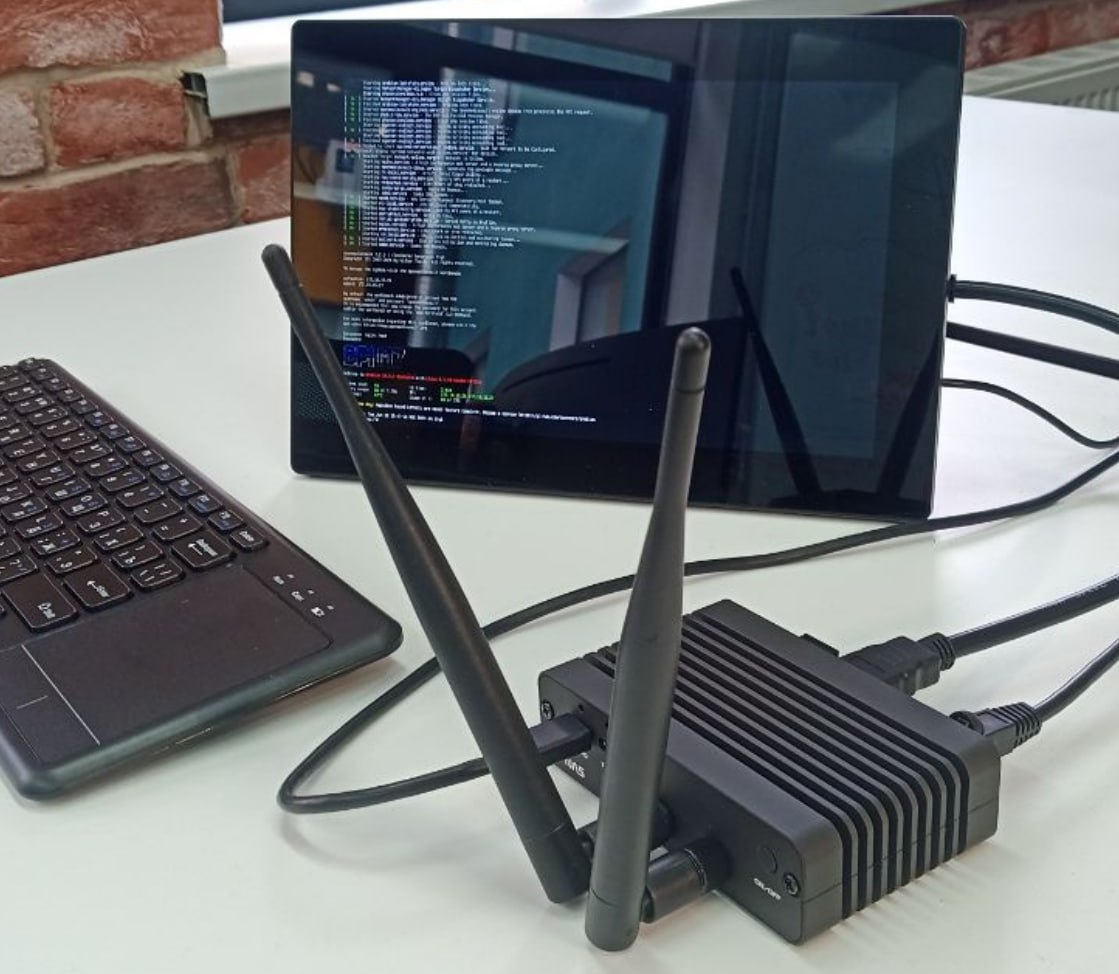
Photo from the published ArmSoMNAS user story. The expansion modules and enclosure belong to that project; they are not standard Sige7 accessories or Jeff’s test setup.
The useful lesson is how to break a complete device into parts that can be validated separately: board and storage first, then power, enclosure and usage. A dual-drive module needs its own topology and compatibility checks. A mobile device also needs power-loss handling, shutdown and recovery validation.
If you are planning a personal file server, field-data collection device or portable shared storage, use the design process as a reference before choosing capacity, redundancy and backups for your own requirements.
Read the complete ArmSoMNAS story
Two more directions to explore
Edge vision and local processing. Separate capture, inference and event recording. Establish a stable single input, validate the intended model and only then add recording and notifications. For multiple video streams, measure the entire pipeline rather than treating model inference speed as system throughput. The ArmSoM RKNN resources provide a starting point.
Linux services and application prototypes. Begin with one defined application, such as device-data collection, a development environment or a local service, then add peripherals incrementally. Record system versions and dependencies, and plan restart, recovery and remote maintenance. Select a suitable desktop environment for windowed applications; configure command-line services according to their needs.
These are project-planning suggestions. This article adds no hardware benchmarks or claims about camera counts, detection accuracy or service capacity.
Four steps towards a reproducible setup
- Identify the device and image. Record the board revision, memory, boot medium and full image filename. Start with the relevant resources in the Sige7 documentation.
- Follow the image’s writing instructions. Image formats may require different tools. Consult the flashing guide and back up the destination medium before writing.
- Validate a minimal system. Connect the necessary power, display or debugging interface; log in and check networking and storage before adding peripherals individually.
- Preserve the environment and reproduction steps. Record kernel and application versions, power supply, cooling and actions. Remove passwords, tokens and private addresses before sharing logs.
These records help teammates reproduce problems and compare releases. Any stability assessment should state its duration, workload and environmental conditions.
Define success with your own application
Give the prototype a few concrete acceptance criteria: repeatable cold boots, behavior under the target workload, recovery after service interruption, and temperature and power trends during sustained operation. Storage projects also need restore checks; vision projects need latency and accuracy measurements with real inputs.
You do not need to validate every feature at once. Build the smallest useful prototype, then expand it while keeping a record of working configurations.
Start your next project with Sige7
Public feedback provides leads, while practical projects turn interfaces and software into usable devices. Whether your goal is a compact NAS, edge vision or a Linux application, compare the available resources with your requirements and test a clearly defined prototype.
- Explore ArmSoM Sige7 and its configurations
- Open the Sige7 developer documentation
- Read the ArmSoMNAS user story
- Read the original community-user feedback
Share projects and reproducible feedback in the community forum. For product selection or collaboration, contact sales@armsom.org.
Sources checked on 12 November 2026. Prepared by ArmSoM Editorial; community statements belong to their respective authors and are not presented as independent certification or performance guarantees.