
ArmSoM platform reference, source RK-KF-YF-935 V1.4.0 for its RK3588 Linux SDK/EVB. Do not copy EVB partitions, GPIO, power or reset settings blindly to an ArmSoM board; verify the schematic, TRM and SDK/BSP. Kernel examples contain 5.10.66/5.10.84-1; no uniform SDK release is specified. No flashing, register writes or hardware tests were performed.
The paired main sources are 12 pages each, both V1.4.0; all five chapters and code are retained. The 10-page Chinese copy under RK3588/UEFI was compared and has the same technical content, so no duplicate article is created. ZH uses two Chinese-source figures; EN/RU/DE use two English-source figures. Source spellings mix boot_uef.img/boot_uefi.img and boot//u-boot/; these are retained pending verification, not silently guessed. Support statements such as UEFI+ACPI refer only to the source version.
1. Code Introduction
The RK3588 Linux SDK has integrated UEFI code. Please check whether there is a uefi directory in the SDK. The related directories are as follows:
- edk2-platforms/Silicon/Rockchip
├── Applications  //Test Demo and Tool
├── Drivers   //General driver
├── Include   //General header file
├── Library   //General library
├── RK3568   //is only for RK3568 IP driver, etc.
├── RK3588   //is only for RK3588 IP driver, etc.
├── Rockchip.dsc.inc   //General configuration
├── Rockchip.fdf.inc   //General configuration
└── RockchipPkg.dec    //General configuration
- edk2-platforms/Platform/Rockchip
├── DeviceTree
│   └── rk3588.dtb   // Device tree file, copied from
kernel/arch/arm64/boot/dts/rockchip/rk3588-evb1-lp4-v10-linux.dtb
├── RK3568
└── RK3588
    ├── AcpiTables
    ├── BootGraphicsResourceTableDxe
    ├── Include
    ├── Library
    ├── LogoDxe
    ├── RK3588.dec
    ├── RK3588.dsc
    ├── RK3588Dxe
    ├── RK3588.fdf
    └── RK3588GpioDxe
2. UEFI Compilation
RK3588 Linux SDK provides the following two compilation methods. Execute the script in the uefi directory:
./make.sh rk3588 #Build rk3588 by default
Or use the build.sh script in the SDK root directory:
./build.sh uefi
The environment variables of EDK2 have been configured in the script. During the compilation process, u-boot will be rebuilt. After the compilation, UEFI firmware: uboot_uefi.img and RK3588_NOR_FLASH.img will be generated in the current directory. Burn this file to the uboot partition. Please select uboot_uefi.img for the board booting from eMMC, and select RK3588_NOR_FLASH.img for the board booting from SPI Nor Flash. At present, RK3588 supports UEFI + DTB booting only, and does not support UEFI + ACPI booting mode. When build.sh uefi is compiling, the Kernel DTB file will be copied to the UEFI directory, so the Kernel compilation must be completed before compiling UEFI. If it is compiled with make.sh in the UEFI directory, you need to manually copy the dtb file to uefi/edk2-platforms/Platform/Rockchip/DeviceTree/rk3588.dtb:
$cp kernel/arch/arm64/boot/dts/rockchip/rk3588-evb1-lp4-v10-linux.dtb uefi/edk2-platforms/Platform/Rockchip/DeviceTree/rk3588.dtb
3. Burn
The ways to burn firmware for the board booting from eMMC and SPI Nor Flash are different: Booting from eMMC
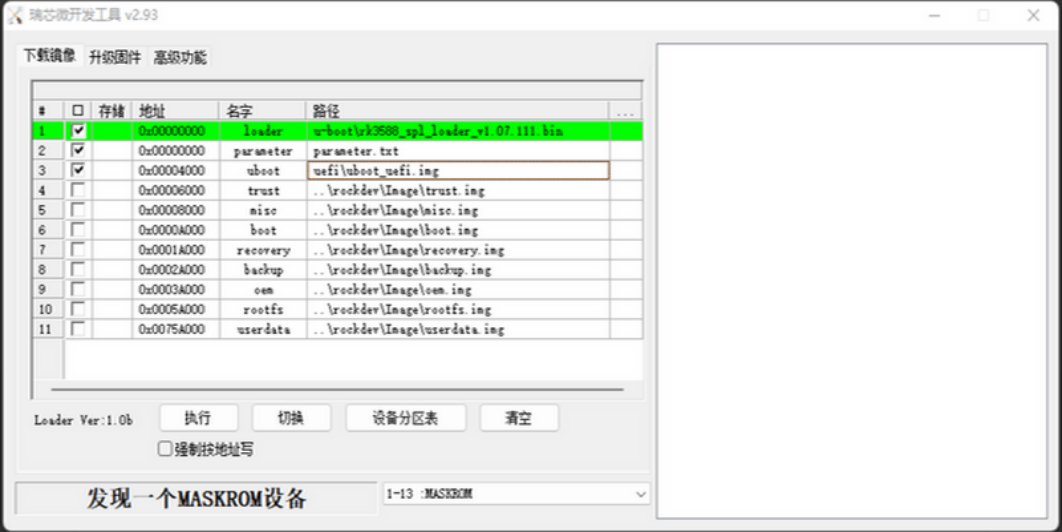
The board booting from eMMC requires a parameter file, so at least, the following 3 files are required to be burned:
u-boot/rk3588_spl_loader_v1.07.111.bin
parameter.txt
uefi/uboot_uefi.img
The address of uboot_uefi.img is determined by the start address of uboot partition in the parameter.txt file. The UEFI firmware burning address defined in the following parameter.txt is 0x4000, the size can not exceed 0x2000, with the unit 512 Byte.
FIRMWARE_VER: 1.0
MACHINE_MODEL: RK3588
MACHINE_ID: 007
MANUFACTURER: RK3588
MAGIC: 0x5041524B
ATAG: 0x00200800
MACHINE: 0xffffffff
CHECK_MASK: 0x80
PWR_HLD: 0,0,A,0,1
TYPE: GPT
CMDLINE: mtdparts=rk29xxnand:0x00002000@0x00004000(uboot),0x00002000@0x00006000(misc),0x00020000@0x00008000(boot),0x00040000@0x00028000(recovery),0x00010000@0x00068000(backup),0x01c00000@0x00078000(rootfs),0x00040000@0x01c78000(oem),-@0x01d18000(userdata:grow)
uuid:rootfs=614e0000-0000-4b53-8000-1d28000054a9
uuid:boot=7A3F0000-0000-446A-8000-702F00006273
Booting from SPI Nor Flash
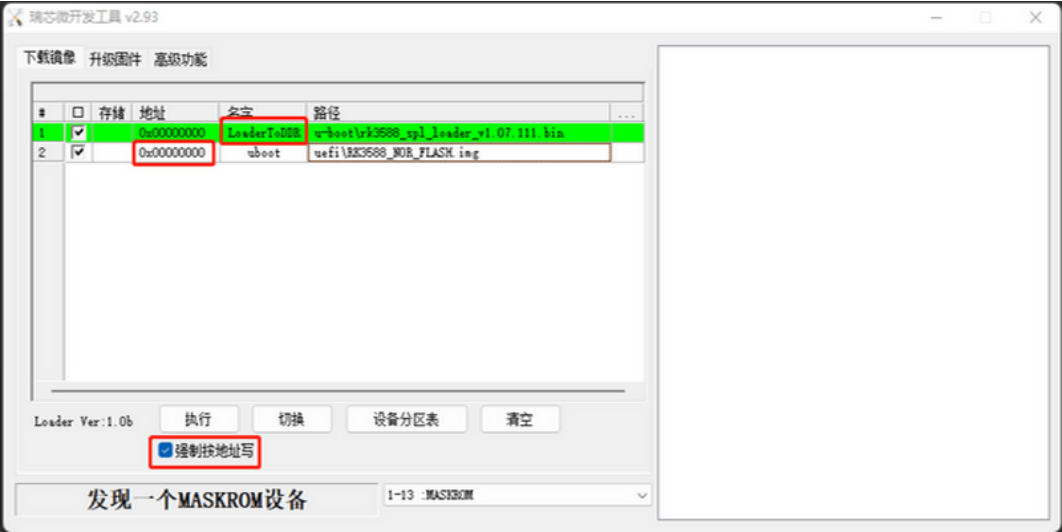
The way to burn firmware for SPI Nor Flash is different from eMMC, no parameter file is required:
boot/rk3588_spl_loader_v1.07.111.bin
uefi/RK3588_NOR_FLASH.img
Notice the red area in the picture above.
4. Booting
There are two ways to boot into the system: Android booting and Grub Booting, the following two booting modes will be introduced respectively.
4.1 Android Boot
The Android Boot mode is similar to RK3588 general Linux booting mode, the differences are: Replace the original uboot and boot with uboot_uefi.img and boot_uef.img, and keep other partitions unchanged; Add the UUID of the boot partition to the parameter. Run build.sh, kernel will build directly and generate boot_uefi.img for burning to the boot partition. The difference between boot_uefi.img and boot.img is that the second section packs dtb instead of resource.img.
4.1.1 Boot Partition Confirmation
The boot_uefi.img for UEFI booting requires GUID of GPT and other information to confirm the partition, so in addition to the general parameter file, the following line of information is required to specify the GUID of the boot partition:
uuid:boot=7A3F0000-0000-446A-8000-702F00006273
In addition, please confirm the offset and size of the boot partition. The detailed partition definition is the PcdAndroidBootDevicePath variable in uefi/edk2-platforms\Platform\Rockchip\RK3588\RK3588.dsc, please make sure that the UUID, offset, and size here should correspond to the parameter file one by one, otherwise UEFI will not find this partition, causing Android Boot to fail.
gEmbeddedTokenSpaceGuid.PcdAndroidBootDevicePath|L"VenHw(100C2CFA-B586-4198-9B4C-1683D195B1DA)/HD(3,GPT,7A3F0000-0000-446A-8000-702F00006273,0x8000,0x20000)"
In the above definition of PcdAndroidBootDevicePath, the UUID of the boot partition is 7A3F0000-0000-446A-8000-702F00006273, the offset is 0x8000, and the size is 0x20000. Through the map command of UEFI Shell, you can also see the whole partition table, and in which you will find the boot partition:
BLK3: Alias(s):
          VenHw(100C2CFA-B586-4198-9B4C-1683D195B1DA)/HD(3,GPT,7A3F0000-0000-446A-8000-702F00006273,0x8000,0x20000)
Note: Android Boot will check whether there is Android header information in the Boot partition. Boot should be packaged in Android format instead of FIT format, otherwise it will prompt that Boot cannot be found. Using the script modified in the kernel patch will generate a boot_uefi.img file in Android format. The default Linux SDK compilation script will build boot.img in FIT format
4.2 Grub Booting
UEFI will find the /efi/boot/grubaa64.efi file of ESP partition, which is the application of GRUB. This file is is usually found in the system installation disk. The GRUB configuration file is grub.cfg, which configures information such as kernel and initrd. For more details, please refer to GRUB official documents and various system installation documents, such as “Debian_Install_Guide”. Here, we will briefly introduce how to build RK3588 kernel:
#Build kernel deb package
cd kernel
export CROSS_COMPILE=../prebuilts/gcc/linux-x86/aarch64/gcc-arm-10.3-2021.07-x86_64-aarch64-none-linux-gnu/bin/aarch64-none-linux-gnu-
export ARCH=arm64
export LOCALVERSION=
export KDEB_PKGVERSION=5.10.84-1
make rockchip_linux_defconfig
make bindeb-pkg -j16

#Build dynamic libraries, which is needed in initrd
make modules
make modules_install INSTALL_MOD_PATH=$(realpath $CUR_DIR)/tmp
The following files will be generated in the SDK root directory, which can be used for kernel installation:
linux-headers-5.10.66_5.10.84-1_arm64.deb
linux-image-5.10.66_5.10.84-1_arm64.deb
linux-libc-dev_5.10.84-1_arm64.deb
In addition, the kernel/arch/arm64/boot/Image file in the kernel directory can be used to start the system installation disk:
cp kernel/arch/arm64/boot/Image /udisk/install.a64/vmlinuz
4.2.1 cmdline
When GRUB starts kernel, kernel will directly use the cmdline passed by GRUB instead of the cmdline carried in dts, so if you need to use ttyS as the debug serial port, you should modify grub.cfg as follows:
linux /install.a64/vmlinuz --- quiet
changed to
linux /install.a64/vmlinuz earlycon=uart8250,mmio32,0xfeb50000 console=ttyS2,1500000n8 --- quiet
If it is not specified in GRUB: console=ttyS2,1500000n8, kernel will use the default ttyFIQ0 as the debug port.
5. Configuration Setting
UEFI hardware-related configurations are generally in the following files:
make.sh //compilation switch
edk2-platforms/Platform/Rockchip/RK3588/RK3588.dsc //variable definition
edk2-platforms/Platform/Rockchip/RK3588/RK3588.fdf //Generate firmware Image configuration
edk2-platforms/Platform/Rockchip/RK3588/Library/RockchipPlatfromLib/RockchipPlatfromLib.c //Hardware related information
Currently, there is no unified GPIO driver for UEFI, so the general way is to write registers directly. Usually, a GPIO needs to modify two registers, IOMUX and GPIO
5.1 SPI Nor Configuration
Please configure the IO pins used by SPI Nor Flash according to the schematic diagram. The default configuration of the SDK is FSPI_M1. If it is not the same, please modify the NorFspiIomux function in edk2-platforms/Platform/Rockchip/RK3588/Library/RockchipPlatfromLib/RockchipPlatfromLib.c:
void
EFIAPI
NorFspiIomux(void)
{
  /* io mux */
  MmioWrite32(NS_CRU_BASE + CRU_CLKSEL_CON78,
             (((0x3 << 12) | (0x3f << 6)) << 16) | (0x0 << 12) | (0x3f << 6));
#define FSPI_M1
#if defined(FSPI_M0)
   /*FSPI M0*/
  BUS_IOC->GPIO2A_IOMUX_SEL_L = ((0xF << 0) << 16) | (2 << 0); //FSPI_CLK_M0
  BUS_IOC->GPIO2D_IOMUX_SEL_L = (0xFFFFUL << 16) | (0x2222);
//FSPI_D0_M0,FSPI_D1_M0,FSPI_D2_M0,FSPI_D3_M0
  BUS_IOC->GPIO2D_IOMUX_SEL_H = ((0xF << 8) << 16) | (0x2 << 8); //FSPI_CS0N_M0
#elif defined(FSPI_M1)
  /*FSPI M1*/
  BUS_IOC->GPIO2A_IOMUX_SEL_H = (0xFF00UL << 16) | (0x3300);
//FSPI_D0_M1,FSPI_D1_M1
  BUS_IOC->GPIO2B_IOMUX_SEL_L = (0xF0FFUL << 16) | (0x3033);
//FSPI_D2_M1,FSPI_D3_M1,FSPI_CLK_M1
  BUS_IOC->GPIO2B_IOMUX_SEL_H = (0xF << 16) | (0x3); //FSPI_CS0N_M1
#else
  /*FSPI M2*/
  BUS_IOC->GPIO3A_IOMUX_SEL_L = (0xFFFFUL << 16) | (0x5555); //[FSPI_D0_M2-FSPI_D3_M2]
  BUS_IOC->GPIO3A_IOMUX_SEL_H = (0xF0UL << 16) | (0x50); //FSPI_CLK_M2
  BUS_IOC->GPIO3C_IOMUX_SEL_H = (0xF << 16) | (0x2); //FSPI_CS0_M2
#endif
}
To store parameters in SPI Nor, “emulated non-volatile variable mode” should be disabled.
diff --git a/edk2-platforms/Platform/Rockchip/RK3588/RK3588.dsc b/edk2-platforms/Platform/Rockchip/RK3588/RK3588.dsc
index 1cf0ca85ff..6301a05a83 100644
--- a/edk2-platforms/Platform/Rockchip/RK3588/RK3588.dsc
+++ b/edk2-platforms/Platform/Rockchip/RK3588/RK3588.dsc
@@ -241,7 +241,7 @@
   #
   # Make VariableRuntimeDxe work at emulated non-volatile variable mode.
   #
-  gEfiMdeModulePkgTokenSpaceGuid.PcdEmuVariableNvModeEnable|TRUE
+  gEfiMdeModulePkgTokenSpaceGuid.PcdEmuVariableNvModeEnable|FALSE
In addition, due to EMMC and SPI_ M0 pin is reused, and if SPI Nor is enabled and FSPI_M0 is configured, EMMC communication errors will occur, please disable EMMC:
diff --git a/edk2-platforms/Platform/Rockchip/RK3588/RK3588.fdf b/edk2-platforms/Platform/Rockchip/RK3588/RK3588.fdf
index 24c01a8463..f936c8ba34 100644
--- a/edk2-platforms/Platform/Rockchip/RK3588/RK3588.fdf
+++ b/edk2-platforms/Platform/Rockchip/RK3588/RK3588.fdf
@@ -279,7 +279,7 @@ READ_LOCK_STATUS   = TRUE
   #INF Silicon/Synopsys/DesignWare/Drivers/DwEmmcDxe/DwEmmcDxe.inf
   INF Silicon/Rockchip/Drivers/MmcDxe/MmcDxe.inf
   #INF Silicon/Rockchip/Drivers/DwEmmcDxe/DwEmmcDxe.inf
-  INF Silicon/Rockchip/Drivers/SdhciHostDxe/SdhciHostDxe.inf
+  #INF Silicon/Rockchip/Drivers/SdhciHostDxe/SdhciHostDxe.inf
5.2 PCIE Configuration
Check whether the compilation switch ROCKCHIP_PCIE30 is enabled in make.sh. If it is not enabled, please add the following modifications manually:
diff --git a/make.sh b/make.sh
index f8f8d68cee..3e35971a9a 100755
--- a/make.sh
+++ b/make.sh
@@ -13,6 +13,7 @@ case "$1" in
         *)
                 CHIP=3588
+                FLAGS+=" -D ROCKCHIP_PCIE30"
                 ;;
 esac
 echo Start to build rk$CHIP UEFI
In addition, please pay attention to the power supply and reset configuration of PCIE. The configuration function is in: edk2-platforms/Platform/Rockchip/RK3588/Library/RockchipPlatfromLib/RockchipPlatfromLib.c Please modify the register according to the schematic diagram and TRM.
void
EFIAPI
Pcie30IoInit(void)
{
    /* Set reset and power IO to gpio output mode */
    MmioWrite32(0xFD5F808C, 0xf << (8 + 16)); /* gpio4b6 to gpio mode -> reset */
    MmioWrite32(0xFEC50008, 0x40004000); /* output */

    MmioWrite32(0xFD5F8070, 0xf << (12 + 16)); /* gpio3c3 to gpio mode -> power
*/
    MmioWrite32(0xFEC4000c, 0x80008); /* output */
}

void
EFIAPI
Pcie30PowerEn(void)
{
    MmioWrite32(0xFEC40004, 0x80008); /* output high to enable power */
}

void
EFIAPI
Pcie30PeReset(BOOLEAN enable)
{
    if(enable)
        MmioWrite32(0xFEC50000, 0x40000000); /* output low */
    else
        MmioWrite32(0xFEC50000, 0x40004000); /* output high */
}
5.3 Display Configuration
The display function is disabled by default, if you want to turn it on, please modify the FLAGS in make.sh
diff --git a/make.sh b/make.sh
index f8f8d68cee..3e35971a9a 100755
--- a/make.sh
+++ b/make.sh
@@ -13,6 +13,7 @@ case "$1" in
         *)
                 CHIP=3588
+                FLAGS+=" -D ROCKCHIP_VOPEN"
                 ;;
 esac
 echo Start to build rk$CHIP UEFI
5.4 USB Configuration
The host function of USB2.0 and Type-c is enabled by default, just enable VBUS power supply, if customer’s hardware is different from EVB, please modify UsbPortPowerEnable in: edk2-platforms/Platform/Rockchip/RK3588/Library/RockchipPlatfromLib/RockchipPlatfromLib.c function:
#define GPIO4_BASE         0xFEC50000
#define GPIO_SWPORT_DR_L   0x0000
#define GPIO_SWPORT_DR_H   0x0004
#define GPIO_SWPORT_DDR_L  0x0008
#define GPIO_SWPORT_DDR_H  0x000C

void
EFIAPI
UsbPortPowerEnable (void)
{
  /* enable usb host vbus supply */
  MmioWrite32(GPIO4_BASE + GPIO_SWPORT_DR_L, (0x0100UL << 16) | 0x0100); /*
GPIO4_B0 */
  MmioWrite32(GPIO4_BASE + GPIO_SWPORT_DDR_L, (0x0100UL << 16) | 0x0100);
  /* enable usb otg0 vbus supply */
  MmioWrite32(GPIO4_BASE + GPIO_SWPORT_DR_H, (0x0100UL << 16) | 0x0100); /*
GPIO4_D0 */
  MmioWrite32(GPIO4_BASE + GPIO_SWPORT_DDR_H, (0x0100UL << 16) | 0x0100);
}
Chinese §4.1 explicitly names build.sh kernel; English only says to run build.sh. Both source statements are recorded; check the actual SDK script arguments. The source example uses $CUR_DIR without defining it in the snippet; verify its actual value.