
Rockchip platform reference for the RK RT-Thread SDK, covering the chips listed in the source, including RK2108/RK2118. Matching ArmSoM board support is unconfirmed; no hardware validation was performed. Check SoC, SDK/BSP, RT-Thread version, controller type, IOMUX, wiring and voltage domains before adaptation. Commands and test results are source examples, not ArmSoM measurements; no hardware or flash operations were executed. Only a Chinese original is available; all four languages use Chinese source figures.
RK-KF-YF-106 · V1.3.0
| SoC | RT-Thread |
|---|---|
| RK2108 / RK625 / RK1808 / RK3308 / RK3358 / RK3568 | 3.1.x+ |
| RK2118 / RK3506 | 4.1.x |
1. Rockchip MCU USB
Supports High-Speed with Full-Speed/Low-Speed compatibility, controller DMA, and Device or OTG mode depending on the chip datasheet. Table 1 lists MCU USB capabilities.
| Chip | Controller | Mode | Rate | Transfer |
|---|---|---|---|---|
| RK2108 | DWC2 | Device only | HS/FS; no LS | DMA |
| RK2118 | DWC2 | OTG (Device/Host) | Device HS/FS; Host HS/FS/LS | DMA |
| RK625 | DWC2 | OTG (Device/Host) | Device HS/FS; Host HS/FS/LS | DMA |
Note:
- Switching Device/Host currently requires static menuconfig selection.
- Device defaults to High-Speed; to cap it at Full-Speed see the speed configuration section.
- For AP chips such as RK3308/RK3568 see Rockchip_Developer_Guide_USB_CN.
2. Software development
2.1 USB source paths
The USB component at rt-thread/components/drivers/usb abstracts the USB2.0 stack and supports Host/Device. Its porting interfaces let vendor BSP HCD (Host Controller Driver) and PCD (Peripheral Controller Driver) connect directly to RT-Thread. Framework paths:
components/drivers/usb/usbdevice/core  /* USB Device 核心代码,实现 Device 协议栈 */
components/drivers/usb/usbdevice/class /* USB Device 设备类驱动 */
components/drivers/usb/usbhost/core    /* USB Host 核心代码,实现 Host 协议栈 */
components/drivers/usb/usbhost/class   /* USB Host 设备类驱动 */
USB adaptation-layer paths, RT-Thread v3.1.x:
bsp/rockchip/common/drivers/drv_usbd.c    /* RT-Thread 与 HAL USB Device DWC2 控制 器驱动之间的适配层 */
bsp/rockchip/common/drivers/drv_usbh.c    /* RT-Thread 与 HAL USB Host DWC2 控制器 驱动之间的适配层 */
bsp/rockchip/common/drivers/drv_usbhost.c /* RT-Thread 与 HAL USB Host EHCI&OHCI 控制器驱动之间的适配层 */
RT-Thread v4.1.x:
bsp/rockchip/common/drivers/drv_usbd.c    /* RT-Thread 与 HAL USB Device DWC2 控制 器驱动之间的适配层 */
bsp/rockchip/common/drivers/drv_usbotgh.c /* RT-Thread 与 HAL USB Host DWC2 控制器 驱动之间的适配层 */
bsp/rockchip/common/drivers/drv_usbhost.c /* RT-Thread 与 HAL USB Host EHCI&OHCI 控制器驱动之间的适配层 */
Supported USB Device classes:
- CDC-ACM (Communication Device Class — Abstract Control Model), virtual serial port.
- CDC-ECM (Communication Device Class — Ethernet Networking Control Model), USB Ethernet.
- HID (Human Interface Device): Keyboard/Mouse/General HID/Mediakeyboard.
- MStorage (Mass Storage).
- RNDIS (Remote Network Driver Interface Specification).
- WINUSB (Windows USB), Microsoft generic USB.
Supported USB Host classes:
- MStorage (Mass Storage).
- HUB: basic driver supported, functionality under debugging.
- HID: basic driver supported, functionality under debugging.
2.2 USB architecture
Built on RT-Thread’s I/O device model. Top to bottom: I/O device management, RTT USB component, RTT/HAL adapter, HAL USB controller driver.
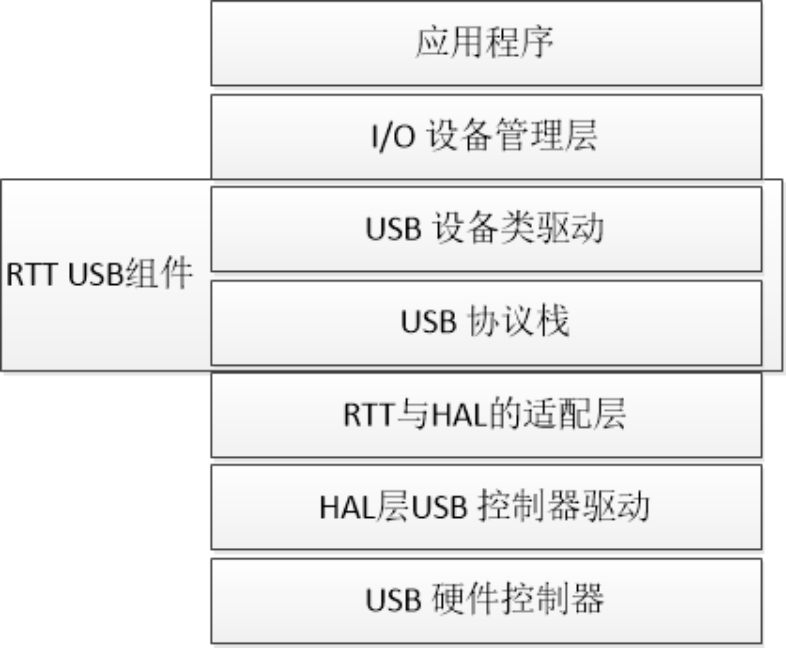
Chinese source figure (p.7)
Figure 1. Applications access class drivers through I/O management, then exchange data/control with the controller. I/O management wraps class drivers with standard application interfaces. RTT USB implements Host/Device stacks and class drivers; classes use USB Core interfaces, and the stack uses adapter interfaces. The adapter configures Rockchip hardware, initializes it through HAL and wraps HAL into RTT-compatible functions. HAL implements low-level reads/writes and can serve different RTOSes. The source also refers to the RT-Thread forum overview “USB组件之USB device框架简单概览”.
2.3 USB configuration
2.3.1 USB Device configuration
Device can expose one interface or multiple interfaces as a Composite Device. Enable composition with RT_USB_DEVICE_COMPOSITE.
RT-Thread Components  --->
    Device Drivers  --->
        Using USB  --->
            [ ] Using USB host
            [*] Using USB device
            (4096) usb thread stack size
            (0x2207) USB Vendor ID
            (0x0007) USB Product ID
            [ ]   Enable composite device
                    Device type (Using custom class by register interface)  --->
Note:
- The source identifies 0x2207 as Rockchip’s unique USB-IF VID, not transferable to another vendor. It is for development/debugging; a product seeking USB-IF certification must obtain its own authorized Vendor ID through USB-IF membership.
- Product ID is 0x0007; adapt it as 0x00XX, keeping the high byte zero to avoid Maskrom/Loader PID conflicts.
- Select CDC/MSC/HID/WINUSB/UAC1 as required.
- Enable composite device for combinations such as MSC + CDC-ACM; unnecessary for a single function.
- Device mainly targets MCU chips RK2108/RK2118/RK625.
2.3.2 USB Host configuration
Host currently supports Mass Storage; HUB/HID are under development. Mass Storage configuration:
RT-Thread Components  --->
    Device Drivers  --->
        Using USB  --->
            [*] Using USB host
            [*]   Enable Udisk Drivers
            (/)     Udisk mount dir
            [ ]   Enable HID Drivers
            [ ] Using USB device
            (4096) usb thread stack size
Host adapter configuration:
RT-Thread rockchip common drivers  --->
    RT-Thread rockchip USB Host driver  --->
        [ ] DWC2 HCD Support
        [ ] EHCI HCD Support
        [ ] OHCI HCD Support
Note:
- Host supports MCU and AP. Select DWC2 or EHCI + OHCI according to the actual controller.
- Adapter limitations prohibit enabling Using USB host and Using USB device simultaneously; doing so causes malfunction.
2.4 Create/register USB Device
rt_device_register() registers the controller in RT-Thread I/O management. Only class drivers such as HID/MStorage access it, not applications directly. Classes may register their own devices for applications; e.g. components/drivers/usb/usbdevice/class/hid.c creates hidd with rt_device_register. The controller Device is created/registered in bsp/rockchip/common/drivers/drv_usbd.c, the RTT/HAL adapter; Figure 2 shows the sequence.
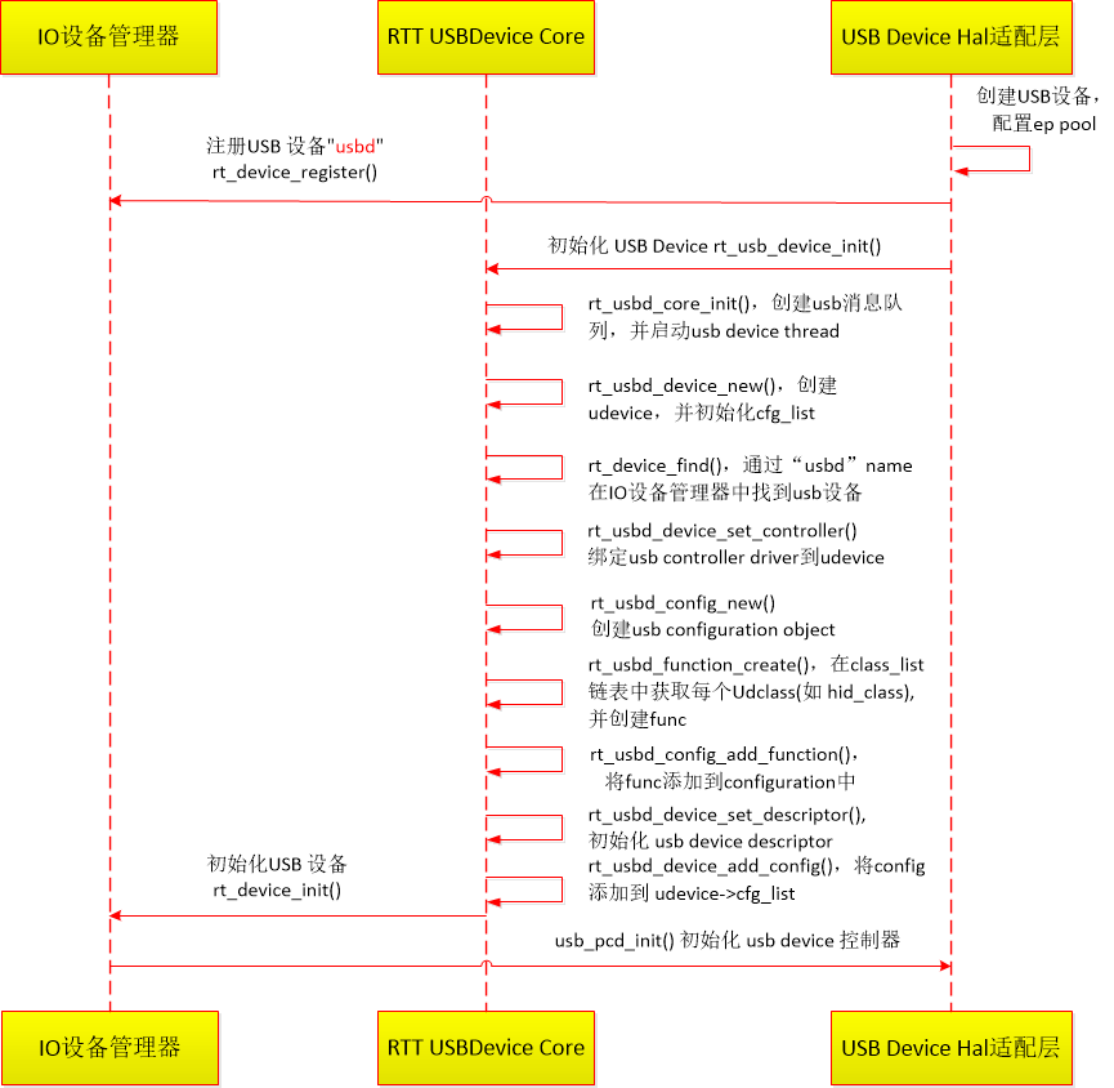
Chinese source figure (p.9)
Figure API/sequence transcription (original identifiers and numbering; not executable code)
rt_device_register("usbd")
rt_usb_device_init()
  rt_usbd_core_init() -> USB message queue / USB device thread
  rt_usbd_device_new() -> udevice / cfg_list
  rt_device_find("usbd")
  rt_usbd_device_set_controller()
  rt_usbd_config_new()
  rt_usbd_function_create() -> Uclass from class_list (hid_class)
  rt_usbd_config_add_function()
  rt_usbd_device_set_descriptor()
  rt_usbd_device_add_config() -> udevice->cfg_list
rt_device_init()
usb_pcd_init()
Figure 2. Use list_device to see the registered USB Device:
msh />list_device
device           type         ref count
-------- -------------------- ----------
usbd     USB Slave Device     0
2.5 Create/register USB Host
Host registers through rt_device_register(). A USBHub thread monitors ports and enumerates devices on changes. A class-driver list manages the drivers. RT-Thread adapters support DWC2/EHCI/OHCI; paths above. Figure 3 uses DWC2 as the example.
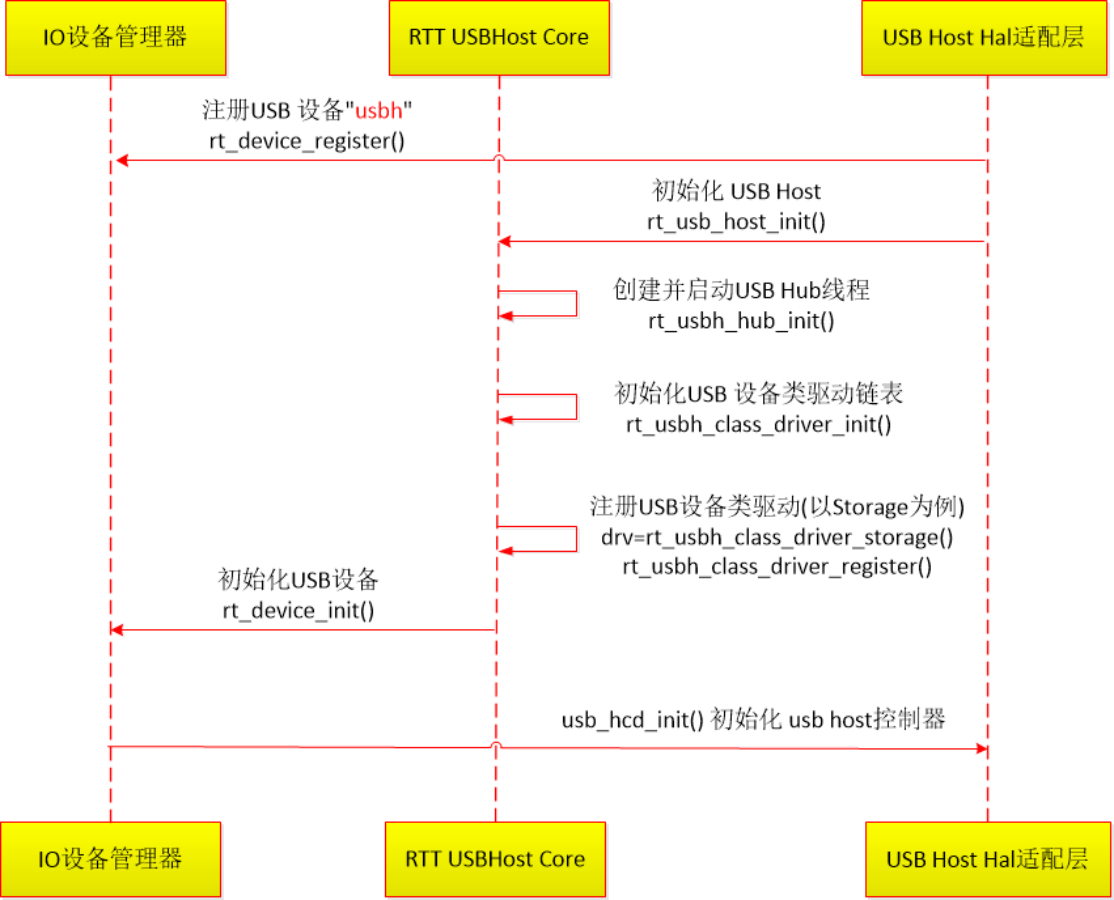
Chinese source figure (p.10)
Figure API/sequence transcription (original identifiers and numbering; not executable code)
rt_device_register("usbh")
rt_usb_host_init()
  rt_usbh_hub_init()
  rt_usbh_class_driver_init()
  drv = rt_usbh_class_driver_storage()
  rt_usbh_class_driver_register()
rt_device_init()
usb_hcd_init()
Figure 3. EHCI/OHCI use bsp/rockchip/common/drivers/drv_usbhost.c with essentially the same creation/registration sequence. list_device shows Host devices:
msh />list_device
device           type         ref count
-------- -------------------- ----------
usbh     USB Host Bus         0
2.6 USB Device examples
2.6.1 Device-management interfaces
Applications access USB hardware through RT-Thread I/O device-management APIs (Table 2):
| Function | Description |
|---|---|
| rt_device_find() | Find USB device |
| rt_device_open() | Open USB device |
| rt_device_read() | Read USB data |
| rt_device_write() | Write USB data |
| rt_device_control() | Control USB device |
2.6.2 HID example
HID supports Keyboard, Mouse, General HID and mediakeyboard; choose as needed. RK2108 USB HID Keyboard is the example. Run scons –menuconfig and select HID.
RT-Thread Components  --->
    Device Drivers  --->
        Using USB  --->
            [ ] Using USB host
            [*] Using USB device
            (4096) usb thread stack size
            (0x2207) USB Vendor ID
            (0x0007) USB Product ID
            [ ]   Enable composite device
                Device type (Enable to use device as HID device)  --->
            [*]   Use to HID device as Keyboard
            (1)     Number of Keyboard(max 3)
            [ ]   Use to HID device as Mouse
            [ ]   Use to HID device as General HID device
            [ ]   Use to HID device as media keyboard
list_device shows the HID character device:
msh />list_device
device           type         ref count
-------- -------------------- ----------
hidd     Character Device     0
HID creation/registration sequence:
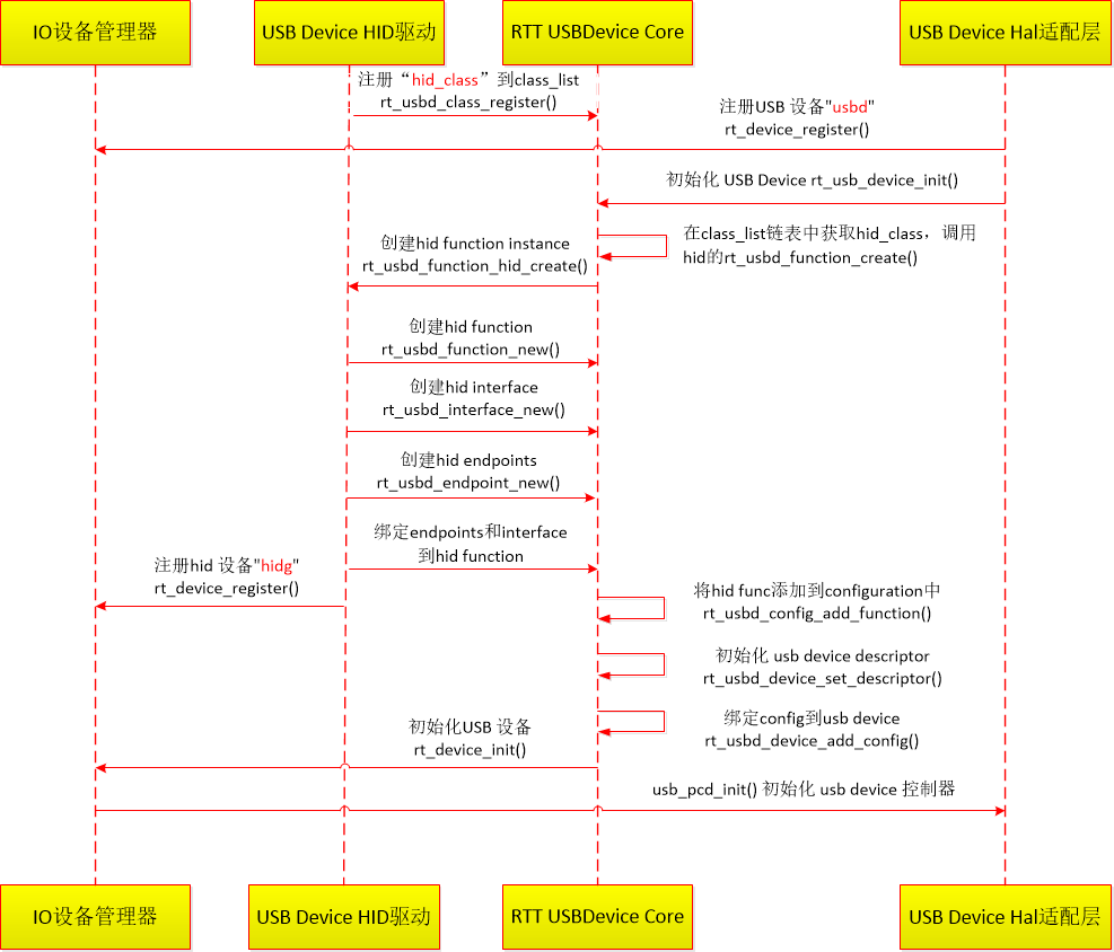
Chinese source figure (p.12)
Figure API/sequence transcription (original identifiers and numbering; not executable code)
rt_usbd_class_register(hid_class)
rt_device_register("usbd")
rt_usb_device_init()
rt_usbd_function_create() -> rt_usbd_function_hid_create()
rt_usbd_function_new()
rt_usbd_interface_new()
rt_usbd_endpoint_new()
rt_device_register("hidg")
rt_usbd_config_add_function()
rt_usbd_device_set_descriptor()
rt_usbd_device_add_config()
rt_device_init()
usb_pcd_init()
Figure 4. Application HID access sequence:
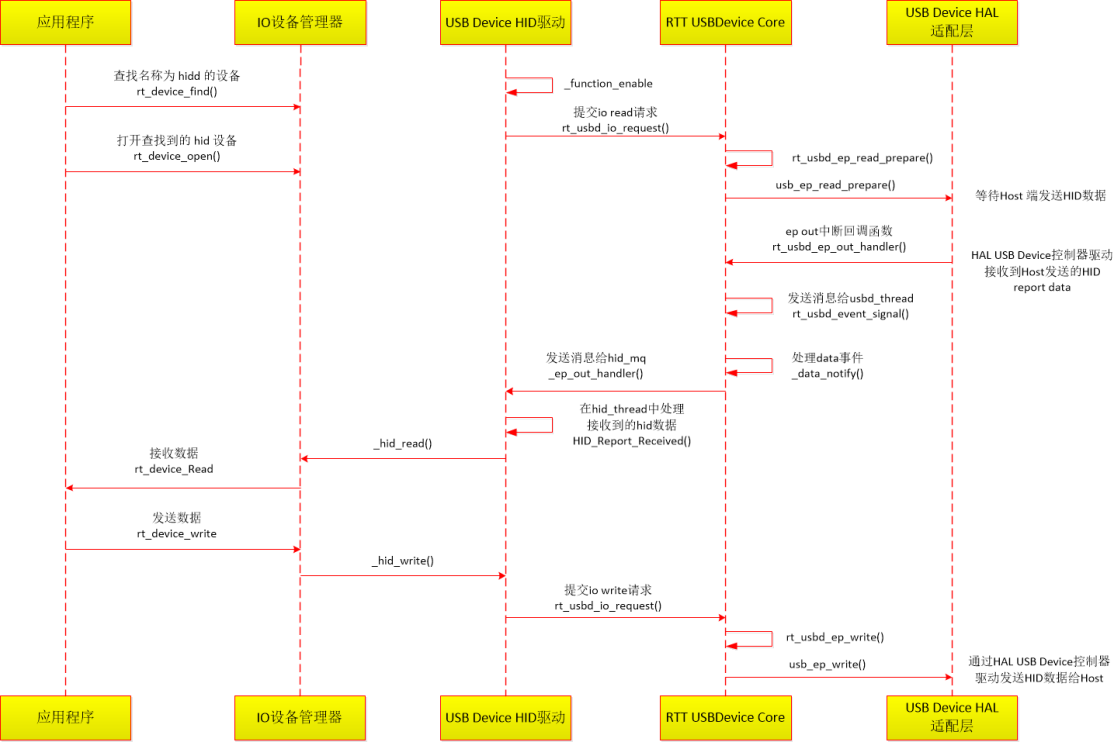
Chinese source figure (p.13)
Figure API/sequence transcription (original identifiers and numbering; not executable code)
rt_device_find("hidd") -> rt_device_open()
function_enable -> rt_usbd_io_request()
rt_usbd_ep_read_prepare() -> usb_ep_read_prepare()
rt_usbd_ep_out_handler() -> rt_usbd_event_signal() -> usbd_thread
_data_notify() -> _ep_out_handler() -> hid_mq -> hid_thread -> HID_Report_Received()
rt_device_Read -> _hid_read()
rt_device_write -> _hid_write() -> rt_usbd_io_request()
rt_usbd_ep_write() -> usb_ep_write()
Figure 5. Reference applications: RT-Thread/IoT_Board USB mouse example; RT-Thread RK2108 HID example. HID transfer optimization: report descriptors and INT endpoint FIFO settings limit the default transfer to 64 bytes, with poor throughput. Adjust endpoint FIFO configuration to support 1024 bytes per transfer; RK2108 example below.
diff --git a/bsp/rockchip/rk2108/board/common/board_base.c b/bsp/rockchip/rk2108/board/common/board_base.c
index 79cc20854..a494d7528 100644
--- a/bsp/rockchip/rk2108/board/common/board_base.c
+++ b/bsp/rockchip/rk2108/board/common/board_base.c
@@ -484,8 +484,8 @@ RT_WEAK struct ep_id g_usb_ep_pool[] =
     { 0x2,  USB_EP_ATTR_BULK,       USB_DIR_OUT,    512,  ID_UNASSIGNED },
     { 0x3,  USB_EP_ATTR_ISOC,       USB_DIR_IN,     1024, ID_UNASSIGNED },
     { 0x4,  USB_EP_ATTR_ISOC,       USB_DIR_OUT,    512,  ID_UNASSIGNED },
-    { 0x5,  USB_EP_ATTR_INT,        USB_DIR_IN,     64,   ID_UNASSIGNED },
-    { 0x6,  USB_EP_ATTR_INT,        USB_DIR_OUT,    64,   ID_UNASSIGNED },
+    { 0x5,  USB_EP_ATTR_INT,        USB_DIR_IN,     1024,   ID_UNASSIGNED },
+    { 0x6,  USB_EP_ATTR_INT,        USB_DIR_OUT,    1024,   ID_UNASSIGNED },
     { 0xFF, USB_EP_ATTR_TYPE_MASK,  USB_DIR_MASK,   0,    ID_ASSIGNED   },
 };
 #endif
diff --git a/components/drivers/include/drivers/usb_common.h b/components/drivers/include/drivers/usb_common.h
index d16b42ea7..2370cdc88 100644
--- a/components/drivers/include/drivers/usb_common.h
+++ b/components/drivers/include/drivers/usb_common.h
@@ -508,7 +508,7 @@ typedef struct uhid_descriptor* uhid_desc_t;
 struct hid_report
 {
     rt_uint8_t report_id;
-    rt_uint8_t report[63];
+    ALIGN(32) rt_uint8_t report[1024];
     rt_uint8_t size;
 };
 typedef struct hid_report* hid_report_t;
diff --git a/components/drivers/usb/usbdevice/class/hid.c b/components/drivers/usb/usbdevice/class/hid.c
index f0e75178b..fdb12001e 100644
--- a/components/drivers/usb/usbdevice/class/hid.c
+++ b/components/drivers/usb/usbdevice/class/hid.c
@@ -194,14 +194,14 @@ const rt_uint8_t _report_desc[]=
     COLLECTION(1),      0x01,
     REPORT_ID(1),       HID_REPORT_ID_GENERAL,

-    REPORT_COUNT(1),    RT_USB_DEVICE_HID_GENERAL_IN_REPORT_LENGTH,
+    REPORT_COUNT(2),    0xff, 0x03,
     USAGE(1),           0x03,
     REPORT_SIZE(1),     0x08,
     LOGICAL_MINIMUM(1), 0x00,
     LOGICAL_MAXIMUM(1), 0xFF,
     INPUT(1),           0x02,

-    REPORT_COUNT(1),    RT_USB_DEVICE_HID_GENERAL_OUT_REPORT_LENGTH,
+    REPORT_COUNT(2),    0xff, 0x03,
     USAGE(1),           0x04,
     REPORT_SIZE(1),     0x08,
     LOGICAL_MINIMUM(1), 0x00,
@@ -347,7 +347,7 @@ const static struct uhid_comm_descriptor _hid_comm_desc =
         USB_DESC_TYPE_ENDPOINT,
         USB_DYNAMIC | USB_DIR_IN,
         USB_EP_ATTR_INT,
-        0x40,
+        1024,
         0x01,
     },

@@ -357,7 +357,7 @@ const static struct uhid_comm_descriptor _hid_comm_desc =
         USB_DESC_TYPE_ENDPOINT,
         USB_DYNAMIC | USB_DIR_OUT,
         USB_EP_ATTR_INT,
-        0x40,
+        1024,
         0x01,
     },
 };
@@ -607,7 +607,7 @@ static rt_size_t _hid_write(rt_device_t dev, rt_off_t pos, const void *buffer, r
         rt_memcpy((void *)report.report,(void *)buffer,size);
         report.size = size;
         hiddev->ep_in->request.buffer = (void *)&report;
-        hiddev->ep_in->request.size = (size+1) > 64 ? 64 : size+1;
+        hiddev->ep_in->request.size = (size+1) > MAX_REPORT_SIZE ? MAX_REPORT_SIZE : size+1;
         hiddev->ep_in->request.req_type = UIO_REQUEST_WRITE;
         rt_usbd_io_request(hiddev->func->device, hiddev->ep_in, &hiddev->ep_in->request);
         return size;
diff --git a/components/drivers/usb/usbdevice/class/hid.h b/components/drivers/usb/usbdevice/class/hid.h
index 4d0f314a1..ea9938220 100644
--- a/components/drivers/usb/usbdevice/class/hid.h
+++ b/components/drivers/usb/usbdevice/class/hid.h
@@ -34,8 +34,8 @@ extern "C" {
 #define USB_HID_REQ_SET_IDLE        0x0a
 #define USB_HID_REQ_SET_PROTOCOL    0x0b

-#define MAX_REPORT_SIZE             64
-#define HID_RX_BUFSIZE              64
+#define MAX_REPORT_SIZE             1024
+#define HID_RX_BUFSIZE              1024

 /* HID Report Types */
 #define HID_REPORT_INPUT            0x01
2.6.3 ADB example
RT-Thread provides ADBD (Android Debug Bridge daemon) for PC file transfer or shell over USB/TCPIP. USB ADB uses WINUSB; ADBD accesses /dev/winusb to exchange controller data. Package documentation: https://packages.rt-thread.org/detail.html?package=adbd ; source: https://github.com/heyuanjie87/adbd . Configure USB with custom class because ADBD implements its WINUSB class in packages/adbd-latest/core/adbusb.c. Set Product ID to the recommended 0x0006, matching Rockchip AP ADB to avoid manual PC driver installation.
RT-Thread Components  --->
    Device Drivers  --->
        Using USB  --->
            -*- Using USB device
            (4096) usb thread stack size
            (0x2207) USB Vendor ID
            (0x0006) USB Product ID
            [ ]   Enable composite device
                  Device type (Using custom class by register interface)  --->
                      (X) Using custom class by register interface
Configure ADBD online packages:
[*] Enable RT-Thread online packages  --->
    RT-Thread online packages  --->
        tools packages  --->
            [*] ADBD: Android Debug Bridge daemon implementation in RT-Thread  --
->
                [ ]   Using TCPIP transfer
                [*]   Using USB transfer
                (1280) Set transfer thread stack size
                [*]   Enable Shell service
                [*]   Enable File service
                (2304)  Set file service thread stack size
                (2000)  Set file service receive timeout(ms)
                [ ]   Enable external MOD
                [ ]   Enable ADB service discover
                      Version (latest)  --->
Disable Using TCPIP transfer; otherwise ADBD defaults to TCPIP and affects USB ADB. Configure required POSIX support:
RT_USING_LEGACY [=y]
RT_USING_DFS [=y]
DFS_USING_POSIX [=y]
RT_USING_POSIX_FS [=y]
RT_USING_POSIX_DEVIO [=y]
RT_USING_POSIX_STDIO [=y]
RT_USING_POSIX_POLL [=y]
RT_USING_POSIX_SELECT [=y]
RT_USING_POSIX_SOCKET [=y]
Configure the filesystem needed by ADB push/pull; see the MSC automatic mount-table section. Save and exit configuration, then download ADBD online packages.
RK2118 SDK example:
~/rt-thread/bsp/rockchip/rk2118$ source ~/.env/env.sh
~/rt-thread/bsp/rockchip/rk2118$ pkgs --update
[Use Gitee server - auto decision based on IP location]
Cloning into '/home/wlf/rt-thread/bsp/rockchip/rk2118/packages/adbd-latest'...
remote: Enumerating objects: 42, done.
remote: Counting objects: 100% (42/42), done.
remote: Compressing objects: 100% (39/39), done.
remote: Total 42 (delta 2), reused 37 (delta 2), pack-reused 0
Receiving objects: 100% (42/42), 10.13 MiB | 1.74 MiB/s, done.
Resolving deltas: 100% (2/2), done.
==============================>  ADBD latest is downloaded successfully.

/home/wlf/rt-thread/bsp/rockchip/rk2118/packages/adbd-latest
==============================>  adbd update done

Operation completed successfully.
Adapt ADBD package sources to Rockchip:
diff --git a/core/adbusb.c b/core/adbusb.c
index 29455d0..034e9bb 100644
--- a/core/adbusb.c
+++ b/core/adbusb.c
@@ -232,7 +232,7 @@ static rt_err_t _ep_out_handler(ufunction_t func, rt_size_t size)
 static rt_err_t _ep_in_handler(ufunction_t func, rt_size_t size)
 {
     winusb_device_t wd = (winusb_device_t)func->user_data;
-    wd->wrcnt -= size;
+    wd->wrcnt -= wd->ep_in->request.size;
     rt_wqueue_wakeup(&(wd->wq), (void *)POLLOUT);

     return RT_EOK;
@@ -284,13 +284,12 @@ static rt_err_t _interface_handler(ufunction_t func, ureq_t setup)
     return RT_EOK;
 }

-#ifdef RT_USING_POSIX
 static int _ep_alloc_request(uep_t ep)
 {
     int size;

     size = EP_MAXPACKET(ep);
-    ep->buffer = rt_malloc(size);
+    ep->buffer = rt_malloc_align(RT_ALIGN(size, USB_DMA_ALIGN_SIZE),
USB_DMA_ALIGN_SIZE);
     if (!ep->buffer)
         return -1;

@@ -300,7 +299,6 @@ static int _ep_alloc_request(uep_t ep)

     return 0;
 }
-#endif

 static rt_err_t _function_enable(ufunction_t func)
 {
@@ -316,7 +314,7 @@ static rt_err_t _function_enable(ufunction_t func)
         return -1;
     if (_ep_alloc_request(wd->ep_in) != 0)
     {
-        rt_free(wd->ep_out->buffer);
+        rt_free_align(wd->ep_out->buffer);
         return -1;
     }
     _readreq(func, wd);
@@ -331,8 +329,8 @@ static rt_err_t _function_disable(ufunction_t func)
     RT_ASSERT(func != RT_NULL);
     wd = func->user_data;

-    rt_free(wd->ep_out->buffer);
-    rt_free(wd->ep_in->buffer);
+    rt_free_align(wd->ep_out->buffer);
+    rt_free_align(wd->ep_in->buffer);
     wd->ep_out->buffer = 0;
     wd->ep_in->buffer = 0;

diff --git a/services/shell_service.c b/services/shell_service.c
index 6252942..80e6cb0 100644
--- a/services/shell_service.c
+++ b/services/shell_service.c
@@ -344,6 +344,7 @@ static bool send_ready(struct shell_ext *ext, char *args)

 extern int libc_stdio_set_console(const char* device_name, int mode);
 extern int libc_stdio_get_console(void);
+extern int ioctl(int fildes, int cmd, ...);

 static int _shell_open(struct adb_service *ser, char *args)
 {
Use list_device and mount to check winusb creation and filesystem mounting.
msh />list_device
device           type         ref count
-------- -------------------- ----------
winusb   Miscellaneous Device 0
usbd     USB Slave Device     0
root     Block Device         1
snor     MTD Device           0
fspi0    Character Device     0
i2c0     I2C Bus              0
pin      Pin Device           0
uart0    Character Device     2

msh />mount
filesystem  device  mountpoint
----------  ------  ----------
devfs       (NULL)  /dev
elm         root    /
PC ADB tools/drivers are in adbd-latest/tools. adb push/pull and adb shell are supported; entering adb shell switches the console from physical UART to USB.
2.6.4 MSC example
MSC (Mass Storage Class) makes the device appear as a removable USB drive on the PC for copying files. RK2108 example: run scons –menuconfig and select Mass Storage device.
RT-Thread Components  --->
    Device Drivers  --->
        Using USB  --->
            [*] Using USB device
            (4096) usb thread stack size
            (0x2207) USB Vendor ID
            (0x0007) USB Product ID
            [ ]   Enable composite device
                    Device type (Enable to use device as Mass Storage device)  --
->
            (root) msc class disk name
            (4096) msc buffer length
Note:
- Set msc class disk name manually to root.
- Enable CONFIG_RT_USING_DFS_MNTTABLE.
- Larger msc buffer length usually improves controller throughput; range 512–65536. MSC depends on an automatic filesystem mount table; without it enumeration may work but reads/writes fail. The SDK supports Littlefs and FAT/EXFAT. Enable the required filesystem in menuconfig and create board-level mnt.c for the mount table. Configuration example:
RT_USING_DFS [=y] #文件系统总开关 DFS_FILESYSTEMS_MAX [=2] #最大允许的挂载节点数目(即分区数目),因为devfs要占用一个,所以这 个值要>=(需要挂载的物理分区+1) DFS_FILESYSTEM_TYPES_MAX [=2] #最大允许的文件系统数目,支持elmfat和devfs,所以是2 DFS_FD_MAX [=16] #最大可同时操作的文件句柄
RT_USING_DFS_MNTTABLE [=y] #启用自动挂载表
RT_USING_DFS_ELMFAT [=y] #启用elmfat文件系统,兼容fat文件系统
RT_USING_DFS_DEVFS [=y] #启用设备文件系统,可以通过文件接口访问设备驱动
RT_DFS_ELM_MAX_SECTOR_SIZE [=4096] # 设置扇区大小为4096,以兼容底层spi flash的擦除块大 小
RK2108 EVB reference: bsp/rockchip/rk2108/board/rk2108d_evb/mnt.c
#ifdef RT_USING_DFS_MNTTABLE
#include <dfs_fs.h>

#define PARTITION_ROOT          "root"

/********************* Private Variable Definition ***************************/
/** @defgroup MNT_Private_Variable Private Variable
 *  @{
 */

/**
 * @brief  Config mount table of filesystem
 * @attention The mount_table must be terminated with NULL, and the partition's
name
 * must be the same as above.
 */
const struct dfs_mount_tbl mount_table[] =
{
    {PARTITION_ROOT, "/", "elm", 0, 0},
#if defined(RT_USING_LITTLEFS) && defined(RT_USING_SPINAND)
    {"spinand0", "/nand", "lfs", 0, 0},
#elif defined(RT_USING_SDIO0) && defined(RT_SDCARD_MOUNT_POINT)
    {"sd0", RT_SDCARD_MOUNT_POINT, "elm", 0, 0},
#endif
    {0}
};
#endif
dfs_mount_tbl structure:
/* mount table */
struct dfs_mount_tbl
{
    const char   *device_name;    /* 设备节点名 */
    const char   *path;           /* 挂载点目录 */
    const char   *filesystemtype; /* 文件系统名字(elm对应fat) */
    unsigned long rwflag;         /* rw(1为读写,0为只读,elm不支持这个标识,填0) */
    const void   *data;           /* 文件系统私有数据(elm不支持,填0) */
};
MSC operation:
After boot without a PC connection, root is mounted locally and the device can read/write it. On USB connection, the driver unmounts root locally; the device cannot access it, while the PC sees and accesses the USB drive. On disconnection, the driver unmounts root and remounts it locally.
2.6.5 UAC1 example
UAC (USB Audio Class) makes the device an external sound card for a PC/host. SDK supports UAC V1.0 only, not V2.0. RT-Thread v3.1.x configuration:
RT-Thread Components  --->
    Device Drivers  --->
        Using USB  --->
            [ ] Using USB host
            [*] Using USB device
            (4096) usb thread stack size
            (0x2207) USB Vendor ID
            (0x0019) USB Product ID
            [ ]   Enable composite device
                    Device type (Enable to use device as UAC1 device)  --->
            (es8388p) uac1 playback card name
            (pdmc) uac1 capture card name
            [ ]   Enable to use pll compensation for clock synchronization
UAC1 configuration, RT-Thread v4.1.x:
RT-Thread Components  --->
    Device Drivers  --->
        Using USB  --->
            [ ] Using USB host
            [*] Using USB device
            (4096) usb thread stack size
            (0x2207) USB Vendor ID
            (0x0019) USB Product ID
            [ ]   Enable composite device
                    Device type (Enable to use device as UAC1 device)  --->
            (es8388p) uac1 playback card name
            (pdmc) uac1 capture card name
            [ ]   Enable to poll ep first transfer status
UAC1 + HID composite configuration (RT-Thread v4.1.x). Notes:
- Disable VAD when UAC1 is enabled: # CONFIG_RT_USING_VAD is not set.
- RT_USB_AUDIO_P_NAME must match the physical playback device. Adapt to the audio hardware; RK2108 reference uses es8388p.
- RT_USB_AUDIO_C_NAME must match the recording hardware; RK2108 reference uses pdmc.
- RT_USB_AUDIO_PLL_COMPENSATION enables dynamic device-clock adjustment for playback. USB Host SOF and device I2S have different clocks, which can cause buffer overrun/underrun. Compensation adjusts processing rate to host data rate, independent of Windows/Linux/MAC OS, improving compatibility. It requires SoC-specific clock software and may be constrained by clock design; currently mainly RK2108.
- RT_USB_AUDIO_USING_EP_POLL replaces interrupts with HAL audio-endpoint polling to detect stream start. For composite UAC1 (e.g. UAC1 + HID), enable by default to avoid possible endpoint interrupt storms depending on host behavior. Polling adds latency: EP_STATUS_POLL_INTERVAL_MS defaults to 5ms; tune for latency-sensitive products.
- RT-Thread v3.1.x UAC1 lacks polling by default; patch: https://redmine.rock-chips.com/attachments/1217535 . Missing playback device allows enumeration but no playback; missing recording device causes a fault. Before enabling UAC1 check Sound devices with list_device. RK2108 example here uses es8311p for playback and pdmc for recording (different from es8388p above in the source). If absent, enable Audio in menuconfig.
msh />list_device
device          type         ref count
------- -------------------- ----------
es8311c Sound Device         0
es8311p Sound Device         1
audpwmp Sound Device         0
pdmc    Sound Device         0
adcc    Sound Device         0
usbd    USB Slave Device     0
root    Block Device         1
snor    MTD Device           0
pwm0    Miscellaneous Device 0
dmac0   Miscellaneous Device 0
i2c0    I2C Bus              0
pin     Miscellaneous Device 0
uart2   Character Device     0
uart0   Character Device     2
2.6.6 UVC example
UVC (USB Video Class) makes a USB video-capture device. Rockchip RT-Thread implements UVC 1.1, supports MJPEG/YUYV and up to three UVC composite channels. Restrictions:
- BULK only, no ISOC.
- RK625 only.
UVC configuration:
RT-Thread Components  --->
    Device Drivers  --->
        Using USB  --->
            [*] Using USB device
            (4096) usb thread stack size
            (0x2207) USB Vendor ID
            (0x0007) USB Product ID
            [*]   Enable composite device
            [*]     Enable to use device as UVC device
            [*]   Use to UVC device as RGB
            [ ]   Use to UVC device as DEPTH
            [ ]   Use to UVC device as IR
            (10240) uvc device max buffer length
Note:
- Configure RGB/DEPTH/IR according to hardware. RK625 supports RGB UVC; RK625 + RK1608 supports three UVC channels.
- uvc device max buffer length supports 4K–16K. UVC is built on RT-Thread USB Framework with thread, driver, buffer management and exception handling:
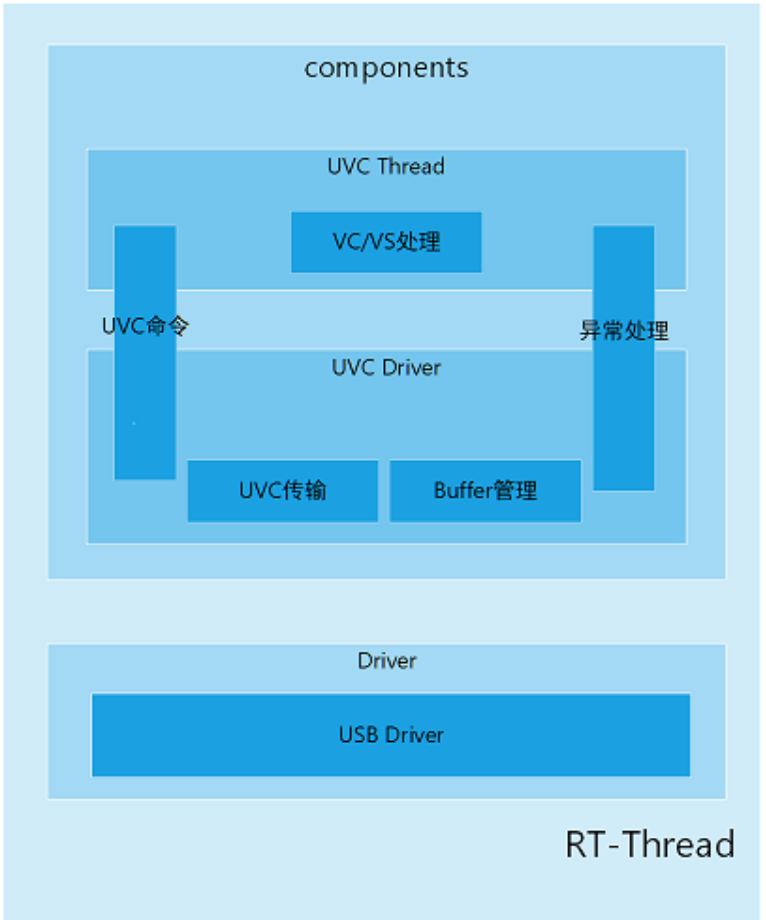
Chinese source figure (p.23)
Figure 6. UVC architecture.
Each UVC channel has its own thread handling VC/VS requests. The driver defines descriptors/resolutions, manages buffer states, schedules video transfers and handles exceptions. Thread/driver communicate with RT-Thread OS Event; UVC/USB drivers through USB IO. To inspect logs, connect the device, open Camera in host preview software, and observe serial logs after camera initialization:
[...1...]
INF: uvc(1) set format fcc 1196444237 width 640 height 480
VIDEO_OPEN(1)
INF: uvc(1) open camera device...
Open camera id width height 1 640 480
[...2...]
INF: uvc(1) buffer(0) addr 0x2006787c
INF: uvc(1) buffer(1) addr 0x2006987c
INF: uvc(1) buffer(2) addr 0x2006b87c
INF: uvc(1) buffer(3) addr 0x2006d87c
INF: uvc(1) mjpeg header addr 0x20087c00
INF: uvc(1) buffer size 8064
[...]
[...3...]
VIDEO_CLOSE(1)
INF: uvc(1) close camera device...
Close camera id 1
close rgb success
[...]
[...4...]
uvc(1) buffer: (0-1) (1-1) (2-1) (3-2)
ERR: uvc(1) buffer overflow irq 0x000100f0
Log 1: camera FCC, width/height. Log 2: ring-buffer count, addresses and sizes; MJPEG additionally prints header-buffer information. After both logs, sensor data causes buffer scheduling and host transfer. Log 3: host closes Camera. Log 4: AMCAP/GUVCView may send only EP Halt on exit, not CloseCamera. EP Halt triggers UVC Buffer Overflow; the manager closes the buffer channel and stops USB transfer.
2.6.7 WINUSB example
WINUSB is Windows’ generic USB driver, providing Bulk transfers without a separate driver installation. Configuration:
RT-Thread Components  --->
    Device Drivers  --->
        Using USB  --->
            [ ] Using USB host
            [*] Using USB device
            (4096) usb thread stack size
            (0x2207) USB Vendor ID
            (0x0007) USB Product ID
            [ ]   Enable composite device
                    Device type (Enable to use device as winusb device)  --->
            ({6860DC3C-C05F-4807-8807-1CA861CC1D66}) Guid for winusb
            (16384) winusb transfer length
list_device shows WINUSB:
msh />list_device
device           type         ref count
-------- -------------------- ----------
winusb   Miscellaneous Device 0
usbd     USB Slave Device     0
Rockchip PC test demo: https://redmine.rock-chips.com/attachments/1213728
2.6.8 CDC_VCOM example
CDC_VCOM implements a USB virtual serial port based on CDC-ACM for host send/receive. Configuration:
RT-Thread Components  --->
    Device Drivers  --->
        Using USB  --->
            [ ] Using USB host
            [*] Using USB device
            (4096) usb thread stack size
            (0x2207) USB Vendor ID
            (0x0007) USB Product ID
            [ ]   Enable composite device
                    Device type (Enable to use device as CDC device)  --->
            (512) virtual com thread stack size
            (128) virtual com rx buffer size
            [ ]   Enable to use dma for vcom tx
            (32021919830108) serial number of virtual co
            (14)  serial number length of virtual com
            (1000) tx timeout(ticks) of virtual com
RT-Thread 3.1.x USB system console modifications:
diff --git a/components/libc/compilers/newlib/libc.c b/components/libc/compilers/newlib/libc.c
index 2234c36f98..07ba2bafeb 100644
--- a/components/libc/compilers/newlib/libc.c
+++ b/components/libc/compilers/newlib/libc.c
@@ -23,6 +23,7 @@ int   _EXFUN(putenv,(char *__string));

 int libc_system_init(void)
 {
+    rt_console_set_device("vcom");
 #if defined(RT_USING_DFS) & defined(RT_USING_DFS_DEVFS) & defined(RT_USING_CONSOLE)
     rt_device_t dev_console;

@@ -47,4 +48,4 @@ int libc_system_init(void)

     return 0;
 }
-INIT_COMPONENT_EXPORT(libc_system_init);
+INIT_APP_EXPORT(libc_system_init);
RT-Thread 4.1.x USB system console modifications require POSIX configuration:
RT_USING_POSIX_FS [=y]
RT_USING_POSIX_DEVIO [=y]
RT_USING_POSIX_STDIO [=y]
diff --git a/components/libc/posix/io/stdio/libc.c b/components/libc/posix/io/stdio/libc.c
index cc891574f3..b12e24610b 100644
--- a/components/libc/posix/io/stdio/libc.c
+++ b/components/libc/posix/io/stdio/libc.c
@@ -20,6 +20,7 @@

 int libc_system_init(void)
 {
+    rt_console_set_device("vcom");
 #ifdef RT_USING_POSIX_STDIO
     rt_device_t dev_console;

@@ -31,7 +32,8 @@ int libc_system_init(void)
 #endif /* RT_USING_POSIX_STDIO */
     return 0;
 }
-INIT_COMPONENT_EXPORT(libc_system_init);
+INIT_APP_EXPORT(libc_system_init);
CDC_VCOM compatibility: the Rockchip device receives serial data from the host but cannot send back correctly. Fix:
Subject: [PATCH] [COMPONENTS]: drivers: usb: cdc_vcom: Fix connected state
The current cdc vcom driver depends the setup wValue of
the request CDC_SET_CONTROL_LINE_STATE to set the connected
state. Refer to CDC Spec V1.2 Chapter 6.3.12 SetControlLineState,
the Bit0 of the wValue is used to indicates to DCE if DTE
(Data Terminal Equipment, for example, a Personal Computer)
is present or not. However, some DTE always set the Bit0 of
the wValue to 0, this cause cdc vcom failed to send message to
DTE. This patch ignores the Bit0 of wValue, and set the
connected state to true directly if it receives the request
CDC_SET_CONTROL_LINE_STATE.

diff --git a/components/drivers/usb/usbdevice/class/cdc_vcom.c b/components/drivers/usb/usbdevice/class/cdc_vcom.c
index df5e03f54c..e201742747 100644
--- a/components/drivers/usb/usbdevice/class/cdc_vcom.c
+++ b/components/drivers/usb/usbdevice/class/cdc_vcom.c
@@ -463,7 +463,7 @@ static rt_err_t _interface_handler(ufunction_t func, ureq_t setup)
         _cdc_get_line_coding(func->device, setup);
         break;
     case CDC_SET_CONTROL_LINE_STATE:
-        data->connected = (setup->wValue & 0x01) > 0?RT_TRUE:RT_FALSE;
+        data->connected = RT_TRUE;
         RT_DEBUG_LOG(RT_DEBUG_USB, ("vcom state:%d \n", data->connected));
         dcd_ep0_send_status(func->device->dcd);
         break;
2.6.9 Device speed configuration
Device defaults to High speed. To force Full speed, e.g. for UAC products, configure #define RT_USING_USBD_SPEED_FULL.
2.6.10 Endpoint FIFO configuration
Endpoint FIFOs are controller hardware resources: all Rx endpoints share one RxFIFO, each Tx endpoint has its own TxFIFO. Configuration is in the DWC2 Device adapter and board code. RK2118 defaults in rt-thread/bsp/rockchip/rk2118/board/common/board_base.c define g_usb_ep_pool for 2 BULK, 2 ISOC and 2 INT endpoints simultaneously. For other composite devices adjust endpoint counts/types to actual needs.
#ifdef RT_USING_USB_DEVICE
RT_WEAK struct ep_id g_usb_ep_pool[] =
{
    { 0x0,  USB_EP_ATTR_CONTROL,    USB_DIR_INOUT,  64,   ID_ASSIGNED   },
    { 0x1,  USB_EP_ATTR_BULK,       USB_DIR_IN,     1024, ID_UNASSIGNED },
    { 0x2,  USB_EP_ATTR_BULK,       USB_DIR_OUT,    512,  ID_UNASSIGNED },
    { 0x3,  USB_EP_ATTR_ISOC,       USB_DIR_IN,     1024, ID_UNASSIGNED },
    { 0x4,  USB_EP_ATTR_ISOC,       USB_DIR_OUT,    512,  ID_UNASSIGNED },
    { 0x5,  USB_EP_ATTR_INT,        USB_DIR_IN,     64,   ID_UNASSIGNED },
    { 0x6,  USB_EP_ATTR_INT,        USB_DIR_OUT,    64,   ID_UNASSIGNED },
    { 0xFF, USB_EP_ATTR_TYPE_MASK,  USB_DIR_MASK,   0,    ID_ASSIGNED   },
};
#endif
HAL FIFO configuration: rt-thread/bsp/rockchip/common/drivers/drv_usbd.c. HAL_PCDEx_SetRxFiFo sets RxFIFO, HAL_PCDEx_SetTxFiFo sets TxFIFO; both use 4-byte units.
static void usb_pcd_lowlevel_hw_init(struct PCD_HANDLE *pcd)
{
    uint8_t i;

    /* Initialize Low Level Driver */
    HAL_PCD_Init(pcd);

#ifndef RT_USB_DEVICE_UVC
    HAL_PCDEx_SetRxFiFo(pcd, 0x118);
#else
    /*
     * Set smaller RxFiFo for 3 * UVC interfaces, then
     * it can assign enough TxFiFo size (1024 Bytes)
     * for each UVC streaming IN endpoint to get higher
     * performance.
     */
    HAL_PCDEx_SetRxFiFo(pcd, 0x8C);
#endif

    /* Set TxFIFOs according to the g_usb_ep_pool array */
    for (i = 0; i < pcd->cfg.epNum + 1; i++)
    {
        if (g_usb_ep_pool[i].addr == 0xFF)
            break;

        if (g_usb_ep_pool[i].dir == USB_DIR_IN || g_usb_ep_pool[i].dir ==
USB_DIR_INOUT)
            HAL_PCDEx_SetTxFiFo(pcd, g_usb_ep_pool[i].addr,
                                (g_usb_ep_pool[i].maxpacket >> 2));
    }

    HAL_PCD_Start(pcd);
}
2.6.11 VBUS detection
Three methods:
- GPIO detection: USB_VBUS_PIN; RK2118 evb reference rt-thread/bsp/rockchip/rk2118/board/evb/board.h.
- PMIC detection: RT_USING_USB_PMIC_VBUS; RK2108 recording_pen reference rt-thread/bsp/rockchip/rk2108/board/recording_pen_v10/board.h.
- USB PHY detection: RT_USING_BVALID_IRQ; RK2118 iotest reference rt-thread/bsp/rockchip/rk2118/board/iotest/board.h.
2.7 USB Host examples
2.7.1 Host MSC example
Host MSC component configuration:
RT-Thread Components  --->
    Device Drivers  --->
        Using USB  --->
        [*] Using USB host
        [*]   Enable Udisk Drivers
        (/)     Udisk mount dir (NEW)
        [ ]   Enable HID Drivers (NEW)
        [ ] Using USB device
        (4096) usb thread stack size
Configure the Host adapter for the actual chip controller and RT-Thread version. RT-Thread v3.1.x:
RT-Thread rockchip common drivers  --->
    RT-Thread rockchip USB Host driver  --->
        [ ] DWC2 HCD Support
        [ ] EHCI HCD Support
        [ ] OHCI HCD Support
Note:
- DWC2 HCD Support selects the DWC2 adapter.
- EHCI HCD Support and OHCI HCD Support select USB2 Host EHCI/OHCI adapters.
From RT-Thread v4.1.x, Host adapter configuration moved from common platform drivers to chip drivers to support multiple simultaneous Host ports. RK3506 example with both OTG0/1 as Hosts:
RT-Thread rockchip RK3506 drivers  --->
    Enable USB HOST  --->
        [*] Enable USB OTG HOST
        [*]   Enable USB OTG0 HOST
        [*]   Enable USB OTG1 HOST
Filesystem configuration required by MSC:
RT-Thread Components  --->
    [*] DFS: device virtual file system  ----
        [*]   Enable elm-chan fatfs
            elm-chan's FatFs, Generic FAT Filesystem Module  --->
RT-Thread currently supports only FAT-32 USB drives. Required cache configuration:
RT-Thread rockchip common drivers  --->
    [*] Enable cache
Host MSC registration/enumeration sequence:
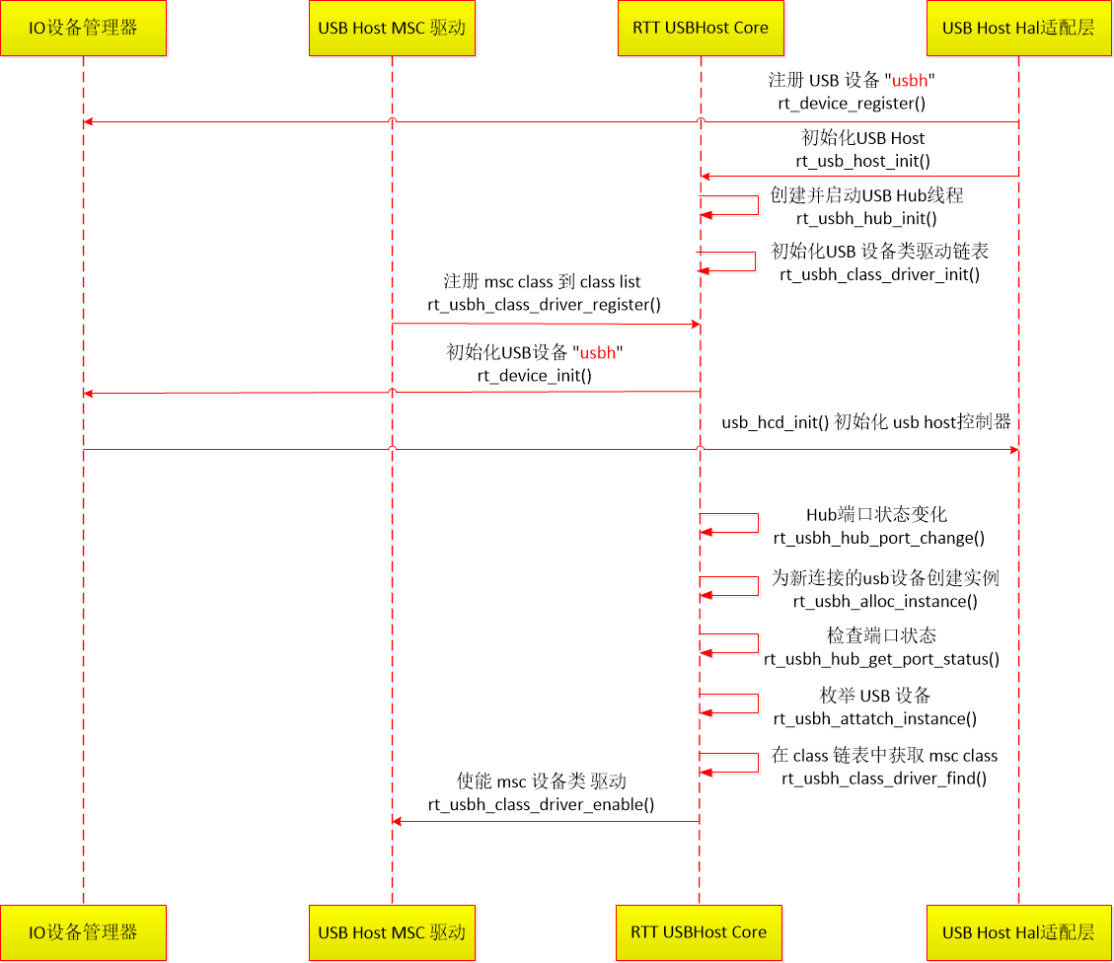
Chinese source figure (p.31)
Figure API/sequence transcription (original identifiers and numbering; not executable code)
rt_device_register("usbh")
rt_usb_host_init()
rt_usbh_hub_init()
rt_usbh_class_driver_init()
rt_usbh_class_driver_register()
rt_device_init()
usb_hcd_init()
rt_usbh_hub_port_change()
rt_usbh_alloc_instance()
rt_usbh_hub_get_port_status()
rt_usbh_attach_instance()
rt_usbh_class_driver_find()
rt_usbh_class_driver_enable()
Figure 7. Application MSC access sequence:
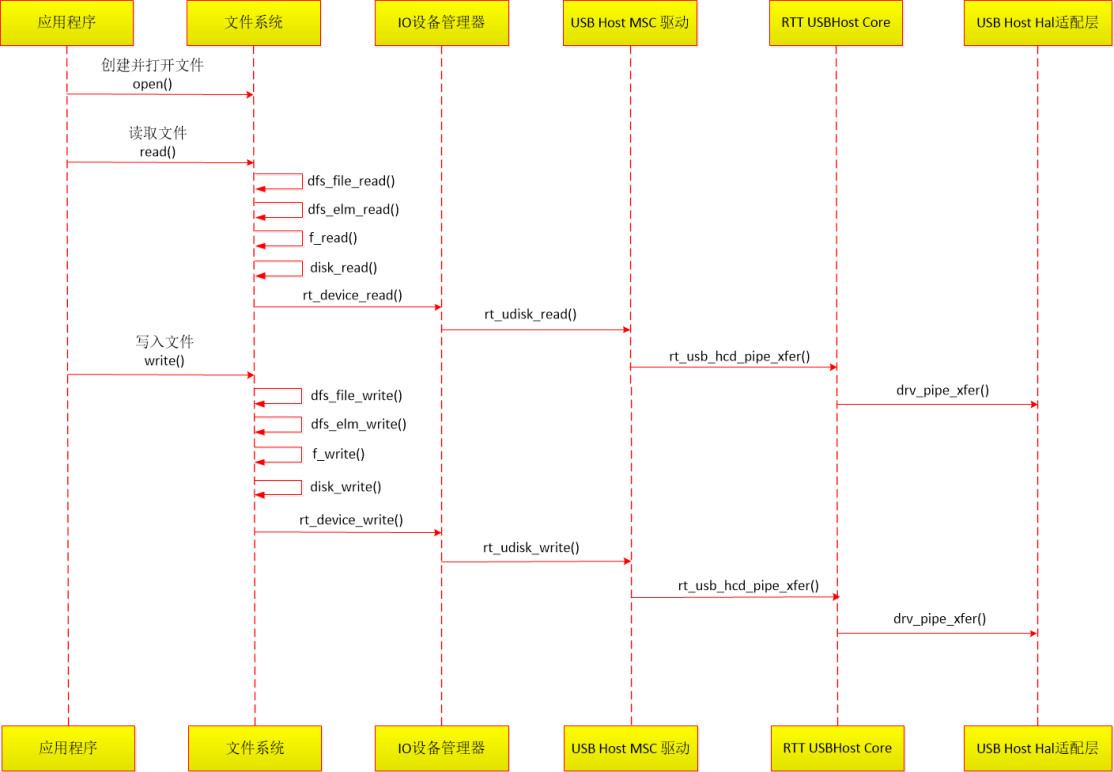
Chinese source figure (p.31)
Figure API/sequence transcription (original identifiers and numbering; not executable code)
open()
read() -> dfs_file_read() -> dfs_elm_read() -> f_read() -> disk_read()
  -> rt_device_read() -> rt_udisk_read() -> rt_usb_hcd_pipe_xfer() -> drv_pipe_xfer()
write() -> dfs_file_write() -> dfs_elm_write() -> f_write() -> disk_write()
  -> rt_device_write() -> rt_udisk_write() -> rt_usb_hcd_pipe_xfer() -> drv_pipe_xfer()
Figure 8. Application access to MSC devices.
2.7.2 Host VBUS control
VBUS 5V output can be controlled by GPIO. Add the corresponding GPIOBANK_PIN macro in the board header.
- USB2.0 OTG Host VBUS GPIO: RK3506 EVB1 defines VBUS in bsp/rockchip/rk3506-32/board/evb1/board.h.
#define USB_OTG_HOST0_VBUS_PIN        BANK_PIN(GPIO_BANK1, 20)
#define USB_OTG_HOST1_VBUS_PIN        BANK_PIN(GPIO_BANK1, 24)
- USB2.0 Host VBUS GPIO: RK3568 EVB1 defines VBUS in bsp/rockchip/rk3568-32/board/rk3568_evb1/board.h.
#define USB_HOST_VBUS_PIN BANK_PIN(GPIO_BANK0, 6)