
This is a platform reference derived from Rockchip V1.4.2 documentation, not an ArmSoM hardware validation report or a promise of support on every board. The source covers SoCs including RK3588 and RK3576. Verify the actual ArmSoM board, SDK/BSP branch, kernel configuration, TEE/OTP availability and algorithm selection. The source lists kernel 4.19/5.10/6.1 commit dependencies; these combinations are not interchangeable. Board-specific adaptation remains unverified.
The Chinese article follows the 49-page Chinese PDF; this English article follows the 52-page English PDF, and Russian translates the English text. Both sources are V1.4.2, but local differences are identified inline and in the editorial notes. All technical chapters, examples, parameters and figures are retained. Cover date, classification, legal/contact matter, intended audience and revision history are omitted. Original code comments are preserved.
Operational risk: OTP writes and read locks may be irreversible and may affect other OTP regions. The API examples are source material only; no programming, locking or crypto test was performed. Check the exact SoC TRM, OTP/TEE guides and SDK implementation first. All performance figures are Rockchip source examples, not ArmSoM measurements. Official platform resources: ArmSoM documentation, Rockchip Linux.
Technical scope retained from the source preface: Rockchip Crypto and HWRNG(TRNG) driver and upper-layer application development. The following is the source product-version table, not an ArmSoM board compatibility guarantee.
| Chipset name | Kernel version |
|---|---|
| All Rockchip chips with crypto IP | Linux 4.19 |
| All Rockchip chips with crypto IP | Linux 5.10 |
| All Rockchip chips with crypto IP | Linux 6.1 |
1. Overview
CRYPTO: There are currently five versions of CRYPTO IP on the RK platform, including CRYPTO V1/V2/V3/V4/CE. V1 is an earlier IP, which supports fewer algorithms and functions. Therefore, the IP core of CRYPTO V2 was redesigned, and a series of functional strengthening and updating were carried out on the basis of V2.V2/V3/V4 was fully compatible with the basic generation function, V3 added multi-threaded switching support on the basis of V2, V4 realized the reuse of CRYPTO IP core on the basis of V3 and reduce the IP chip area.
RKCE is on the original computing core, redesign the register and call mode, the driver is completely incompatible with V2/V3/V4, rewrite the new driver.
TRNG: Most of the hardware random number modules of the chip platform previously existed in the hardware CRYPTO IP (including CRYPTO V1 and some CRYPTO V2). Starting with RK356x, HWRNG (TRNG) is a separate hardware module.
1.1 crypto v1
| Algorithm | Description |
|---|---|
| DES/TDES | Support DES/3DES (ECB and CBC chain mode) |
| AES | Support AES 128/192/256 bits key mode, ECB/CBC/CTR/XTS chain mode |
| HASH | Support SHA1/SHA256/MD5 (with hardware padding) HASH function |
| RSA | Support PKA 512/1024/2048 bit Exp Modulator (RK3126, RK3128, RK3288, and RK3368 are not supported) |
| TRNG | Support 256 bit True Random Number Generator (TRNG) |
Source difference: Chinese §1.1 additionally lists TDES EEE/EDE, and §1.2 limits TDES to EDE. These restrictions are not fully stated in the English table; verify the exact IP and SDK.
1.2 crypto v2
| Algorithm | Description |
|---|---|
| DES/TDES | Support ECB/CBC/OFB/CFB mode. |
| AES | Support ECB/CBC/OFB/CFB/CTR/CTS/XTS/CCM/GCM/CBC-MAC/CMAC mode. |
| SM4 | Support ECB/CBC/OFB/CFB/CTR/CTS/XTS/CCM/GCM/CBC-MAC/CMAC mode. (SM4 is optional) |
| HASH | Support MD5/SHA1/SHA224/SHA256/SHA384/SHA512/SM3/SHA512-224/SHA512-256 with hardware padding. (SM3 is optional) |
| HMAC | Support HMAC of SHA-1, SHA-256, SHA-512, MD5, SM3 with hardware padding. (SM3 is optional) |
| RSA/ECC | Support up to 4096 bits PKA mathematical operations for RSA/ECC/SM2. |
| TRNG | Support 256 bit True Random Number Generator (TRNG) |
Source difference: Chinese §1.1 additionally lists TDES EEE/EDE, and §1.2 limits TDES to EDE. These restrictions are not fully stated in the English table; verify the exact IP and SDK.
1.3 crypto v3
On the basis of Crypto V2 algorithm, Crypto V3 add multithreading support. The Cyrpto V3 platform has been able to automatically identify supported algorithms since RV1106, so compatible uses “rockchip,crypto-v3” as the identifier.
1.4 crypto v4
On the basis of crypto v3 algorithm, some optimization is done. In the use of IP drivers and crypto v3 can be compatible with normal reuse code. This compatible uniformly uses “rockchip,crypto-v4” as the identifier.
1.5 crypto ce
RKCE is on the original computing core, redesign the register and call mode, the driver is completely incompatible with V2/V3/V4, rewrite the new driver. This compatible uniformly uses “rockchip,crypto-ce” as the identifier.
1.6 The crypto IP version of chips
The crypto IP version of chips show below:
The platforms that use crypto V1 are:
RK3399, RK3288, RK3368, RK3328/RK3228H, RK322x, RK3128, RK1108, RK3126
The platforms that use crypto V2 are:
RK3326/PX30, RK3308, RK1808, RV1126/RV1109, RK2206, RK356x, RK3588
The platforms that use crypto V3 are:
RV1106, RV1103
The platforms that use crypto V4 are:
RK3528, RK3562, RK3503, RK3506, RK3576, RV1103B, RV1106B
The platforms that use crypto CE are:
RV1126B
2. Driver Development
2.1 Driver Code Description
2.1.1 hwrng
Crypto V1 / V2, TRNGV1, RKRNG four platforms are centralized in the same c file because HWRNG driver is relatively simple.
The driver does not distinguish the specific chip model, only according to “rockchip,cryptov1-rng” and “rockchip,cryptov2-rng”, “rockchip,trngv1”, “rockchip,rkrng” four compatible partition. Currently, ‘rockchip,trngv1’ and “rockchip,rkrng” is a separate HWRNG module, and the other two HWRNG are built into the Crypto module.
Driver Source Code: drivers/char/hw_random/rockchip-rng.c
2.1.2 crypto
The current driver implementation algorithm is as follows:
crypto v1:
AES: ECB/CBC
DES/TDES: ECB/CBC
HASH: SHA1/SHA256/MD5
crypto v2/v3/v4: (Some chipset may not support all algorithm)
AES: ECB/CBC/OFB/CFB/CTR/GCM
DES/TDES: ECB/CBC/CFB/OFB
SM4: ECB/CBC/OFB/CFB/OFB/CTR/GCM
HASH: SHA1/SHA256/SHA384/SHA512/MD5/SM3
HMAC: HMAC_SHA1/HMAC_SHA256/HMAC_SHA512/HMAC_MD5/HMAC_SM3
RSA: Support up to 4096 bits key length.
crypto v2/v3/v4 Hardware full version(The mode driver for the following deleted lines has not been implemented yet):
AES(128/192/256): ECB/CBC/OFB/CFB/CTR/XTS/CTS/CCM/GCM/CBC-MAC/CMAC
SM4: ECB/CBC/OFB/CFB/CTR/XTS/CTS/CCM/GCM/CBC-MAC/CMAC
DES/TDES: ECB/CBC/OFB/CFB
HASH: MD5/SHA-1/SHA256/SHA512/SM3/SHA224/SHA384/SHA512_224/SHA512_384
HMAC: SHA-1/SHA-256/SHA-512/MD5/SM3
RSA: Support up to 4096 bits key length.
crypto v2/v3/v4 Hardware difference table
| Chip | AES | DES/TDES | SM3/SM4 | HASH | HMAC | RSA/ECC | multi - thread |
|---|---|---|---|---|---|---|---|
| RK3326/PX30/RK3308 | ✓ | ✓ | × | ✓ | ✓ | RSA | × |
| RK1808 | AES-128 | × | × | SHA-1SHA-224/SHA-256/MD5 | ✓ | RSA | × |
| RV1126/RV1109 | AES-128/AES-256 | ✓ | ✓ | ✓ | ✓ | RSA | × |
| RK2206 | ✓ | ✓ | × | ✓ | ✓ | RSA | × |
| RK3568/RK3588 | ✓ | ✓ | ✓ | ✓ | ✓ | RSA | × |
| RV1106/RV1103 | ✓ | ✓ | × | SHA-1/SHA-224/SHA-256/MD5 | ✓ | RSA | ✓ |
| RK3562 | ✓ | ✓ | × | SHA-1/SHA-224/SHA-256/MD5 | ✓ | RSA | ✓ |
| RK3528 | ✓ | ✓ | ✓ | ✓ | ✓ | RSA | ✓ |
| RK3503/RK3506 | ✓ | × | × | SHA-1/SHA-224/SHA-256/MD5 | ✓ | RSA | ✓ |
| RK3576 | ✓ | ✓ | ✓ | ✓ | ✓ | RSA/ECC/SM2 | ✓ |
| RV1103B/RV1106B | ✓ | ✓ | × | SHA-1/SHA-224/SHA-256/MD5 | ✓ | RSA | ✓ |
| RV1126B | ✓ | × | ✓ | SHA-1/SHA-224/SHA-256/MD5 | ✓ | RSA/ECC/SM2 | ✓ |
Note:
1. RK1808 : AES supports only 128bit. For kernel drivers, AES is not supported.
2. RV1126/RV1109: AES-192 is not supported, so the AES-192 part can only be implemented by the soft algorithm, but the soft algorithm cannot support all the modes of the hard algorithm. Therefore, it is recommended not to change the list of configured algorithms in the code.
The driver file are show as below:
drivers/crypto/rockchip/rkcrypto // crypto v1/v2/v3/v4 driver
|-- procfs.c // proc statistics info (clock rate, algo list, etc.)
|-- procfs.h // proc head file
|-- rk_crypto_bignum.c // crypto PKA bignum api
|-- rk_crypto_bignum.h // crypto PKA bignum file
|-- rk_crypto_core.c // linux crypto Driver framework and public interface
|-- rk_crypto_core.h // linux crypto common head file
|-- rk_crypto_ecc.c // crypto v4 ecc/sm2 operation implement
|-- rk_crypto_ecc.h // crypto v4 ecc/sm2 register definition
|-- rk_crypto_ahash_utils.c // ahash common api
|-- rk_crypto_ahash_utils.h // ahash common head file
|-- rk_crypto_skcipher_utils.c // skcipher common api
|-- rk_crypto_skcipher_utils.h // skcipher common head file
|-- rk_crypto_utils.c // crypto common api
|-- rk_crypto_utils.h // crypto common head file
|-- rk_crypto_v1.c // crypto v1 hardware related interface implementation
|-- rk_crypto_v1.h // crypto v1 structure and interface declaration
|-- rk_crypto_v1_skcipher.c // crypto v1 block cipher algorithm implement
|-- rk_crypto_v1_ahash.c // crypto v1 hash algorithm implement
|-- rk_crypto_v1_reg.h // crypto v1 hardware register definition
|-- rk_crypto_v2.c // crypto v2 hardware related interface implementation
|-- rk_crypto_v2.h // crypto v2 structure and interface declaration
|-- rk_crypto_v2_skcipher.c // crypto v2 block cipher algorithm implement
|-- rk_crypto_v2_ahash.c // crypto v2 hash algorithm implement
|-- rk_crypto_v2_akcipher.c // crypto v2 RSA/EC algorithm implement
|-- rk_crypto_v2_pka.c // crypto v2 pka operation implement
|-- rk_crypto_v2_reg.h // crypto v2 hardware register definition
|-- rk_crypto_v3.c // crypto v3/v4 Hardware related interface implementation
|-- rk_crypto_v3.h // crypto v3/v4 Structure and interface declaration
|-- rk_crypto_v3_skcipher.c // crypto v3/v4 block cipher algorithm implement
|-- rk_crypto_v3_ahash.c // crypto v3/v4 hash algorithm implement
|-- rk_crypto_v3_reg.h // crypto v3/v4 hardware register definition
|-- rk_ecdsasignature.asn1 // ecdsa signature asn1 struct definition
`-- rk_sm2signature.asn1 // sm2 signature ans1 struct definition
drivers/crypto/rockchip/rkce // crypto ce driver
|-- rkce_akcipher.c // rkce RSA/EC algorithm implement
|-- rkce_akcipher.h // rkce RSA/EC algorithm define
|-- rkce_bignum.c // rkce PKA bignum api
|-- rkce_bignum.h // rkce PKA bignum file
|-- rkce_buf.c // rkce CMA buffer api
|-- rkce_buf.h // rkce CMA buffer file
|-- rkce_core.c // linux crypto Driver framework and public interface
|-- rkce_core.h // linux crypto common head file
|-- rkce_debug.c // rkce debug api
|-- rkce_debug.h // rkce debug file
|-- rkce_dev.c // rkce crypto algorithm registration
|-- rkce_dev.h // rkce crypto head file
|-- rkce_ecc.c // rkce ecc/sm2 operation
|-- rkce_ecc.h // rkce v4 ecc/sm2 register definition
|-- rkce_ecdsasignature.asn1 // ecdsa signature asn1 struct
|-- rkce_error.h // rkce error code define
|-- rkce_hash.c // rkce hash algorithm implement
|-- rkce_hash.h // rkce hash algorithm define
|-- rkce_monitor.c // monitor thread to prevent computation from stalling
|-- rkce_monitor.h // monitor thread head file
|-- rkce_pka.c // rkce pka operation implement
|-- rkce_pka.h // rkce pka operation define
|-- rkce_reg.h // rkce hardware register
|-- rkce_skcipher.c // rkce block cipher algorithm
|-- rkce_skcipher.h // rkce block cipher define
`-- rkce_sm2signature.asn1 // sm2 signature ans1 struct
2.2 Enable hwrng
2.2.1 Menuconfig
The HWRNG driver is compiled into the kernel by default, and the dts file determines whether to enable it.
The configuration is shown in the following figure (Red marks indicate the configuration path and the options that need to be configured).
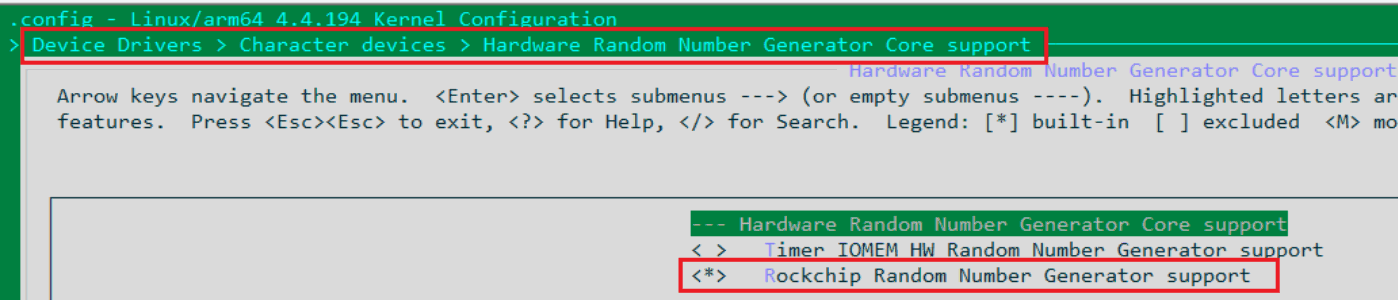
Or add the following statement to the config file (which is configured by default in rockchip_defconfig) :
CONFIG_HW_RANDOM=y
CONFIG_HW_RANDOM_ROCKCHIP=y
2.2.2 Enable rng node in dts
At present, most chips dtsi file have been configured with HWRNG nodes, and you only need to enable the rng module in the board-level dts, as shown below:
&rng {
    status = "okay";
}
2.2.3 Added rng node for new chip
Most of the chip platforms have been configured with rng nodes. If the dtsi of chip has not been configured with rng nodes, you can perform the following operations to configure them.
Attention:
1. The RNG base address needs to be modified according to the chip TRM. The RNG base address is the CRYPTO base address.
2. Clocks macros may differ from platform to platform. If there is an error on dts, you can go to the include/dt-bindings/clock directory and execute grep -rn CRYPTO to find the corresponding clock macros name, as shown below:
troy@inno:~/kernel/include/dt-bindings/clock$ grep -rn CRYPTO
rk3328-cru.h:57:#define SCLK_CRYPTO 59
rk3328-cru.h:206:#define HCLK_CRYPTO_MST 336
rk3328-cru.h:207:#define HCLK_CRYPTO_SLV 337
rk3328-cru.h:284:#define SRST_CRYPTO 68
crypto v1:
rng: rng@ff060000 {
    compatible = "rockchip,cryptov1-rng";
    reg = <0x0 0xff060000 0x0 0x4000>;
    clocks = <&cru SCLK_CRYPTO>, <&cru HCLK_CRYPTO_SLV>;
    clock-names = "clk_crypto", "hclk_crypto";
    assigned-clocks = <&cru SCLK_CRYPTO>, <&cru HCLK_CRYPTO_SLV>;
    assigned-clock-rates = <150000000>, <100000000>;
    status = "disabled";
};
crypto v2:
The actual TRNG does not need to rely on all clocks, but only on hclk_crypto
rng: rng@ff500400 {
    compatible = "rockchip,cryptov2-rng";
    reg = <0xff500400 0x80>; # Need to add 0x400 if rng is inside crypto
    clocks = <&cru HCLK_CRYPTO>;
    clock-names = "hclk_crypto";
    power-domains = <&power RV1126_PD_CRYPTO>;
    resets = <&cru SRST_CRYPTO_CORE>;
    reset-names = "reset";
    status = "disabled";
};
trng v1:
At present, RK3588 and RV1106 use the random number module of TRNG V1, which is completely different from the TRNG module split in Crypto V2 in design and improves the randomness.
rng: rng@fe378000 {
    compatible = "rockchip,trngv1";
    reg = <0x0 0xfe378000 0x0 0x200>;
    interrupts = <GIC_SPI 400 IRQ_TYPE_LEVEL_HIGH>;
    clocks = <&scmi_clk SCMI_HCLK_SECURE_NS>;
    clock-names = "hclk_trng";
    resets = <&scmi_reset SRST_H_TRNG_NS>;
    reset-names = "reset";
    status = "disabled";
};
2.2.4 Verify that HWRNG is enabled
1. Execute cat /sys/devices/virtual/misc/hw_random/rng_current. A value of rockchip identifies the selected hardware driver.
2. linux: execute cat /dev/hwrng | od -x | head -n 1 will get a row of random numbers, and every time you run it, the content of the random number is different.
3. Android: execute cat /dev/hw_random | od -x | head -n 1 will get a row of random numbers, and every time you run it, the content of the random number is different.
2.3 Enable hardware crypto
Current driver code crypto v1 support rk3328, crypto v2 support px30 / rv1126 / rk3568 / rk3588, crypto v3 support rv1106 . For the above platforms, just enable config and dts node to enable hardware crypto.
The supported features will be reflected in the register information since RV1106, and Crypto V3 can automatically adapt to the new chip.
2.3.1 Menuconfig
After menuconfig configuration, Rockchip crypto driver will be compiled into kernel. It will automatically adapt crypto IP version according to the chip platform compatible ID.
You can see the related configuration items of hardware crypto only after ensuring that CONFIG_CRYPTO_HW is enabled.
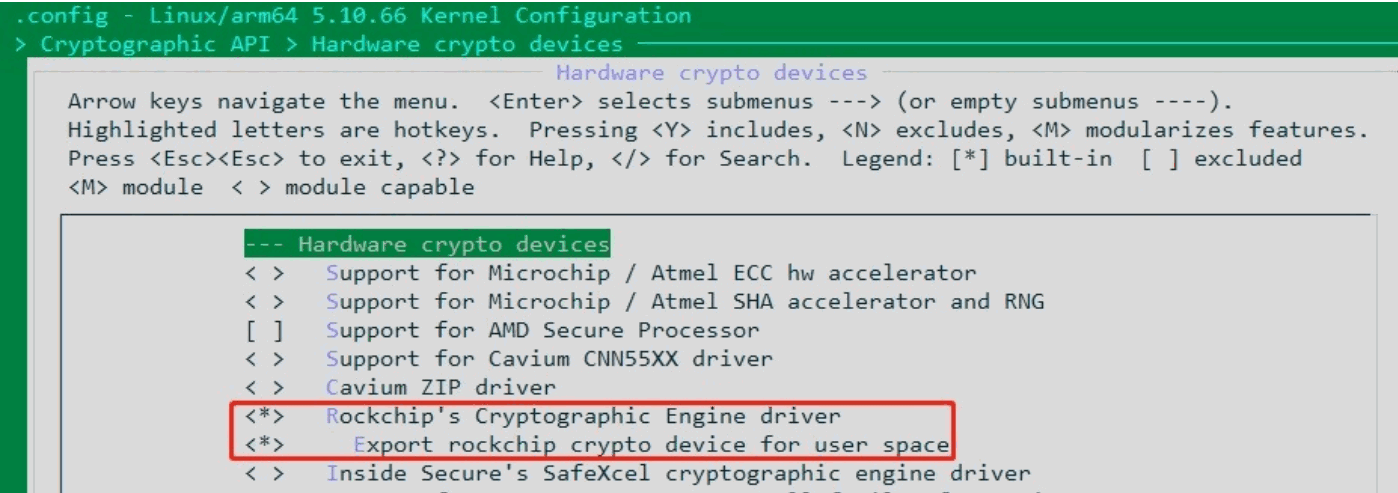
Or add the following statement to the config file. CONFIG_CRYPTO_DEV_ROCKCHIP_V3 is just an example. You must change it according to the actual chip configuration. It is recommended to use menuconfig, which will automatically select the platform.
CONFIG_CRYPTO_HW=y
CONFIG_CRYPTO_DEV_ROCKCHIP=y
CONFIG_CRYPTO_DEV_ROCKCHIP_V3=y
CONFIG_CRYPTO_DEV_ROCKCHIP_DEV=y
2.3.2 Enable crypto node dts
After confirming that the crypto dts node is correctly configured, just enable the crypto module in the board- level dts file, as shown in the following:
&crypto {
    status = "okay";
};
2.3.3 Added crypto node for new chip
If there is no crypto node in chip dtsi file, follow these steps to add support.
1. Determine the version of the chip crypto IP V1 / V2 /V3. V3 version from RV1106, compatible has been determined as “rockchip,crypto-v3”, algorithm tailoring and feature are adapted by the software..
2. drivers/crypto/rockchip/rk_crypto_core.c add algs_name, soc_data, compatible info.
/* Add the algorithm information supported by the chip. Px30 belongs to crypto V2. For
the supported algorithms, see crypto_V2_algs */
/* Attention: Crypto_v2_algs is full algorithms supported by crypto V2. */
/* Some chips are trimmed on Crypto V2. For example, RK1808 does not support SHA512
algorithm, so it is necessary to compare TRM to confirm the algorithm supported */
static char *px30_algs_name[] = {
    "ecb(aes)", "cbc(aes)", "xts(aes)",
    "ecb(des)", "cbc(des)",
    "ecb(des3_ede)", "cbc(des3_ede)",
    "sha1", "sha256", "sha512", "md5",
};
/* bind px30_algs_name to px30_soc_data */
static const struct rk_crypto_soc_data px30_soc_data =
    RK_CRYPTO_V2_SOC_DATA_INIT(px30_algs_name, false);
/* bind px30_soc_data to id_table */
static const struct of_device_id crypto_of_id_table[] = {
    /* crypto v2 in belows */
    {
        .compatible = "rockchip,px30-crypto",
        .data = (void *)&px30_soc_data,
    },
    {
        .compatible = "rockchip,rv1126-crypto",
        .data = (void *)&rv1126_soc_data,
    },
    /* crypto v1 in belows */
    {
        .compatible = "rockchip,rk3288-crypto",
        .data = (void *)&rk3288_soc_data,
    },
    { /* sentinel */ }
};
3. Add crypto node for new chip
Attention:
1. Determine the CRYPTO base address according to the chip TRM
2. Clocks macros may differ from platform to platform. If there is an error on dts, you can go to include/dt-bindings/clock and grep -rn CRYPTO to find the corresponding clock macros name, as shown below:
troy@inno:~/kernel/include/dt-bindings/clock$ grep -rn CRYPTO
rk3328-cru.h:57:#define SCLK_CRYPTO 59
rk3328-cru.h:206:#define HCLK_CRYPTO_MST 336
rk3328-cru.h:207:#define HCLK_CRYPTO_SLV 337
rk3328-cru.h:284:#define SRST_CRYPTO 68
crypto v1:
crypto: cypto-controller@ff8a0000 { /* crypto base address */
    compatible = "rockchip,rk3288-crypto"; /* platform "rk3399-crypto" */
    reg = <0x0 0xff8a0000 0x0 0x4000>; /* crypto base address */
    interrupts = <GIC_SPI 48 IRQ_TYPE_LEVEL_HIGH>; /* crypto interrupts number */
    clocks = <&cru ACLK_CRYPTO>, <&cru HCLK_CRYPTO>,
             <&cru SCLK_CRYPTO>, <&cru ACLK_DMAC1>;
    clock-names = "aclk", "hclk", "sclk", "apb_pclk";
    resets = <&cru SRST_CRYPTO>;
    reset-names = "crypto-rst";
    status = "disabled";
};
crypto v2:
For most crypto V2 chips, the register address of HWRNG is in the middle of crypto. Therefore, you need to split the crypto address space into two parts when configuring reg address. The first part is the register used by the CIPHER and the second part is the register used by RSA.
---------------------- reg map ----------------------
| cipher/hash | rng | pka |
-----------------------------------------------------
crypto: crypto@ff500000 { /* crypto base address */
    compatible = "rockchip,rv1126-crypto"; /* modify platform */
    reg = <0xff500000 0x400>, <0xff500480 0x3B80>; /* crypto base address */
    interrupts = <GIC_SPI 3 IRQ_TYPE_LEVEL_HIGH>;
    clocks = <&cru CLK_CRYPTO_CORE>, <&cru CLK_CRYPTO_PKA>,
    <&cru ACLK_CRYPTO>, <&cru HCLK_CRYPTO>;
    clock-names = "aclk", "hclk", "sclk", "apb_pclk";
    power-domains = <&power RV1126_PD_CRYPTO>;
    resets = <&cru SRST_CRYPTO_CORE>;
    reset-names = "crypto-rst";
    status = "disabled";
};
4. enable crypto node
&crypto {
    status = "okay";
};
2.3.4 Verify that hardware crypto is enabled
Run cat /proc/crypto | grep rk to see registered Rockchip hardware crypto algorithms. The following example uses RV1126.
driver : pkcs1pad(rsa-rk,sha256)
driver : rsa-rk
driver : hmac-sm3-rk
driver : hmac-md5-rk
driver : hmac-sha512-rk
driver : hmac-sha256-rk
driver : hmac-sha1-rk
driver : sm3-rk
driver : md5-rk
driver : sha512-rk
driver : sha256-rk
driver : sha1-rk
driver : ofb-des3_ede-rk
driver : cfb-des3_ede-rk
driver : cbc-des3_ede-rk
driver : ecb-des3_ede-rk
driver : ofb-des-rk
driver : cfb-des-rk
driver : cbc-des-rk
driver : ecb-des-rk
driver : xts-aes-rk
driver : ctr-aes-rk
driver : cfb-aes-rk
driver : cbc-aes-rk
driver : ecb-aes-rk
driver : xts-sm4-rk
driver : ctr-sm4-rk
driver : ofb-sm4-rk
driver : cfb-sm4-rk
driver : cbc-sm4-rk
driver : ecb-sm4-rk
You can view the information about the Rockchip crypto driver by running the cat /proc/rkcrypto command. (Make sure to update the latest code. The old code does not support this function.) Including crypto version, clock frequency, currently available algorithms, and some statistics of current driver operation, will continue to improve and supplement in the future. (“CRYPTO V3.0.0.0 multi” indicates that the current platform supports CRYPTO support multithreading).
Note: RKCE’s platform does not generate /proc/rkcrypto.
Rockchip Crypto Version: CRYPTO V2.0.0.0
use_soft_aes192 : false
clock info:
        aclk 350000000
        hclk 150000000
        sclk 350000000
        pka 350000000
Valid algorithms:
        CIPHER:
                ecb(sm4)
                cbc(sm4)
                cfb(sm4)
                ofb(sm4)
                ctr(sm4)
                ecb(aes)
                cbc(aes)
                cfb(aes)
                ofb(aes)
                ctr(aes)
                ecb(des)
                cbc(des)
                cfb(des)
                ofb(des)
                ecb(des3_ede)
                cbc(des3_ede)
                cfb(des3_ede)
                ofb(des3_ede)
        AEAD:
                gcm(sm4)
                gcm(aes)
        HASH:
                sha1
                sha224
                sha256
                sha384
                sha512
                md5
                sm3
        HMAC:
                hmac(sha1)
                hmac(sha256)
                hmac(sha512)
                hmac(md5)
                hmac(sm3)
        ASYM:
                rsa
Statistic info:
        busy_cnt : 1
        equeue_cnt : 28764
        dequeue_cnt : 28765
        done_cnt : 310710
        complete_cnt : 28765
        fake_cnt : 0
        irq_cnt : 310710
        timeout_cnt : 0
        error_cnt : 0
        last_error : 0
Crypto queue usage [0/50], ever_max = 1, status: idle
3. User space development
3.1 user space invoke hwrng
There are two ways for user space to obtain random numbers output by hwrng:
read kernel driver node
invoke librkcrypto API
Attention:
1. After the hwrng hardware driver is successfully registered, entropy can be added to the kernel random driver. The random numbers generated by hwrng are input to the entropy pool of the random driver. The random driver of kernel is CSPRNG (Cryptography Secure Pseudo Random Number Generator), which meets the security standards of cryptography. For high quality random numbers,, you can read /dev/random or /dev/urandom nodes for random numbers.
3.1.1 read kernel driver node
If the kernel has enabled rng module, random numbers can be obtained by reading nodes in the user space. Linux reads the node /dev/hwrng, Android reads the node /dev/hw_random. Reference code is as follows:
#ifdef ANDROID
#define HWRNG_NODE "/dev/hw_random"
#else
#define HWRNG_NODE "/dev/hwrng"
#endif
RK_RES rk_get_random(uint8_t *data, uint32_t len)
{
        RK_RES res = RK_CRYPTO_SUCCESS;
        int hwrng_fd = -1;
        int read_len = 0;
        hwrng_fd = open(HWRNG_NODE, O_RDONLY, 0);
        if (hwrng_fd < 0) {
                E_TRACE("open %s error!", HWRNG_NODE);
                return RK_CRYPTO_ERR_GENERIC;
        }
        read_len = read(hwrng_fd, data, len);
        if (read_len != len) {
                E_TRACE("read %s error!", HWRNG_NODE);
                res = RK_CRYPTO_ERR_GENERIC;
        }
        close(hwrng_fd);
        return res;
}
3.1.2 invoke librkcrypto API
Refer to the API description: rk_get_random.
3.2 user space invoke hardware crypto
user space calls the librkcrypto interface to operate the hardware cipher module. This section provides instructions for librkcrypto.
Before use, verify that hardware Crypto is enabled in the kernel; see §2.3 and §2.3.4 for configuration and verification.
3.2.1 Scope of application
| API | RK3588 | RK356x | RV1109/1126 | others |
|---|---|---|---|---|
| rk_crypto_mem_alloc/free | ✓ | ✓ | ✓ | |
| rk_crypto_init/deinit | ✓ | ✓ | ✓ | |
| rk_get_random | ✓ | ✓ | ✓ | |
| rk_hash_init/update/update_virt/final/rk_hash_virt | ✓ | ✓ | ✓ | |
| rk_cipher_init/crypt/crypt_virt/final | ✓ | ✓ | ✓ | |
| rk_ae_init/set_aad/set_aad_virt/crypt/crypt_virt/final | ✓ | ✓ | ✓ | |
| rk_rsa_pub_encrypt/priv_decrypt/priv_encrypt/pub_decrypt | ✓ | ✓ | ✓ | |
| rk_rsa_sign/verify | ✓ | ✓ | ✓ | |
| rk_ec_verify | × | × | × | RK3576 |
| rk_write_oem_otp_key | ✓ | ✓ | ✓ | |
| rk_oem_otp_key_is_written | ✓ | ✓ | ✓ | |
| rk_set_oem_hr_otp_read_lock | ✓ | × | × | |
| rk_oem_otp_key_cipher | ✓ | ✓ | ✓ | |
| rk_oem_otp_key_cipher_virt | ✓ | ✓ | ✓ |
3.2.2 Version Dependencies
3.2.2.1 V1.3.0
Librkcrypto V1.3.0 library functions depends on the following kernel commit points. Currently, only newer chips support ECC/SM2 functionality (such as RK3576), mainly on the kernel 6.1 core.
1. kernel 6.1
commit 3b667c194bcbb60c1087afc54094d585d965f493
Author: Lin Jinhan <troy.lin@rock-chips.com>
Date: Thu Oct 10 17:32:29 2024 +0800
    crypto: rockchip: cryptodev: add ec verify support
    Signed-off-by: Lin Jinhan <troy.lin@rock-chips.com>
    Change-Id: If5372d28643b16c16c86448292887a011c3d9900
3.2.2.2 V1.2.0
Librkcrypto V1.2.0 library functions depend on the following kernel commit points. If the kernel crypto driver is not updated to the following commit points, some functions may be unavailable.
1. kernel 4.19
commit c255a0aa097afbf7f28e3c0770c5ab778e5616b2
Author: Lin Jinhan <troy.lin@rock-chips.com>
Date: Tue Sep 13 17:20:46 2022 +0800
    crypto: rockchip: rk3326/px30 add aes gcm support
    Signed-off-by: Lin Jinhan <troy.lin@rock-chips.com>
    Change-Id: I75949554d4f573c63092841eef76765a69cc6b24
2. kernel 5.10
commit 47e85085826daf6401265b803ac9ac7116ae6bb4
Author: Lin Jinhan <troy.lin@rock-chips.com>
Date: Tue Sep 13 17:20:46 2022 +0800
    crypto: rockchip: rk3326/px30 add aes gcm support
    Signed-off-by: Lin Jinhan <troy.lin@rock-chips.com>
    Change-Id: I75949554d4f573c63092841eef76765a69cc6b24
3.2.3 Attention
The input data length of the symmetric algorithm is required to be consistent with the data length of the selected algorithm and mode. For example, ECB and CBC require block alignment, while CTS and CTR do not require data length alignment. There’s no padding in the API.
If the amount of calculated data is pretty large, the algorithm interface that transmits data through dma_fd is recommended to improve the efficiency. Since crypto only supports contiguous physical addresses up to 4G, the buffer allocated by dma fd must be physically contiguous addresses up to 4G (CMA). It can be allocated using the rk_crypto_mem interface provided by librkcrypto, or allocated by yourself using a memory allocation interface such as DRM to get dma fd.
CMA config: Crypto only supports access to CMA addresses up to 4G. If the device uses more than 4G memory, you need to modify the CMA configuration in dts. Otherwise, rk_crypto_mem can be allocated successfully, but the allocated memory cannot be used.The following takes rk3588-android.dtsi platform as an example. In the preceding command, 0x10000000 indicates the start address of the CMA (256MB, do not change the value), and 0x00800000 indicates the size of the CMA. You can change the value as required. For details about the CMA, see the documentation Rockchip_Developer_Guide_Linux_CMA_CN.
--- a/arch/arm64/boot/dts/rockchip/rk3588-android.dtsi
+++ b/arch/arm64/boot/dts/rockchip/rk3588-android.dtsi
@@ -70,7 +70,8 @@
                cma {
                          compatible = "shared-dma-pool";
                          reusable;
  - size = <0x0 (8 * 0x100000)>;
  + //size = <0x0 (8 * 0x100000)>;
  + reg = <0x0 0x10000000 0x0 0x00800000>;
                          linux,cma-default;
                  };
Before using the following interface, ensure that the TEE function is available. See Rockchip_Developer_Guide_TEE_SDK_CN for details.
rk_write_oem_otp_key
rk_oem_otp_key_is_written
rk_set_oem_hr_otp_read_lock
rk_oem_otp_key_cipher
rk_oem_otp_key_cipher_virt
rk_set_oem_hr_otp_read_lock: If key_id is set to RK_OEM_OTP_KEY0/1/2, the attributes of other OTP areas will be affected after the setting is successful. For example, some OTP regions become unwritable, see the Rockchip_Developer_Guide_OTP_CN document. Therefore, RK_OEM_OTP_KEY3 is recommended.
rk_oem_otp_key_cipher_virt: The maximum len value supported is affected by the shared memory of the TEE, which may be smaller than expected if the TEE shared memory is occupied before this interface is used.
3.2.4 Data Structure
3.2.4.1 rk_crypto_mem
typedef struct {
    void *vaddr;
    int dma_fd;
    size_t size;
} rk_crypto_mem;
- vaddr - virtual address of memory
- dma_fd - dma_fd of memory
- size - size of memory
3.2.4.2 rk_cipher_config
typedef struct {
        uint32_t algo;
        uint32_t mode;
        uint32_t operation;
        uint8_t key[64];
        uint32_t key_len;
        uint8_t iv[16];
        void *reserved;
} rk_cipher_config;
- algo - algorithms type, See RK_CRYPTO_ALGO. The actual value range is subject to the API description. The same below.
- mode - algorithms mode, See RK_CIPIHER_MODE. Support ECB/CBC/CTR/CFB/OFB/ mode.
- operation - encrypt or decrypt, See RK_CRYPTO_OPERATION.
- key - plaintext key. Invalid when otp key is used.
- key_len - key length (Unit: byte)
- iv - the initial vector is not valid in ECB mode. In other modes, executing rk_cipher_crypt/crypt_virt will automatically update iv for multiple segmentation calculations
- reserved - for future use
3.2.4.3 rk_ae_config
typedef struct {
        uint32_t algo;
        uint32_t mode;
        uint32_t operation;
        uint8_t key[32];
        uint32_t key_len;
        uint8_t iv[16];
        uint32_t iv_len;
        uint32_t tag_len;
        uint32_t aad_len;
        uint32_t payload_len;
        void *reserved;
} rk_ae_config;
- algo - algorithms type, See RK_CRYPTO_ALGO. Support AES/SM4.
- mode - algorithms mode, See RK_CIPIHER_MODE. Support GCM/CCM.
- operation - encrypt or decrypt, See RK_CRYPTO_OPERATION.
- key - plaintext key. Invalid when otp key is used.
- key_len - key length (Unit: byte)
- iv - initial vector
- iv_len - initial vector length (Unit: byte)
- tag_len - tag length (Unit: byte)
- aad_len - aad length (Unit: byte)
- payload_len - payload length (Unit: byte)
- reserved - for future use
3.2.4.4 rk_hash_config
typedef struct {
        uint32_t algo;
        uint8_t *key;
        uint32_t key_len;
} rk_hash_config;
- algo - algorithms type, See RK_CRYPTO_ALGO. Support HASH/HMAC.
- key - key for hash-mac, only valid when algo is HMAC
- key_len - key length (Unit: byte)
3.2.4.5 rk_rsa_pub_key
typedef struct {
    const uint8_t *n;
    const uint8_t *e;
    uint16_t n_len;
    uint16_t e_len;
} rk_rsa_pub_key;
- n - module, same as OpenSSL, big-endian mode
- e - exponent, same as OpenSSL, big-endian mode
- n_len - module length
- e_len - exponent length
3.2.4.6 rk_rsa_pub_key_pack
typedef struct {
    enum RK_RSA_KEY_TYPE key_type;
    rk_rsa_pub_key key;
} rk_rsa_pub_key_pack;
- key_type - key type, See RK_RSA_KEY_TYPE . Support plaintext key and OTP_KEY encrypted ciphertext key, librkcrypto will pass the key to crypto driver and decrypt it with the corresponding otp key before use.
- key - public key, See rk_rsa_pub_key .
3.2.4.7 rk_rsa_priv_key
typedef struct {
    const uint8_t *n;
    const uint8_t *e;
    const uint8_t *d;
    const uint8_t *p;
    const uint8_t *q;
    const uint8_t *dp;
    const uint8_t *dq;
    const uint8_t *qp;
    uint16_t n_len;
    uint16_t e_len;
    uint16_t d_len;
    uint16_t p_len;
    uint16_t q_len;
    uint16_t dp_len;
    uint16_t dq_len;
    uint16_t qp_len;
} rk_rsa_priv_key;
- n - module, same as OpenSSL, big-endian mode
- e - exponent, same as OpenSSL, big-endian mode
- d - private key, same as OpenSSL, big-endian mode
- p - optional
- q - optional
- dp - optional
- dq - optional
- qp - optional
- len - the length information of each element will not be described here
3.2.4.8 rk_rsa_priv_key_pack
typedef struct {
    enum RK_RSA_KEY_TYPE key_type;
    rk_rsa_priv_key key;
} rk_rsa_priv_key_pack;
- key_type - key type, See RK_RSA_KEY_TYPE . Support plaintext key and OTP_KEY encrypted ciphertext key, librkcrypto will pass the key, with the corresponding otp key decrypted before use.
- key - private key, See rk_rsa_priv_key .
3.2.4.9 rk_ec_pub_key
typedef struct {
    uint32_t curve;
    const uint8_t *x;
    const uint8_t *y;
    uint16_t x_len;
    uint16_t y_len;
} rk_ec_pub_key;
- curve -curve select, See RK_EC_CURVE,.Such as RK_EC_CURVE_SM2/P192/P224/P256…
- x - The x-coordinate of the public key, same as OpenSSL, big-endian mode
- y - The y-coordinate of the public key, same as OpenSSL, big-endian mode
- x_len - The length of x data
- y_len - The length of y data
3.2.4.10 rk_ec_pub_key_pack
typedef struct {
    enum RK_EC_KEY_TYPE key_type;
    rk_ec_pub_key key;
} rk_ec_pub_key_pack;
- key_type - key type, See RK_EC_KEY_TYPE . Support plaintext key and OTP_KEY encrypted ciphertext key, librkcrypto will pass the key, with the corresponding otp key decrypted before use.
- key - public key, See rk_ec_pub_key .
3.2.4.11 rk_ec_priv_key
typedef struct {
    uint32_t curve;
    const uint8_t *x;
    const uint8_t *y;
    const uint8_t *d;
    uint16_t x_len;
    uint16_t y_len;
    uint16_t d_len;
} rk_ec_priv_key;
- curve -curve select, See RK_EC_CURVE,.Such as RK_EC_CURVE_SM2/P192/P224/P256…
- x - The x-coordinate of the public key, same as OpenSSL, big-endian mode
- y - The y-coordinate of the public key, same as OpenSSL, big-endian mode
- d - The d value of the private key, same as OpenSSL, big-endian mode
- x_len - The length of x data
- y_len - The length of y data
- d_len - The length of d data
3.2.4.12 rk_ec_priv_key_pack
typedef struct {
    enum RK_EC_KEY_TYPE key_type;
    rk_ec_priv_key key;
} rk_ec_priv_key_pack;
- key_type - key type, See RK_EC_KEY_TYPE . Support plaintext key and OTP_KEY encrypted ciphertext key, librkcrypto will pass the key, with the corresponding otp key decrypted before use.
- key - private key, See rk_ec_priv_key .
3.2.5 Constant
3.2.5.1 RK_CRYPTO_ALGO
/* crypto algorithm */
enum RK_CRYPTO_ALGO {
        RK_ALGO_CIPHER_TOP = 0x00,
        RK_ALGO_AES,
        RK_ALGO_DES,
        RK_ALGO_TDES,
        RK_ALGO_SM4,
        RK_ALGO_CIPHER_BUTT,
        RK_ALGO_HASH_TOP = 0x10,
        RK_ALGO_MD5,
        RK_ALGO_SHA1,
        RK_ALGO_SHA256,
        RK_ALGO_SHA224,
        RK_ALGO_SHA512,
        RK_ALGO_SHA384,
        RK_ALGO_SHA512_224,
        RK_ALGO_SHA512_256,
        RK_ALGO_SM3,
        RK_ALGO_HASH_BUTT,
        RK_ALGO_HMAC_TOP = 0x20,
        RK_ALGO_HMAC_MD5,
        RK_ALGO_HMAC_SHA1,
        RK_ALGO_HMAC_SHA256,
        RK_ALGO_HMAC_SHA512,
        RK_ALGO_HMAC_SM3,
        RK_ALGO_CMAC_AES,
        RK_ALGO_CBCMAC_AES,
        RK_ALGO_CMAC_SM4,
        RK_ALGO_CBCMAC_SM4,
        RK_ALGO_HMAC_BUTT,
};
3.2.5.2 RK_CIPIHER_MODE
/* crypto mode */
enum RK_CIPIHER_MODE {
        RK_CIPHER_MODE_ECB = 0x00,
        RK_CIPHER_MODE_CBC,
        RK_CIPHER_MODE_CTS,
        RK_CIPHER_MODE_CTR,
        RK_CIPHER_MODE_CFB,
        RK_CIPHER_MODE_OFB,
        RK_CIPHER_MODE_XTS,
        RK_CIPHER_MODE_CCM,
        RK_CIPHER_MODE_GCM,
        RK_CIPHER_MODE_BUTT
};
3.2.5.3 RK_OEM_HR_OTP_KEYID
enum RK_OEM_OTP_KEYID {
        RK_OEM_OTP_KEY0 = 0,
        RK_OEM_OTP_KEY1,
        RK_OEM_OTP_KEY2,
        RK_OEM_OTP_KEY3,
        RK_OEM_OTP_KEY_FW = 10, //key id of fw_encryption_key
        RK_OEM_OTP_KEYMAX
};
3.2.5.4 RK_CRYPTO_OPERATION
/* Algorithm operation */
#define RK_OP_CIPHER_ENC 1
#define RK_OP_CIPHER_DEC 0
3.2.5.5 RK_RSA_KEY_TYPE
enum RK_RSA_KEY_TYPE {
    RK_RSA_KEY_TYPE_PLAIN = 0,
    RK_RSA_KEY_TYPE_KEY0_ENC = RK_OEM_OTP_KEY0 +1,
    RK_RSA_KEY_TYPE_KEY1_ENC,
    RK_RSA_KEY_TYPE_KEY2_ENC,
    RK_RSA_KEY_TYPE_KEY3_ENC,
    RK_RSA_KEY_TYPE_MAX,
};
3.2.5.6 RK_RSA_CRYPT_PADDING
enum RK_RSA_CRYPT_PADDING {
    RK_RSA_CRYPT_PADDING_NONE = 0x00, /* without padding */
    RK_RSA_CRYPT_PADDING_BLOCK_TYPE_0, /* PKCS#1 block type 0 padding*/
    RK_RSA_CRYPT_PADDING_BLOCK_TYPE_1, /* PKCS#1 block type 1padding*/
    RK_RSA_CRYPT_PADDING_BLOCK_TYPE_2, /* PKCS#1 block type 2 padding*/
    RK_RSA_CRYPT_PADDING_OAEP_SHA1, /* PKCS#1 RSAES-OAEP-SHA1 padding*/
    RK_RSA_CRYPT_PADDING_OAEP_SHA224, /* PKCS#1 RSAES-OAEP-SHA224 padding*/
    RK_RSA_CRYPT_PADDING_OAEP_SHA256, /* PKCS#1 RSAES-OAEP-SHA256 padding*/
    RK_RSA_CRYPT_PADDING_OAEP_SHA384, /* PKCS#1 RSAES-OAEP-SHA384 padding*/
    RK_RSA_CRYPT_PADDING_OAEP_SHA512, /* PKCS#1 RSAES-OAEP-SHA512 padding*/
    RK_RSA_CRYPT_PADDING_PKCS1_V1_5, /* PKCS#1 RSAES-PKCS1_V1_5 padding*/
};
3.2.5.7 RK_RSA_SIGN_PADDING
enum RK_RSA_SIGN_PADDING {
    RK_RSA_SIGN_PADDING_PKCS1_V15_SHA1 = 0x100,/* PKCS#1 RSASSA_PKCS1_V15_SHA1 signature*/
    RK_RSA_SIGN_PADDING_PKCS1_V15_SHA224, /* PKCS#1 RSASSA_PKCS1_V15_SHA224 signature*/
    RK_RSA_SIGN_PADDING_PKCS1_V15_SHA256, /* PKCS#1 RSASSA_PKCS1_V15_SHA256 signature*/
    RK_RSA_SIGN_PADDING_PKCS1_V15_SHA384, /* PKCS#1 RSASSA_PKCS1_V15_SHA384 signature*/
    RK_RSA_SIGN_PADDING_PKCS1_V15_SHA512, /* PKCS#1 RSASSA_PKCS1_V15_SHA512 signature*/
    RK_RSA_SIGN_PADDING_PKCS1_PSS_SHA1, /* PKCS#1 RSASSA_PKCS1_PSS_SHA1 signature*/
    RK_RSA_SIGN_PADDING_PKCS1_PSS_SHA224, /* PKCS#1 RSASSA_PKCS1_PSS_SHA224 signature*/
    RK_RSA_SIGN_PADDING_PKCS1_PSS_SHA256, /* PKCS#1 RSASSA_PKCS1_PSS_SHA256 signature*/
    RK_RSA_SIGN_PADDING_PKCS1_PSS_SHA384, /* PKCS#1 RSASSA_PKCS1_PSS_SHA1 signature*/
    RK_RSA_SIGN_PADDING_PKCS1_PSS_SHA512, /* PKCS#1 RSASSA_PKCS1_PSS_SHA256 signature*/
};
3.2.5.8 RK_EC_KEY_TYPE
enum RK_EC_KEY_TYPE {
    RK_EC_KEY_TYPE_PLAIN = 0,
    RK_EC_KEY_TYPE_KEY0_ENC = RK_OEM_OTP_KEY0 +1,
    RK_EC_KEY_TYPE_KEY1_ENC,
    RK_EC_KEY_TYPE_KEY2_ENC,
    RK_EC_KEY_TYPE_KEY3_ENC,
    RK_EC_KEY_TYPE_MAX,
};
3.2.5.9 RK_EC_CURVE
enum RK_EC_CURVE {
    RK_EC_CURVE_SM2 = 0,
    RK_EC_CURVE_P192,
    RK_EC_CURVE_P224,
    RK_EC_CURVE_P256,
    RK_EC_CURVE_P384,
    RK_EC_CURVE_P521,
};
3.2.5.10 Other Constants
/* Algorithm block length */
#define DES_BLOCK_SIZE 8
#define AES_BLOCK_SIZE 16
#define SM4_BLOCK_SIZE 16
#define SHA1_HASH_SIZE 20
#define SHA224_HASH_SIZE 28
#define SHA256_HASH_SIZE 32
#define SHA384_HASH_SIZE 48
#define SHA512_HASH_SIZE 64
#define MD5_HASH_SIZE 16
#define SM3_HASH_SIZE 32
#define AES_AE_DATA_BLOCK 128
#define MAX_HASH_BLOCK_SIZE 128
#define MAX_TDES_KEY_SIZE 24
#define MAX_AES_KEY_SIZE 32
#define MAX_AE_TAG_SIZE 16
#define RSA_BITS_1024 1024
#define RSA_BITS_2048 2048
#define RSA_BITS_3072 3072
#define RSA_BITS_4096 4096
#define MAX_RSA_KEY_BITS RSA_BITS_4096
#define RK_CRYPTO_MAX_DATA_LEN (1 * 1024 * 1024)
3.2.6 API
3.2.6.1 Data Type
typedef uint32_t RK_RES;
typedef uint32_t rk_handle;
3.2.6.2 Return Codes
/* API return codes */
#define RK_CRYPTO_SUCCESS 0x00000000
#define RK_CRYPTO_ERR_GENERIC 0xF0000000
#define RK_CRYPTO_ERR_PARAMETER 0xF0000001
#define RK_CRYPTO_ERR_STATE 0xF0000002
#define RK_CRYPTO_ERR_NOT_SUPPORTED 0xF0000003
#define RK_CRYPTO_ERR_OUT_OF_MEMORY 0xF0000004
#define RK_CRYPTO_ERR_ACCESS_DENIED 0xF0000005
#define RK_CRYPTO_ERR_BUSY 0xF0000006
#define RK_CRYPTO_ERR_TIMEOUT 0xF0000007
#define RK_CRYPTO_ERR_UNINITED 0xF0000008
#define RK_CRYPTO_ERR_KEY 0xF0000009
#define RK_CRYPTO_ERR_VERIFY 0xF000000A
#define RK_CRYPTO_ERR_PADDING 0xF000000B
#define RK_CRYPTO_ERR_PADDING_OVERFLOW 0xF000000C
#define RK_CRYPTO_ERR_MAC_INVALID 0xF000000D
3.2.6.3 rk_crypto_mem_alloc
rk_crypto_mem *rk_crypto_mem_alloc(size_t size);
function
To request a block of memory, rk_crypto_mem is returned, which contains the virtual address of the memory and dma_fd.
parameters
- [in] size - size of the memory to be alloced
- [out] memory - memory address info, See rk_crypto_mem .
Attention
1. The maximum memory size depends on the kernel CMA buffer size and usage.
3.2.6.4 rk_crypto_mem_free
void rk_crypto_mem_free(rk_crypto_mem *memory);
function
Free the memory allocated by rk_crypto_mem_alloc.
parameters
- [in] memory - memory address info, See rk_crypto_mem .
3.2.6.5 rk_crypto_init
RK_RES rk_crypto_init(void);
function
crypto initialization, such as open device nodes, etc.
parameters
None
3.2.6.6 rk_crypto_deinit
void rk_crypto_deinit(void);
function
Release crypto resources, such as close device nodes.
parameters
None
3.2.6.7 rk_hash_init
RK_RES rk_hash_init(rk_hash_config *config, rk_handle *handle);
function
Initializes the hash algorithm, support MD5/SHA1/SHA224/SHA256/SHA384/SHA512/SM3.
parameters
- [in] config - hash/hmac configure
- [out] handle - hash/hmac handle
Attention
1. After rk_hash_init succeeds, rk_hash_final must be called to destroy resources regardless of whether rk_hash_update() or rk_hash_update_virt was executed successfully or not.
2. If rk_hash_init returns RK_CRYPTO_ERR_BUSY, the platform does not support multithreading and only one handle can work at a time. You need to wait for the previous handle to be released before applying for a new handle.
3.2.6.8 rk_hash_update
RK_RES rk_hash_update(rk_handle handle, int data_fd, uint32_t data_len);
function
Receive dma_fd of data as input, calculates the hash/hmac value, and supports multiple packet calculations.
parameters
- [in] handle - hash/hmac handle
- [in] data_fd - handle of data to be calculated
- [in] data_len - data length (Unit: byte)
Attention
1. handle must be initialized with rk_hash_init().
2. It can be called multiple times to feed the data that needs to be computed.
3. The data length data_len must be 64 bytes aligned if data is not the last group of data.
3.2.6.9 rk_hash_update_virt
RK_RES rk_hash_update_virt(rk_handle handle, uint8_t *data, uint32_t data_len);
function
Receive virtual address data as input and computes the hash value. Supports multiple packet computations.
parameters
- [in] handle - hash/hmac handle
- [in] data - data to be calculated
- [in] data_len - data length (Unit: byte)
Attention
1. handle must be initialized with rk_hash_init().
2. It can be called multiple times to feed the data that needs to be computed.
3. The data length data_len must be 64 bytes aligned if data is not the last group of data.
3.2.6.10 rk_hash_final
RK_RES rk_hash_final(rk_handle handle, uint8_t *hash);
function
After all the data is computed, the interface is called to get the final hash/hmac value and release the handle. If you need to interrupt the computation, you must also call this interface to end the hash computation.
parameters
- [in] handle- hash/hmac handle
- [out] hash - output of hash/hmac
Attention
1. handle must be initialized with rk_hash_init().
2. The hash/hmac output buffer size must be greater than or equal to the hash length.
3.2.6.11 rk_hash_virt
RK_RES rk_hash_virt(uint32_t algo, const uint8_t *input, uint32_t in_len,
             uint8_t *hash, uint32_t *hash_len);
function
Receives virtual address data as input and calculates the hash value at a single time
parameters
- [in] algo- hash algo, Such as RK_ALGO_MD5/SHA1/SHA256…
- [in] input- virtual address of the hash to be computed
- [in] in_len- the length of input (Unit: byte)
- [out] hash - output of hash
- [in/out] hash_len - the input indicates the hash buffer size, and the output indicates the actual hash length
3.2.6.12 rk_cipher_init
RK_RES rk_cipher_init(rk_cipher_config *config, rk_handle *handle);
function
Initialize symmetric cipher algorithms. Support TDES/AES/SM4 algorithms type. Support ECB/CBC/CTR/CFB/OFB mode.
parameters
- [in] config - algorithm, pattern, key, iv, etc. See rk_cipher_config
- [out] handle - handle of cipher
Attention
1. After init succeeds, rk_cipher_final() must be called to destroy the related resources, regardless of whether rk_cipher_crypt/crypt_virt() was successfully executed.
3.2.6.13 rk_cipher_crypt
RK_RES rk_cipher_crypt(rk_handle handle, int in_fd, int out_fd, uint32_t len);
function
Receive dma_fd of data to perform encryption and decryption by using symmetric cipher algorithm.
parameters
- [in] handle - handle of cipher
- [in] in_fd - dma_fd of input data
- [out] out_fd - dma_fd of output data
- [in] len - input data length(Unit: byte)
Attention
1. handle must be initialized with rk_cipher_init().
2. in_fd and out_fd can be the same dma_fd.
3. After the calculation, iv in rk_cipher_config will be updated. Repeat many times, can realize the segmented call.
3.2.6.14 rk_cipher_crypt_virt
RK_RES rk_cipher_crypt_virt(rk_handle handle, const uint8_t *in, uint8_t *out, uint32_t
len);
function
Receive virtual address of data to perform encryption and decryption by using symmetric cipher algorithm.
parameters
- [in] handle - handle of cipher
- [in] in - input data buffer
- [out] out - output data buffer
- [in] len - input data length (Unit: byte)
Attention
1. handle must be initialized with rk_cipher_init().
2. input and output can be the same buffer.
3. After the calculation, iv in rk_cipher_config will be updated. Repeat many times, can realize the segmented call.
3.2.6.15 rk_cipher_final
RK_RES rk_cipher_final(rk_handle handle);
function
End the calculation process and release the handle.
parameters
- [in] handle - handle of cipher that must be initialized with rk_cipher_init().
3.2.6.16 rk_get_random
RK_RES rk_get_random(uint8_t *data, uint32_t len)
function
Gets a random number of the specified length from HWRNG.
parameters
- [out] data - random data
- [in] len - the length of the random number to get (Unit: byte)
3.2.6.17 rk_write_oem_otp_key
RK_RES rk_write_oem_otp_key(enum RK_OEM_OTP_KEYID key_id, uint8_t *key,
                            uint32_t key_len);
function
Writes the key in plaintext to the specified OEM OTP region.
For details of OEM OTP features, see Rockchip_Developer_Guide_OTP_CN.
parameters
- [in] key_id - the key region index to be written
- [in] key - plaintext of key
- [in] key_len - plaintext key length (Unit: byte)
Attention
1. Key_id supports four keys RK_OEM_OTP_KEY0 - 3 by default. For RV1126 / RV1109, key_id RK_OEM_OTP_KEY_FW is supported. RK_OEM_OTP_KEY_FW is the key used by BootROM to decrypt loader.rk_oem_otp_key_cipher_virt supports the encryption and decryption of service data using this key.
2. For RK_OEM_OTP_KEY_FW, key_len supports 16 byte. For other keys, key_len supports 16, 24, and 32 byte.
3.2.6.18 rk_oem_otp_key_is_written
RK_RES rk_oem_otp_key_is_written(enum RK_OEM_OTP_KEYID key_id, uint8_t *is_written);
function
Check whether the key has been written to the specified OEM OTP area. For details of OEM OTP features, see Rockchip_Developer_Guide_OTP_CN.
parameters
- [in] key_id - the key region index to be written
- [out] is_written - check whether the secret key has been written. 1 indicates that the secret key has been written. 0 indicates that the secret key has not been written.
return value
is_written values are meaningful only when the return value is #define RK_CRYPTO_SUCCESS 0x00000000.
On RK3588, the driver also checks whether key_id is locked. A locked key_id returns #define RK_CRYPTO_ERR_ACCESS_DENIED 0xF0000005.
Attention
1. key_id supports four keys RK_OEM_OTP_KEY0 - 3 by default. For RV1126/RV1109, the key whose key_id is RK_OEM_OTP_KEY_FW is supported.
3.2.6.19 rk_set_oem_hr_otp_read_lock
RK_RES rk_set_oem_hr_otp_read_lock(enum RK_OEM_OTP_KEYID key_id);
function
Set the read lock flag for the specified OEM OTP area. After the read lock flag is set successfully, the OTP area is forbidden to write data, and the existing data in the OTP area is unreadable by CPU software. You can use the key through the rk_oem_otp_key_cipher_virt interface. For details of OEM OTP features, see Rockchip_Developer_Guide_OTP_CN.
parameters
- [in] key_id - The key_id to be set supports RK_OEM_OTP_KEY0 - 3
3.2.6.20 rk_oem_otp_key_cipher
RK_RES rk_oem_otp_key_cipher(enum RK_OEM_OTP_KEYID key_id, rk_cipher_config *config,
                             int32_t in_fd, int32_t out_fd, uint32_t len);
function
Select the key in the OEM OTP area and perform single cipher calculation in dma_fd mode.
parameters
- [in] key_id - the otp key index to use
- [in] config - algorithm, pattern, key, iv, etc
- [in] in_fd - dma_fd of input which can be the same as output
- [out] out_fd - dma_fd of output
- [in] len - input data length (Unit: byte)
Attention
1. Key_id supports RK_OEM_OTP_KEY0 - 3 by default. For RV1126 / RV1109, RK_OEM_OTP_KEY_FW is supported.
2. Support AES/SM4 algorithms type and ECB/CBC/CTS/CTR/CFB/OFB mode.
3. The key length can be 16, 24, or 32 bytes. On the RV1109/RV1126 platform, the key length can be 16 or 32 bytes. When the key_id is RK_OEM_OTP_KEY_FW , the key length can be 16 bytes.
4. in_fd and out_fd can be the same.
3.2.6.21 rk_oem_otp_key_cipher_virt
RK_RES rk_oem_otp_key_cipher_virt(enum RK_OEM_OTP_KEYID key_id, rk_cipher_config *config,
                                  uint8_t *src, uint8_t *dst, uint32_t len);
function
Select the key in the OEM OTP area, and perform single cipher calculation in virtual addr mode.
parameters
- [in] key_id -the otp key index to use
- [in] config - algorithm, pattern, key, iv, etc
- [in] src - input data buffer
- [out] dst - output data buffer
- [in] len - input data length (Unit: byte)
Attention
1. Key_id supports RK_OEM_OTP_KEY0 - 3 by default. For RV1126 / RV1109, RK_OEM_OTP_KEY_FW is supported.
2. Support AES/SM4 algorithms type and ECB/CBC/CTS/CTR/CFB/OFB mode.
3. The key length can be 16, 24, or 32 bytes. On the RV1109/RV1126 platform, the key length can be 16 or 32 bytes. When the key_id is RK_OEM_OTP_KEY_FW , the key length can be 16 bytes.
4. in_fd and out_fd can be the same.
5. The default maximum length of the input and output buffers len is 1MB. For RV1126/RV1109, len is 500KB.
3.2.6.22 rk_ae_init
function
The source does not provide an rk_ae_init prototype here; no declaration has been invented.
AEAD algorithms initialization. AES/SM4 is supported. Currently, only GCM is supported.
parameters
- [in] config - algorithm, mode, key, iv, aad length, tag length, etc. See rk_ae_config .
- [out] handle - handle of AEAD
Attention
After init succeeds, you must call rk_ae_final() to destroy resources regardless of whether subsequent execution succeeds.
3.2.6.23 rk_ae_set_aad
RK_RES rk_ae_set_aad(rk_handle handle, int aad_fd);
function
Receiving dma_fd of data and sets aad parameters.
parameters
- [in] handle - handle of cipher
- [in] aad_fd - dma_fd of aad data
Attention
1. handle must be initialized with rk_ae_init().
2. Currently, rk_ae_set_aad can only be called once after rk_ae_init. Multiple AAD data updates are not supported. Multiple updates cause the contents of AAD to be overwritten.
3.2.6.24 rk_ae_set_aad_virt
RK_RES rk_ae_set_aad_virt(rk_handle handle, uint8_t *aad_virt);
function
Receiving virtual address to sets AAD data.
parameters
- [in] handle - handle of cipher
- [in] in - buffer of aad data
Attention
1. handle must be initialized with rk_ae_init().
2. Currently, rk_ae_set_aad_virt can only be called once after rk_ae_init. Multiple AAD data updates are not supported. Multiple updates cause the contents of AAD to be overwritten.
3.2.6.25 rk_ae_crypt
RK_RES rk_ae_crypt(rk_handle handle, int in_fd, int out_fd, uint32_t len, uint8_t *tag);
function
AEAD algorithm is used to perform encryption and decryption and tag calculation/verification for receiving dma_fd of data.
parameters
- [in] handle - handle of ae
- [in] in_fd - dma_fd of input data
- [out] out_fd - dma_fd of output data
- [in] len - input data length(Unit: byte)
- [in/out] tag - input for encryption, output for decryption
Source conflict: the Chinese source specifies tag output for encryption and input for decryption; the English source says the reverse above. The conflict is preserved explicitly, not silently corrected. Verify the matching SDK implementation.
Attention
1. handle must be initialized with rk_ae_init().
2. in_fd and out_fd can be the same dma_fd.
3. Multiple call segments are not supported.
3.2.6.26 rk_ae_crypt_virt
RK_RES rk_ae_crypt_virt(rk_handle handle, const uint8_t *in, uint8_t *out, uint32_t len,
uint8_t *tag);
function
AEAD algorithm is used to encrypt and decrypt virtual address data.
parameters
- [in] handle - handle of ae
- [in] in - input buffer
- [out] out - output buffer
- [in] len - input data length(Unit: byte)
- [in/out] tag - input for encryption, output for decryption
Source conflict: the Chinese source specifies tag output for encryption and input for decryption; the English source says the reverse above. The conflict is preserved explicitly, not silently corrected. Verify the matching SDK implementation.
Attention
1. handle must be initialized with rk_ae_init().
2. input and output can be the same buffer..
3. Multiple call segments are not supported.
3.2.6.27 rk_ae_final
RK_RES rk_ae_final(rk_handle handle);
function
End the calculation process and release the handle.
parameters
- [in] handle - handle of AE that must be initialized with rk_ae_init().
3.2.6.28 rk_rsa_pub_encrypt
RK_RES rk_rsa_pub_encrypt(const rk_rsa_pub_key_pack *pub, enum RK_RSA_CRYPT_PADDING padding,
const uint8_t *in, uint32_t in_len, uint8_t *out, uint32_t *out_len);
function
The public key is used to encrypt data, and encryption padding is supported.
parameters
- [in] pub - rsa public key information. See rk_rsa_pub_key_pack .
- [in] padding - encrypt padding type. See RK_RSA_CRYPT_PADDING .
- [in] in - input data
- [in] in_len - input data length(Unit: byte). If the input data is too long, the error code RK_CRYPTO_ERR_PADDING_OVERFLOW is returned.
- [out] out - ciphertext encrypted by the public key
- [out] out_len - ciphertext length
Attention
1. The public key must be set correctly to specify whether the key is in plaintext or the ciphertext encrypted by OTP KEY. This step will affect key parsing.
2. In-situ encryption and decryption are not recommended.
3.2.6.29 rk_rsa_priv_decrypt
RK_RES rk_rsa_priv_decrypt(const rk_rsa_priv_key_pack *priv, enum RK_RSA_CRYPT_PADDING
padding, const uint8_t *in, uint32_t in_len, uint8_t *out, uint32_t *out_len);
function
The private key is used to decrypt the data, and padding parsing is supported.
parameters
- [in] priv - rsa private key information. See rk_rsa_priv_key_pack
- [in] padding - the padding type must be the same as the encryption padding. See RK_RSA_CRYPT_PADDING
- [in] in - input data
- [in] in_len - input data length(Unit: byte)
- [out] out - plaintext decrypted by private key
- [out] out_len - plaintext length
Attention
1. The private key must be set correctly to specify whether the key is in plain text or the ciphertext encrypted by OTP KEY. This step will affect key parsing.
2. In-situ encryption and decryption are not recommended.
3.2.6.30 rk_rsa_priv_encrypt
RK_RES rk_rsa_priv_encrypt(const rk_rsa_priv_key_pack *priv, enum RK_RSA_CRYPT_PADDING
padding, const uint8_t *in, uint32_t in_len, uint8_t *out, uint32_t *out_len);
function
The private key is used to encrypt data, and encryption padding is supported.
parameters
- [in] priv - rsa private key information. See rk_rsa_priv_key_pack
- [in] padding - encrypt padding type. See RK_RSA_CRYPT_PADDING
- [in] in - input data
- [in] in_len - input data length(Unit: byte). If the input data is too long, the error code RK_CRYPTO_ERR_PADDING_OVERFLOW is returned.
- [out] out - ciphertext encrypted by the private key
- [out] out_len - ciphertext length
Attention
1. The private key must be set correctly to specify whether the key is in plain text or the ciphertext encrypted by OTP KEY. This step will affect key parsing.
2. In-situ encryption and decryption are not recommended.
3.2.6.31 rk_rsa_pub_decrypt
RK_RES rk_rsa_pub_decrypt(const rk_rsa_pub_key_pack *pub, enum RK_RSA_CRYPT_PADDING padding,
const uint8_t *in, uint32_t in_len, uint8_t *out, uint32_t *out_len);
function
The public key is used to decrypt the data, and padding parsing is supported.
parameters
- [in] pub - rsa public key information. See rk_rsa_pub_key_pack .
- [in] padding - the padding type must be the same as the encryption padding. see RK_RSA_CRYPT_PADDING
- [in] in - input data
- [in] in_len - input data length(Unit: byte)
- [out] out - plaintext decrypted by public key
- [out] out_len - plaintext length
Attention
1. The public key must be set correctly to specify whether the key is in plain text or the ciphertext encrypted by OTP KEY. This step will affect key parsing.
2. In-situ encryption and decryption are not recommended.
3.2.6.32 rk_rsa_sign
RK_RES rk_rsa_sign(const rk_rsa_priv_key_pack *priv, enum RK_RSA_SIGN_PADDING padding, const
uint8_t *in, uint32_t in_len, const uint8_t *hash, uint8_t *out, uint32_t *out_len);
function
Use the private key pair to calculate the hash of input data or use the external hash value for signature.
parameters
- [in] priv - rsa private key information. See rk_rsa_priv_key_pack
- [in] padding - signature padding type. See RK_RSA_SIGN_PADDING
- [in] in - input data will calculating hash first and signed by private key (optional)
- [in] in_len - input data length (Unit: byte)
- [in] hash - hash value(optional), the hash length is determined according to the padding algorithm, and the hash value can be signed directly by using the private key
- [out] out - signature data signed using the private key
- [out] out_len - signature data length
Attention
1. The private key must be set correctly to specify whether the key is in plain text or the ciphertext encrypted by OTP KEY. This step will affect key parsing.
2. When in != NULL && hash == NULL, the interface calculates the hash value of input data (the hash algorithm is determined by the padding format) and then executes the padding signature on the hash value.
3. The interface padding the incoming hash value directly if hash != NULL.
3.2.6.33 rk_rsa_verify
RK_RES rk_rsa_verify(const rk_rsa_pub_key_pack *pub, enum RK_RSA_SIGN_PADDING padding, const
uint8_t *in, uint32_t in_len, const uint8_t *hash, uint8_t *sign, uint32_t sign_len);
function
Verify the signature using the public key.
parameters
- [in] pub - rsa public key information. See rk_rsa_pub_key_pack .
- [in] padding - the padding type must be the same as the signing padding. See RK_RSA_SIGN_PADDING
- [in] in - input data will calculating hash first and signed by private key (optional)
- [in] in_len - input data length (Unit: byte)
- [in] hash - hash value(optional)
- [in] sign - signature data
- [in] sign_len - signature data length (Unit: byte)
Attention
1. The public key must be set correctly to specify whether the key is in plain text or the ciphertext encrypted by OTP KEY. This step will affect key parsing.
2. When in != NULL && hash == NULL, the interface calculates the hash value of in (the hash algorithm is determined by the padding format) and then executes the padding verify the hash value.
3. The interface padding the incoming hash value directly if hash != NULL.
3.2.6.34 rk_ec_verify
RK_RES rk_ec_verify(const rk_ec_pub_key_pack *pub, int hash_algo,
            const uint8_t *in, uint32_t in_len, const uint8_t *hash,
            uint8_t *sign, uint32_t sign_len);
function
Verify the ecc/sm2 signature using the public key.
parameters
- [in] pub - the public key of ecc/sm2. See rk_ec_pub_key_pack
- [in] hash_algo - The hash algorithm format of the signature must be consistent with the signature format
- [in] in - input data will calculating hash first and signed by private key (optional)
- [in] in_len - input data length (Unit: byte)
- [in] hash - hash value(optional)
- [in] sign - signature data
- [in] sign_len - signature data length (Unit: byte)
Attention
1. The public key must be set correctly to specify whether the key is in plain text or the ciphertext encrypted by OTP KEY. This step will affect key parsing.
2. When in != NULL && hash == NULL, the interface calculates the hash value of in (the hash algorithm is determined by the hash_algo) and then executes the padding verify the hash value.
3. The interface padding the incoming hash value directly if hash != NULL.
3.2.7 debug log
librkcrypto logs are currently divided into the following levels.
enum RKCRYPTO_TRACE_LEVEL {
    TRACE_TOP = 0,
    TRACE_ERROR = 1,
    TRACE_INFO = 2,
    TRACE_DEBUG = 3,
    TRACE_VERBOSE = 4,
    TRACE_BUTT,
};
The default log level is TRACE_INFO. You can change the log level by setting the environment variable (which must be set before the librkcrypto library is loaded). It can also be set through the rkcrypto_set_trace_level interface before rk_crypto_init.
Android:
setprop vendor.rkcrypto.trace.level 1/2/3/4
Linux:
export rkcrypto_trace_level=1/2/3/4
4. Hardware Crypto Performance
The following is a list of typical chip performance under uboot as a reference, the specific performance of the librkcrypto source code in the “perf_reports” directory. The performance of the “perf_reports” directory is measured by the application layer calling the kernel crypto driver at the highest CPU/DDR fixed frequency. Due to the system call, the performance is slightly lower than that of the uboot test.
4.1 Factors that affect performance
1. Whether the physical address corresponding to the user data is consecutive and whether the start address is 64-byte alignment affects the calculation efficiency.. Because CRYPTO IP has no integrated MMU, it can only process data in continuous memory, and the starting address has the requirement of alignment. In the case of using virtual address virt, if the data does not meet the address alignment and continuity, an application computation request may be split into multiple hardware calculations in the driver, and the user data will be copied to the 32KByte physical continuous memory inside the driver for calculation, and the performance will be affected.
2. Block size of a single calculation. The larger the block size, the closer the actual performance is to the theoretical performance. In addition to the time consumed by the actual hardware computation, the CRYPTO driver also has additional overhead such as kernel calls, task queues, cache flushes, etc., and the extra overhead time is relatively constant. In the case of small partitions, the time proportion of the extra overhead increases, resulting in a sharp decline in actual performance.
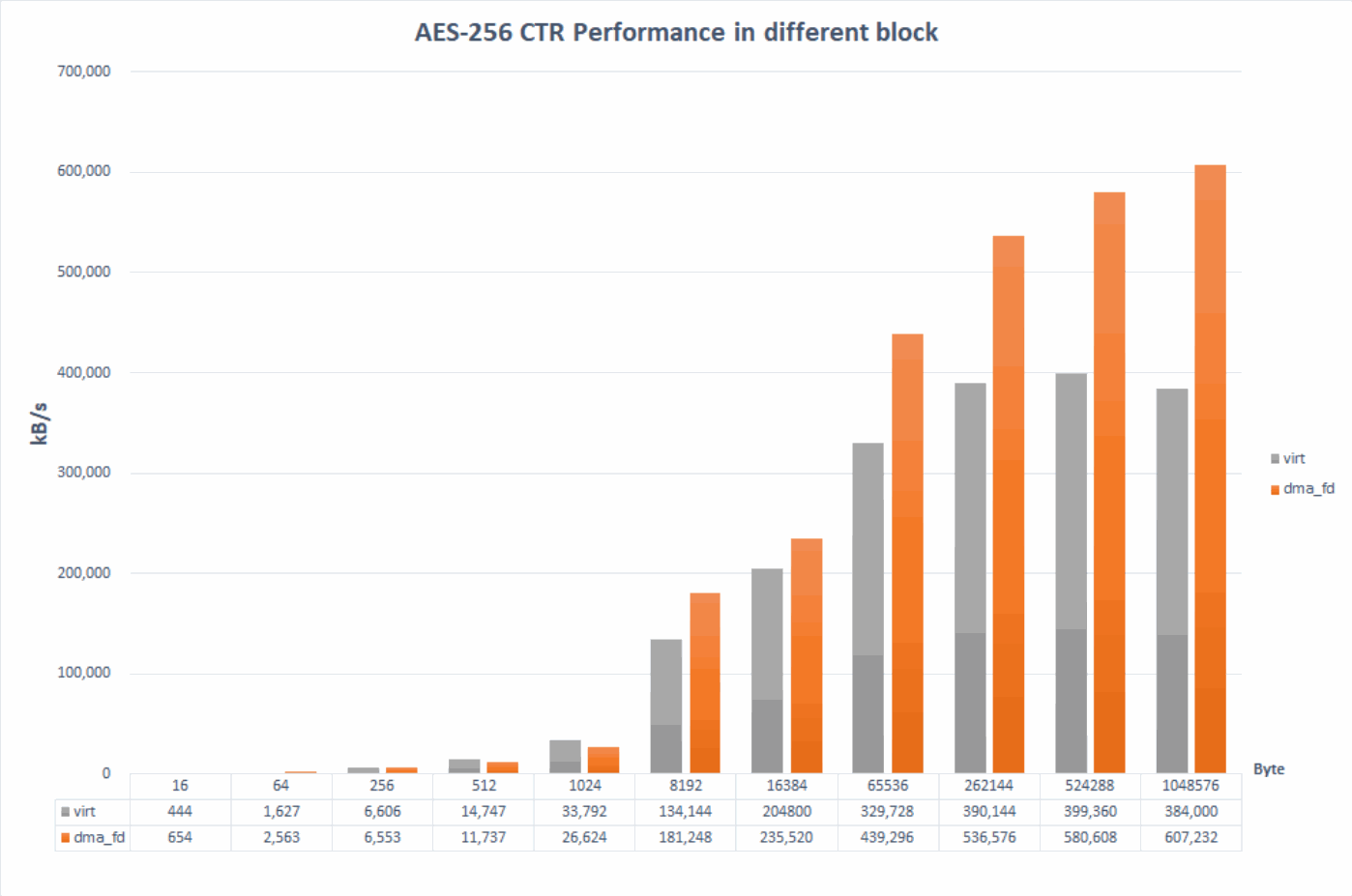
In view of the impact of block size on computing performance, the librkcrypto test of RK3588 is taken as an example. The test performance results are as follows:
| Block (Byte) | virt (kB/s) | dma_fd (kB/s) |
|---|---|---|
| 16 | 444 | 654 |
| 64 | 1627 | 2563 |
| 256 | 6606 | 6553 |
| 512 | 14747 | 11737 |
| 1024 | 33792 | 26624 |
| 8192 | 134144 | 181248 |
| 16384 | 204800 | 235520 |
| 65536 | 329728 | 439296 |
| 262144 | 390144 | 536576 |
| 524288 | 399360 | 580608 |
| 1048576 | 384000 | 607232 |
As can be seen from the figure above, the 1MByte block size is preferred and the continuous memory of dma fd is used for calculation, which can play a better performance. For small amounts of data such as 64KByte or less, hardware CRYPTO is not recommended, and soft algorithms are preferred (some chips support NEON/CE instruction sets, which accelerate encryption and decryption).
4.2 hardware crypto performance under uboot
4.2.1 crypto v1 performance
Test environment (uboot RK3399):
clock Rate: CRYPTO_CORE = 200M, The highest frequency varies slightly from chip to chip.
CIPHER/HASH Performance:
| ALGO | Actual (MBps) | Theoretical (MBps) |
|---|---|---|
| DES | - | <=94 |
| TDES | - | <=31 |
| AES-128 | - | <=290 |
| AES-192 | - | <=246 |
| AES-256 | - | <213 |
| MD5 | 125 | <196 |
| SHA1 | 125 | <158 |
| SHA256 | 125 | - |
RSA Performance:
| RSA key length (nbits) | pub enc/priv dec (ms) |
|---|---|
| 2048 | 8 / 632 |
4.2.2 crypto v2 / v3 /v4 performance
The computing core of these versions of CRYPTO IP has not changed greatly, and the performance difference is only reflected in the working frequency of CRYPTO IP, the frequency of CRYPTO V3/V4 can be up to 350M, and its theoretical performance can be simply converted on the basis of V2.
Test environment (uboot RV1126 V2) :
Clock Rate: CRYPTO_CORE = 200M, CRYPTO_PKA=300M, DDR=786M
Hash/HMAC: A total of 128M data is tested, and 4M data is calculated each time.
DES/3DES/AES/SM4: A total of 128M data is tested, 4M plaintext and 4M aad data are calculated each time.
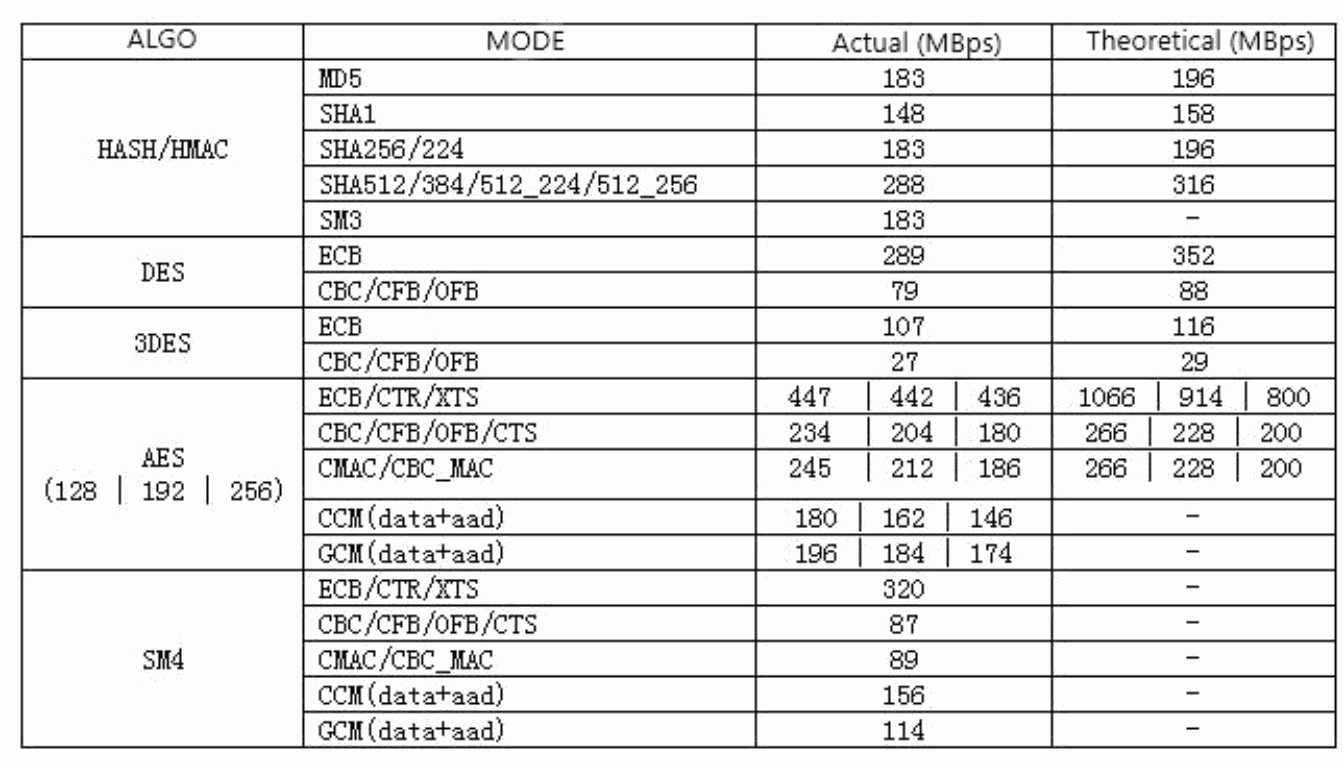
| Algorithm | Mode | Source actual (MBps) | Theoretical (MBps) |
|---|---|---|---|
| HASH/HMAC | MD5 | 183 | 196 |
| HASH/HMAC | SHA1 | 148 | 158 |
| HASH/HMAC | SHA256/224 | 183 | 196 |
| HASH/HMAC | SHA512/384/512_224/512_256 | 288 | 316 |
| HASH/HMAC | SM3 | 183 | - |
| DES | ECB | 289 | 352 |
| DES | CBC/CFB/OFB | 79 | 88 |
| 3DES | ECB | 107 | 116 |
| 3DES | CBC/CFB/OFB | 27 | 29 |
| AES (128 | 192 | 256) | ECB/CTR/XTS | 447 | 442 | 436 | 1066 | 914 | 800 |
| AES (128 | 192 | 256) | CBC/CFB/OFB/CTS | 234 | 204 | 180 | 266 | 228 | 200 |
| AES (128 | 192 | 256) | CMAC/CBC_MAC | 245 | 212 | 186 | 266 | 228 | 200 |
| AES (128 | 192 | 256) | CCM(data+aad) | 180 | 162 | 146 | - |
| AES (128 | 192 | 256) | GCM(data+aad) | 196 | 184 | 174 | - |
| SM4 | ECB/CTR/XTS | 320 | - |
| SM4 | CBC/CFB/OFB/CTS | 87 | - |
| SM4 | CMAC/CBC_MAC | 89 | - |
| SM4 | CCM(data+aad) | 156 | - |
| SM4 | GCM(data+aad) | 114 | - |
RSA test: Generate rsa keys, including n, e, and d, and perform public key encryption and private key decryption tests
Public key encrypt: ciphertext = d ^e % n
Private key decrypt: plaintext = d^d % n
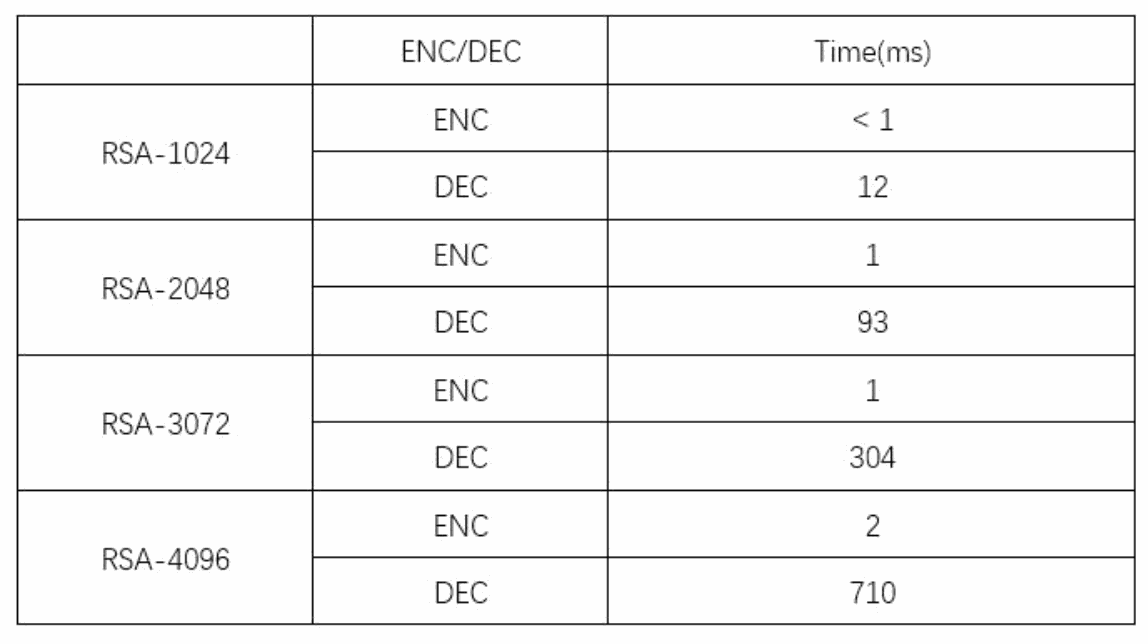
| RSA | Operation | Source time (ms) |
|---|---|---|
| RSA-1024 | ENC | < 1 |
| RSA-1024 | DEC | 12 |
| RSA-2048 | ENC | 1 |
| RSA-2048 | DEC | 93 |
| RSA-3072 | ENC | 1 |
| RSA-3072 | DEC | 304 |
| RSA-4096 | ENC | 2 |
| RSA-4096 | DEC | 710 |
5. FAQ
5.1 What is serial and parallel in the theoretical performance of the algorithm in the document, and can it be selected by the user?
Answer: The encryption and decryption of OFB, CCM, GCM, CBC_MAC, CMAC, BYPASS, and encryption of CFB, CBC, and CTS are set to serial mode. The encryption and decryption of ECB, CTR, XTS, and decryption of CFB, CBC, and CTSare in parallel mode.
There are four computing core units in hardware CYPTO, which automatically performs serial or parallel encryption and decryption according to the algorithm mode. Users cannot intervene in this process and do not need to do additional operations. As long as users choose the parallel mode, it will naturally be more efficient. From the point of view of security and use, CTR mode is preferred, so that encryption and decryption will work in parallel mode.
5.2 Why is the performance in “perf_reports” much different from the theoretical value?
Answer: The theoretical value is inferred from the operating frequency of the CRYPTO IP and the cycle of the hardware computing unit, completely ignoring other overhead in the actual operation. In practice, in addition to the time overhead of CRYPTO IP computing itself, there will be the following additional time overhead.
1. Kernel system calls are time consuming, and it takes time to get stuck into the kernel from the system call and back from the kernel after execution.
2. Data transfer requires time overhead, if it is physically non-continuous memory, the driver also needs to organize and copy the data, which is affected by the CPU frequency.
3. Because hardware CRYPTO itself is moved and calculated using DMA, the larger the data block, the closer the performance will be to the theoretical value, but limited by the system itself, the data cannot be infinite. The block size taken by demo is 1MByte.
4. Time spent refreshing cache in the kernel driver to ensure cache consistency.
5. The call overhead of the kernel driver, such as converting the received user computing requests from parallel to serial in order to perform hardware calculations (the serial parallelism here is for computing requests, and the parallel and serial algorithm is not a concept), and the task scheduling overhead.
5.3 Why are the theoretical values of parallel and serial different by a factor of 4, but the actual values are not so different?
Answer: The time cost listed in question 5.2 is basically the same under the serial algorithm and the parallel algorithm. Assuming that the frame computation consumes 10ms fixed, and the hardware computation requires 90ms in serial mode, the serial mode can play 90% of the performance. It takes 20ms to compute in parallel mode, and the parallel mode can only perform 66% of the time.
In summary, only when the extra overhead of the framework is infinitesimal and approaches 0, the actual performance of the serial mode and the parallel mode will reach 1:4 as the theoretical performance.
6. References
7. Appendix
7.1 Professional Term
Source chapters 6 and 7 and §7.1 contain headings only; the final PDF page has no subsequent body text. This records the empty source sections explicitly.