
ArmSoM applicability and source
This is a Rockchip platform reference, not an ArmSoM test report. The source lists platforms including RK3588 and RK3576 but specifies no board, SDK/BSP or kernel version. Verify the matching NPU driver, Runtime, Toolkit, operating system and model support before adapting it to a particular ArmSoM board; a matching SoC name alone does not prove compatibility. README.pdf in the Chinese and English directories is byte-identical and its body is English. Chinese, Russian and German fully translate that same content. Chinese uses the figure from the Chinese-directory PDF (whose labels are English); English, Russian and German use the corresponding English-directory original. There is no document version number; v2.3.2 identifies the software snapshot, not a claim about the latest release. No hardware or model-performance validation was performed.
Editorial notes · ArmSoM Documentation
1. Description
The RKNN software stack helps users deploy AI models to Rockchip chips quickly. Its overall framework follows.
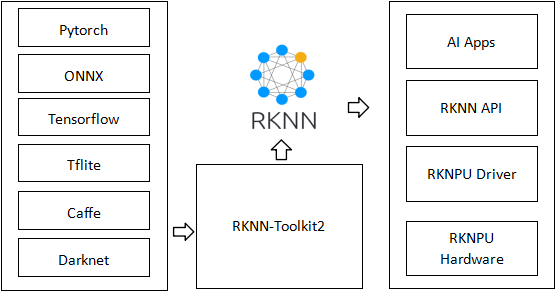
To use RKNPU, first run RKNN-Toolkit2 on a computer to convert the trained model to RKNN format, then perform inference on the development board using the RKNN C API or Python API.
- RKNN-Toolkit2 is a software development kit for model conversion, inference and performance evaluation on PCs and Rockchip NPU platforms.
- RKNN-Toolkit-Lite2 provides Python programming interfaces for Rockchip NPU platforms, helping deploy RKNN models and accelerate AI application implementation.
- RKNN Runtime provides C/C++ programming interfaces for Rockchip NPU platforms, helping deploy RKNN models and accelerate AI application implementation.
- RKNPU kernel driver interacts with NPU hardware. It is open source and can be found in Rockchip kernel code.
2. Supported platforms in the source
- RK3588 Series
- RK3576 Series
- RK3566/RK3568 Series
- RK3562 Series
- RV1103/RV1106
- RV1103B/RV1106B
- RV1126B
- RK2118
For RK1808/RV1109/RV1126/RK3399Pro, the source instead refers readers to the following projects. Do not conflate them with the Toolkit2 platform list above:
3. Download
All packages, Docker images, examples, documentation and platform-tools can also be obtained from RKNPU2_SDK; the source lists fetch code rknn. More examples are available in rknn_model_zoo. These are source-document download references; no software was downloaded or executed during this work.
4. Notes and Python versions
RKNN-Toolkit2 is not compatible with RKNN-Toolkit. The source lists the following Python versions:
- Python 3.6
- Python 3.7
- Python 3.8
- Python 3.9
- Python 3.10
- Python 3.11
- Python 3.12
The source says “Latest version: v2.3.2”. This records the PDF snapshot, not the currently latest release, and does not assert that every package supports every Python version listed above.
5. RKNN LLM
For LLM (Large Language Model) deployment, the source introduces an SDK named RKNN-LLM; see rknn-llm. The original link and naming are retained rather than silently replaced with another product name.
6. Technical changes in v2.3.2
- Support for the RV1126B platform.
- Improved einsum and Norm operation support.
- Added automatic mixed precision functionality.
- Enhanced graph optimization capabilities.
For older releases, the source refers to CHANGELOG. Its PDF hyperlink targets an internal local file, not a public page. The filename is retained without publishing a clickable internal path; consult the CHANGELOG supplied with the SDK in use.