
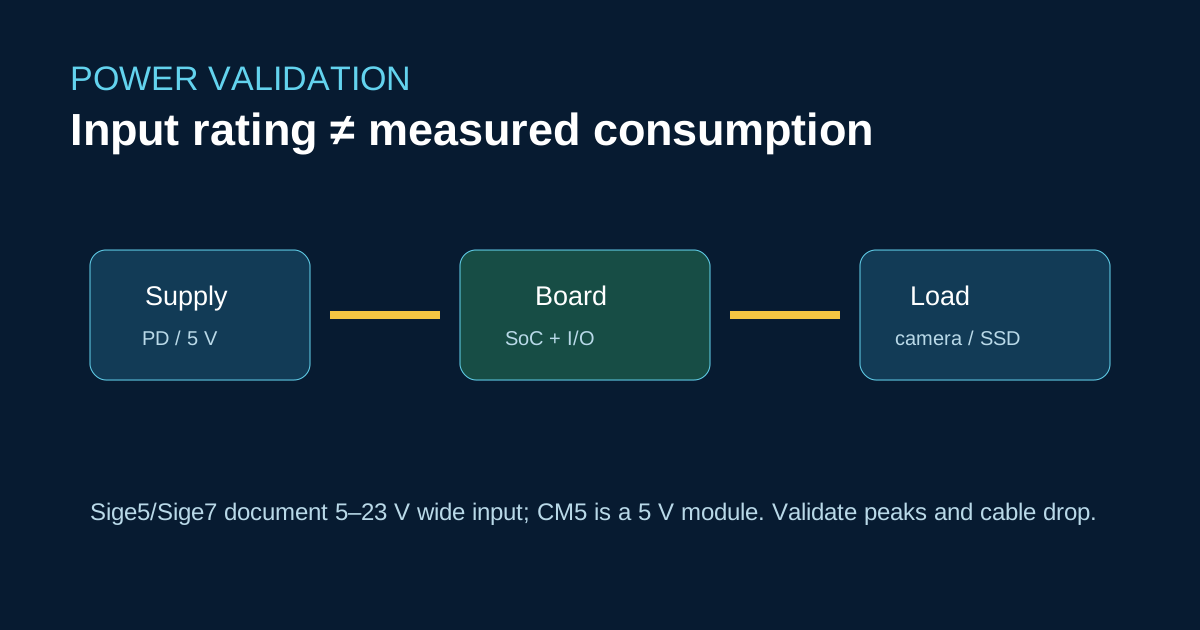
ArmSoM documents a wide 5–23 V input range for Sige5 and Sige7, while a CM5 module uses a 5 V rail. The rating tells you what the board accepts; it does not tell you the current peak of an SSD, camera, USB device or fan.
Measure the complete system
Use an inline meter or scope at the board connector. Test cold boot, CPU load, NPU load, display, network traffic and storage simultaneously. Log voltage at the board, not only at the adapter.
for z in /sys/class/thermal/thermal_zone*/temp; do
  printf '%s ' "$z"; cat "$z"; done
cat /sys/devices/system/cpu/cpufreq/policy*/scaling_cur_freq
Select a supply with margin for cable resistance and transient load. A PD negotiation that works on the bench can fail with a long cable or an enclosure fan starting at the same time.
Migration boundary
Raspberry Pi HAT power assumptions and Jetson Nano barrel-jack expectations are not interchangeable with ArmSoM connectors. Treat connector pinout, PD profile, thermal interface and enclosure airflow as new design inputs.
References
Pre-publication check
- Report supply, cable, peripheral load and ambient conditions.
- Test the worst-case combined workload.
- Do not turn an input-voltage range into a consumption claim.